
Why Dolphins Swim So Fast: Scientists Decode The Role Of Eddies

Dolphins have long fascinated scientists with their remarkable speed and fluid movement through water. Now, new research offers a clearer explanation of the physics behind their efficiency, shedding light on how these marine mammals generate powerful propulsion.

A study published in Physical Review Fluids by researchers at The University of Osaka identifies a crucial mechanism: the formation of large, energetic vortices driven by the dolphin’s tail motion. Using advanced numerical simulations, the team mapped how these swirling water structures influence propulsion under varying conditions.

As dolphins swim, they move their tails in a rhythmic up-and-down motion, pushing water backward. This action produces a turbulent wake filled with vortices of different sizes. Until now, the exact contribution of these complex flow patterns to forward motion remained difficult to isolate.

Lead author Yutaro Motoori explained that the team aimed to pinpoint which elements of this turbulence actually aid speed. By deploying supercomputer-based simulations, the researchers were able to break down the flow into components and identify the dominant forces at play.

The findings reveal that large-scale vortex rings generated by the oscillating tail are the primary drivers of thrust. These powerful structures push water backward, effectively propelling the dolphin forward. In contrast, smaller vortices—formed through what scientists call an energy cascade—play only a minor role in movement, despite being more numerous.

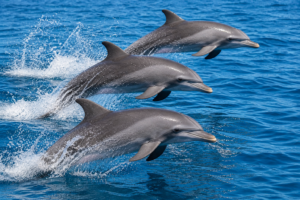
Senior researcher Susumu Goto noted that understanding this hierarchy of vortices is key. While turbulence appears chaotic, it follows an organized structure where the largest vortices do most of the work, and smaller ones are largely by-products.

The simulation-based approach allowed the team to observe fluid dynamics in extraordinary detail—something that is nearly impossible through direct experimentation. It also enabled them to test different swimming speeds, with results remaining consistent across scenarios.

Beyond explaining dolphin agility, the research holds practical promise. Insights into efficient propulsion could inform the design of faster, energy-efficient underwater robots and improve technologies that manage turbulent flows.

For now, the study offers a compelling reminder that nature’s most graceful swimmers are guided by deeply intricate physics beneath the surface.

Also Read:

Aquatic plant reduces antibiotics in water and genetic damage in fish, but risks remain

Scared of spiders? A world without them is true nightmare tale: Study

Compulsory Yoga/Games in high school level for holistic development of children

The Minister of State (I/C) for Youth Affairs and Sports Shri Vijay Goel said in the Rajya Sabha today that education falls under the Concurrent List, majority of schools fall under State Examination Boards and the school curriculum is determined by the State Governments. However, the National Curriculum Framework 2005 recognizes the role of sports and physical education in the holistic development of children and youth in the country. As part of this policy, the Government has made access to play fields, equipment for sports & games and engagement of physical education instructor- a mandatory requirement for all schools under the Right to Education Act.

In a written reply he said, the Central Board of Secondary Education (CBSE) places special importance on co-scholastic areas which includes sports and physical fitness. Details of salient measures taken by CBSE to promote sports in schools are given in the Annexure. It is expected that State Education Boards would also emulate the CBSE example.

Annexure

Annexure referred to in reply to part (a) & (b) of the Rajya Sabha Unstarred Question No. 2558 to be answered on 08.08.2017 regarding ‘Compulsory yoga/games in high school level’ by SHRI MOHD. ALI KHAN:

Salient steps taken to promote yoga/games/sports in the schools affiliated to CBSE are as

follows:

In classes VI-X any two activities out of the following are compulsory:

a. Sports/Indigenous sports (Kho-Kho etc.)

b. NCC/NSS

c . Scouting and Guiding

d. Swimming

e. Gymnastics

f. Yoga

g. First Aid

h. Gardening/Shramdaan

2. The Board has advised schools that there should be at least 40-45 minutes of physical Activities or Games period for Classes I-X every day. For Classes XI- XII schools should ensure that all the students participate in physical Activity / Games / Mass P.T. / Yoga with maximum health benefits for at least two period per week ( 90- 120 min week).

3. The Board also organizes ‘Inter school Sports and Games Competitions’ in as many as 24 disciplines at Cluster, Zone and National level. Over 1.5 lac students participate in it each year. In order to identify, recognize, nurture and develop the extraordinary talent among the students studying in class VIII onwards in sports and games, the Board provides Chacha Nehru Scholarship.

Rio Olympics 2016: Opening Tomorrow with Swim Events

Australia and USA teams with their biggest names in swimming have arrived in Rio as the competition for swimming events kicks off on Thursday, ahead of the official opening on Friday.

The two big teams have been sizing each other up before the serious action kicks off, starting with men’s 400m individual medley heats.

"I briefly saw them this morning, they were warming up as I was swimming and by the time I was hopping out they were hopping in," said Australia’s double gold medalist Emily Seebohm.

Team-mate Cameron McEvoy, Australia’s big hope of a first 100 freestyle men’s gold since 1968, said both sides are familiar with each other. "A lot of us are really, really good friends with the Americans," he said. "It was exciting to see them coming. They are a powerhouse team and you can definitely feel their presence in the pool.”

But for Japan’s Yuka Sato, a triathlete, this is her first Olympic games and owes much to some inspiration from her mother. “My mother heard about the sport of triathlon and that’s what got me interested in it, from the age of nine” she says. “Luckily enough, I won the gold medal in my first appearance at the junior national championships. I had good friends in my triathlon club who were a little older than me, and enjoyed training hard in an effort to catch those more senior kids up. My strength naturally improved and I built from there.”

Sato finished third in April’s Asian Triathlon Championships but has been less satisfied with other recent results; now, it is all about peaking at the right time in August. Here, she has a fair idea of who her biggest rival will be in Rio. Flora Duffy, the Bermudan triathlete who has won two World Championships.

“She is a strong swimmer; her style is to come out of the swim along and with a big lead, keeping the advantage throughout the remainder of the race until the finish,” Sato says. “Therefore, how close I can be to Duffy after finishing the swim will be key for me in Rio.”

At 24 years of age, Sato says, “I’m hoping to reach my peak in 2020 for the Tokyo Olympic Games."
[ TAGS RIO 2016 , IOC NEWS , YOGA , TRIATHLON, sato, swimming events, USA< australia, thursday events]