Artemis II (launched April 1, 2026) successfully completed its historic crewed lunar flyby on April 6, 2026. The four-person crew NASA astronauts Reid Wiseman (Commander), Victor Glover (Pilot), Christina Koch (Mission Specialist), and Jeremy Hansen (CSA Mission Specialist) became the first humans to view the Moon’s far side in over 50 years, traveled farther from Earth than any previous crew (surpassing Apollo 13’s record at ~252,000+ miles), and are now on their return journey.
Splashdown is scheduled for Friday, April 10, 2026 (evening) in the Pacific Ocean off San Diego.
Recent Media Updates (as of April 9, 2026): The crew has been actively sharing experiences via live calls, press conferences from Orion, and transmitted images/footage while heading back to Earth.
LIVE: Artemis II astronauts answer media questions as they continue their journey toward Earth following their record-breaking lunar flyby. https://t.co/iAN74RMaRk
Return journey underway
The crew has completed the lunar flyby and is now on a gravity-assisted return trajectory to Earth, with splashdown expected in the Pacific.
Record-breaking distance achieved
Astronauts travelled over 252,000 miles from Earth, becoming the farthest humans ever in space, surpassing Apollo-era records.
Historic firsts during return
Crew made a record “space-to-space” call with the ISS, spanning ~230,000 miles — a first in human spaceflight.
Emotional reflections from space
Astronauts described the mission as a “relay race” for future explorers, emphasizing lessons for upcoming lunar missions.
Rare space phenomena observed
Witnessed a solar eclipse from the Moon’s far side, an experience crew said was “breathtaking”.
Scientific work continues during return
Ongoing experiments include studying the solar corona, monitoring meteoroid impacts, and testing astronaut health systems for re-entry.
Iconic imagery released
NASA shared first-ever human-captured views of the Moon’s far side, including Earthrise and eclipse visuals.
Symbolic gestures & legacy moments
Crew proposed naming lunar craters “Integrity” (after their Orion spacecraft) and “Carroll” (after Wiseman’s late wife).
Preparation for re-entry
Astronauts are now stowing equipment and conducting trajectory corrections ahead of a high-speed atmospheric re-entry.
Mission significance
The mission is seen as a critical stepping stone for future Moon landings and Mars missions, with data feeding into upcoming Artemis flights. The mission has been a major success so far, paving the way for future Artemis landings.
Artemis II marked a key step in its return to Earth late Tuesday, as the Orion spacecraft fired its engines to fine-tune its path home.
At 8:03 p.m. Eastern Time, Orion, named Integrity, performed its first return trajectory correction burn. The 15-second firing adjusted the spacecraft’s velocity by 1.6 feet per second, a small but critical change that aligned the crew’s course back toward Earth. NASA astronaut Christina Koch and Canadian Space Agency astronaut Jeremy Hansen oversaw the maneuver, reviewing procedures and closely tracking navigation and system data.
During a mission status briefing the same day, officials from the National Aeronautics and Space Administration released the first images captured during the crew’s lunar flyby, offering early visual data from the historic pass around the Moon. The agency also confirmed that the USS John P. Murtha (LPD-26) has departed port and is en route to a staging position in the Pacific Ocean, where it will support recovery operations following splashdown.
NASA said it will continue to share updates on recovery logistics and weather conditions in its daily briefings.
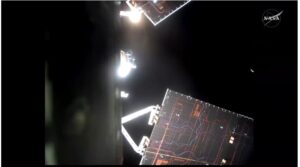
A live view shows the Orion spacecraft and its solar arrays as the Artemis II crew completed the mission’s first return correction burn on Flight Day 7.
With the burn complete, the crew is expected to rest before beginning a new round of flight objectives on Wednesday, April 8, focused on preparing for reentry.
Among the scheduled tasks is a test of an orthostatic intolerance garment, equipment designed to help astronauts regulate blood pressure and circulation as they transition from microgravity to Earth’s gravity. Reid Wiseman, Victor Glover, Koch and Hansen will evaluate how effectively the garment supports cardiovascular stability during the return phase.
Later in the day, the crew will take manual control of Orion as part of a piloting demonstration. Using the spacecraft’s viewing systems, they will align with a designated target and guide Orion into a tail-to-Sun orientation while comparing its control modes.
The manual piloting test is scheduled to begin at 9:59 p.m., adding another layer of real-time data to NASA’s assessment of the spacecraft’s performance during its journey home.
An international team of scientists reported on April 7, 2026, that water on the Moon likely accumulated gradually over billions of years rather than from a single event. The study, published in Nature Astronomy, points to permanently shadowed craters near the lunar south pole as the most likely reservoirs of ice. Using data from NASA missions and simulations, researchers identified older craters as prime targets for future exploration and resource use.
For decades, scientists have known that water may exist on the Moon. What remained unclear was how it got there and why it appears unevenly spread across the surface.
A new study published April 7 in Nature Astronomy offers a clearer picture. The research suggests that lunar water did not arrive in a single dramatic event, such as a comet impact, but instead accumulated slowly over billions of years.
The study was led by Oded Aharonson of the Weizmann Institute of Science, with contributions from Paul Hayne at the University of Colorado Boulder and collaborators including Norbert Schörghofer. Their findings draw on years of observations and modeling to explain one of lunar science’s longest-standing questions.
Lunar south pole ice locations and cold traps explained
Evidence of water on the Moon has come primarily from missions led by NASA, including the Lunar Reconnaissance Orbiter. Instruments aboard the spacecraft detected signals consistent with ice inside deep craters near the Moon’s south pole. These craters, known as “cold traps,” remain in permanent shadow and can preserve ice for billions of years.
Observations from the orbiter’s Lyman Alpha Mapping Project instrument indicated that ice is not evenly distributed. Some craters appear rich in ice, while others show little to none. That patchy pattern has puzzled scientists for years.
The new study attempts to explain that uneven distribution by looking back at the Moon’s geological history. The researchers combined temperature data from the orbiter’s Diviner instrument with computer simulations that reconstructed how the Moon’s orientation has shifted over time.
The Moon’s tilt relative to Earth has not always been constant. As it shifted, craters that are permanently shadowed today may once have received sunlight, while others remained dark for much longer periods. This variation appears to have influenced where ice could accumulate and persist.
“It looks like the moon’s oldest craters also have the most ice,” Hayne said, noting that this pattern suggests a slow and continuous buildup of water over as much as 3 to 3.5 billion years.
How water may have formed and accumulated on the Moon
The study does not identify a single source of lunar water, but it narrows down the likely mechanisms. Researchers ruled out the idea that most of the Moon’s water arrived in one large delivery, such as a massive comet impact.
Instead, multiple processes likely contributed over time. Volcanic activity in the Moon’s distant past may have released water from its interior. Comets and asteroids could have delivered additional water through smaller impacts. Hydrogen from the solar wind may also have reacted with oxygen in lunar soil to form water molecules.
“Through the solar wind, a constant stream of hydrogen bombards the moon, and some of that hydrogen can be converted to water on the lunar surface,” Hayne said.
The researchers found that the craters that have remained in shadow the longest are also those most likely to contain ice today. One example is Haworth Crater near the Moon’s south pole, which may have been in continuous darkness for more than 3 billion years.
These findings could guide future lunar missions. Identifying where ice is most likely to be concentrated can help scientists and engineers plan landing sites and exploration strategies.
Water on the Moon is not just a scientific curiosity. It has practical implications for long-term human exploration. Ice deposits could be mined for drinking water, breathable oxygen and even rocket fuel by separating hydrogen and oxygen atoms.
“Finding water beyond Earth in liquid and usable form is one of the most important challenges in astronomy,” Aharonson said in a statement released by his institute.
Future missions aim to confirm lunar ice deposits
The study highlights the need for direct sampling to confirm the origin and distribution of lunar water. Observational data and simulations can narrow possibilities, but they cannot fully resolve the question.
Hayne and his colleagues are working on a new instrument, the Lunar Compact Infrared Imaging System, designed to study surface ice in greater detail. The instrument is expected to be deployed near the Moon’s south pole around 2027 as part of upcoming missions.
“Ultimately, the question of the source of the moon’s water will only be solved by sample analysis,” Hayne said. “We will need to go to the moon to analyze those samples there or find ways to bring them from the moon back to Earth.”
As space agencies and private companies accelerate plans for lunar exploration, the findings provide a clearer map of where to look. The Moon’s darkest craters, once seen as inaccessible voids, are emerging as some of the most valuable real estate beyond Earth.
The National Aeronautics and Space Administration launched four astronauts on April 2 from Kennedy Space Center in Florida aboard the Artemis II mission. The crew is set for a 10-day test flight around the Moon, marking the first human lunar flyby since the Apollo era. The mission aims to validate spacecraft systems and pave the way for future Moon landings and Mars exploration.
NASA’s Artemis II mission has marked humanity’s return to deep space, becoming the first crewed journey near the Moon since Apollo 17. Four astronauts aboard the Orion spacecraft completed a seven-hour lunar flyby, capturing detailed observations of the Moon’s far side. The crew also set a new record for the farthest distance traveled by humans, surpassing Apollo 13. During the mission, they witnessed a solar eclipse from space and observed rare meteoroid impacts on the lunar surface. The spacecraft is now on its return trajectory, while scientists analyze data collected during the flyby.
Aboard the Orion spacecraft were NASA astronauts Reid Wiseman, Victor Glover and Christina Koch, along with Canadian Space Agency astronaut Jeremy Hansen who completed their lunar flyby, broke the Apollo 13 distance record (252,756 miles from Earth), and regained contact after passing the Moon’s far side.
🚀 LIVE FROM SPACE: President Donald J. Trump Calls Artemis II Astronauts After Breaking the Farthest Distance Record in Human Spaceflight 🇺🇸 HISTORIC!
“Your mission paves the way for America’s return to the lunar surface very soon.” pic.twitter.com/1TzmIEQG0l
US President Donald J.Trump calls the Artemis II Astronauts in space:
The White House shared video of President Trump phoning the Artemis II crew to congratulate them after breaking the human spaceflight distance record during their lunar flyby. Artemis II astronauts reached about 252,757 miles from Earth on April 6, 2026, surpassing Apollo 13’s 1970 mark of 248,655 miles by over 4,000 miles while passing the Moon’s far side.
Trump told the crew their mission paves the way for America’s return to the lunar surface, highlighting it as a historic step in U.S. space leadership.
Trump further said , “Thank you very much Jared and you are doing a fantastic job and hello very special hello to Artemis II. Today you’ve made history and made all America really proud, incredibly proud. We have a lot of things to be proud of lately, but there’s nothing like what you’re doing, circling around the moon for the first time in more than a half a century and breaking the all-time record for the farthest distance from planet Earth.
“Humans have really never seen anything quite like what you’re doing in a manned spacecraft. It’s really special. I wanted to congratulate each and every one of you. I want to personally salute and congratulate Commander Reid Wiseman, Pilot Victor Glover, Mission Specialist Christina Koch and Jeremy Hansen, and I also want to thank the entire amazing team at NASA, headed by Jared [Isaacman], who’s a very special guy, by the way. You have made this day possible, you’ve really inspired the entire world, really, everybody’s watching it”, Trump added.
And also there were few question from Trump to Artemis Crew about the mission where Trump asked “about most unforgettable part of this really historic day, and was there any difference in feel between the far side of the moon and the near side of the Moon, to which the Astronauts explained the differences due to Earth’s gravitational pull creating dramatic variations in the lunar landscapes. They described views of the Orientale crater, a solar eclipse from space, and Earthshine.
The four astronauts aboard Artemis II closed out a landmark day in deep space Tuesday, completing a lunar flyby that carried humans farther from Earth than ever before.
NASA astronauts Reid Wiseman, Victor Glover, and Christina Koch, along with Canadian Space Agency astronaut Jeremy Hansen, spent nearly seven hours observing the Moon as their Orion spacecraft swept past its far side. It marked the first time humans have traveled this route since Apollo 17 in December 1972.
The crew crossed a historic threshold earlier in the day. At 1:56 p.m. Eastern Time, Orion surpassed the distance record set during Apollo 13, when astronauts reached 248,655 miles from Earth during their emergency return. Two minutes after their closest lunar approach, the Artemis II crew pushed that boundary further, reaching approximately 252,756 miles from Earth.
Eclipsed: A View from Orion: The Moon, backlit by the Sun during a solar eclipse, is photographed by NASA’s Orion spacecraft on April 6, 2026, during the Artemis II mission. Orion is visible in the foreground on the left. Earth is reflecting sunlight at the left edge of the Moon, which is slightly brighter than the rest of the disk. The bright spot visible just below the Moon’s bottom right edge is Saturn. Beyond that, the bright spot at the right edge of the image is Mars. Credit: NASA Image Credit: NASA
Lunar Flyby Observations And Record-Breaking Distance
The spacecraft’s closest pass came at about 7:00 p.m., when Orion flew roughly 4,067 miles above the Moon’s surface. That maneuver occurred during a planned communications blackout, as the Moon temporarily blocked signals between the spacecraft and Earth.
While out of contact, the crew documented the lunar far side, a region never visible from Earth. They photographed impact craters, ancient lava plains, and networks of ridges and fractures shaped over billions of years. Differences in brightness and color were also noted, offering clues about the Moon’s composition and geological history.
As Orion slipped behind the Moon, the astronauts witnessed an “Earthset,” watching Earth disappear below the lunar horizon. Moments later, as the spacecraft emerged, they observed an “Earthrise,” a visual long associated with early Apollo missions.
The observations are expected to support ongoing lunar science work. NASA officials said the imagery and data collected during the flyby will help refine understanding of the Moon’s surface evolution and assist in planning future crewed missions under the Artemis program.
Starstruck art002e012588 (April 7, 2026) – A stunning snapshot in time. The Artemis II crew captured this breathtaking photo of our galaxy, the Milky Way. The Milky Way’s elegant spiral structure is dominated by just two arms wrapping off the ends of a central bar of stars. Spanning more than 100,000 light-years, Earth is located along one of the galaxy’s spiral arms, about halfway from the center. Credit: NASA Image Credit: NASA
Solar Eclipse And Rare Lunar Phenomena Recorded
Toward the end of the flyby, the alignment of the spacecraft, the Moon, and the Sun created a prolonged solar eclipse visible from Orion. For nearly an hour, the astronauts observed the Sun’s outer atmosphere, known as the corona, appearing as a halo around the Moon’s edge.
The eclipse also allowed the crew to study the Moon’s darkened surface under unique conditions. During this period, astronauts reported seeing six brief flashes of light, believed to be meteoroids striking the lunar surface at high speeds.
Such impacts occur regularly but are rarely observed directly from orbit. Scientists plan to analyze the timing and location of these flashes using spacecraft data and compare them with observations from Earth-based astronomers.
Post-Flyby Outreach And Data Analysis Begins
Following the flyby, the crew took part in a live call with Donald Trump, who congratulated the astronauts during NASA’s broadcast coverage. They also spoke with NASA Administrator Jared Isaacman and responded to questions submitted through social media platforms.
Mission teams are now preparing to receive a large volume of data transmitted from Orion. Engineers and scientists will review images, audio recordings, and telemetry collected during the flyby to identify key scientific insights and operational lessons.
NASA said the crew is scheduled to discuss their observations with the lunar science team in a live broadcast on April 7. Researchers are also expected to invite amateur astronomers to contribute observations taken during the same window, particularly in tracking the reported impact flashes.
The Artemis II mission, designed as a crewed test flight, continues its journey back toward Earth following the flyby. The success of this phase is expected to inform future missions aimed at returning astronauts to the lunar surface for the first time in more than half a century.
The four astronauts aboard NASA’s Artemis II mission woke up to a milestone few humans have experienced. Less than 19,000 miles from the Moon, they began final preparations for a lunar flyby that will mark humanity’s return to deep space after more than five decades.
Reid Wiseman, Victor Glover, Christina Koch, and Canadian astronaut Jeremy Hansen are expected to guide the Orion spacecraft through a carefully timed trajectory past the Moon later in the day. The moment carries symbolic weight. The last time humans ventured this far was during Apollo 17 in December 1972.
The crew’s wake-up call came with music. “Good Morning,” by Mandisa and TobyMac played through the spacecraft, followed by a recorded message from Apollo-era astronaut Jim Lovell, who died in 2025. Lovell commanded Apollo 13, the mission that previously held the record for the farthest distance traveled by humans from Earth.
That record is expected to fall at approximately 1:56 p.m. Eastern Time. Orion will surpass Apollo 13’s maximum distance of 248,655 miles, eventually reaching about 252,760 miles from Earth later in the evening.
“Hello, Artemis II! This is Apollo astronaut Jim Lovell. Welcome to my old neighborhood! When Frank Borman, Bill Anders, and I orbited the Moon on Apollo 8, we got humanity’s first up-close look at the Moon and got a view of the home planet that inspired and united people around the world. I’m proud to pass that torch on to you — as you swing around the Moon and lay the groundwork for missions to Mars … for the benefit of all. It’s a historic day, and I know how busy you’ll be. But don’t forget to enjoy the view. So, Reid, Victor, Christina, and Jeremy, and all the great teams supporting you – good luck and Godspeed from all of us here on the good Earth.”
Lovell,Gemini VII, Gemini XII, Apollo 8, and Apollo 13 Astronaut
Lunar Flyby Timeline And Observation Plans
The flyby itself is scheduled to begin around 2:45 p.m. Eastern Time and will span roughly seven hours. During this window, Orion will pass close enough to the lunar surface to allow astronauts to observe geological features in detail.
NASA has indicated that cameras mounted on Orion’s solar arrays will transmit live views of the Moon back to Earth. The agency plans to stream coverage across multiple platforms, including NASA+, YouTube, and major streaming services.
Engineers have cautioned that image quality may fluctuate. The distance from Earth, along with bandwidth constraints across NASA’s Deep Space Network, could affect transmission clarity during portions of the flyby.
The spacecraft’s closest approach is expected shortly after a planned communications blackout. At about 6:44 p.m., Orion will pass behind the Moon, temporarily losing contact with Earth as lunar mass blocks radio signals. The blackout is expected to last around 40 minutes.
Within that window, at approximately 7:02 p.m., Orion will reach its nearest point to the lunar surface, about 4,070 miles above it. This maneuver is critical for setting up the spacecraft’s trajectory for its return journey.
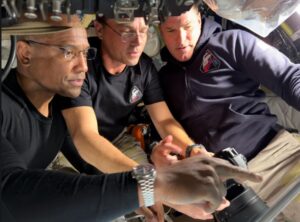
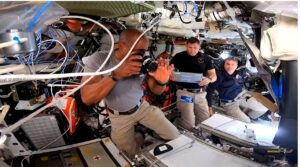
Final Flyby Preparations art002e009294 (April 6, 2026) – Artemis II Pilot Victor Glover, Commander Reid Wiseman, and Mission Specialist Jeremy Hansen prepare for their journey around the far side of the Moon by configuring their camera equipment shortly before beginning their lunar flyby observations. Image Credit: NASA
Solar Eclipse Viewed From Deep Space
As the flyby concludes, the crew will witness a rare celestial alignment. Beginning around 8:35 p.m., the astronauts are expected to see a solar eclipse from their vantage point in space.
From Orion, the Moon will move directly between the spacecraft and the Sun, blocking sunlight for nearly an hour. The crew will observe the solar corona, the outermost layer of the Sun’s atmosphere, which becomes visible during such eclipses.
NASA officials have said this phase of the mission offers both scientific and experiential value. Observing the corona from deep space provides a unique opportunity to study solar activity without atmospheric interference.
The Artemis II mission is designed as a test flight, evaluating systems that will support future lunar landings under NASA’s Artemis program. Unlike later missions, Artemis II does not include a landing. Its focus remains on validating life support systems, navigation, and crew operations in deep space.
Still, Tuesday’s flyby represents a turning point. For the first time in more than 50 years, humans are returning to the Moon’s vicinity, setting the stage for a sustained presence in lunar orbit and, eventually, on its surface.
The spacecraft will continue its journey following the flyby, looping back toward Earth in the coming days.
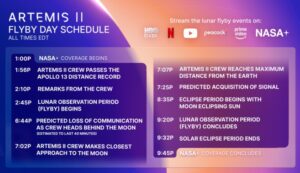
Key moments for the lunar flyby include this following. All times are Eastern and may be adjusted based on real-time operations:
NASA
Monday, April 6
1:30 p.m.: The science officer in the Mission Control Center at NASA’s Johnson Space Center in Houston will brief the crew on their science goals for the upcoming flyby.
1:56 p.m.: The Artemis II crew is expected to surpass the record previously set by the Apollo 13 crew in 1970 for the farthest humans have ever traveled from Earth.
2:45 p.m.: Lunar observations begin.
6:44 p.m.: Mission control expects to temporarily lose communication with the crew as the Orion spacecraft passes behind the Moon.
6:45 p.m.: During “Earthset,” Earth will glide behind the Moon from Orion’s perspective.
7:02 p.m.: Orion reaches its closest approach to the Moon at 4,070 miles above the surface.
7:07 p.m.: Crew reach their maximum distance from Earth during the mission (252,706 miles).
7:25 p.m.: “Earthrise” marks Earth coming back into view on the opposite edge of the Moon.
7:25 p.m.: Mission control will re-acquire communication with the astronauts.
8:35-9:32 p.m.: During a solar eclipse, the Sun will pass behind the Moon from the crew’s perspective.
9:20 p.m.: Lunar observations conclude.
Tuesday, April 7
1:25 p.m.: Orion exits the lunar sphere of influence at 41,072 miles from the Moon.
Researchers at Princeton University have found that high-fat diets may make certain breast cancers more invasive by altering tumor structure. The study, published March 3 in APL Bioengineering, examined triple-negative breast cancer using advanced 3D models. Scientists say the findings could help explain why diet influences cancer outcomes, though results remain limited to lab conditions.
In a controlled lab setting, researchers watched tumors change shape.
Not grow faster. Not shrink. Change form.
That shift, they say, may help explain why diet influences how some cancers behave.
A team at Princeton University has identified new links between high-fat diets and aggressive breast cancer, focusing on how fat alters the structure of tumors rather than simply accelerating their growth.
The study examined triple-negative breast cancer, a subtype that does not respond to many conventional therapies and is often associated with poorer outcomes.
High-fat nutrients linked to invasive tumor structure
Using 3D tumor models designed to mimic human biological conditions, researchers exposed cancer cells to different nutrient environments, including fats, cholesterol, insulin, and ketones.
The results showed a clear structural difference.
Tumors exposed to fatty acids and cholesterol developed hollow, branching extensions that spread outward from the tumor core. These structures are associated with invasive behavior, allowing cancer cells to penetrate surrounding tissue and potentially spread through the body.
Celeste Nelson, the study’s lead investigator, described these formations as characteristic of aggressive cancers.
“Aggressive cancers have these tendrils, and it’s the leading edges that end up invading into our normal tissues and making it into either a lymphatic or a blood vessel and escaping and metastasizing,” she said.
Notably, the tumors did not grow significantly faster under high-fat conditions. Instead, cells redistributed, moving from the center toward the edges, reshaping the tumor’s structure.
Gene activity points to possible mechanism
The team also identified increased activity of a gene known as MMP1, which is associated with the breakdown of collagen, a key structural component of tissue.
Higher MMP1 levels were strongly correlated with the structural changes observed in the tumors.
Researchers believe this may allow cancer cells to break down surrounding tissue more easily, creating pathways for invasion.
However, the study stops short of proving direct causation. Nelson said further research is needed to determine whether high-fat diets directly trigger this gene activity or if other factors are involved.
Future experiments may test whether blocking MMP1 changes how tumors respond to high-fat conditions.
Fluorescence images of sample tumors show invasions into surrounding tissue over several days. Branching invasions are most pronounced in the lower right frame. (Photo illustration from image provided by the researchers/Princeton University.) Credit:Princeton University
Other diets showed limited impact in the model
The study also tested tumor responses under different nutrient conditions, including high insulin, glycerol, and ketones.
These conditions showed little difference from baseline tumors, which remained relatively compact and did not develop invasive structures.
One unexpected result involved a simulated ketogenic diet, which is typically high in fat and low in carbohydrates.
Researchers had expected it might slow tumor progression. Instead, the tumors did not show improved outcomes compared to baseline conditions within the model.
“We were expecting a ketogenic diet to be protective,” Nelson said. “Yet we didn’t see that here.”
She added that the model may not fully capture the complexity of how such diets interact with the human body, particularly immune responses and other systemic factors.
Study highlights limits of lab-based cancer models
The findings are based on 3D microfluidic tumor models, which aim to replicate aspects of real biological environments more accurately than traditional lab methods.
Unlike 2D cell cultures, which grow in simplified conditions, these models simulate both the physical and chemical environment of tumors. At the same time, they remain more controlled than animal studies, allowing researchers to isolate specific variables such as diet.
Even so, the researchers caution that the results are limited.
The tumors studied are simplified representations and do not include the full range of interactions present in the human body. That means the findings cannot be directly translated into dietary recommendations or clinical outcomes.
“Every tumor is an individual’s tumor,” Nelson said, noting the challenge of capturing the full diversity of cancer behavior in a single study.
New direction for diet and cancer research
The study adds to a growing body of evidence suggesting that diet influences cancer progression, though the mechanisms remain unclear.
By focusing on structural changes rather than growth rates, the Princeton team offers a different lens for understanding how nutrients interact with tumors.
The research also points to potential targets for future therapies, particularly genes involved in tissue breakdown and tumor invasion.
For now, the findings remain an early step.
They show how fat may change the way tumors behave under controlled conditions, opening new questions about how those processes unfold inside the human body.
Indian Railways has approved projects worth ₹1,364.45 crore to strengthen safety, signalling and communication systems across multiple zones. The works include Kavach deployment on locomotives, optical fibre expansion and signalling upgrades. The approvals, part of the 2024–25 works programme, aim to improve operational safety and network efficiency.
What is Kavach
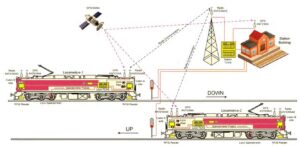
Kavach is an indigenous automatic train protection (ATP) system developed by Indian Railways to prevent train collisions and improve safety on the rail network. It is like an automatic braking and warning system that takes control if something goes wrong.
How Kavach works:
Kavach acts like a real-time safety shield for trains.
It uses radio communication and GPS to continuously track trains
It connects locomotives, tracks, and control centers
It constantly compares train speed and position with safe limits
If a driver makes a mistake, Kavach automatically applies brakes to avoid accidents.
Where It Is Installed
Kavach works through a combination of systems:
Onboard equipment in locomotives
Trackside devices along railway lines
Station systems integrated with signalling
Central control systems monitoring operations
India’s national rail network is moving deeper into a technology-led safety upgrade, with a fresh round of approvals targeting both trains and trackside systems.
Indian Railways has sanctioned projects worth ₹1,364.45 crore covering locomotive safety equipment, communication backbone expansion and signalling modernisation across several key zones. The approvals are part of a broader capital programme focused on reducing risk, improving reliability and preparing the network for higher traffic density.
Kavach deployment on locomotives in Southern Railway
A key component of the package is the rollout of Kavach, the indigenous train collision avoidance system, across locomotives in Southern Railway.
The transporter has approved ₹208.81 crore for installing onboard Kavach equipment on 232 locomotives. The work falls under a larger umbrella programme titled “Provision of Kavach with communication backbone of Long-Term Evolution (LTE) on balance routes of Indian Railways (Umbrella Work 2024–25),” which carries an overall outlay of ₹27,693 crore.
Within this, Southern Railway has been allocated ₹2,950 crore. The current phase focuses on equipping locomotives with Kavach Version 4.0, which integrates real-time signalling inputs and automatic braking systems to prevent collisions.
Kavach has been positioned as a central pillar of railway safety strategy, especially on high-density routes where traffic frequency increases the risk of human error.
Optical fibre expansion strengthens communication backbone
Parallel investments are being made to upgrade the communication systems that support modern signalling and safety technologies.
In Northern Railway, three projects worth ₹400.86 crore have been approved to expand the optical fibre cable network. These works fall under a separate umbrella programme for strengthening and replacing communication backbone infrastructure, with a total approved cost of ₹4,871 crore.
A sub-allocation of ₹871 crore has been earmarked for the zone.
The approved works include installation of 2×48 fibre cables across 926.05 route kilometres in Ambala Division, 1,204 route kilometres in Delhi Division along with station-level OFC rooms, and 1,074 route kilometres in Lucknow Division.
The upgrades are designed to improve bandwidth, reliability and redundancy in communication systems, which are critical for both signalling operations and Kavach deployment.
OFC network expansion in North Central Railway
Further expansion of the fibre network is planned in North Central Railway, where ₹176.77 crore has been approved for laying 2×48 fibre OFC cables across 2,196 route kilometres.
The work is split across major divisions, including 1,016 kilometres in Prayagraj, 709 kilometres in Jhansi and 471 kilometres in Agra.
This project is part of the same communication backbone programme and is supported by a ₹200 crore sub-allocation for the zone.
Officials say the expansion will support high-density routes where real-time communication between trains and control systems is essential for safe operations.
Electronic interlocking upgrades in South Central Railway
Signalling systems are also being upgraded through a shift from older panel interlocking systems to electronic interlocking.
In South Central Railway, projects worth ₹578.02 crore have been approved to replace panel interlocking at 49 stations.
The works include upgrades at 35 stations in Guntakal Division and 14 stations in Nanded Division, both located on high-density and highly utilised routes.
These projects fall under an umbrella programme for electronic interlocking, which has an overall cost of ₹15,164 crore.
Electronic interlocking systems reduce manual intervention and improve the precision and reliability of train routing decisions. They are also better suited for integration with automated safety systems such as Kavach.
Network-wide push toward safer, more efficient operations
The latest approvals reflect a layered approach to railway modernisation, combining onboard safety systems, trackside communication upgrades and signalling improvements.
Each component supports the others. Kavach relies on robust communication networks, while modern signalling systems ensure accurate data flow and control.
Indian Railways has been scaling up these technologies as part of its long-term strategy to handle increasing passenger and freight demand without compromising safety.
The ₹1,364 crore package represents a targeted investment across zones, but it also fits into a much larger national effort to upgrade infrastructure, reduce accidents and improve operational efficiency.
As these systems are deployed, the network is expected to move closer to a model where technology plays a central role in preventing errors and managing traffic at scale.
In a repurposed building in Belapur, discarded clothes are no longer waste. They are inventory.
Sarees, uniforms, denim, and worn-out household linen arrive in bags, tagged, sorted, and redirected into a system that treats fabric as a resource rather than refuse. What emerges on the other side is not just recycled material, but income for women and a shift in how cities think about waste.
India generates nearly 7.8 million metric tonnes of post-consumer textile waste each year, a volume that has historically flowed into landfills with little intervention. Municipal systems have begun to acknowledge that textiles, long overlooked in solid waste management, require dedicated recovery and reuse frameworks.
Textile recovery facility in Belapur
The Textile Recovery Facility (TRF) set up in Belapur represents one of the first structured municipal attempts to address that gap.
Developed under Swachh Bharat Mission-Urban 2.0, the facility is designed as a full-cycle system that integrates collection, sorting, processing, and product development.
Collection begins at the neighborhood level. The city has deployed 140 textile bins across housing societies in all eight municipal wards, with plans to expand to 250. The approach is decentralized, built to encourage participation at the household level.
Once collected, materials are routed to the Belapur facility, where each item is weighed, tagged, and categorized into streams such as reusable, recyclable, upcyclable, downcyclable, or reject.
Technology plays a central role in this process. Handheld scanners are used to identify fiber types in real time, distinguishing between cotton, polyester, wool, and blended materials. This level of classification allows for more efficient recovery and reduces contamination in recycling streams.
A digital tracking system is also under development, intended to map each item’s journey from donation to end-use. The system is expected to improve traceability and support data-driven decisions on waste management.
Women-led workforce turns discarded fabric into income
Inside the facility, the work is largely carried out by women from self-help groups.
More than 300 women have undergone structured training modules covering fiber identification, repair techniques, and upcycling methods. Over 150 are now actively engaged in the process, earning between ₹9,000 and ₹15,000 per month through sorting, stitching, and product creation.
The transformation is both economic and social. Participants move from informal or unpaid roles into structured work tied to a growing segment of the urban economy.
Recovered textiles are converted into bags, garments, accessories, and home décor items. These products are sold through exhibitions and public events, creating a market link that sustains the system.
The facility has already produced more than 400 upcycled product samples, including experimental outputs such as paper derived from textile waste.
Scale, outreach, and measurable waste reduction
The numbers offer a snapshot of the model’s reach.
The facility has collected 30 metric tonnes of textile waste so far, with 25.5 metric tonnes processed through scientific sorting systems. More than 41,000 individual items have been handled, averaging around 500 items per day.
Public engagement has been central to the initiative. Outreach efforts have reached over 114,000 families, supported by more than 75 awareness workshops and the involvement of over 350 housing society representatives.
The model relies on this participation. Without household-level segregation and donation, the system would not function at scale.
Challenges and expansion plans for textile waste management
Early implementation was not without friction.
Officials encountered resistance to placing textile bins in residential areas, along with limited awareness around fabric segregation. Sorting mixed-fiber materials also posed technical challenges.
These issues were addressed through phased rollout strategies, public engagement campaigns, and the adoption of fiber-scanning technology.
With the interim facility demonstrating viability, the next phase involves establishing a permanent, higher-capacity center in Koparkhairane near Nisarg Udyan.
The expansion signals an attempt to move from pilot to scalable infrastructure, positioning textile recovery as a formal component of urban waste systems.
Circular economy model gains policy relevance
The Navi Mumbai initiative aligns with broader policy frameworks focused on sustainability and resource efficiency.
It connects with national programs such as Swachh Bharat 2.0 and the Smart Cities Mission, while also reflecting global sustainability goals tied to responsible consumption and production.
At its core, the model reframes textile waste as an economic input. Materials once discarded are reintroduced into production cycles, generating both environmental and financial value.
In Belapur, that shift is visible in the daily flow of fabric through the facility. Each item carries a different outcome, but the system around it is consistent.
In deep space, small adjustments carry large consequences.
Late in the day, astronauts aboard Orion executed a short but critical maneuver, firing the spacecraft’s thrusters for just 17.5 seconds to refine their trajectory toward the Moon. The burn began at 11:03 p.m. Eastern Daylight Time and was coordinated with teams at the NASA Johnson Space Center.
The timing and duration were deliberate. Even minor changes in velocity can alter the spacecraft’s path over hundreds of thousands of miles, making precision essential as the mission approaches lunar proximity.
Commander Reid Wiseman, pilot Victor Glover, and mission specialists Christina Koch and Jeremy Hansen remain on track for a planned flyby of the Moon.
The outbound correction burn marks one of the final propulsion adjustments before the spacecraft reaches the Moon.
Earlier in the mission, multiple planned burns were canceled after flight controllers confirmed Orion was already following a precise trajectory. This maneuver, however, was carried out to fine-tune the spacecraft’s alignment ahead of the flyby.
Such burns are part of standard deep space navigation. They ensure that the spacecraft arrives at the correct position, orientation, and velocity for key mission events.
NASA engineers monitor these maneuvers closely, analyzing performance data to confirm that propulsion systems respond as expected.
Orion survival suit testing completed in orbit
Earlier in the day, the crew completed a full evaluation of the Orion Crew Survival System suits, one of the mission’s key human systems tests.
Each astronaut performed a sequence that included donning and pressurizing the suit, conducting leak checks, simulating seat entry, and assessing mobility. They also tested their ability to eat and drink while wearing the suit.
The suits are designed to support astronauts during high-risk phases of flight, including launch and reentry, and to provide life support in the event of cabin depressurization. They also play a role in post-splashdown survival operations.
Engineers are using the data to assess how the suits perform during extended wear in microgravity, where movement, comfort, and thermal regulation become critical.
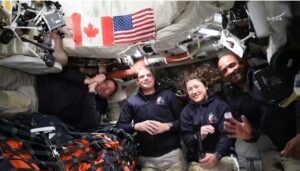
The Artemis II crew – NASA Astronaut Reid Wiseman Wiseman (far left), CSA (Canadian Space Agency) Astronaut Jeremy Hansen (center left) and NASA astronauts Christina Koch (center right) and Victor Glover (right) participated in a live media event in the Orion spacecraft during Flight Day 4. and seen live on the agency’s 24/7 coverage. NASA
Entering lunar gravity sets stage for far-side flyby
As the day concludes, Orion is scheduled to cross a key threshold. At approximately 12:41 a.m. on April 6, the spacecraft will enter the Moon’s gravitational sphere of influence.
At that point, lunar gravity becomes the dominant force shaping the spacecraft’s trajectory, marking a shift from transit to direct lunar interaction.
The milestone sets up the next phase of the mission: a flight around the far side of the Moon.
This segment carries both operational and symbolic weight. It will take the crew out of direct communication with Earth for a period, as the Moon blocks radio signals, and position Orion for its primary observation window.
Inside the capsule, preparations are largely complete. The trajectory has been refined, systems have been tested, and the crew has worked through the procedures that will guide them through the flyby.
The spacecraft continues forward on a path that now depends less on correction and more on execution.
Key lunar flyby times, milestones (all times Eastern subject to change based on real-time operations):
1 p.m.: NASA+ coverage of lunar flyby begins.
1:56 p.m.: The crew will surpass the record for humans’ farthest distance from Earth, previously set by Apollo 13 in 1970.
2:10 p.m.: Crew remarks on breaking Apollo 13 distance record (audio only)
2:15 p.m.: Crew configures Orion’s cabin for flyby operations
2:45 p.m.: Lunar observation begins
6:44 p.m.: Predicted loss of communications as crew heads behind the Moon (approximately 40 minutes)
7:02 p.m. Orion closest approach to the Moon (4,070 miles)
7:07 p.m.: Orion reaches maximum distance from Earth (252,757 miles)
7:25 p.m.: “Earthrise” marks Earth coming back into view on the opposite edge of the moon; Predicted acquisition of communications as crew reemerges from behind the Moon
8:35-9:32 p.m.: During a solar eclipse, the Sun will pass behind the Moon from the crew’s perspective
9:20 p.m.: Lunar observation concludes
The crew is scheduled to begin their sleep period for the day at 2:20 a.m., and will receive their wake up call to begin flight day 6 at 10:50 a.m. on Monday, April 6.
Watch live coverage of the Artemis II lunar flyby on NASA+, Amazon Prime, Apple TV, Hulu, Netflix, HBO Max and Roku beginning at 1 p.m., alongside the agency’s 24/7 coverage on its YouTube channel. Learn how to stream NASA content through a variety of online platforms, including social media.
Astronauts aboard Artemis II continue their workday aboard the Orion spacecraft, testing survival suits and preparing for a lunar flyby set for Monday, April 6. The crew is set to enter the Moon’s gravitational influence just after midnight and execute a key trajectory correction burn later in the day. Final science targets, including major lunar basins, have been assigned ahead of a six-hour observation window.
Inside Orion, the workday has shifted toward final preparations for one of the mission’s defining moments.
With the Moon now close enough to begin shaping the spacecraft’s path, the four astronauts are balancing system checks with scientific planning, moving through a schedule that blends engineering discipline with observation readiness.
Commander Reid Wiseman, pilot Victor Glover, and mission specialists Christina Koch and Jeremy Hansen are continuing a full evaluation of the Orion Crew Survival System suits, a system designed for worst-case scenarios in spaceflight.
Orion spacesuit testing and emergency readiness in deep space
The suit demonstration involves a complete operational sequence. Astronauts are performing leak checks, simulating seat entry, and testing how well they can move, eat, and drink while fully suited.
NASA designed the suits to function across multiple mission phases. They provide life support if cabin pressure is lost, protect crew members during launch and reentry, and support survival after splashdown in the ocean.
Engineers are using this test to understand how the suits perform over extended use in microgravity. Comfort and flexibility are critical, especially for missions that will last longer than earlier lunar programs.
The evaluation also feeds into planning for future deep space missions, where astronauts may need to rely on such systems for longer durations and under more demanding conditions.
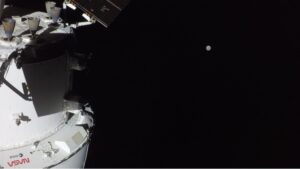
(This photo shows the Orion spacecraft with the Moon in the distance, as captured by a camera on the tip of one of its solar array wings during flight day 2 of the mission. NASA)
Outbound trajectory correction burn and lunar approach timing
Following the suit tests, the crew is scheduled to carry out an outbound trajectory correction burn at approximately 11:03 p.m. Eastern Daylight Time.
The maneuver will refine Orion’s path toward the Moon, ensuring that the spacecraft is correctly aligned for its flyby observation window. Earlier in the mission, two planned burns were canceled after flight controllers confirmed the spacecraft was already on an accurate trajectory.
Ahead of the maneuver, Koch and Hansen are reviewing procedures, with Hansen assigned to monitor navigation data and spacecraft configuration during the burn.
The mission timeline also includes a key milestone. Orion is expected to enter the Moon’s gravitational sphere of influence at about 12:41 a.m. on April 6, marking the transition from transit to direct lunar interaction.
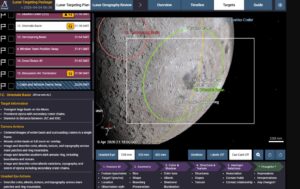
(A screenshot of the application the Artemis II crew sees on their PCDs that guides them in the execution of the lunar science observation plan. This custom software was built by the Crew Lunar Observations Team, a subset of the Artemis II lunar science team. In this screenshot you can see Orientale basin, target number 12 circled on the bottom right of the Moon, and to its left, target number 13, Hertzsprung basin. NASA)
Lunar flyby science targets include major impact basins
Mission control has delivered the final list of lunar observation targets, giving the crew a defined set of features to document during the flyby.
Among the most prominent is the Orientale basin, a massive impact structure nearly 600 miles wide that spans the boundary between the Moon’s near and far sides.
Formed roughly 3.8 billion years ago, the basin preserves clear evidence of a large collision, including concentric rings and dramatic surface topography. Its visibility during the flyby makes it a priority for imaging and analysis.
Another key target is the Hertzsprung basin, located northwest of Orientale on the Moon’s far side. At roughly 400 miles across, it represents an older and more degraded structure.
By comparing the two basins, astronauts will help scientists study how lunar features evolve over time. Differences in structure, erosion, and impact history offer clues about the Moon’s geological development.
The crew is expected to review these targets in detail and coordinate with mission controllers to finalize observation techniques before the flyby begins.
Final preparations inside Orion as flyby approaches
As the spacecraft moves deeper into the Moon’s gravitational influence, operations inside Orion are becoming more tightly focused.
Each task, from suit testing to trajectory adjustments, is tied directly to the upcoming flyby. The six-hour observation window will require precise timing, coordination, and execution.
The astronauts are working through final checklists, ensuring that both human and mechanical systems are ready. Cameras must be positioned, observation plans synchronized, and spacecraft orientation carefully controlled.
The mission has reached a stage where preparation outweighs transit. The spacecraft continues along a stable path, but the emphasis has shifted to how effectively the crew can carry out their objectives once they reach lunar proximity.
For the Artemis II team, the work now is less about getting to the Moon and more about what they will do when they get there.
Key moments for the lunar flyby include the following. All times are Eastern and may change based on real-time operations:
Monday, April 6
12:41 a.m.: Orion enters lunar sphere of influence at 41,072 miles from the Moon.
1:30 p.m.: The science officer in mission control will brief the crew on their science goals for the upcoming flyby.
1:56 p.m.: The Artemis II crew is expected surpass the record previously set by the Apollo 13 crew in 1970 for the farthest humans have ever traveled from Earth.
2:45 p.m.: Lunar observations begin.
6:44 p.m.: Mission control expects to temporarily lose communication with the crew as the Orion spacecraft passes behind the Moon.
6:45 p.m.: During “Earthset,” Earth will glide behind the Moon from Orion’s perspective.
7:02 p.m.: Orion reaches its closest approach to the Moon at 4,070 miles above the surface.
7:07 p.m.: Crew reach their maximum distance from Earth during the mission.
7:25 p.m.: “Earthrise” marks Earth coming back into view on the opposite edge of the Moon.
7:25 p.m.: NASA’s Mission Control Center should re -acquire communication with the astronauts.
8:35-9:32 p.m.: During a solar eclipse, the Sun will pass behind the Moon from the crew’s perspective.
9:20 p.m.: Lunar observations conclude.
Tuesday, April 7
1:25 p.m.: Orion exits the lunar sphere of influence at 41,072 miles from the Moon.
During the flyby, the spacecraft will break the record for the farthest distance from Earth traveled by any human mission, surpassing the mark set by Apollo 13 in April 1970 during its emergency return to Earth. The spacecraft is expected to break the record at 1:56 p.m. and will reach its maximum distance at 7:07 p.m., a total of 252,760 miles from Earth; Apollo 13 reached 248,655 miles from Earth.
When Orion passes behind the Moon, the mission will enter a planned communications blackout of about 40 minutes as the lunar surface blocks the radio signals needed for the Deep Space Network to connect with the spacecraft. Similar blackouts occurred during the Artemis I and Apollo missions and are expected with an Earth-based communications infrastructure. Once Orion reemerges, the network will quickly reacquire its signal and restore contact with mission control.
Astronauts aboard Artemis II began Flight Day 5 by testing their Orion survival suits as the Orion spacecraft closed to within 65,235 miles of the Moon. The activities include a full suit evaluation, a planned trajectory correction burn, and entry into the Moon’s gravitational sphere of influence. The mission is transitioning into its final approach phase ahead of a scheduled lunar flyby.
As CeeLo Green’s “Working Class Heroes (Work)” played through the cabin, the four astronauts shifted quickly into one of the mission’s most practical tests: evaluating the suits designed to keep them alive if something goes wrong.
At this stage of the mission, the spacecraft is about 65,235 miles from the Moon. The distance marks a transition point, where lunar gravity begins to shape the trajectory more strongly than Earth’s pull.
The crew also heard a special message from Apollo astronaut Charlie Duke.
“John Young and I landed on the Moon in 1972 in a lunar module we named Orion. I’m glad to see a different kind of Orion helping return humans to the Moon as America charts the course to the lunar surface. Below you on the Moon is a photo of my family. I pray it reminds you that we and America and all of the world are cheering you on.”
Charlie duke, Apollo 16 Astronaut
Orion Crew Survival System suit test in microgravity
Commander Reid Wiseman, pilot Victor Glover, and mission specialists Christina Koch and Jeremy Hansen are conducting a full operational sequence using the Orion Crew Survival System suit.
The test is structured to mirror real mission scenarios. Astronauts will don the suits, pressurize them, and perform leak checks. They will then simulate entering their seats and assess how easily they can move, eat, and drink while fully suited.
NASA engineers are particularly focused on how the suits perform over extended periods in microgravity. Unlike earlier programs, Artemis missions are designed for longer durations, making comfort and mobility as critical as protection.
The suit itself serves multiple purposes. It is built to provide life support if the cabin loses pressure, protect astronauts during high-risk phases such as launch and reentry, and support survival operations after splashdown in the ocean.
Enhanced thermal regulation, improved communication systems, and greater flexibility are among the features being evaluated during this demonstration. The data collected will shape how future crews operate during longer missions beyond the Moon.
Victor Glover, Jeremy Hansen, and Reid Wiseman work together inside the Orion spacecraft on their way to the Moon.
Final trajectory adjustments and lunar approach phase
Later in the day, the crew is scheduled to execute an outbound trajectory correction burn, one of the final planned propulsion maneuvers before the lunar flyby.
These burns fine-tune the spacecraft’s path, ensuring that Orion reaches the correct position and orientation for its observation window around the Moon. Earlier in the mission, several planned burns were canceled due to the spacecraft’s precise trajectory. This maneuver is expected to proceed as scheduled.
The crew will also receive their final set of lunar science targets, completing the preparation phase for the flyby. These targets include specific surface features identified by NASA scientists for observation and imaging.
By the end of the day, Orion is expected to enter the Moon’s gravitational sphere of influence, a region where lunar gravity becomes the dominant force acting on the spacecraft.
This shift has both symbolic and operational significance. It marks the point where the mission transitions from transit to direct lunar interaction.
(The Artemis II crew took this photo on day 4 of their journey to the Moon. In it, the Moon is oriented with the South Pole at the top and are beginning to see parts of the lunar far side. Orientale basin is on the right edge of the lunar disk in this image. Artemis II marks the first time that humans have seen the entire basin. The Artemis II crew will continue to observe Orientale from multiple angles as they approach the Moon and throughout the lunar flyby. Orientale is the textbook multi-ring impact basin used as a baseline to compare other impact craters on rocky worlds from Mercury to Pluto. NASA)
Mission operations continue under close ground coordination
Mission managers and scientists are scheduled to provide a detailed update during a briefing streamed on NASA’s official channels later in the day.
The briefings serve as a key link between the spacecraft and the public, offering updates on system performance, crew health, and mission progress.
Inside the capsule, the crew’s schedule remains tightly controlled. Each task, from suit testing to propulsion maneuvers, is timed to align with both spacecraft operations and communication windows with Earth.
The suit demonstration stands out as one of the more human-centered activities in the mission. It focuses not on where the spacecraft is going, but on how the crew will function if conditions change rapidly.
As Orion continues its approach, the astronauts are balancing technical precision with preparation for the unexpected. The systems being tested now, including the suits, are designed for scenarios that mission planners hope never occur but must be ready to handle.
The Moon is now close enough to influence the spacecraft’s path. Inside Orion, the crew is working through the final checklists that will carry them into the flyby phase, where observation, timing, and coordination will define the mission’s next milestone.
Astronauts aboard Artemis II completed a 41-minute manual piloting test of the Orion spacecraft on Flight Day 4, taking turns controlling the vehicle in deep space. The demonstration, carried out tested thruster modes and maneuvering capabilities as the crew also reviewed targets for an upcoming lunar flyby. The mission continues on a stable trajectory toward the Moon, with further piloting tests planned later in the flight.
The astronauts aboard Orion spent part of their fourth day in space doing something few humans have ever done: manually steering a spacecraft far beyond Earth orbit.
Late in the day, Christina Koch and Jeremy Hansen took control of the capsule, guiding it through a series of controlled maneuvers designed to test how the spacecraft responds to human input in deep space.
The exercise began at 9:09 p.m. Eastern Daylight Time and lasted 41 minutes, giving engineers a detailed look at Orion’s handling under different conditions.
Orion manual piloting test evaluates deep space handling
During the demonstration, the astronauts tested two distinct thruster configurations. One allowed full six degrees of freedom, enabling movement and rotation across all axes. The other restricted motion to three degrees of freedom, simplifying control inputs and simulating different operational scenarios.
The goal is data. NASA engineers are studying how Orion behaves when astronauts take direct control, measuring responsiveness, stability, and precision. These findings will inform how future crews operate spacecraft during longer missions, where autonomy becomes essential.
Commander Reid Wiseman and pilot Victor Glover are scheduled to repeat the test on Flight Day 8, allowing ground teams to compare performance across different crew members.
Manual control remains a backup capability in modern spacecraft, but NASA continues to treat it as a core skill. In deep space, where delays in communication can limit ground intervention, astronauts must be able to operate independently if needed.
Lunar flyby imaging plan finalized ahead of observation window
While piloting tests drew focus late in the day, earlier hours were spent preparing for the mission’s next major milestone: the lunar flyby.
The crew reviewed a list of imaging targets prepared by NASA’s science team, outlining specific features on the Moon that astronauts will photograph and analyze during a six-hour observation period.
That window begins at approximately 2:45 p.m. on April 6, when Orion’s main cabin windows will be oriented toward the lunar surface.
The targets include impact craters, volcanic plains formed by ancient lava flows, and structural features such as ridges and fractures. By documenting variations in brightness, texture, and color, astronauts will contribute data that helps scientists interpret the Moon’s geological history.
Unlike earlier missions that passed close to the surface, Orion will observe the Moon from thousands of miles away. That distance allows the crew to capture a broader view, including polar regions that are difficult to study from low-altitude trajectories.
The planning session ensures that each crew member understands their role during the flyby. Timing, camera positioning, and observational priorities must align precisely during the limited window available.
Crew life aboard Orion blends routine with milestone moments
Even as the mission advances toward the Moon, daily life aboard Orion continues to follow a structured routine.
Earlier in the day, the astronauts used one of the spacecraft’s external solar array cameras to capture selfies, offering a glimpse of the crew inside the capsule as Earth recedes in the distance. The images are expected to be transmitted to mission control in the coming days.
Such moments, while informal, serve a broader purpose. NASA often shares these images to document the human experience of spaceflight, providing visual context for missions that otherwise unfold far from public view.
The crew is scheduled to begin their sleep period at 3:15 a.m., with mission control at the NASA Johnson Space Center set to wake them at noon Central Daylight Time to begin Flight Day 5.
Structured sleep cycles remain essential. Maintaining physical and cognitive performance is critical as the mission approaches its most observation-intensive phase.
Precision trajectory allows focus on operations
Artemis II continues along a stable trajectory toward the Moon, allowing astronauts to dedicate more time to operational tasks rather than propulsion adjustments.
NASA flight controllers have already canceled multiple planned trajectory correction burns, citing the spacecraft’s accurate path. That precision reduces workload on both the crew and ground teams while conserving fuel for later mission phases.
Inside Orion, that translates into a shift in focus. The early days of the mission emphasized propulsion and navigation. Now, attention has turned to piloting validation, scientific preparation, and system monitoring.
The manual piloting demonstration is part of that transition. It marks a point where the spacecraft is no longer just being guided by automated systems but is also being tested as a vehicle that astronauts can control directly in deep space.
As the Moon draws closer, the crew’s preparations inside the capsule are becoming more deliberate. Every maneuver, checklist review, and system test feeds into the upcoming flyby.
For now, the spacecraft continues forward on a steady path, with astronauts alternating between routine tasks and moments that underscore the scale of the mission.
As the Orion spacecraft continues its path toward the Moon, the Artemis II crew will spend their fourth flight day preparing for their lunar flyby on Monday, April 6. Traveling more than 169,000 miles from Earth aboard the Orion spacecraft, astronauts are set to manually pilot the vehicle and study the Moon from a distant vantage point. The mission will also include a planned communications blackout and record-breaking distance milestone as Orion moves deeper into space.
Inside the Orion capsule, the day began with music and routine. The four astronauts, already days into deep space travel, woke to Chappell Roan’s “Pink Pony Club” before shifting into a tightly scheduled slate of mission tasks.
By the time they started work, the spacecraft had already crossed roughly 169,000 miles from Earth and was closing in on the Moon, which lay about 110,700 miles ahead. The numbers mark a point where Earth is no longer the dominant visual reference, and operational focus shifts toward lunar proximity.
Manual control test of Orion in deep space
Later in the day, pilot Victor Glover is scheduled to take manual control of Orion, a rare exercise designed to evaluate how the spacecraft responds to human input far beyond Earth orbit.
NASA officials have framed the test as critical for future missions, where astronauts may need to intervene directly in spacecraft navigation. The maneuver will provide engineers with data on handling characteristics, including responsiveness and stability under manual control.
The crew is also running a 24-hour acoustics test inside the cabin. Engineers are using the data to map the spacecraft’s sound environment, which affects both crew comfort and communication clarity during extended missions.
These activities reflect a broader goal of Artemis II. Beyond reaching the Moon, the mission is designed to validate systems that astronauts will rely on during longer journeys, including eventual missions to Mars.
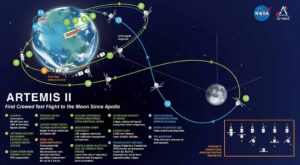
(This artist’s concept depicts the nominal trajectory for NASA’s Artemis II test flight, an approximately 10-day mission that will send four astronauts around the Moon and back. The agency’s SLS (Space Launch System) rocket and Orion spacecraft will launch from Kennedy Space Center in Florida. Orion will fly two orbits of Earth and then venture around the Moon in a figure-eight pattern before returning to Earth.NASA/JSC/Goddard)
Lunar flyby observations and scientific targets
Preparation for the lunar flyby dominates the schedule. The six-hour observation window begins at approximately 2:45 p.m., when Orion’s main windows will face the Moon, allowing astronauts to begin detailed visual and photographic analysis.
Unlike the Apollo missions, which passed about 70 miles above the lunar surface, Orion will remain roughly 4,066 miles away at its closest point. From that distance, the crew will see the Moon as a full disk, including polar regions rarely observed in a single view.
Astronauts Reid Wiseman, Christina Koch, and Jeremy Hansen will work through a checklist of surface features identified by NASA’s science team.
They are expected to document impact craters, ancient lava plains, and fractures in the Moon’s crust. Variations in brightness and color will also be recorded, offering clues about the composition and geological history of the lunar surface.
The flyby will also create a rare viewing condition. As Orion, the Moon, and the Sun align, astronauts will witness a solar eclipse from space lasting about an hour. During that period, they will study the Sun’s outer atmosphere, known as the corona, as it becomes visible around the Moon’s edge.
NASA has also tasked the crew with watching for flashes of light caused by meteoroid impacts on the lunar surface. These observations could help scientists better understand surface hazards for future missions.
(This visualization follows the trajectory of the Orion spacecraft during the Artemis II flyby of the Moon, showing what astronauts will see out the window as they approach the Moon and fly around its far side. The flyby will last from 2:45 – 9:40 PM EDT on April 6, 2026, and marks the window of time that the Artemis II crew will be close enough to the Moon to make scientific observations and Orion’s windows will be pointed toward the Moon. The angle of the Sun’s illumination of the Moon will change throughout the period based on the shifting positions of the Sun, Moon, and spacecraft — revealing both familiar nearside terrain and portions of the far side not visible from Earth. This visualization, compressed from seven hours to one minute, includes Earthrise and Earthset, and a solar eclipse, which will be visible to the crew at the end of the flyby window, when the Sun will glide behind the Moon for nearly an hour from the perspective of Orion.NASA/Ernie Wright)
Communications blackout and record distance milestone
A planned communications blackout is expected when Orion passes behind the Moon. The interruption will begin around 5:47 p.m. and last approximately 40 minutes, as the Moon blocks signals between the spacecraft and NASA’s Deep Space Network.
Such blackouts are standard in lunar missions and were also experienced during earlier programs. Once Orion emerges from behind the Moon, ground stations are expected to quickly reestablish contact.
During this phase, Artemis II is also set to surpass a long-standing distance record. Orion will travel about 252,757 miles from Earth at its farthest point, exceeding the distance reached by the Apollo 13 crew.
The milestone reflects both trajectory design and the mission’s broader objective of pushing human spaceflight deeper into space than previous crewed missions.
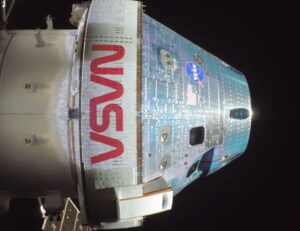
(Orion snapped this high-resolution selfie in space with a camera mounted on one of its solar array wings during a routine external inspection of the spacecraft on the second day into the Artemis II mission. The image was downlinked by the Orion Artemis II Optical Communications System.NASA)
Life sciences research and onboard system challenges
Beyond navigation and observation, Artemis II is carrying a suite of experiments aimed at understanding how humans and biological systems respond to deep space.
One payload, known as AVATAR, includes bone marrow cells derived from crew blood samples to study immune system behavior in space. The astronauts are also collecting saliva samples as part of ongoing biomedical research.
Radiation exposure remains a key concern. Sensors provided by the German Aerospace Center, along with NASA instruments, are measuring radiation levels throughout the spacecraft.
Crew members are also wearing actigraphy devices that track sleep patterns, movement, and overall health. These data sets will inform planning for longer missions, where maintaining crew performance becomes increasingly complex.
Not all systems have operated without issue. Engineers are working to clear a wastewater vent line after a partial blockage. The crew has been instructed to use backup collection methods if necessary, although the main system remains functional.
Mission controllers at the NASA Johnson Space Center have again canceled a planned trajectory correction burn, confirming that Orion remains on its intended path. Instead, the spacecraft will be oriented toward the Sun to help resolve the vent issue.
Expanding communications capabilities in deep space
In parallel with crew operations, Orion’s optical communications system has surpassed 100 gigabytes of data transmitted back to Earth.
The system uses laser-based transmission, allowing higher data rates than traditional radio signals. NASA officials see the technology as essential for future missions that will require rapid transmission of high-resolution imagery and scientific data.
As Artemis II approaches its lunar flyby, the mission has shifted into a phase where precision operations, scientific observation, and human endurance intersect. The spacecraft continues on a trajectory that requires no correction, while inside, astronauts prepare to document the Moon from a distance no crew has experienced in decades.
The crew of Artemis II moved into preparation mode on April 6 as their spacecraft, Orion spacecraft, continued its trajectory toward a lunar flyby. The outbound trajectory correction burn was canceled after flight controllers confirmed the spacecraft remained on course. Astronauts focused on cabin readiness, medical drills, and system checks as the mission passed its halfway point to the Moon.
The four astronauts aboard Artemis II are settling into the rhythms of deep space travel as their spacecraft closes in on a critical phase of the mission. By Monday afternoon, the crew had shifted focus from major propulsion events to preparing the Orion capsule for sustained lunar observation, a period that will define the mission’s operational success.
“We all had a collective expression of joy at that… We can see the Moon out of the docking hatch right now. It’s a beautiful sight.” –Christina KOCH, NASA Astronaut (Artemis II Mission)
Mission controllers at the NASA Johnson Space Center confirmed that the first planned outbound trajectory correction burn was no longer necessary. The spacecraft’s path, they said, remained precise enough to meet mission parameters without adjustment. That decision removed one of three scheduled trajectory maneuvers designed to fine-tune Orion’s route to the Moon.
Inside the capsule, the change translated into a different kind of workload. Rather than executing propulsion tasks, the crew began configuring their living and observation environment for the upcoming lunar flyby window.
Victor Glover, Jeremy Hansen, and Reid Wiseman work together inside the Orion spacecraft on their way to the Moon.
Orion cabin preparation for lunar observation phase
Cabin preparation is not cosmetic. It involves reconfiguring equipment, securing loose items, and ensuring all observation tools are accessible during the Moon flyby. Astronauts must also adjust lighting, camera systems, and window access points to capture scientific data and imagery.
NASA officials have described this phase as one of the most human-centered parts of the mission. The spacecraft, which has operated largely as a transport vehicle until now, becomes a workspace and observation platform as it approaches lunar proximity.
Crew members spent part of the day organizing onboard equipment and verifying that all systems required for observation are functioning within expected parameters. This includes environmental controls, onboard computing systems, and manual override mechanisms.
Alongside technical preparation, astronauts continued routine health maintenance. Exercise sessions remain a daily requirement to counter the effects of microgravity on muscles and bone density. Medical response drills were also conducted, simulating potential emergencies that could arise far from Earth.
These drills are not theoretical. NASA requires crews to demonstrate the ability to respond to medical situations independently, given the communication delays and physical distance involved in deep space missions.
Deep space systems testing and mission timeline adjustments
The crew also tested Orion’s emergency communications system, a critical component designed to maintain contact with Earth under degraded conditions. Engineers on the ground monitor these tests closely, using them to validate system redundancy and resilience.
Deep space communication differs significantly from low Earth orbit operations. Signal delays increase, and the margin for error narrows. Testing ensures that backup systems can function if primary channels fail.
NASA’s decision to cancel the trajectory correction burn underscores the precision of the spacecraft’s navigation systems. According to mission control, Orion’s current trajectory aligns closely with pre-flight calculations, reducing the need for mid-course corrections.
That precision has operational consequences. Fewer burns mean conservation of fuel and reduced mechanical stress on propulsion systems, both of which can extend mission flexibility.
The Artemis II timeline continues to evolve in real time. While the crew prepared for rest around 3 a.m. Central Daylight Time, mission control scheduled their wake-up for the next operational phase. The timeline reflects both planned activities and adjustments based on spacecraft performance.
Despite the technical complexity, daily life aboard Orion follows a structured routine. Sleep cycles, exercise periods, and work blocks are carefully scheduled to maintain crew health and efficiency.
For the astronauts, the mission has now entered a quieter but equally demanding stage. The high-energy launch and orbital maneuvers have given way to sustained operations, where attention to detail becomes critical.
The lunar flyby, expected soon, will serve as both a technical demonstration and a symbolic milestone. Artemis II is the first crewed mission under NASA’s Artemis program, which aims to return humans to the Moon and establish a long-term presence.
The mission builds on decades of spaceflight experience while introducing new systems designed for deep space exploration. Orion, developed specifically for missions beyond low Earth orbit, represents a shift in spacecraft design priorities, emphasizing autonomy, durability, and crew safety over extended durations.
As the spacecraft moves closer to the Moon, the crew’s preparations inside the cabin will shape how effectively they can carry out observation tasks. Every adjustment made now, from equipment placement to system checks, feeds into that moment.
For mission control teams in Houston, the cancellation of a major burn signals confidence in both the spacecraft and the planning behind it. For the astronauts, it means more time to prepare for the view ahead.
The Moon is no longer a distant objective. It is approaching, steadily, on a trajectory that no longer requires correction.
India on April 3 advanced its millet strategy with a new training facility at the Central Food Technology Research Institute in Mysuru and growing global adoption of millet-based foods. Union Minister Jitendra Singh said innovations developed at the institute are already being used by international food chains such as McDonald’s. The move links research, skill development, and market access as part of a broader push for sustainable nutrition and rural livelihoods.
A millet-based dish developed in an Indian lab now finds its way onto global fast-food menus. In Mysuru, that journey from grain to global product is being scaled up.
On April 3, Union Minister for Science and Technology Dr. Jitendra Singh laid the foundation for a 30-room single-occupancy hostel at the Central Food Technology Research Institute (CFTRI), a premier food research body under India’s Council of Scientific and Industrial Research. The facility is designed to support trainees, farmers, and entrepreneurs working in millet-based food processing.
The announcement came alongside a broader push to expand India’s millet ecosystem, with the minister highlighting that millet recipes developed using Indian technology are already being served by global chains, including McDonald’s.
Union Minister Dr Jitendra Singh
CFTRI Mysuru millet centre and hostel project details
The new hostel facility, funded under the Rashtriya Krishi Vikas Yojana (RKVY), will accommodate around 50 participants and include kitchen and dining infrastructure. Officials expect it to be completed within a year.
The residential setup is intended to support immersive training programs for Farmer Producer Organisations, self-help groups, and startups. By enabling participants from across the country to stay on campus, the institute aims to expand access to hands-on training in food processing, entrepreneurship, and value addition.
Officials said demand for such structured programs has grown steadily, with CFTRI already conducting dozens of training sessions annually. The residential model is expected to improve participation and learning outcomes, particularly for those who cannot afford independent accommodation.
During his visit, Singh reviewed the institute’s Centre of Excellence on Millets, which he described as one of the first globally dedicated platforms for millet innovation.
The facility includes seven processing lines and a laboratory capable of handling end-to-end processing of major millet varieties. Technologies at the centre allow cleaning, dehulling, polishing, and sorting, along with production of value-added products such as flakes, extruded foods, baked goods, and semolina.
Union Minister Dr Jitendra Singh
India millet strategy links research, industry and rural livelihoods
The millet centre, supported by ₹20 crore under RKVY, is designed for industrial-scale efficiency. It can process between 300 kg and 1,000 kg per hour and handle all nine major millet varieties within a single integrated system.
Its infrastructure includes cleaning capacities of up to 70 tonnes per day and milling capacities of up to 15 tonnes per day, producing flour, bran, and semolina while preserving nutritional content.
One of the key technological advances highlighted during the visit is the extension of millet flour shelf life from about one month to nearly ten months. That improvement is seen as critical for commercial viability, especially for packaged and export-ready products.
Singh also pointed to efforts to expand innovation beyond millets, including work on sustainable food products derived from “Kalari,” a traditional cheese from Jammu and Kashmir.
The minister emphasized that the next phase of growth lies in strengthening the commercial ecosystem around such technologies. That includes greater engagement with startups, micro, small, and medium enterprises, and digital outreach to expand market access.
India’s focus on millets has gained international visibility in recent years, particularly after the United Nations declared an International Year of Millets, a move led by India to promote climate-resilient crops and sustainable diets.
The CFTRI model reflects a broader policy shift that links scientific research with grassroots capacity building. The millet centre provides the technological base, while the new hostel aims to expand the pool of trained individuals who can apply these innovations in real-world settings.
Public sentiment around millets has also evolved as awareness grows. In a Reddit discussion on sustainable diets, user “EcoFoodIndia,” writing on Reddit (1,600 upvotes), said, “Millets went from being seen as poor man’s food to something global brands now want.”
As global demand rises for climate-resilient and nutrient-rich foods, policymakers are positioning millets as a strategic component of India’s food economy.
The developments in Mysuru suggest a coordinated approach that brings together research institutions, industry adoption, and training infrastructure. The outcome will depend on how effectively these elements translate into scalable production and wider market access.
Astronomers studying the exoplanet TOI-5205 b have found unexpected atmospheric properties that challenge existing models of planet formation. Using the James Webb Space Telescope, researchers observed the Jupiter-sized planet orbiting a small red dwarf star and detected unusually low heavy-element content. The findings, published this week, suggest new mechanisms may shape how giant planets form around smaller stars.
A giant planet circles a small, dim star, and astronomers are still working out how it got there.
The exoplanet TOI-5205 b, roughly the size of Jupiter, orbits a red dwarf star that is far smaller than the Sun. Systems like this are often described as unusual because standard models of planet formation struggle to explain how such a large planet could emerge from a relatively small disk of material.
Now, new observations using the James Webb Space Telescope (JWST) have added another layer to the puzzle. Researchers report that the planet’s atmosphere contains fewer heavy elements than expected, even when compared to its own host star.
The findings were published in The Astronomical Journal and led by scientists at NASA Goddard Space Flight Center, with contributions from Carnegie Institution for Science and other international partners.
JWST transit data reveals unexpected atmospheric composition
TOI-5205 b orbits its host star closely enough that it regularly passes in front of it, an event known as a transit. During these transits, the planet blocks about six percent of the star’s light, allowing astronomers to analyze its atmosphere.
Using spectrographs aboard JWST, researchers split the starlight filtering through the planet’s atmosphere into different wavelengths. This technique reveals the chemical composition of the gases surrounding the planet.
The results showed the presence of methane and hydrogen sulfide, both commonly found in gas giant atmospheres. But what stood out was the relative lack of heavier elements, often referred to as metallicity in astronomy.
The planet’s atmosphere appears less enriched in heavy elements than Jupiter, and even less than its own host star. That runs counter to expectations. In most known systems, giant planets tend to have atmospheres richer in heavy elements than their stars.
“Forbidden” planet raises questions about how worlds form
TOI-5205 b belongs to a class sometimes called giant exoplanets around M dwarf stars, or GEMS. These systems are rare because smaller stars are thought to have less material available in their protoplanetary disks, making it harder to form large planets.
The existence of TOI-5205 b already challenged that assumption when it was confirmed in 2023 using data from the Transiting Exoplanet Survey Satellite (TESS). The new atmospheric findings deepen the mystery.
Researchers expected that if such a planet formed, it would show clear signs of heavy-element enrichment. Instead, the data suggests the opposite.
To interpret the results, scientists used models of planetary interiors developed at the University of Zurich. These models indicate that while the planet as a whole may be rich in heavier elements, those materials could be concentrated deep inside.
That separation between interior and atmosphere points to a process where heavy elements migrate inward during formation, leaving the outer layers relatively depleted.
An artist’s conception of the gas giant planet TOI-5205 b orbiting a small, cool red dwarf star. Credit-Katherine Cain, Carnegie Science.
New clues about early planetary evolution
The findings suggest that TOI-5205 b may have experienced a more complex formation process than previously thought. One possibility is that the planet formed quickly, capturing large amounts of hydrogen and helium before heavier elements could mix evenly throughout its structure.
Another possibility involves limited mixing between the planet’s interior and its atmosphere, preventing heavier elements from rising to observable levels.
The study also points to a carbon-rich, oxygen-poor atmosphere, which could influence how clouds form and how heat moves through the planet’s outer layers.
Astronomers plan to expand their observations through a broader program focused on similar systems. By studying more giant planets around small stars, researchers hope to determine whether TOI-5205 b is an outlier or part of a larger pattern.
For now, the planet stands as a case that does not fit neatly into existing models. A massive world orbiting a modest star, with an atmosphere that defies expectations.
Young children in the United States continue to suffer frequent injuries from household cleaning products, with more than 240,000 emergency visits recorded between 2007 and 2022. Researchers at Nationwide Children’s Hospital found bleach and detergents as the leading causes, with toddlers aged one to two most at risk. The study highlights ingestion as the most common cause and calls for stronger packaging and safer storage practices.
A toddler reaches for a brightly colored detergent packet on a kitchen counter. It looks like candy. Within minutes, the mistake can send a family rushing to an emergency room.
That pattern has played out thousands of times across the United States over the past decade and a half. A new study from the Center for Injury Research and Policy at Nationwide Children’s Hospital, a pediatric research institution based in Columbus, Ohio, estimates more than 240,800 emergency department visits tied to household cleaning product injuries among children aged five and younger between 2007 and 2022. That translates to one injury every 35 minutes.
The findings, published in the medical journal Pediatrics, draw on 16 years of data from the National Electronic Injury Surveillance System (NEISS), a database maintained by the U.S. Consumer Product Safety Commission, the federal agency that tracks product-related injuries.
Detergent packets and bleach remain leading causes of child injuries
Among the products linked to injuries, bleach and detergents consistently ranked at the top. Researchers found detergent packets alone accounted for 33 percent of all injuries in the study period.
These single-use packets, introduced widely into the market in 2012, quickly emerged as a major hazard. Injury rates tied to them climbed sharply in the years after their launch, peaking in 2015 before gradually declining. Researchers attribute that drop to safety measures such as child-resistant packaging, opaque containers, and changes to the packet film that make it dissolve more slowly and taste bitter.
Despite those improvements, detergent packets remained the leading cause of detergent-related injuries as recently as 2022, according to the study’s authors.
Bleach-related injuries, by contrast, did not show the same decline. The study found rates remained steady over time, often linked to products stored in spray bottles that are easy for children to access and use.
Spray bottles themselves accounted for 28 percent of all injuries, with many cases involving eye exposure. These incidents frequently resulted in chemical burns, poisoning, or skin and eye irritation conditions such as dermatitis and conjunctivitis.
Nearly one-quarter of spray bottle injuries occurred when another person sprayed the child, suggesting that risk extends beyond direct handling by toddlers.
Toddlers face highest risk as ingestion drives most injuries
Children between the ages of one and two were identified as the most vulnerable group. Researchers linked this to developmental behavior, noting that toddlers often explore objects by putting them in their mouths without understanding danger.
Ingestion emerged as the most common pathway for injury. Poisoning was the leading diagnosis, and nearly all poisoning cases stemmed from children swallowing cleaning products.
The severity of these incidents is reflected in hospitalization rates. The study found that 7 percent of affected children required hospital admission, up from 5.5 percent reported in earlier research by the same group nearly two decades ago.
That increase suggests that while awareness of risks has grown, the consequences of exposure remain significant.
Public concern around the issue appears to mirror the data. In a widely upvoted Reddit discussion on household safety, user “ParentingRealTalk,” writing on Reddit (1,800 upvotes), said, “You think you’ve childproofed everything until something as normal as detergent becomes the danger.”
Researchers call for stronger packaging and safer storage
The study’s authors urged manufacturers and regulators to strengthen packaging standards, particularly for products stored in spray bottles and other easily accessible containers. They emphasized the importance of child-resistant designs as a first line of defense.
Researchers also pointed to gaps in how products are stored and handled in homes. While earlier decades saw a decline in injuries linked to improvised storage such as kitchen containers, spray bottles and original packaging continue to pose risks when left within reach of children.
Safety guidance from the study focuses on simple but consistent practices. Caregivers are advised to store cleaning products out of sight and preferably in locked cabinets, keep items in their original containers, and secure lids immediately after use.
The study also highlights the importance of rapid response. The national Poison Help Line, operated across the United States, remains a critical resource for parents who suspect exposure, even before symptoms appear.
The findings add to a growing body of evidence that everyday household products continue to present a measurable risk to young children, even as safety measures evolve.
For families, the risks often sit in plain sight, in kitchens, bathrooms, and laundry rooms. For researchers and policymakers, the challenge remains how to reduce injuries tied to products designed for routine use but capable of causing harm in seconds.
The Unique Identification Authority of India (UIDAI) has entered into a partnership with MapmyIndia to integrate authorised Aadhaar service centres into the Mappls mobile application, a move aimed at simplifying access to Aadhaar-related services across the country.
The agreement, signed on April 1, 2026, will allow users to locate verified Aadhaar centres through the Mappls App, the navigation platform developed by MapmyIndia. The rollout is expected over the coming months.
Under the collaboration, UIDAI will provide authenticated data on Aadhaar centres, which will be digitally mapped and listed within the app. The integration is designed to ensure that users searching for Aadhaar services are directed only to authorised centres.
Search-Based Access To Verified Aadhaar Services
The feature will allow residents to identify centres based on specific services offered, including new enrolments for adults and children, as well as updates to address and mobile details.
By categorising centres according to services, the platform aims to reduce confusion for users who often rely on incomplete or unverified information when seeking Aadhaar services.
The initiative also seeks to address concerns around misinformation and unauthorised operators. By displaying only verified locations, UIDAI intends to create a single, reliable digital layer for Aadhaar service access.
Focus On Convenience And Digital Mapping
“UIDAI is always driven by resident centricity. This kind of collaboration will allow digital mapping of verified Aadhaar Centres across India and help people find the authorised Aadhaar centres easily,” said Bhuvnesh Kumar, Chief Executive Officer of UIDAI.
MapmyIndia will be responsible for integrating the data into its platform, ensuring accurate geolocation, consistent updates, and clear identification of Aadhaar centres within the app interface.
“It is a privilege to serve UIDAI and enable people with easy access to Aadhaar Centres, through the Mappls App,” said Rakesh Verma, Co-founder and Chairman and Managing Director of MapmyIndia.
Nationwide Access Through Aadhaar Seva Kendras
The initiative covers Aadhaar Seva Kendras (ASKs) and other authorised centres operating across India. These centres provide services including biometric enrolment, demographic updates, and document verification.
By embedding this network into a widely used navigation app, the collaboration aims to bridge the gap between physical service points and digital discovery tools.
The rollout is expected to make Aadhaar services more accessible, particularly for users unfamiliar with official centre locations or navigating multiple service providers.
NASA confirmed the Artemis II crew completed a perigee raise maneuver on April 2, refining Orion’s orbit around Earth. A brief communications loss occurred shortly after the burn but was quickly resolved with no reported impact on crew safety. The agency will hold a press conference from Kennedy Space Center as the mission prepares for its next orbital milestone.
A routine engine burn sharpened Artemis II’s orbit. Minutes later, mission control lost contact. Then the signal came back.
The National Aeronautics and Space Administration said the Orion spacecraft successfully completed its perigee raise maneuver, one of the key early steps in shaping its path around Earth. The burn used the interim cryogenic propulsion stage’s RL10 engine to lift the spacecraft’s lowest orbital point, refining its trajectory for later mission phases.
The maneuver followed earlier orbital adjustments and forms part of a sequence designed to prepare Orion for operations beyond low Earth orbit. NASA officials said the burn occurred as planned, with precise timing required to achieve the desired orbital change.
Artemis II perigee raise burn and orbital adjustments
The perigee raise maneuver increases the spacecraft’s minimum altitude during its orbit. Along with a separate apogee raise burn, which affects the highest orbital point, these adjustments create a stable and elongated orbit suitable for further testing.
NASA said these burns are critical in preparing Orion for a planned high Earth orbit phase lasting about 23.5 hours. During that period, astronauts and ground teams will conduct system checkouts before committing to the next stage of the mission.
The work is coordinated through mission control at Johnson Space Center, where engineers track propulsion performance, navigation data, and onboard systems in real time.
A view over the shoulders of NASA astronauts Victor Glover (left) and Reid Wiseman (right), pilot and commander, respectively, inside the Orion spacecraft as they participate in a proximity operations demonstration. This demonstration tests the spacecraft’s ability to manually maneuver relative to another spacecraft, the interim cryogenic propulsion stage, after separation, using its onboard navigation sensors and reaction control thrusters. NASA
Brief communication dropout under review
Shortly after completing the burn, ground teams experienced a temporary loss of communications with the spacecraft. NASA said controllers were unable to receive data from Orion or the crew for a brief period.
The interruption resolved quickly. Astronauts reported that they continued to hear communications from the ground throughout the event, indicating that onboard systems remained functional.
NASA said engineers are reviewing telemetry to determine the cause of the dropout. The agency has not indicated any impact on mission safety or trajectory.
Such communication gaps, while uncommon, are treated as high-priority review items during test missions. Artemis II, as a crewed test flight, is designed to expose and evaluate system behavior under real operating conditions.
NASA press conference and mission leadership
NASA will hold a post-launch press conference at 8 p.m. EDT from the Kennedy Space Center to provide further updates.
Scheduled participants include NASA Administrator Jared Isaacman, Associate Administrator Amit Kshatriya, Lori Glaze, who serves as acting associate administrator for the Exploration Systems Development Mission Directorate, and Norm Knight, director of the Flight Operations Directorate.
The briefing is expected to address the completed maneuver, the communication anomaly, and upcoming mission steps.
Public attention remains fixed on the mission’s progress. “Even a small signal loss gets people nervous, but that’s why they test,” wrote Reddit user SpaceTrackLive in a post that drew more than 900 upvotes, reflecting cautious optimism among spaceflight observers.
Next milestone: apogee raise burn and system checks
The next major step for Artemis II is the apogee raise maneuver. This burn will increase the highest point of Orion’s orbit, complementing the earlier perigee adjustment.
Together, these orbital changes define the spacecraft’s path before it transitions into high Earth orbit operations. NASA said this phase will allow for extended system verification and crew activity in preparation for the mission’s later trajectory toward the Moon.
Engineers view these incremental milestones as essential. Each burn, test, and anomaly review contributes to a broader goal: confirming that Orion can safely carry astronauts through deep space and back.
For now, Artemis II continues to move step by step. One maneuver completed, one anomaly under review, and another burn on the horizon.