First underground radar images from Mars Perseverance rover reveal some surprises

Key takeaways:

  • Roving the Red Planet. Perseverance landed on Mars in February 2021 and has been gathering data on the planet’s geology and climate and searching for signs of ancient life.​​​​​​
  • What lies beneath. The rover’s subsurface radar experiment, co-led by UCLA’s David Paige, has returned images showing unexpected variations in rock layers beneath the Jezero crater.
  • Probing the past. The variations could indicate past lava flows or possibly a river delta even older than the one currently being explored on the crater floor.

After a tantalizing year-and-a-half wait since NASA’s Mars Perseverance rover touched down on our nearest planetary neighbor, new data is arriving — and bringing with it a few surprises.

The rover, which is about the size of car and carries seven scientific instruments, has been probing Mars’ 30-mile-wide Jezero crater, once the site of a lake and an ideal spot to search for evidence of ancient life and information about the planet’s geological and climatic past.

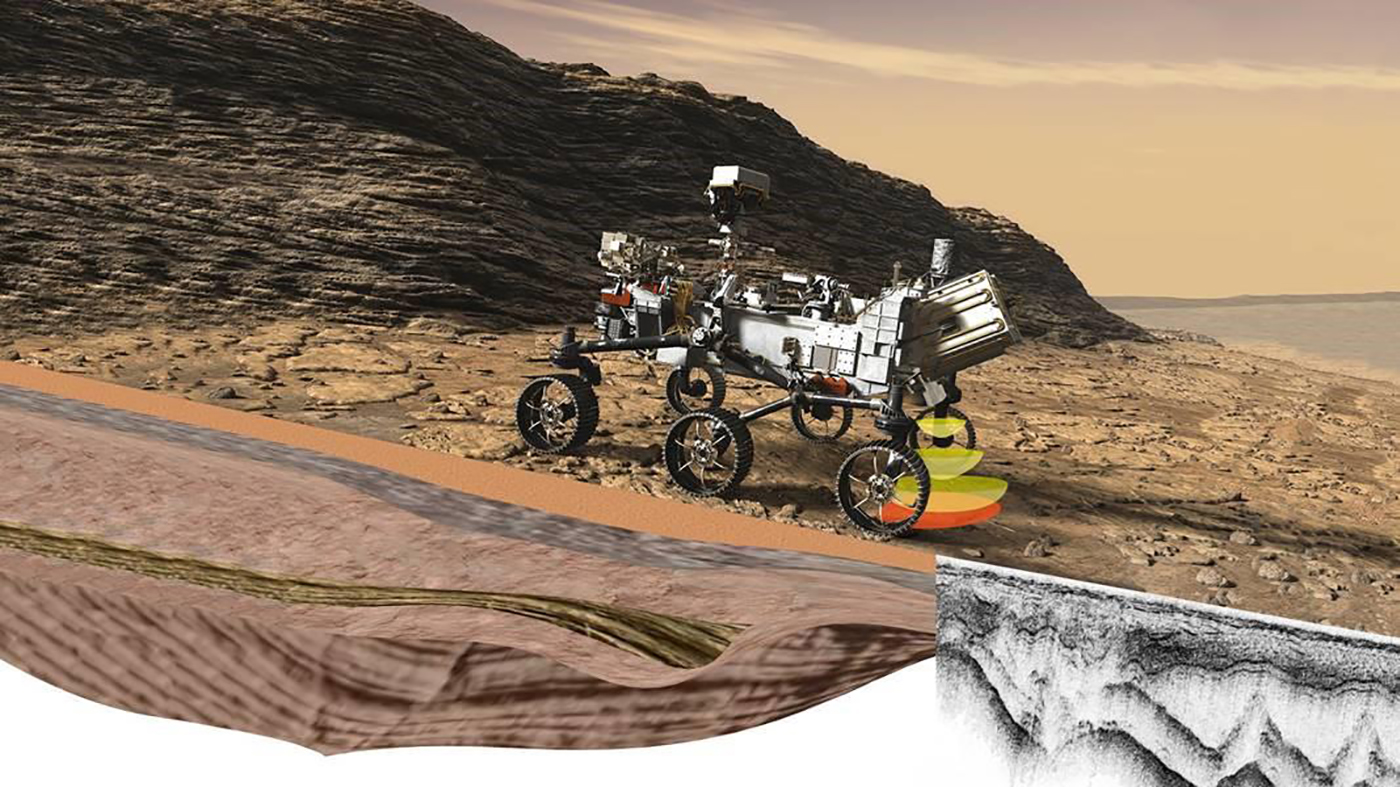
Rendering of Perseverance, whose RIMFAX technology is exploring what lies beneath the Martian surface. Photo: NASA/JPL/Caltech/FFI

In a paper published today in the journal Science Advances, a research team led by UCLA and the University of Oslo reveals that rock layers beneath the crater’s floor, observed by the rover’s ground-penetrating radar instrument, are unexpectedly inclined. The slopes, thicknesses and shapes of the inclined sections suggest they were either formed by slowly cooling lava or deposited as sediments in the former lake.

Perseverance is currently exploring a delta on the western edge of the crater, where a river once fed the lake, leaving behind a large deposit of dirt and rocks it picked up along its course. As the rover gathers more data, the researchers hope to clear up the complex history of this part of the Red Planet.

“We were quite surprised to find rocks stacked up at an inclined angle,” said David Paige, a UCLA professor of Earth, planetary and space sciences and one of the lead researchers on the Radar Imager for Mars Subsurface Experiment, or RIMFAX. “We were expecting to see horizontal rocks on the crater floor. The fact that they are tilted like this requires a more complex geologic history. They could have been formed when molten rock rose up towards the surface, or, alternatively, they could represent an older delta deposit buried in the crater floor.”

Paige said that most of the evidence gathered by the rover so far points to an igneous, or molten, origin, but based on the RIMFAX data, he and the team can’t yet say for certain how the inclined layers formed. RIMFAX obtains a picture of underground features by sending bursts of radar waves below the surface, which are reflected by rock layers and other obstacles. The shapes, densities, thicknesses, angles and compositions of underground objects affect how the radar waves bounce back, creating a visual image of what lies beneath.

During Perseverance’s initial 3-kilometer traverse, the instrument has obtained a continuous radar image that reveals the electromagnetic properties and bedrock stratigraphy — the arrangement of rock layers — of Jezero’s floor to depths of 15 meters, or about 49 feet. The image reveals the presence of ubiquitous layered rock strata, including those that are inclined at up to 15 degrees. Compounding the mystery, within those inclined areas are some perplexing highly reflective rock layers that in fact tilt in multiple directions.

“RIMFAX is giving us a view of Mars stratigraphy similar to what you can see on Earth in highway road cuts, where tall stacks of rock layers are sometimes visible in a mountainside as you drive by,” Paige explained. “Before Perseverance landed, there were many hypotheses about the exact nature and origin of the crater floor materials. We’ve now been able to narrow down the range of possibilities, but the data we’ve acquired so far suggest that the history of the crater floor may be quite a bit more complicated than we had anticipated.”

The data collected by RIMFAX will provide valuable context to rock samples Perseverance is collecting, which will eventually be brought back to Earth.

“RIMFAX is giving us the backstory of the samples we’re going to analyze. It’s exciting that the rover’s instruments are producing data and we’re starting to learn, but there’s a lot more to come,” Paige said. “We landed on the crater floor, but now we’re driving up on the actual delta, which is the main target of the mission. This is just the beginning of what we’ll hopefully soon know about Mars.”

The paper, “Ground penetrating radar observations of subsurface structures in the floor of Jezero crater, Mars,” is one of three simultaneously published papers discussing some of the first data from Perseverance.

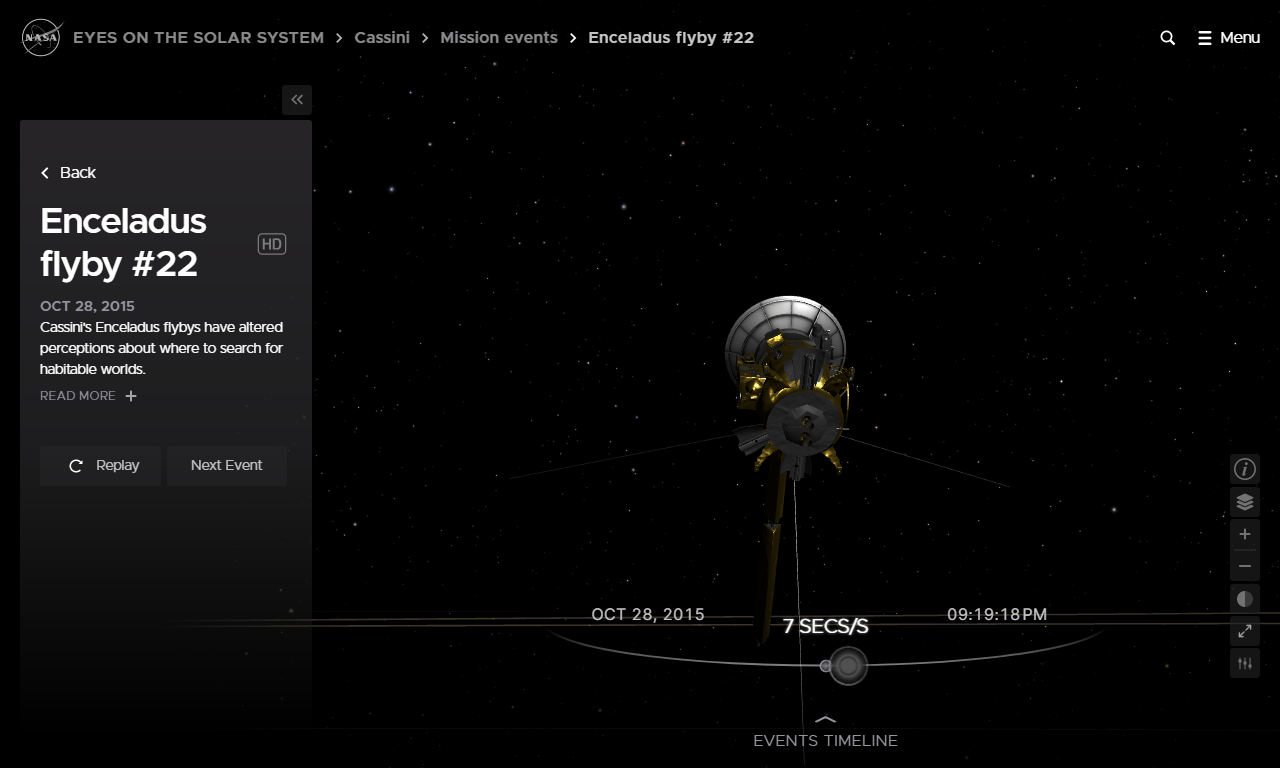
Explore the Solar System With NASA’s New, Improved 3D ‘Eyes’

The agency’s newly upgraded “Eyes on the Solar System” visualization tool includes Artemis I’s trajectory along with a host of other new features.

NASA has revamped its “Eyes on the Solar System” 3D visualization tool, making interplanetary travel easier and more interactive than ever. More than two years in the making, the update delivers better controls, improved navigation, and a host of new opportunities to learn about our incredible corner of the cosmos – no spacesuit required. All you need is a device with an internet connection.

 Trace the course Artemis I will take to lunar orbit, or touch down with Perseverance during its harrowing entry, descent, and landing on the Red Planet. Learn the basics about dwarf planets or the finer points of gas giants, and ride alongside no fewer than 126 space missions past and present. You can even follow the paths of spacecraft and celestial bodies as far back as 1949 and as far into the future as 2049.

While you’re at it, you can rotate objects, compare them side by side, and even modulate the perspective as well as the lighting. The visuals are striking. This latest version of “Eyes” also lets you scroll through rich interactive journeys, including Voyager’s Grand Tour of Jupiter, Saturn, Uranus, and Neptune.

“The beauty of the new browser-based ‘Eyes on the Solar System’ is that it really invites exploration. You just need an internet connection, a device that has a web browser, and some curiosity,” said Jason Craig, the producer of the “Eyes” software at NASA’s Jet Propulsion Laboratory.

Apply now to experience the Launch of NASA’s SpaceX Crew-5 Mission[Full details]

Digital content creators are invited to register to attend the launch of the fifth SpaceX Crew Dragon spacecraft and Falcon 9 rocket that will carry astronauts to the International Space Station for a science expedition mission. This mission is part of NASA’s Commercial Crew Program.

The earliest targeted launch date for the agency’s SpaceX Crew-5 mission is Oct. 3, from Kennedy’s Launch Complex 39A. The launch will carry NASA astronauts Nicole Mann, commander; Josh Cassada, pilot; and mission specialists Koichi Wakata, of JAXA (Japan Aerospace Exploration Agency), and Roscosmos cosmonaut Anna Kikina.

If your passion is to communicate and engage the world online, then this is the event for you! Seize the opportunity to be on the front line to see and share the #Crew5 mission launch.

A maximum of 35 social media users will be selected to attend this two-day event and will be given access similar to news media.

NASA Social participants will have the opportunity to:

  • View a launch of the SpaceX Falcon 9 rocket
  • Tour NASA facilities at Kennedy Space Center
  • Meet and interact with Crew-5 subject matter experts
  • Meet fellow space enthusiasts who are active on social media

NASA Social registration for the Crew-5 launch opens on August 31 and the deadline to apply is September 6 at 3 p.m. EDT. All social applications will be considered on a case-by-case basis.


APPLY NOW


Do I need to have a social media account to register?
Yes. This event is designed for people who:

  • Actively use multiple social networking platforms and tools to disseminate information to a unique audience.
  • Regularly produce new content that features multimedia elements.
  • Have the potential to reach a large number of people using digital platforms.
  • Reach a unique audience, separate and distinctive from traditional news media and/or NASA audiences.
  • Must have an established history of posting content on social media platforms.
  • Have previous postings that are highly visible, respected and widely recognized.

Users on all social networks are encouraged to use the hashtag #NASASocial, and #Crew5.  Updates and information about the event will be shared on Twitter via @NASASocial and @NASAKennedy, and via posts to Facebook and Instagram.

How do I register?
Registration for this event opens August 31 and closes at 3 p.m. EDT on September 6. Registration is for one person only (you) and is non-transferable. Each individual wishing to attend must register separately. Each application will be considered on a case-by-case basis.

Can I register if I am not a U.S. citizen?
Because of the security deadlines, registration is limited to U.S. citizens. If you have a valid permanent resident card you will be processed as a U.S. citizen.

When will I know if I am selected?
After registrations have been received and processed, an email with confirmation information and additional instructions will be sent to those selected. We expect to send the first notifications on September 13 and waitlist notifications on September 14.

What are NASA Social credentials?
All social applications will be considered on a case-by-case basis. Those chosen must prove through the registration process they meet specific engagement criteria.

If you do not make the registration list for this NASA Social, you still can attend the launch offsite and participate in the conversation online. Find out about ways to experience a launch here.

What are the registration requirements?
Registration indicates your intent to travel to NASA’s Kennedy Space Center in Florida and attend the two-day event in person. You are responsible for your own expenses for travel, accommodation, food, and other amenities.

Some events and participants scheduled to appear at the event are subject to change without notice. NASA is not responsible for loss or damage incurred as a result of attending. NASA, moreover, is not responsible for loss or damage incurred if the event is cancelled with limited or no notice. Please plan accordingly.

Kennedy is a government facility. Those who are selected will need to complete an additional registration step to receive clearance to enter the secure areas.

IMPORTANT: To be admitted, you will need to provide two forms of unexpired government-issued identification; one must be a photo ID and match the name provided on the registration. Those without proper identification cannot be admitted. For a complete list of acceptable forms of ID, please visit: NASA Credentialing Identification Requirements.

All registrants must be at least 18 years old.

Photo: Nasa.gov

What if the launch date changes?
Hundreds of different factors can cause a scheduled launch date to change multiple times. The launch date will not be official until after the Flight Readiness Review. If the launch date changes prior to then, NASA may adjust the date of the NASA Social accordingly to coincide with the new target launch date. NASA will notify registrants of any changes by email.

If the launch is postponed, attendees will be invited to attend a later launch date. NASA cannot accommodate attendees for delays beyond 72 hours.

NASA Social attendees are responsible for any additional costs they incur related to any launch delay. We strongly encourage participants to make travel arrangements that are refundable and/or flexible.

What if I cannot come to the Kennedy Space Center?
If you cannot come to the Kennedy Space Center and attend in person, you should not register for the NASA Social. You can follow the conversation using the #NASASocial hashtag on Twitter. You can watch the launch on NASA Television or www.nasa.gov/live. NASA will provide regular launch and mission updates on @NASA@NASAKennedy, and @Commercial_Crew.

What are the safety protocols for this event?
COVID-19 safety protocols for this event will be communicated closer to the date of the event.

If you cannot make this NASA Social, don’t worry; NASA is planning many other Socials in the near future at various locations! Check back here for updates.

NASA’s Webb Detects Carbon Dioxide in Exoplanet Atmosphere

NASA’s James Webb Space Telescope has captured the first clear evidence for carbon dioxide in the atmosphere of a planet outside the solar system. This observation of a gas giant planet orbiting a Sun-like star 700 light-years away provides important insights into the composition and formation of the planet. The finding, accepted for publication in Nature, offers evidence that in the future Webb may be able to detect and measure carbon dioxide in the thinner atmospheres of smaller rocky planets.

WASP-39 b is a hot gas giant with a mass roughly one-quarter that of Jupiter (about the same as Saturn) and a diameter 1.3 times greater than Jupiter. Its extreme puffiness is related in part to its high temperature (about 1,600 degrees Fahrenheit or 900 degrees Celsius). Unlike the cooler, more compact gas giants in our solar system, WASP-39 b orbits very close to its star – only about one-eighth the distance between the Sun and Mercury – completing one circuit in just over four Earth-days. The planet’s discovery, reported in 2011, was made based on ground-based detections of the subtle, periodic dimming of light from its host star as the planet transits, or passes in front of the star.

Previous observations from other telescopes, including NASA’s Hubble and Spitzer space telescopes, revealed the presence of water vapor, sodium, and potassium in the planet’s atmosphere. Webb’s unmatched infrared sensitivity has now confirmed the presence of carbon dioxide on this planet as well.

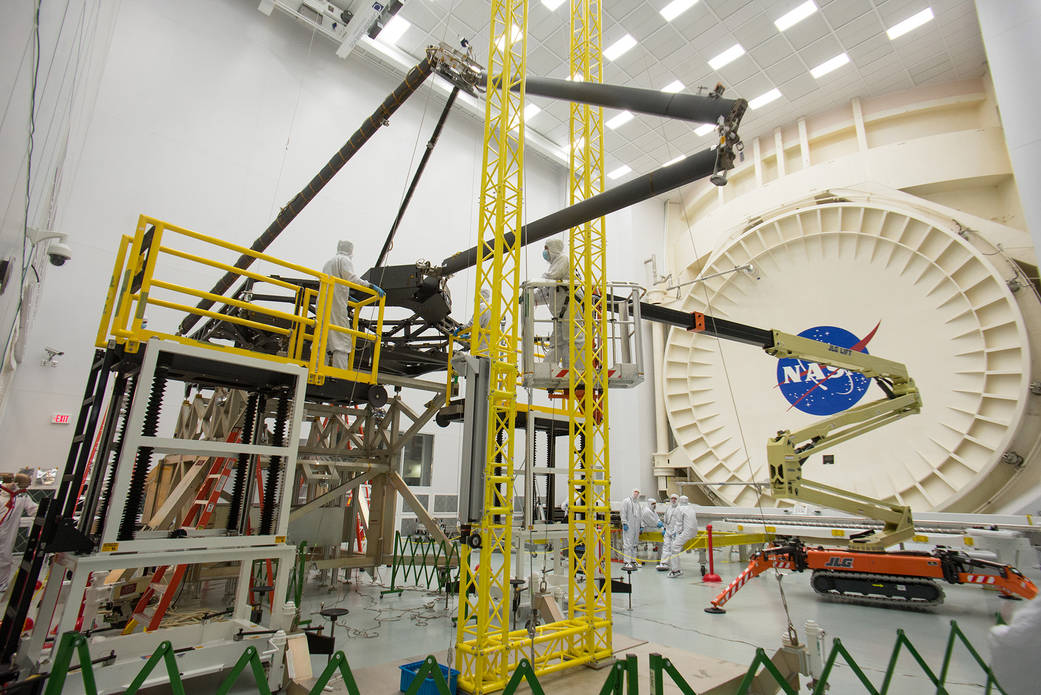
NASA Prepares Webb Telescope /NASA

Filtered Starlight

Transiting planets like WASP-39 b, whose orbits we observe edge-on rather than from above, can provide researchers with ideal opportunities to probe planetary atmospheres.

During a transit, some of the starlight is eclipsed by the planet completely (causing the overall dimming) and some is transmitted through the planet’s atmosphere.

Because different gases absorb different combinations of colors, researchers can analyze small differences in brightness of the transmitted light across a spectrum of wavelengths to determine exactly what an atmosphere is made of. With its combination of inflated atmosphere and frequent transits, WASP-39 b is an ideal target for transmission spectroscopy.

First Clear Detection of Carbon Dioxide

The research team used Webb’s Near-Infrared Spectrograph (NIRSpec) for its observations of WASP-39b. In the resulting spectrum of the exoplanet’s atmosphere, a small hill between 4.1 and 4.6 microns presents the first clear, detailed evidence for carbon dioxide ever detected in a planet outside the solar system.

“As soon as the data appeared on my screen, the whopping carbon dioxide feature grabbed me,” said Zafar Rustamkulov, a graduate student at Johns Hopkins University and member of the JWST Transiting Exoplanet Community Early Release Science team, which undertook this investigation. “It was a special moment, crossing an important threshold in exoplanet sciences.”

No observatory has ever measured such subtle differences in brightness of so many individual colors across the 3 to 5.5-micron range in an exoplanet transmission spectrum before. Access to this part of the spectrum is crucial for measuring abundances of gases like water and methane, as well as carbon dioxide, which are thought to exist in many different types of exoplanets.

“Detecting such a clear signal of carbon dioxide on WASP-39 b bodes well for the detection of atmospheres on smaller, terrestrial-sized planets,” said Natalie Batalha of the University of California at Santa Cruz, who leads the team.

Understanding the composition of a planet’s atmosphere is important because it tells us something about the origin of the planet and how it evolved. “Carbon dioxide molecules are sensitive tracers of the story of planet formation,” said Mike Line of Arizona State University, another member of this research team. “By measuring this carbon dioxide feature, we can determine how much solid versus how much gaseous material was used to form this gas giant planet. In the coming decade, JWST will make this measurement for a variety of planets, providing insight into the details of how planets form and the uniqueness of our own solar system.”

NASA hopes to Launch Artemis I Moon Mission on Sept 3

NASA will target Saturday, Sept. 3 at 2:17 p.m. EDT, the beginning of a two-hour window, for the launch of Artemis I, the first integrated test of NASA’s Orion spacecraft, Space Launch System (SLS) rocket, and the ground systems at the agency’s Kennedy Space Center in Florida.

Mission managers met Tuesday to discuss data and develop a forward plan to address issues that arose during an Aug. 29 launch attempt for the flight test. During that launch attempt, teams were not able to chill down the four RS-25 engines to approximately minus 420 degrees F, with engine 3 showing higher temperatures than the other engines. Teams also saw a hydrogen leak on a component of the tail service mast umbilical quick disconnect, called the purge can, and managed the leak by manually adjusting propellant flow rates.

Artemis I launch on Aug 27, 2022 / NASA

In the coming days, teams will modify and practice propellant loading procedures to follow a procedure similar to what was successfully performed during the Green Run at NASA’s Stennis Space Center in Mississippi. The updated procedures would perform the chilldown test of the engines, also called the kick start bleed test, about 30 to 45 minutes earlier in the countdown during the liquid hydrogen fast fill liquid phase for the core stage.

Teams also are configuring platforms at Launch Pad 39B to enable engineers access to the purge can on the tail service mast umbilical. Once access is established, technicians will perform assessments and torque connection points where necessary.

Meteorologists with the U.S. Space Force Space Launch Delta 45 predict favorable weather conditions for Saturday. While rain showers are expected, they are predicted to be sporadic during the launch window.

The mission management team will reconvene Thursday to review data and overall readiness.

NASA Engineer Develops Tiny, High-Powered terahertz Laser to Find Water on the Moon

Finding water on the Moon could be easier with a Goddard technology that uses an effect called quantum tunneling to generate a high-powered terahertz laser, filling a gap in existing laser technology.

Locating water and other resources is a NASA priority crucial to exploring Earth’s natural satellite and other objects in the solar system and beyond. Previous experiments inferred, then confirmed the existence of small amounts of water across the Moon. However, most technologies do not distinguish among water, free hydrogen ions, and hydroxyl, as the broadband detectors used cannot distinguish between the different volatiles.

Goddard engineer Dr. Berhanu Bulcha said a type of instrument called a heterodyne spectrometer could zoom in on particular frequencies to definitively identify and locate water sources on the Moon. It would need a stable, high-powered, terahertz laser, which was prototyped in collaboration with Longwave Photonics through NASA’s Small Business Innovation Research (SBIR) program.

“This laser allows us to open a new window to study this frequency spectrum,” he said. “Other missions found hydration on the Moon, but that could indicate hydroxyl or water. If it’s water, where did it come from? Is it indigenous to the formation of the Moon, or did it arrive later by comet impacts? How much water is there? We need to answer these questions because water is critical for survival and can be used to make fuel for further exploration.”

As the name implies, spectrometers detect spectra or wavelengths of light in order to reveal the chemical properties of matter that light has touched. Most spectrometers tend to operate across broad sections of the spectrum. Heterodyne instruments dial in to very specific light frequencies such as infrared or terahertz. Hydrogen-containing compounds like water emit photons in the terahertz frequency range — 2 trillion to 10 trillion cycles per second — between microwave and infrared.

Like a microscope for subtle differences within a bandwidth like terahertz, heterodyne spectrometers combine a local laser source with incoming light. Measuring the difference between the laser source and the combined wavelength provides accurate readings between sub-bandwidths of the spectrum.

Traditional lasers generate light by exciting an electron within an atom’s outer shell, which then emits a single photon as it transitions, or returns to its resting energy level. Different atoms produce different frequencies of light based on the fixed amount of energy it takes to excite one electron. However, lasers fall short in a particular portion of the spectrum between infrared and microwave known as the terahertz gap.

“The problem with existing laser technology,” Dr. Bulcha said, “is that no materials have the right properties to produce a terahertz wave.”

This tiny laser capitalizes on quantum-scale effects of materials just tens of atoms across to generate a high-powered beam in a portion of the spectrum where traditional lasers fade in strength/NASA/Michael Giunto

Electromagnetic oscillators like those that generate radio or microwave frequencies produce low-powered terahertz pulses by using a series of amplifiers and frequency multipliers to extend the signal into the terahertz range. However, this process consumes a lot of voltage, and the materials used to amplify and multiply the pulse have limited efficiency. This means they lose power as they approach the terahertz frequencies.

From the other side of the terahertz gap, optical lasers pump energy into a gas to generate photons. However, high-powered, terahertz-band lasers are large, power hungry, and not suitable for space exploration purposes where mass and power are limited, particularly hand-held or Small Satellite applications. The power of the pulse also drops as optical lasers push towards the terahertz bandwidths.

To fill that gap, Dr. Bulcha’s team is developing quantum cascade lasers that produce photons from each electron transition event by taking advantage of some unique, quantum-scale physics of materials layered just a few atoms thick.

In these materials, a laser emits photons in a specific frequency determined by the thickness of alternating layers of semiconductors rather than the elements in the material. In quantum physics, the thin layers increase the chance that a photon can then tunnel through to the next layer instead of bouncing off the barrier. Once there, it excites additional photons. Using a generator material with 80 to 100 layers, totaling less than 10 to 15 microns thick, the team’s source creates a cascade of terahertz-energy photons.

This cascade consumes less voltage to generate a stable, high-powered light. One drawback of this technology is its beam spreads out in a large angle, dissipating quickly over short distances. Using innovative technology supported by Goddard’s Internal Research and Development (IRAD) funding, Dr. Bulcha and his team integrated the laser on a waveguide with a thin optical antenna to tighten the beam. The integrated laser and waveguide unit reduces this dissipation by 50% in a package smaller than a quarter.

He hopes to continue the work to make a flight-ready laser for NASA’s Artemis program.

The laser’s low size and power consumption allow it to fit in a 1U CubeSat, about the size of a teapot, along with the spectrometer hardware, processor, and power supply. It could also power a handheld device for use by future explorers on the Moon, Mars, and beyond.

Sharpest image ever of universe’s most massive known star

By harnessing the capabilities of the 8.1-meter Gemini South telescope in Chile, which is part of the International Gemini Observatory operated by NSF’s NOIRLab, astronomers have obtained the sharpest image ever of the star R136a1, the most massive known star in the Universe. Their research, led by NOIRLab astronomer Venu M. Kalari, challenges our understanding of the most massive stars and suggests that they may not be as massive as previously thought.

Astronomers have yet to fully understand how the most massive stars — those more than 100 times the mass of the Sun — are formed. One particularly challenging piece of this puzzle is obtaining observations of these giants, which typically dwell in the densely populated hearts of dust-shrouded star clusters. Giant stars also live fast and die young, burning through their fuel reserves in only a few million years. In comparison, our Sun is less than halfway through its 10 billion year lifespan. The combination of densely packed stars, relatively short lifetimes, and vast astronomical distances makes distinguishing individual massive stars in clusters a daunting technical challenge.

By pushing the capabilities of the Zorro instrument on the Gemini South telescope of the International Gemini Observatory, operated by NSF’s NOIRLab, astronomers have obtained the sharpest-ever image of R136a1 — the most massive known star. This colossal star is a member of the R136 star cluster, which lies about 160,000 light-years from Earth in the center of the Tarantula Nebula in the Large Magellanic Cloud, a dwarf companion galaxy of the Milky Way.

Previous observations suggested that R136a1 had a mass somewhere between 250 to 320 times the mass of the Sun. The new Zorro observations, however, indicate that this giant star may be only 170 to 230 times the mass of the Sun. Even with this lower estimate, R136a1 still qualifies as the most massive known star.

Astronomers are able to estimate a star’s mass by comparing its observed brightness and temperature with theoretical predictions. The sharper Zorro image allowed NSF’s NOIRLab astronomer Venu M. Kalari and his colleagues to more accurately separated the brightness of R136a1 from its nearby stellar companions, which led to a lower estimate of its brightness and therefore its mass.

Our results show us that the most massive star we currently know is not as massive as we had previously thought,” explained Kalari, lead author of the paper announcing this result. “This suggests that the upper limit on stellar masses may also be smaller than previously thought.

This result also has implications for the origin of elements heavier than helium in the Universe. These elements are created during the cataclysmicly explosive death of stars more than 150 times the mass of the Sun in events that astronomers refer to as pair-instability supernovae. If R136a1 is less massive than previously thought, the same could be true of other massive stars and consequently pair instability supernovae may be rarer than expected.

The star cluster hosting R136a1 has previously been observed by astronomers using the NASA/ESA Hubble Space Telescope and a variety of ground-based telescopes, but none of these telescopes could obtain images sharp enough to pick out all the individual stellar members of the nearby cluster.

Gemini South’s Zorro instrument was able to surpass the resolution of previous observations by using a technique known as speckle imaging, which enables ground-based telescopes to overcome much of the blurring effect of Earth’s atmosphere [1]. By taking many thousands of short-exposure images of a bright object and carefully processing the data, it is possible to cancel out almost all this blurring [2]. This approach, as well as the use of adaptive optics, can dramatically increase the resolution of ground-based telescopes, as shown by the team’s sharp new Zorro observations of R136a1 [3].

This result shows that given the right conditions an 8.1-meter telescope pushed to its limits can rival not only the Hubble Space Telescope when it comes to angular resolution, but also the James Webb Space Telescope,” commented Ricardo Salinas, a co-author of this paper and the instrument scientist for Zorro. “This observation pushes the boundary of what is considered possible using speckle imaging.

We began this work as an exploratory observation to see how well Zorro could observe this type of object,” concluded Kalari. “While we urge caution when interpreting our results, our observations indicate that the most massive stars may not be as massive as once thought.

Zorro and its twin instrument `Alopeke are identical imagers mounted on the Gemini South and Gemini North telescopes, respectively. Their names are the Hawaiian and Spanish words for “fox” and represent the telescopes’ respective locations on Maunakea in Hawai‘i and on Cerro Pachón in Chile. These instruments are part of the Gemini Observatory’s Visiting Instrument Program, which enables new science by accommodating innovative instruments and enabling exciting research. Steve B. Howell, current chair of the Gemini Observatory Board and senior research scientist at the NASA Ames Research Center in Mountain View, California, is the principal investigator on both instruments.

Gemini South continues to enhance our understanding of the Universe, transforming astronomy as we know it. This discovery is yet another example of the scientific feats we can accomplish when we combine international collaboration, world-class infrastructure, and a stellar team,” said NSF Gemini Program Officer Martin Still.

NASA captures in-depth images of strange formations on Mars

The Mars Reconnaissance Orbiter has captured some strange formations on the surface of the Red Planet with its Context Camera giving clues about the measurements of one impact crater with a central peak and another collapse depression with concentric troughs.

Gullies on Martian sand dunes found on Matara Crater, have been very active, with many flows seen in the last ten years. These flows typically occur when seasonal frost is present on the Red Planet. There are no fresh flows so far this year, but HiRISE will keep watching, said NASA in a statement.

The imgages shared by the US space agency reveal a trough in a close-up, along with some channels receding into the depression. Some grooved material on the floor of the trough resemble similar formations visible in middle latitude region with glacial flow. Origin of these trough, visible in other regions of Mars are still elusive.

NASA’s image CTX 033783_1509 was captured by MRO’s Context Camera that has a larger viewing angle than HiRISE, though its resolution is limited compared to the latter. The original image scale is 51.3 centimeters (20.2 inches) per pixel (with 2 x 2 binning); objects at 154 centimeters (60.6 inches) across are resolved but the current image is at a scale of 50 centimeters (19.7 inches) per pixel. North is up.

Lobo Vallis rippples

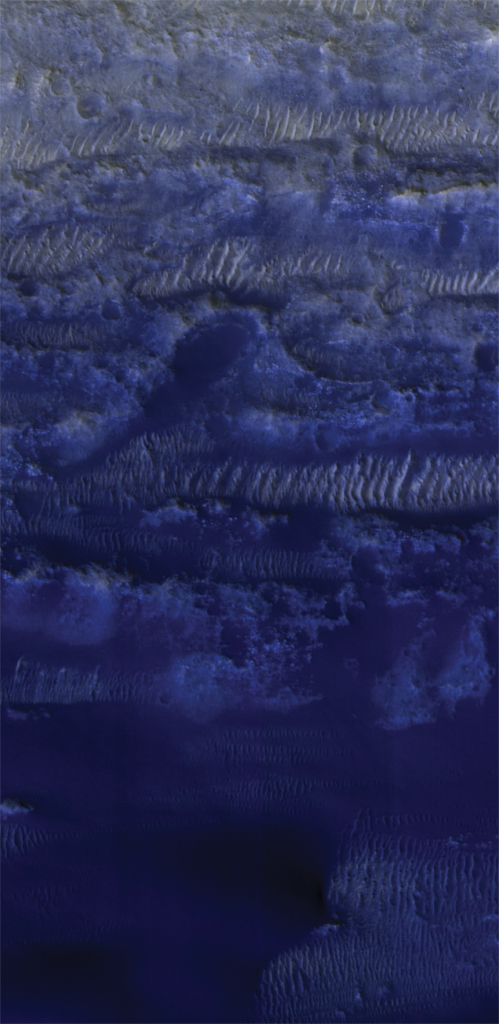
In another image, NASA’s Mars Reconnaissance Orbiter has shown bright ripples,lining the topography in this region, formed within a past climate. Dark dunes and sand streaks of basaltic sand have moved and filled lower areas, pushed by more recent winds from the top towards the bottom of this image. Lobo Vallis is named for a river on the Ivory Coast.

(NASA)

The map is projected here at a scale of 50 centimeters (19.7 inches) per pixel. [The original image scale is 57.7 centimeters (22.6 inches) per pixel (with 2 x 2 binning); objects on the order of 173 centimeters (68.1 inches) across are resolved.] North is up.

Mars Reconnaissance Orbiter (MRO) is a multipurpose spacecraft that is conducting reconnaissance and exploration of Mars from orbit since March 2006, to join five other Mars missions — Mars Global Surveyor, Mars Express, 2001 Mars Odyssey, and the two Mars Exploration Rovers (Spirit and Opportunity) — sent earlier to survey the surface of the Mars.

MRO’s telecommunications system has transferred more data back to Earth than all previous interplanetary missions combined, and it serves as a highly capable relay satellite for future missions, with a lifespan to last for two more decades.

The University of Arizona, Tucson, operates HiRISE and NASA’s Jet Propulsion Laboratory (JPL) manages the Mars Reconnaissance Orbiter Project for NASA’s Science Mission Directorate, Washington.