Artemis II Update-6, Day 2 : Crew, houston poll ‘Go’ for Translunar injection burn, crew prepares for Moon flight

NASA approved the translunar injection burn for Artemis II on April 2, clearing the Orion spacecraft to leave Earth orbit at 7:49 p.m. EDT. The burn will send astronauts Reid Wiseman, Victor Glover, Christina Koch, and Jeremy Hansen toward the Moon for the first time since 1972. The decision follows a mission management review confirming spacecraft readiness and system performance.

The call came from Houston after a day of checks and calculations. The answer was simple. Go.

With that, NASA cleared Artemis II to attempt the maneuver that will send its crew beyond Earth orbit. If executed as planned, the burn will place humans on a path toward the Moon for the first time in more than five decades.

The mission marks a major step for the National Aeronautics and Space Administration and its Artemis program, which aims to return astronauts to deep space operations.

Translunar injection burn timing and Orion engine performance

The translunar injection burn is scheduled to begin at 7:49 p.m. Eastern Time. Orion’s main engine will fire for five minutes and 49 seconds, providing the acceleration needed to break free from Earth’s orbit.

The engine, located on the spacecraft’s service module, produces up to 6,000 pounds of thrust. NASA compares that output to accelerating a car from zero to 60 miles per hour in about 2.7 seconds.

The burn must be executed with precise timing and orientation. Even minor deviations can alter the spacecraft’s path over the hundreds of thousands of miles between Earth and the Moon.

Flight controllers will track engine performance, guidance systems, and navigation data in real time to ensure Orion remains aligned with its intended trajectory.


NASA flight directors Rick Henfling (right) and Judd Frieling (left) sit on console in Mission Control’s White Flight Control room during NASA’s Artemis II mission launch on Wednesday, April 1, 2026.
ROBERT MARKOWITZ NASA-JSC

Crew activities and first full day operations in space

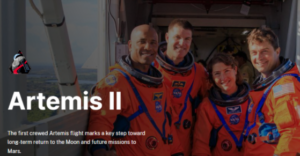
Earlier in the day, the Artemis II crew began their first full schedule of in-space operations. NASA astronauts Reid Wiseman, Victor Glover, and Christina Koch were joined by Jeremy Hansen of the Canadian Space Agency.

Mission control woke the crew at 2:35 p.m. Eastern Time with the song “Green Light” by John Legend and Andre 3000, continuing a long-standing NASA tradition of musical wake-up calls.

The astronauts moved into preparations for the burn, reviewing procedures and monitoring spacecraft systems. They also conducted their first exercise session using Orion’s flywheel-based device, designed to help maintain muscle and bone health in microgravity.

Exercise equipment is a standard feature for crewed missions, particularly those that extend beyond low Earth orbit. Maintaining physical conditioning becomes critical as mission duration increases.

The hours leading up to the burn are structured around system checks, communication with ground teams, and final readiness confirmations.

The Artemis II mission is designed as a test flight. Yet the stakes of this maneuver are clear. Once the engine fires, the crew will begin a journey that carries them away from Earth and toward the Moon, retracing a path last taken during the Apollo era.

Also Read:

Artemis II Update-5: perigee raise burn complete, translunar injection burn next

Artemis II Update-4: Crew completes proximity test, perigee raise burn up next

Artemis II Update-5: Perigee raise burn complete, translunar injection burn next

NASA confirmed the Artemis II crew completed the perigee raise burn on April 2, firing Orion’s engine for 43 seconds to refine its orbit around Earth. The maneuver placed the spacecraft into a stable high Earth orbit ahead of a planned translunar injection later the same day. Mission managers will review system performance before approving the burn that would send astronauts toward the Moon for the first time since 1972.

The Artemis II crew woke to music and a tightly timed task. Minutes later, they were watching their spacecraft reshape its path around Earth.

Inside Orion, the capsule named Integrity, astronauts monitored systems as the engine fired for just over 40 seconds. The burn was brief. Its impact on the mission trajectory was not.

The maneuver marked another step in a sequence designed by the National Aeronautics and Space Administration to prepare astronauts for a return to deep space operations.

Perigee raise burn details and Orion orbit adjustment

The perigee raise burn began after a scheduled wake-up at 7:06 a.m. Eastern Time, when mission control in Houston signaled the crew with the song “Sleepyhead” by Young and Sick.

Shortly after, Orion’s service module main engine ignited. It burned for 43 seconds, increasing the spacecraft’s perigee, the lowest point in its orbit around Earth.

This adjustment refined Orion’s trajectory, placing it into a stable high Earth orbit. The new orbit aligns with the spacecraft’s planned path for departure toward the Moon.

Engineers design these burns to test propulsion precision under real mission conditions. Small timing or thrust variations can significantly alter a spacecraft’s trajectory over long distances.

Following the maneuver, astronauts returned to a rest cycle lasting about four and a half hours, part of a schedule structured to balance workload and recovery during the mission’s early phase.

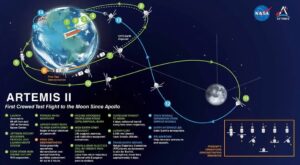
Trajectory for Artemis II, NASA’s first flight with crew aboard SLS, Orion to pave the way for long-term return to the Moon, missions to Mars

Translunar injection burn timing and mission approval process

Attention now shifts to the next and more consequential maneuver, the translunar injection burn.

Mission management teams are scheduled to meet later in the day to assess spacecraft health, propulsion data, and navigation accuracy. Their approval is required before proceeding.

If cleared, the translunar injection burn is set for 7:49 p.m. Eastern Time. The maneuver will last five minutes and 49 seconds and is expected to increase Orion’s velocity by 1,274 feet per second.

That acceleration would push the spacecraft out of Earth orbit and onto a trajectory toward the Moon. It would mark the first time humans leave low Earth orbit since the Apollo era, which concluded with the final Moon mission in 1972.

Flight controllers will monitor engine performance and guidance systems throughout the burn. Navigation data must remain within tight tolerances to ensure Orion stays aligned with its intended path.

The Artemis II mission is designed as a test flight, but each milestone carries operational weight. With the perigee burn complete, the next decision point will determine whether the crew begins its journey beyond Earth orbit.

Also Read:

Artemis II Update-4: Crew completes proximity test, perigee raise burn up next
Artemis II Update-3: Apogee Raise burn complete, Crew prepares critical Proximity Test

Artemis II Crew and Ground Teams Successfully Troubleshoot Orion’s Toilet Glitch

NASA confirmed the Artemis II crew resolved a toilet system fault aboard the Orion spacecraft on April 2 while in Earth orbit. The issue, first detected as a blinking fault light on April 1, was addressed through coordinated troubleshooting with mission control in Houston. The fix comes ahead of a scheduled perigee raise burn, a maneuver that will adjust Orion’s orbit for future deep space operations.

A minor but essential system aboard NASA’s Artemis II spacecraft briefly drew attention this week. It was not propulsion or navigation. It was the toilet.

Astronauts aboard Orion, the capsule named Integrity, reported a blinking fault light tied to the waste management system on April 1. Within hours, engineers on the ground and the crew in orbit worked through the problem together. By the next mission update, the system was back to normal operation.

The episode highlights how even routine spacecraft functions demand precision during crewed missions led by the National Aeronautics and Space Administration.

Orion spacecraft toilet issue and in-flight troubleshooting

The issue first surfaced ahead of a planned apogee raise burn, when the crew noticed a blinking fault indicator linked to Orion’s toilet system. Such warning signals are designed to flag irregularities early, even when the system continues functioning.

NASA’s mission control team at the Johnson Space Center in Houston began reviewing telemetry immediately. Engineers assessed system data while communicating directly with the astronauts to isolate the cause.

The troubleshooting process involved both software diagnostics and procedural checks inside the spacecraft. The agency did not report any hardware damage or safety risk tied to the issue.

By April 2, NASA confirmed that normal functionality had been restored. The resolution ensured that one of the spacecraft’s life-support subsystems remained fully operational as the mission continued.

Waste management systems in microgravity rely on airflow, pressure control, and precise mechanical components. Even minor anomalies require immediate attention, as they can affect crew comfort and long-duration mission readiness.

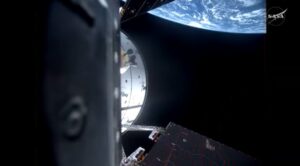
A view of the Earth’s horizon from NASA’s Orion spacecraft as it orbits above the planet during the first hours of the Artemis II test flight. NASA astronauts Commander Reid Wiseman, Pilot Victor Glover, and Mission Specialist Christina Koch, and CSA (Canadian Space Agency) astronaut Mission Specialist Jeremy Hansen, launched at 6:35 p.m. EDT on Wednesday, April 1, 2026, on an approximately 10-day mission around the Moon and back to Earth.
NASA 

Perigee raise burn timing and mission trajectory planning

With the issue resolved, the Artemis II crew is preparing for the next major step in the mission timeline. The perigee raise burn is scheduled after a planned rest period.

Perigee refers to the lowest point of a spacecraft’s orbit around Earth. Raising it changes the orbital shape, making it more stable and better suited for future maneuvers.

This burn follows an earlier apogee raise maneuver, which increased Orion’s highest orbital point. Together, the two burns define the spacecraft’s initial orbit and test its propulsion system under operational conditions.

NASA scheduled a four-hour rest period for the crew before the maneuver. Astronauts are set to wake at 7 a.m. Eastern Time on April 2 to begin preparations. After completing post-burn procedures, they will return to a second sleep cycle later in the morning.

The sequence reflects the structured rhythm of human spaceflight, where operational tasks alternate with carefully timed rest to maintain performance.

The Artemis II mission continues to build toward its broader objective: validating systems for future missions that will carry astronauts beyond Earth orbit and toward the Moon.

Also Read:

Artemis II Mission Launch: NASA Sends Crew on First Moon Flyby in 50 Years

Artemis II Update-1: Orion Completes Proximity Operations, Perigee Burn Next

Artemis II Update-4: Crew completes proximity test, perigee raise burn up next

NASA’s Artemis II crew completed a proximity operations test on April 2, maneuvering the Orion spacecraft near a detached rocket stage in Earth orbit. The demonstration, lasting about 70 minutes, tested manual control systems and gathered data critical for future lunar missions. The crew now prepares for a perigee raise burn, while engineers continue troubleshooting a minor onboard toilet system issue.

The astronauts aboard NASA’s Artemis II mission spent part of April 2 guiding their spacecraft through a tightly choreographed exercise hundreds of miles above Earth.

Inside Orion, the capsule named Integrity, the crew manually steered within close range of a discarded rocket stage, testing how precisely humans can control the spacecraft in space. The task lasted just over an hour. It marked one of the first hands-on demonstrations of Orion’s maneuverability under crew control.

The exercise is part of a broader effort by the National Aeronautics and Space Administration (NASA) to validate systems before sending astronauts farther into deep space, including eventual missions to the Moon under the Artemis program.

The proximity operations demonstration centered on Orion’s ability to approach and move away from another object in orbit. For this test, the crew used the detached interim cryogenic propulsion stage, or ICPS, as a reference target.

The ICPS, a temporary upper stage used during launch, had already separated from the spacecraft. It remained nearby long enough for the astronauts to conduct controlled approach and retreat maneuvers.

During the roughly 70-minute session, the crew adjusted Orion’s position repeatedly, testing navigation, thruster response, and onboard guidance systems. These maneuvers simulate conditions required for future missions that may involve docking or operating near other spacecraft.

At the end of the exercise, Orion executed an automated departure burn, increasing its distance from the ICPS. The stage is scheduled to perform a disposal burn, sending it into Earth’s atmosphere over a remote Pacific region, according to NASA mission updates.

The demonstration provides engineers with real-time data on how Orion performs under manual control, a capability considered essential for complex operations during lunar missions.

Alongside the crewed mission, four small satellites known as CubeSats launched as secondary payloads aboard the Space Launch System (SLS).

CubeSats are compact, shoebox-sized spacecraft designed for targeted scientific experiments. They will deploy after the Orion stage adapter separates from the main spacecraft.

Each satellite carries a distinct research objective:

  • ATENEA, developed by Argentina’s national space agency, focuses on radiation shielding and communication systems in high Earth orbit.
  • Space Weather CubeSat-1, built by the Saudi Space Agency, will measure solar radiation, X-rays, and magnetic field activity.
  • TACHELES, from the German Aerospace Center, is testing electrical systems for future lunar logistics vehicles.
  • K-Rad Cube, developed by the Korea AeroSpace Administration, will study radiation effects across the Van Allen belts, regions of charged particles surrounding Earth.

The CubeSat deployments expand the mission’s scientific output, offering data on space weather and radiation environments that astronauts may encounter during longer missions.

Trajectory for Artemis II, NASA’s first flight with crew aboard SLS, Orion to pave the way for long-term return to the Moon, missions to Mars

Perigee raise burn planned as engineers monitor onboard issue

Attention now shifts to the next key maneuver, the perigee raise burn, scheduled after the crew’s rest period.

Perigee refers to the lowest point in a spacecraft’s orbit around Earth. Raising it adjusts the shape of the orbit and prepares Orion for later phases of the mission, including potential translunar trajectories.

The maneuver follows an earlier apogee raise burn, which increased the spacecraft’s highest orbital point. Together, these burns define Orion’s initial orbital path and test propulsion performance under operational conditions.

Before the next burn, the crew completed routine spacecraft checks. During a systems review, they reported a blinking fault light in the onboard toilet system.

NASA ground teams are analyzing the data and working with the crew to diagnose the issue. No broader system impacts have been reported in official updates.

After a scheduled four-hour rest period, the astronauts are set to wake at 7 a.m. Eastern Time on April 2 to prepare for the maneuver. The timeline includes post-burn activities followed by another sleep cycle later in the morning.

The sequence of tests, adjustments, and troubleshooting reflects the mission’s dual purpose: demonstrating Orion’s readiness for deep space while gathering operational data from a live crewed environment.

Also Read:

Artemis II Mission Launch: NASA Sends Crew on First Moon Flyby in 50 Years

Artemis II Update-2 : Perigee Raise Burn Completed with brief Communications Loss, NASA Probes

Artemis II Update-3: Apogee Raise burn complete, Crew prepares critical Proximity Test

Artemis II Update-3: Apogee Raise burn complete, Crew prepares critical Proximity Test

NASA confirmed the Artemis II crew completed the apogee raise burn on April 2, increasing Orion’s orbital high point. The mission now transitions toward a proximity operations demonstration that will test manual spacecraft control near another object. Engineers continue to monitor a minor onboard system issue as the crew prepares for the next phase.


Artemis II Update-2 : Perigee Raise Burn Completed with brief Communications Loss, NASA Probes

NASA confirmed the Artemis II crew completed a perigee raise maneuver on April 2, refining Orion’s orbit around Earth. A brief communications loss occurred shortly after the burn but was quickly resolved with no reported impact on crew safety. The agency will hold a press conference from Kennedy Space Center as the mission prepares for its next orbital milestone.


Artemis II Update-1: Orion Completes Proximity Operations, Perigee Burn Next

Astronauts aboard NASA’s Artemis II mission completed a key proximity operations test on April 2 while orbiting Earth. The maneuver involved controlled movements around a detached rocket stage to evaluate spacecraft handling. With CubeSat deployments ahead and a minor onboard system issue under review, the crew is now preparing for a perigee raise burn to refine Orion’s orbit.


Artemis II Mission Launch: NASA Sends Crew on First Moon Flyby in 50 Years

The National Aeronautics and Space Administration launched four astronauts on April 2 from Kennedy Space Center in Florida aboard the Artemis II mission. The crew is set for a 10-day test flight around the Moon, marking the first human lunar flyby since the Apollo era. The mission aims to validate spacecraft systems and pave the way for future Moon landings and Mars exploration.


NASA’s Artemis II Rocket Reaches Launch Pad 39B, Final Countdown Begins

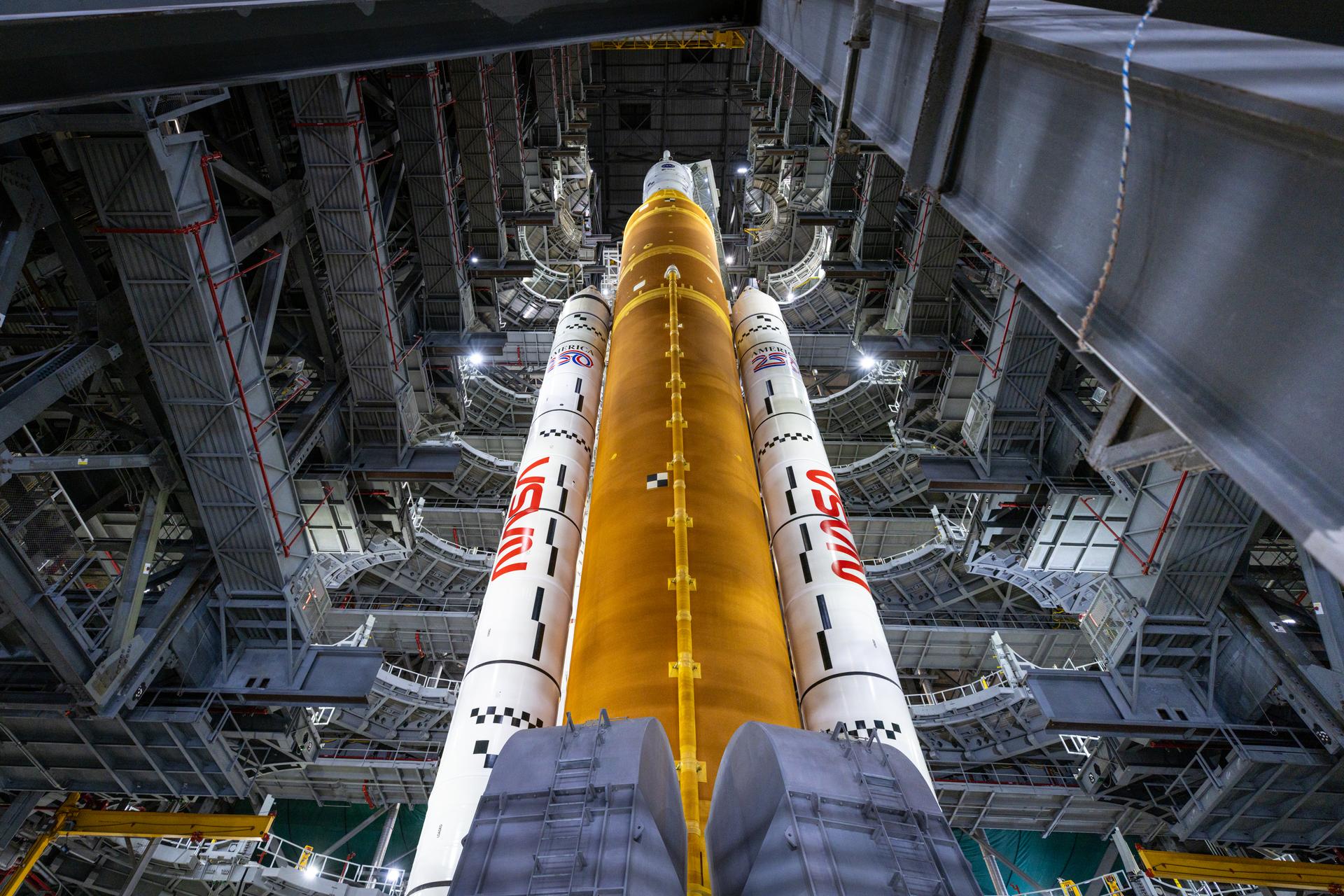
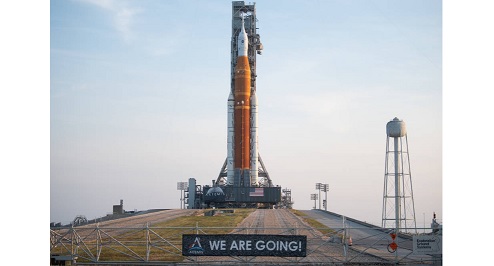
Cape Canaveral, March 22, 2026: NASA’s Artemis II mission has reached a critical milestone, with the Space Launch System (SLS) rocket and Orion spacecraft now standing at Launch Pad 39B at the agency’s Kennedy Space Center in Florida, setting the stage for the first crewed lunar mission in more than five decades.

The towering 322-foot-tall Moon rocket arrived at the pad at 11:21 a.m. EDT on Friday, March 20, completing an 11-hour journey from the Vehicle Assembly Building. The slow and steady trek began at 12:20 a.m. EDT, as NASA’s crawler-transporter 2 carried the integrated SLS and Orion, secured atop the mobile launcher, along the 4-mile path at a maximum speed of just 0.82 mph.

With the rocket now in place at Pad 39B, the historic launch site of Apollo missions and numerous space shuttle flights, NASA teams are entering the final phase of prelaunch preparations. The mission is targeting liftoff as soon as Wednesday, April 1, with the early April launch window extending through Monday, April 6.

Artemis II will mark the first crewed test flight of the SLS rocket and Orion spacecraft, carrying a four-member astronaut team on a 10-day journey around the Moon and back. The crew includes NASA astronauts Reid Wiseman as Commander, Victor Glover as Pilot, and Christina Koch as Mission Specialist, alongside Canadian Space Agency (CSA) astronaut Jeremy Hansen as Mission Specialist.

The mission represents a pivotal step in what NASA describes as a “Golden Age of innovation and exploration.” Artemis II will pave the way for subsequent U.S.-crewed missions to the lunar surface, with the goal of establishing a sustained presence on the Moon that will ultimately enable the agency to prepare for human exploration of Mars.

As the world watches, the final countdown has begun for humanity’s return to deep space.

Also Read:

NASA to stream launch and docking of ‘Progress 94 cargo spacecraft’ to ISS

Huge Craters On an Asteroid Psyche Could Provide Clues to Early Planets


NASA to live coverage Artemis I mission Demonstration Test, Host Media Call [Live schedule, streaming website details]

NASA will provide live coverage with commentary of the upcoming Artemis I cryogenic demonstration test beginning at 7:15 a.m. EDT on Wednesday, Sept. 21.

The demonstration test will allow teams to confirm the repair to a hydrogen leak seen during an early September Artemis I launch attempt, evaluate updated propellant loading procedures, and conduct additional evaluations. The demonstration will conclude when the objectives for the test have been met.+

Live coverage of the test will air on NASA Television, the NASA app, and the agency’s website. While NASA is airing coverage of the launch, rendezvous, docking, and hatch opening of the Soyuz MS-22 carrying NASA Astronaut Frank Rubio to the International Space Station on NASA’s Television’s Public Channel, the Artemis I demonstration test will air only on the Media Channel. During all other times, the test will air on both the Public and Media Channels.

NASA’s Space Launch System (SLS) rocket with the Orion spacecraft aboard is seen atop a mobile launcher at Launch Pad 39B as preparations for launch continue, Sunday, Aug. 28, 2022, at NASA’s Kennedy Space Center in Florida. NASA’s Artemis I flight test is the first integrated test of the agency’s deep space exploration systems: the Orion spacecraft, SLS rocket, and supporting ground systems. Launch of the uncrewed flight test is targeted for no earlier than Aug. 29 at 8:33 a.m. ET. Photo Credit: (NASA/Joel Kowsky)

The agency also will host a media teleconference to preview the test at 11:30 a.m. Monday, Sept. 19. Participants include:

  • Tom Whitmeyer, deputy associate administrator for Common Exploration Systems Development, NASA Headquarters
  • Mike Sarafin, Artemis mission manager, NASA Headquarters
  • Jeremy Parsons, deputy manager, Exploration Ground Systems Program, NASA’s Kennedy Space Center
  • John Blevins, chief engineer, Space Launch System Program, NASA’s Marshall Space Flight Center

Audio of the media call will stream live on the agency’s website at:

https://www.nasa.gov/live

To participate by telephone, media must RSVP no later than two hours prior to the start of the event to: ksc-newsroom@mail.nasa.gov.

Artemis I is an uncrewed flight test. It is the first in a series of increasingly complex missions to provide a foundation for human exploration in deep space and demonstrate our commitment and capability to extend human existence to the Moon and beyond.

Through Artemis missions, NASA will land the first woman and the first person of color on the Moon, paving the way for a long-term lunar presence and serving as a steppingstone to send astronauts to Mars.

For updates, follow along on NASA’s Artemis blog at:

https://blogs.nasa.gov/artemis

NASA hopes to Launch Artemis I Moon Mission on Sept 3

NASA will target Saturday, Sept. 3 at 2:17 p.m. EDT, the beginning of a two-hour window, for the launch of Artemis I, the first integrated test of NASA’s Orion spacecraft, Space Launch System (SLS) rocket, and the ground systems at the agency’s Kennedy Space Center in Florida.

Mission managers met Tuesday to discuss data and develop a forward plan to address issues that arose during an Aug. 29 launch attempt for the flight test. During that launch attempt, teams were not able to chill down the four RS-25 engines to approximately minus 420 degrees F, with engine 3 showing higher temperatures than the other engines. Teams also saw a hydrogen leak on a component of the tail service mast umbilical quick disconnect, called the purge can, and managed the leak by manually adjusting propellant flow rates.

Artemis I launch on Aug 27, 2022 / NASA

In the coming days, teams will modify and practice propellant loading procedures to follow a procedure similar to what was successfully performed during the Green Run at NASA’s Stennis Space Center in Mississippi. The updated procedures would perform the chilldown test of the engines, also called the kick start bleed test, about 30 to 45 minutes earlier in the countdown during the liquid hydrogen fast fill liquid phase for the core stage.

Teams also are configuring platforms at Launch Pad 39B to enable engineers access to the purge can on the tail service mast umbilical. Once access is established, technicians will perform assessments and torque connection points where necessary.

Meteorologists with the U.S. Space Force Space Launch Delta 45 predict favorable weather conditions for Saturday. While rain showers are expected, they are predicted to be sporadic during the launch window.

The mission management team will reconvene Thursday to review data and overall readiness.

Team Indus Pitches for $40 Mln Funding to Emerge as India’s Equivalent of SpaceX

Team Indus, the only Indian team competing for the Google Lunar XPRIZE, wants to go beyond the challenge and emerge as India’s equivalent of SpaceX, US private space company, with an eye on additional fund-raising to the tune of $40 million in the next round.

With its lunar rover mission launch set for December aboard ISRO’s PSLV rocket, Team Indus wants to expand its operational capabilities in launching and managing communication satellites.

The $30M Google Lunar XPRIZE challenge is a global competition to inspire engineers and entrepreneurs to develop low-cost methods of robotic space exploration by a privately funded team. The team must successfully place a robot on the Moon that explores at least 500 meters and transmits high-definition video and images back to Earth.

Team Indus has already raised $20 million in its first round from the country’s top investors such as Ratan Tata, Nandan Nilekani, Sachin Bansal, Binny Bansal, Subrata Mitra and Shekhar Kirani. The next round of funding will be utilized for expansion of its North Bangalore facility to undertake more space launches, said Team Indus founder Rahul Narayan.

The upcoming mission will carry its rover and 11 other payloads from Japan, France and UAE in the moon-laning mission. The spacecraft is under development at National Aerospace Laboratories (NAL) and the final assembly will be done at the Team Indus facility in North Bengaluru.

Elaborating on their moon landing mission, Narayan told TOI: “ISRO’s Chandrayaan 1 was an orbital mission, while our spacecraft has to land on the Moon.” The flight testing of the spacecraft and payloads will be done at ISRO’s facility, before the final launch, he said.

Since ISRO is planning to employ a private launch vehicle by 2020, Team Indus sees imense potential and emerge as the country’s top private spacecraft manufacturer. “We see ourselves augmenting ISRO’s capacities, not capabilities,” Narayan said.

Team Indus is among the five teams to have been awarded a combined $5.25 million in recognition of “key technological advancements toward their quest to land a private spacecraft on the surface of the moon,” said the Xprize Foundation. The successful landing will get the team the final prize amount of $15 million.

Peter Diamandis, Lunar XPRIZE founder, while announcing the prize, said:”It has been many decades since we explored the Moon from the lunar surface, and it could be another 6–8 years before any government returns. Even then, it will be at a large expense, and probably with little public involvement.”

While the ideas initially mooted by Peter Diamandis, NASA was facing budget constraints, he approached Google founders Larry Page and Sergey Brin, at an X Prize Foundation fundraiser and they agreed to sponsor it, and raise the amount of the prize money to $30 million, including a second prize, besides some bonus prizes. However, it was brought down to $15 million later.