Sudden escalation of trade tensions sends shockwaves through global economy

Tariff-driven price pressures are adding to inflation risks, leaving trade-dependent economies particularly vulnerable.

Higher tariffs and shifting trade policies are threatening to disrupt global supply chains, raise production costs, and delay key investment decisions – all of this weakening the prospects for global growth.

General slowdown

The economic slowdown is widespread, affecting both developed and developing economies around the world, according to the report.

In the United States, growth is projected to slow “significantly”, said DESA, as higher tariffs and policy uncertainty are expected to weigh on private investment and consumer spending.

Several major developing economies, including Brazil and Mexico, are also experiencing downward revisions in their growth forecasts.

China’s economy is expected to grow by 4.6 per cent this year, down from 5.0 per cent in 2024. This slowdown reflects a weakening in consumer confidence, disruptions in export-driven manufacturing, and ongoing challenges in the Chinese property sector.

Inflation risks

By early 2025, inflation had exceeded pre-pandemic averages in two-thirds of countries worldwide, with more than 20 developing economies experiencing double-digit inflation rates.

This comes despite global headline inflation easing between 2023 and 2024.

Food inflation remained especially high in Africa, and in South and Western Asia, averaging above six per cent. This continues to hit low-income households hardest.

Rising trade barriers and climate-related shocks are further driving up inflation, highlighting the urgent need for coordinated policies to stabilise prices and protect the most vulnerable populations.

Developing economies

The tariff shock risks hitting vulnerable developing countries hard,” said Li Junhua, UN Under-Secretary-General for Economic and Social Affairs.

As central banks try to balance the need to control inflation with efforts to support weakening economies, many governments – particularly in developing countries – have limited fiscal space. This makes it more difficult for them to respond effectively to the economic slowdown.

For many developing countries, this challenging economic outlook threatens efforts to create jobs, reduce poverty, and tackle inequality, the report underlines.

Francoise picks out vegetables to resell to the Congolese traders at the Elakat market in the DRC.


Source link

‘Politically unacceptable, morally repugnant’: UN chief calls for global ban on ‘killer robots’

“There is no place for lethal autonomous weapon systems in our world,” Mr. Guterres said on Monday, during an informal UN meeting in New York focused on the use and impact of such weapons.

“Machines that have the power and discretion to take human lives without human control should be prohibited by international law.”

The two-day meeting in New York brought together Member States, academic experts and civil society representatives to examine the humanitarian and human rights risks posed by these systems.

The goal: to lay the groundwork for a legally binding agreement to regulate and ban their use.

Human control is vital

While there is no internationally accepted definition of autonomous weapon systems, they broadly refer to weapons such as advanced drones which select targets and apply force without human instruction.

The Secretary-General said in his message to the meeting that any regulations and prohibitions must make people accountable. 

“Human control over the use of force is essential,” Mr. Guterres said. “We cannot delegate life-or-death decisions to machines.”

There are substantial concerns that autonomous weapon systems violate international humanitarian and human rights laws by removing human judgement from warfare.

The UN chief has called for Member States to set clear regulations and prohibitions on such systems by 2026.

Approaching a legally binding agreement

UN Member States have considered regulations for autonomous weapons systems since 2014 under the Convention on Certain Conventional Weapons (CCW) which deals with weapons that may violate humanitarian law.

Most recently, the Pact for the Future, adopted in September last year, included a call to avoid the weaponization and misuse of constantly evolving weapons technologies.

Stop Killer Robots – a coalition of approximately 270 civil society organizations – was one of the organizations speaking out during this week’s meeting. 

Executive Director Nicole van Rooijen told UN News that consensus was beginning to emerge around a few key issues, something which she said was a “huge improvement.”

Specifically, there is consensus on what is known as a “two-tiered” approach, meaning that there should be both prohibitions on certain types of autonomous weapon systems and regulations on others.

However, there are still other sticking points. For example, it remains unclear what precisely characterizes an autonomous weapon system and what it would look like to legislate “meaningful human control.”

Talks so far have been consultations only and “we are not yet negotiating,” Ms. Rooijen told UN News: “That is a problem.”

‘Time is running out’

The Secretary-General has repeatedly called for a ban on autonomous weapon systems, saying that the fate of humanity cannot be left to a “black box.”

Recently, however, there has been increased urgency around this issue, in part due to the quickly evolving nature of artificial intelligence, algorithms and, therefore, autonomous systems overall.

The cost of our inaction will be greater the longer we wait,” Ms. Rooijen told us.

Ms. Rooijen also noted that systems are becoming less expensive to develop, something which raises concerns about proliferation among both State and non-state actors.

The Secretary-General, in his comments Monday also underlined the “need for urgency” in establishing regulations around autonomous weapon systems.

“Time is running out to take preventative action,” Mr. Guterres said. 

Source link

In Berlin, broad backing for UN peacekeeping as global threats mount

UN Secretary-General António Guterres meanwhile warned that peace operations are under growing strain and must adapt to meet today’s rising threats.

The two-day conference on peacekeeping, hosted by the Government of Germany, brought together over 1,000 participants – including defence and foreign ministers – to reaffirm commitment to the UN’s flagship tool for maintaining peace and stability.

It concluded on Wednesday with a wide array of pledges, including 88 military and police units, specialized training, and investments in emerging technologies and strategic communications.

Difference between life and death

In trouble spots around the world, ‘blue helmets’ can mean the difference between life and death,” Mr. Guterres said in his opening remarks.

“Now more than ever, the world needs the United Nations. And the United Nations needs peacekeeping that is fully equipped for today’s realities and tomorrow’s challenges.”

Germany, which currently contributes troops to UN missions in South Sudan, Lebanon, and Western Sahara, announced €82 million (around $91.7 million) in funding, along with commitments in training, renewable energy solutions and drone technology.

“Germany continues to be a steadfast supporter of UN peacekeeping,” said Defense Minister Boris Pistorius.

Broad and diverse commitments

A total of 74 UN Member States made specific pledges, ranging from uniformed personnel to training and strategic support.

This includes pledges which will bolster military and police units, including airlift and rapid deployment capabilities (53 national contributions), specialized training (59), technological enhancements (18), advancing the Women, Peace and Security Agenda (38) and safety and protection (16).

Eleven countries also committed to improving accountability and conduct, including support to the trust fund for victims of sexual exploitation and abuse, and eight nations supporting the UN’s efforts to counter mis- and disinformation through strategic communications.

Deminers with the UN peacekeeping mission in Mali, MINUSMA, clearing an airstrip in Kidal region. (file photo)

Mounting pressures

At a press conference following the meeting, Secretary-General Guterres acknowledged that peacekeepers operate in an increasingly complex and dangerous environment, citing a record number of global conflicts, the targeting of peacekeepers by drones and improvised explosive devices (IEDs) and the rising threat from disinformation campaigns.

We need to ask some tough questions about the mandates guiding these operations, and what the outcomes and solutions should look like,” he said, speaking alongside German Foreign Minister Johann Wadephul and Defence Minister Pistorius.

Every context is different, and missions must be adapted accordingly.

The UN chief also stressed the importance of sustained financial backing, highlighting that many missions continue to struggle with cash flow shortages due to delayed payments from Member States.

“It is absolutely essential that all Member States respect their financial obligations, paying their contributions in full and on time,” he said.

Crucial reforms

The Berlin meeting feeds into the UN’s broader reform efforts, including an ongoing Review of Peace Operations announced in last year’s Pact for the Future, aimed at making peacekeeping and peace enforcement more flexible, cost-effective, and aligned with real-world needs.

This year’s Ministerial also coincides with the 80th anniversary of the United Nations and the 10-year anniversary of the 2015 New York Summit on Peacekeeping. It follows similar high-level meetings in Accra, Seoul, Vancouver and London.

Peacekeeping remains one of the UN’s most visible activities, with over 61,000 uniformed personnel from 119 countries currently deployed across 11 missions, supported by more than 7,000 civilian staff.

Source link

UN warns copper shortage risks slowing global energy and technology shift

In its latest Global Trade Update, released this week, UNCTAD describes copper as “the new strategic raw material” at the heart of the rapidly electrifying and digitising global economy.  

But with demand set to rise more than 40 per cent by 2040, copper supply is under severe strain – posing a critical bottleneck for technologies ranging from electric vehicles and solar panels to AI infrastructure and smart grids.

More than just metal

Copper is no longer just a commodity,” said Luz María de la Mora, Director of the International Trade and Commodities Division at UNCTAD.

Valued for its high conductivity and durability, copper is essential to power systems and clean energy technologies. It runs through homes, cars, data centres and renewable infrastructure.

Yet developing new mines is a slow and expensive process, and fraught with environmental risks – often taking up to 25 years from discovery to operation.

Meeting projected demand by 2030 could require $250 billion in investment and at least 80 new mining projects, according to UNCTAD estimates.

The Democratic Republic of the Congo holds some of the world’s largest copper reserves, yet most of the metal is exported, limiting the country’s ability to benefit fully from this valuable resource.

Uneven geography, unequal gains

Over half of the world’s known copper reserves are concentrated in just five countries – Chile, Australia, Peru, the Democratic Republic of the Congo and Russia.

However, much of the value-added production occurs elsewhere, particularly in China, which now imports 60 per cent of global copper ore and produces over 45 per cent of the world’s refined copper, says the UN.

This imbalance leaves many developing countries stuck at the bottom of the value chain, unable to fully benefit from their resources.

“Digging and shipping copper is not enough,” the report states.

To move up the ladder, copper-rich developing countries must invest in refining, processing and manufacturing – this means strengthening infrastructure and skills, establishing industrial parks, offering tax incentives and pursuing trade policies that support higher-value production.”

Tariff and trade barriers

UNCTAD also highlights the challenge of tariff escalation, where duties on refined copper are relatively low – typically below two per cent – but can rise to as high as eight per cent for finished products like wires, tubes and pipes.

These trade barriers discourage investment in higher-value industries and lock countries into roles as raw material suppliers, the report warns.

To address this, UNCTAD is urging governments to streamline permitting, reduce trade restrictions, and develop regional value chains to help developing economies climb the industrial ladder.

Scrappy solution

With new mining projects facing long lead times, recycling is emerging as a vital part of the solution.

In 2023, secondary sources accounted for 4.5 million tonnes – nearly 20 per cent of global refined copper output. The United States, Germany and Japan are the top exporters of copper scrap, while China, Canada and the Republic of Korea are major importers.

“For developing countries, copper scrap could be a strategic asset,” UNCTAD notes.

“Investing in recycling and processing capacity can reduce import dependence, support value-added trade and advance a more circular, sustainable economy.”

Test case for critical materials

Copper, UNCTAD says, is a likely “test case” for how global trade systems handle rising demand for critical materials amid growing pressures.

“The age of copper has arrived…but without coordinated trade and industrial strategies, supply will remain under strain and many developing countries risk missing out,” the report concludes.

Source link

Guterres welcomes election of Pope Leo ‘at a time of great global challenges’

His Holiness Pope Leo XIV – born Robert Francis Prevost – is the first person from the United States to lead the Catholic Church, although he also holds Peruvian citizenship after working in the Latin American country for many years.

He was selected by cardinals voting at the Vatican and later greeted thousands gathered in St. Peter’s Square with a message of peace.

Strong voices needed

Mr. Guterres extended heartfelt congratulations to the new pontiff and Roman Catholics everywhere. 

 “The election of a new Pope is a moment of profound spiritual significance for millions of faithful around the world, and it comes at a time of great global challenges,” he said.

 “Our world is in need of the strongest voices for peace, social justice, human dignity and compassion.”

Building on the legacy

 The Secretary-General said he looks forward to building on the long legacy of cooperation between the UN and the Holy See – nurtured most recently by the late Pope Francis – to advance solidarity, foster reconciliation, and build a just and sustainable world for all.

 “It is rooted in the first words of Pope Leo,” he noted.  “Despite the rich diversity of backgrounds and beliefs, people everywhere share a common goal: May peace be with all the world.”

© FAO/Giuseppe Carotenuto

António Guterres, UN Secretary-General (fourth from right) greets an official in front of St. Peter’s Basilica at the funeral of Pope Francis.

Pope Leo, 69, was born and grew up in the midwestern city of Chicago and spent years working as a missionary in Peru, before becoming a bishop and then rising to head the international Order of St. Augustine.

He became a cardinal in 2023 and went on to run the Vatican office that selects and manages Catholic bishops worldwide. 

He succeeds Pope Francis – the first Pope from Latin America – who died in April after serving for 12 years.

Following his death, the UN Secretary-General recalled that “Pope Francis was a transcendent voice for peace, human dignity and social justice” who “leaves behind a legacy of faith, service and compassion for all — especially those left on the margins of life or trapped by the horrors of conflict.” 

Source link

WHO chief laments most disruptive cuts to global health funding ‘in living memory’

We are living through the greatest disruption to global health financing in memory,” said WHO Director-General Dr Tedros Adhanom Ghebreyesus.

He cautioned that abrupt withdrawals of funding are jeopardising hard-won medical progress, including efforts to combat tropical diseases, which are now re-emerging in some regions.

This is just the tip of the iceberg,” he told journalists at WHO headquarters in Geneva.

Outbreaks intensify

Since January, Angola has been facing its worst cholera outbreaks in 20 years, with over 17,000 cases and more than 550 deaths recorded so far. 

Inadequate access to safe water, hygiene and sanitation is fuelling the outbreak. 

As WHO and partners carry out a large-scale vaccination campaign on the ground, one of their priorities is to bring the death rate down, said Tedros. 

Amid funding cuts, advances in tackling neglected tropical diseases affecting over one billion people, are disproportionately impacting the poorest and most marginalized communities.

Reduced access

In many countries where insecurity is rife and hospitals are being targeted, access to healthcare has been severely reduced, Tedros continued. 

On April 22, one of Haiti’s largest public hospitals, Hôpital Universitaire de Mirebalais, was forced to shut down due to violence. In the capital Port-au-Prince, more than 40 per cent of health facilities remain closed, he said.  

Needless deaths

Turning to the Gaza blockade, he said the situation there was “catastrophically bad,” with the violence “driving an influx of casualties to a health system that is already on its knees.” 

While essential medicines, and trauma and medical supplies, are running out, “people are dying from preventable diseases while medicines wait at the border,” said Tedros. 

Reiterating the UN’s call for a ceasefire, Tedros added that “peace is the best medicine.” 

Source link

Stuck in the middle? Indebted nations plot path to growth amid global trade upheaval

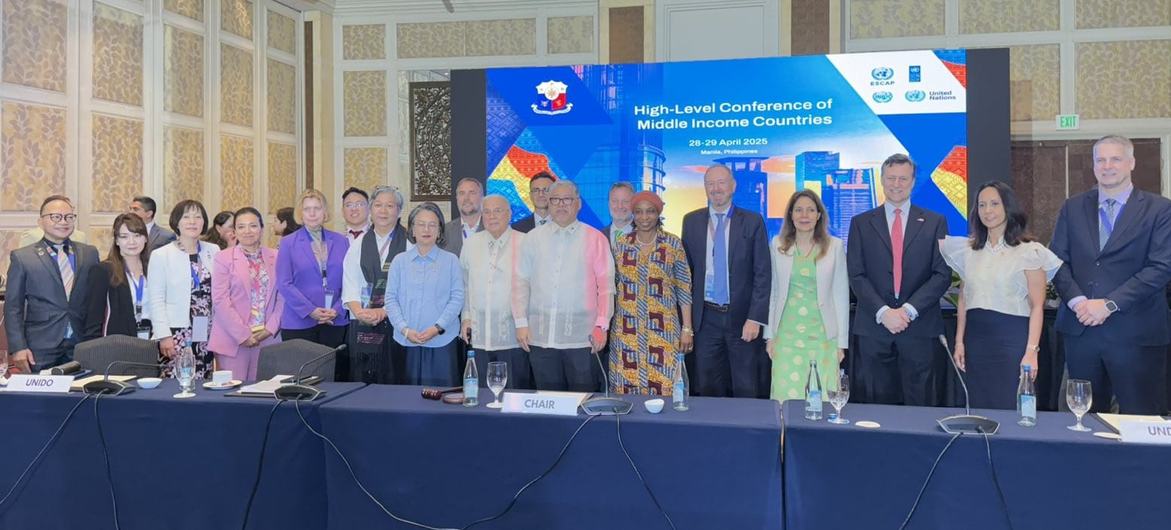
The High-Level Conference of Middle-Income Countries (MICs), held on 28 and 29 April, was attended by senior representatives from 24 MICs, many of which are highly indebted, leaving them little room for spending on developing their economies.

Since 2000, only 27 countries transitioned from middle income to high-income status, and many have experienced reversals back to middle-income level: 11 nations switched back and forth at least once before reaching their current high-income status.

“The transition of middle-income countries to high-income status while meeting sustainable development ambitions calls for the bolstering of financing for development,” said Armida Salsiah Alisjahbana, Executive Secretary of the UN Economic and Social Commission for Asia and the Pacific (ESCAP) at the opening of the event. “This calls for domestic policy reforms aimed at expanding fiscal space, maintaining debt sustainability and channeling resources towards productive investments.”

The Makati Declaration on Middle-Income Countries calls for the UN to support MICs in accessing development financing, including via innovative financing mechanisms, and to provide support in a number of areas, ranging from programs and initiatives to mitigate and adapt to the climate crisis to digital transformation and making countries more resilient to global shocks (see full list of measures below).

Delegates at the High-Level Conference of Middle-Income Countries (April 2025)

“We recognize that middle-income countries experience frequent growth slowdowns, and if left unaddressed, this loss of economic dynamism can cause countries to get stuck in what is referred to as the “middle-income trap,” the Declaration states. “We stress that middle-income countries continue to face specific challenges related to, inter alia, high levels of inequalities, low growth, persistent poverty, unemployment, loss of biodiversity, the adverse effects of disaster risks and climate change, reliance on primary commodity exports, high levels of external debt and the volatility of exchange rates and capital flows, and digital divide.”

MICs will strengthen cooperation among themselves and offer increasing resources under technical cooperation between countries in the global South, which could become particularly important given the recent reduction in development support from traditional donors of the global North.

“We are re-moulding traditional development partnerships as more MICs, including the Philippines, increase resources for South-South and technical cooperation,” said Enrique Manalo, Secretary for Foreign Affairs of the Philippines at the event. “This is a trend that, if scaled up, could potentially result in game-changing dividends for the global development system.”

The Like-Minded Group of MICs are “as champions of multilateralism,” he added. “Carving a steady path for all middle-income countries behooves us to support strongly an international rules-based order underpinned by equity and justice.”

Source link

UN warns of $4 trillion shortfall threatening global development goals

Speaking at UN Headquarters in New York, Secretary-General António Guterres, General Assembly President Philémon Yang and Economic and Social Council President Bob Rae stressed the need for more resources and a global financial overhaul.

Without an effective response, they stressed, the world risks falling even further behind on ending poverty, fighting climate change, and building new sustainable economies.

They were addressing the ECOSOC annual forum on financing for development, which follows last week’s World Bank and International Monetary Fund (IMF) Spring Meetings where global growth, trade tensions and the rising debt burden in developing countries were front and centre.

Everyone loses in a trade war

This year’s ECOSOC Forum comes at a pivotal time,” Mr. Guterres told delegates, warning that global cooperation itself is under threat.

He pointed to rising trade tensions as a major risk, noting that while fair trade is a clear example of the benefits of international collaboration, the surge in trade barriers poses a “clear and present danger” to the global economy – as seen in recent downgrades to global growth forecasts by the IMF, the World Trade Organization (WTO), and UN economists.

In a trade war, everybody loses – especially the most vulnerable countries and people, who are hit the hardest,” he said.

We must shift into overdrive

Mr. Guterres highlighted how many donors are pulling back from aid commitments while soaring borrowing costs drain public investments, putting the SDGs “dramatically off track.”

With just five years to reach the SDGs, we need to shift into overdrive,” he stressed, urging countries to deliver bold outcomes at the upcoming Fourth International Conference on Financing for Development, in Seville.

“Against this turbulent background, we cannot let our financing for development ambitions get swept away.”

Secretary-General António Guterres (right) addresses the ECOSOC 2025 Forum on Financing for Development Follow-up. At his left is Philémon Yang, President of the General Assembly.

Crushing debt burdens

ECOSOC President Bob Rae echoed these concerns, emphasising that over three billion people live in countries where governments spend more on interest payments than on health or education.

“We desperately need a more affordable debt architecture – it’s that simple,” he said, calling for urgent reforms that would allow countries a fair chance to repay what they owe while investing in their futures.

He also sounded the alarm over rising trade barriers – citing recent moves by major economies, like the United States, to impose new tariffs.

Trade is not a four-letter word,” Mr. Rae said, “it is a positive way for countries to exchange goods and services and emerge from poverty.”

He urged countries not to see trade as a zero-sum game – where there are only winners and losers – and embrace fair, open trading systems as a path to shared prosperity.

Calls for reform

General Assembly President Philémon Yang underscored the consequences of rising debts and shrinking fiscal space.

In more than 50 developing countries, governments now spend over 10 percent of their revenues on debt servicing – and in 17 of them, over 20 percent – a clear warning sign of default, according to UN economists.

“Our inability to reform the international financial architecture is severely restricting capital access,” Mr. Yang warned, stressing that closing the financing gap – now estimated at over $4 trillion annually – is critical to achieving the SDGs.

Time is of the essence. Let us use this ECOSOC Forum to bridge divides, build trust, and lay the foundation for success.

The 17 Sustainable Development Goals are all interconnected, for instance progress on SDG 2 to end hunger is closely tied to advances in health and education.

Looking ahead to Seville

As negotiations continue towards an agreed outcome in Seville, Secretary-General Guterres highlighted three priority areas – tackling unsustainable debt, strengthening multilateral development banks and unlocking new streams of sustainable finance.

He called for mobilizing more domestic resources, innovative financing solutions, better controls on illicit financial flows and stronger partnerships with the private sector.

ECOSOC President Rae added that the conversation must move beyond declarations to concrete, measurable action.

We need innovation, creativity and partnerships that deliver lasting and transformative impact,” he said.

The Fourth International Conference on Financing for Development – to be held from 30 June to 3 July in Seville, Spain – represents a critical opportunity to rebuild the global financial system to unleash the investments urgently needed to achieve the SDGs.

Source link

Indigenous Peoples sidelined in global climate fight, UN warns

Launched on Thursday, The State of the World’s Indigenous Peoples exposes a stark imbalance: while Indigenous Peoples make up just six per cent of the global population, they safeguard 80 per cent of the planet’s remaining biodiversity – yet receive less than one per cent of international climate funding.

The report offers a sobering assessment of climate action that is not only lacking in urgency, but in fairness. From green energy projects imposed without consent to policy decisions made in rooms where Indigenous voices are absent, these communities are too often excluded from climate solutions, displaced by them, and denied the resources to lead the way.

“Although we are disproportionately affected by the climate crisis, Indigenous Peoples are not victims,” writes Hindou Oumarou Ibrahim, Chair of the UN Permanent Forum on Indigenous Issues, in the report’s foreword.

We are custodians of the natural world who are committed to maintaining the natural equilibrium of the planet for the generations to come.”

The publication, overseen by the UN, brings together contributions from Indigenous leaders, researchers and the World Health Organization (WHO), combining case studies, data and lived experience from seven distinct regions of the world.

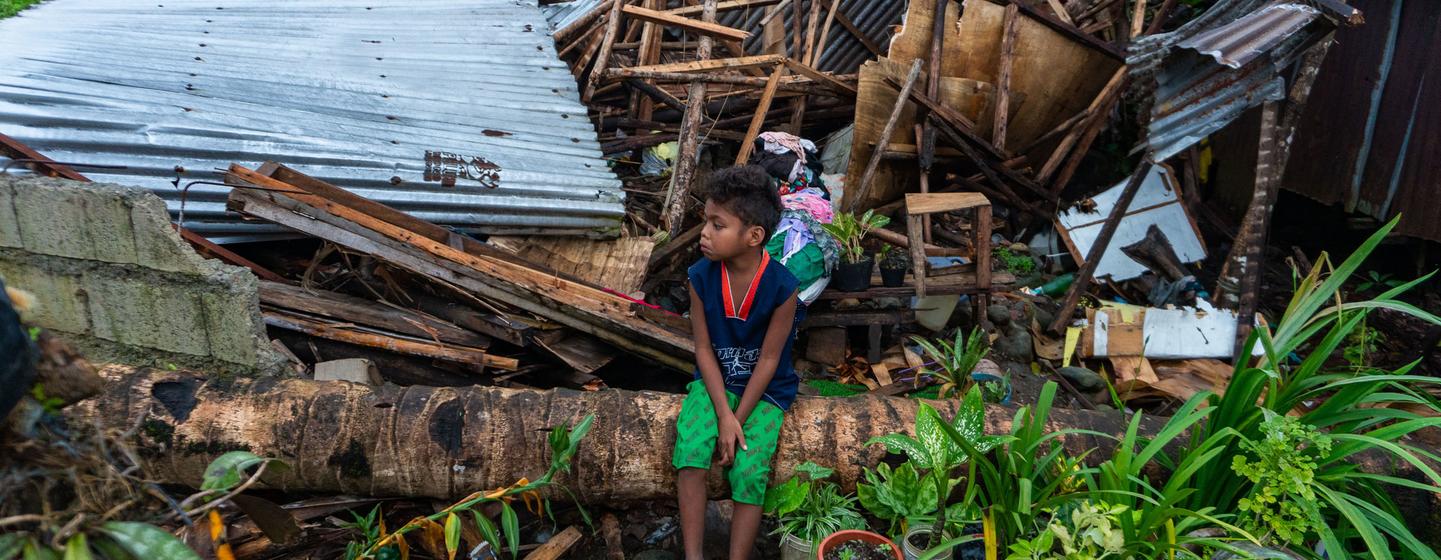
A child from the Badjao Indigenous community in the Philippines sits amid the wreckage left by a typhoon.

Modern problems, ancient solutions

The report calls for a seismic shift in how Indigenous knowledge is understood and respected – reframing it not as “traditional” or folkloric, but as scientific and technical knowledge.

Indigenous knowledge systems, authors argue, are “time-tested, method-driven” and built on direct relationships with ecosystems that have sustained life for millennia.

For example, in Peru, a Quechua community in Ayacucho has revived water sowing and harvesting practices to adapt to shrinking glaciers and drought. These methods, part of ancestral stewardship of hydrological cycles, are now being shared across borders with Costa Rican farmers as a model of South-South climate cooperation.

In Somalia, oral traditions serve as ecological law. The report cites cultural norms such as prohibitions on cutting certain trees (gurmo go’an) as evidence of environmental governance embedded in generational wisdom – passed through proverbs, stories, and taboos rather than policy papers.

Meanwhile, the Comcaac people of Mexico encode ecological and maritime knowledge in their language. Names like Moosni Oofia (where green turtles gather) and Tosni Iti Ihiiquet (where pelicans hatch) act as living data points – “vital  to their survival,” the report emphasises.

© Unsplash/Paul-Alain Hunt

Ore containing copper, cobalt and nickel at a mine.

Green solutions without consultation

The report also looks at how even as the world embraces a renewable energy future, many Indigenous Peoples are finding themselves on the frontlines not as climate partners, but as collateral damage from some of the solutions.

So-called green solutions often pose as much of a threat to Indigenous Peoples as the climate crisis itself,” writes Mr. Ibrahim. From biofuel expansion, carbon offsetting schemes, and mineral extraction for clean energy technologies, the new economy is often being built on old injustices.

For example, in Africa, the report draws attention to how demand for minerals linked to the green energy transition — including lithium and cobalt — has led to extractive activities that proceed without free, prior and informed consent. These projects often result in environmental degradation and displacement, echoing colonial patterns of land exploitation.

In several countries across the Americas, carbon offset projects tied to forest conservation have also been implemented without consultation – often on Indigenous lands – resulting in environmental degradation and exclusion from financial benefits.

Throughout, the report warns that if climate actions continue to be designed and implemented without Indigenous Peoples at the centre, they risk replicating the extractive and exclusionary systems that fuelled the crisis in the first place.

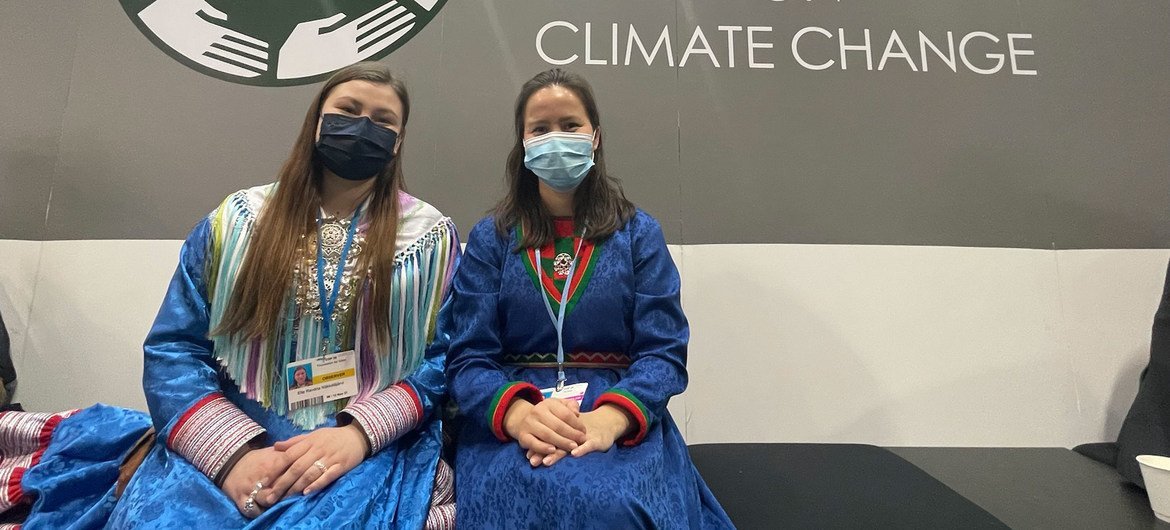
Indigenous young women representatives of the Sami People at the COP26 pavilions.

Climate change is a health crisis

The report also includes a chapter commissioned by WHO that details how climate-related health impacts intersect with the social, cultural, and spiritual lives of Indigenous communities.

In the Arctic, changes in temperature, wildlife migration, and weather patterns are disrupting traditional practices like hunting and harvesting. These disruptions are causing stress and threatening food security.

Indigenous women are particularly affected by the intersection of climate change and health. In East Africa, for example, women are more vulnerable to neglected tropical diseases such as schistosomiasis, leishmaniasis, and soil-transmitted helminthiases.

In the Amazon, climate-induced biodiversity loss has reduced access to traditional foods and medicinal plants, contributing to nutritional deficiencies among pregnant and nursing women, as well as broader community health vulnerabilities.

Despite these challenges, the report emphasises resilience. Communities are implementing locally rooted adaptation strategies, often led by women and elders. These include restoring traditional diets, strengthening intergenerational knowledge sharing, and adapting harvesting calendars to new ecological rhythms.

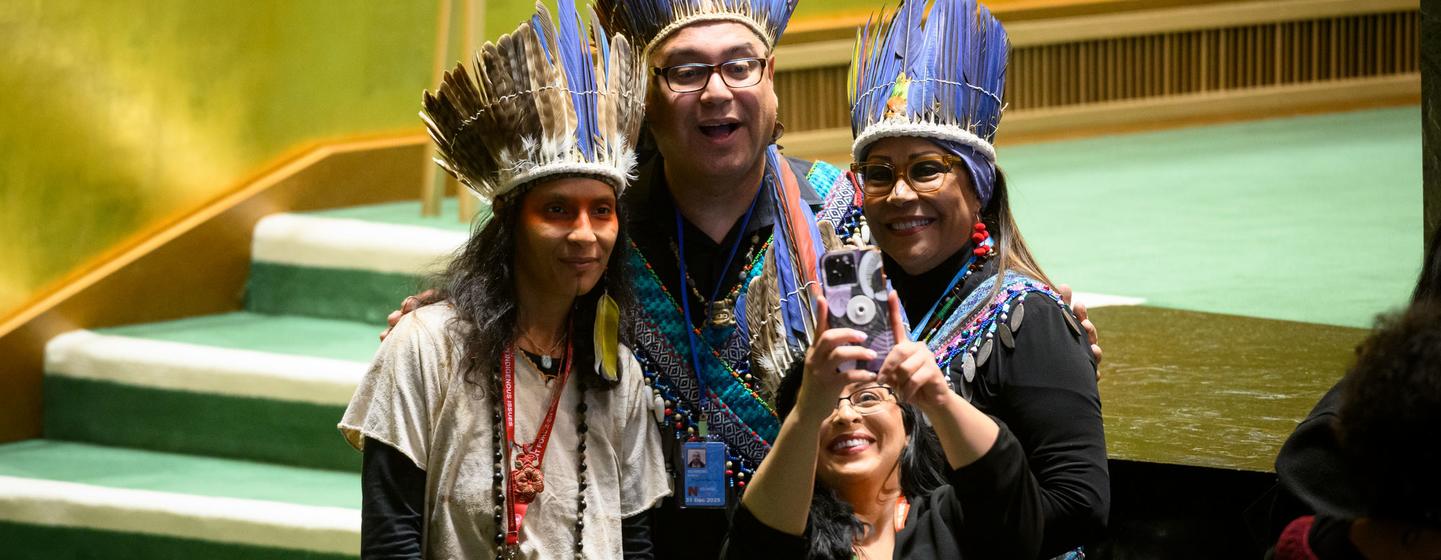
Participants attend the opening of the 24th Session of the Permanent Forum on Indigenous Issues.

Excluded from the table and the funds

Although Indigenous Peoples are increasingly acknowledged in global environmental frameworks, the report reveals that their role in shaping and implementing climate policy remains severely limited — both in terms of funding and governance.

Indigenous communities continue to face structural barriers that prevent them from accessing international climate finance. While significant resources flow through climate initiatives worldwide, less than 1 per cent reaches Indigenous Peoples directly.

The report calls for a fundamental shift: not just to increase funding, but to change who controls it.

Among its key recommendations are the creation of Indigenous-led financial mechanisms, formal recognition of Indigenous governance systems, and the protection of data sovereignty – ensuring communities control how knowledge about their lands and livelihoods is collected and used.

Unless these systems are transformed, the report warns, climate action risks reproducing the same patterns of exclusion and dispossession that have long undermined both Indigenous rights and global environmental goals.


Source link