Ministry of Railways have signed the Memorandum of Understanding (MoU), Memorandum of Cooperation (MoC), Joint Declaration of Intent (JDI), and Protocol with the following foreign Ministries and Railways for Technical Cooperation in Railway Sector, said Minister of State for Railways Rajen Gohain in a written reply to a question in Rajya Sabha on 17.03.2017 (Friday).
The agreements include cooperation areas such as High Speed Railway, Station Development, Speed Raising, Modernization of rolling stock, modernization of infrastructure, development of logistic parks and freight terminals, safety in train operations among others, said the minister. Here is a full list of agreements with foreign countries:
• National Railway Administration of the Government of the People’s Republic of China.
• RENFE-OPERADORA and ADIF of the Kingdom of Spain.
• Ministry of Land, Infrastructure and Transport of the Government of the Republic of Korea.
• French National Railways (SNCF).
• Department of Transport of Canada.
• Kazakhstan TemirZholy.
• Ministry of Transport, Construction and Regional Development of the Slovak Republic.
• Department for Transport of the Government of the United Kingdom of Great Britain and Northern Ireland.
• Research Design and Standards Organization (RDSO), India and Railway Technical Research Institute (RTRI), Japan.
• Ministry of Land, Infrastructure, Transport and Tourism of Japan.
• Government of Japan.
• Czech Railway (CESKE DRAHY) of the Czech Republic and Association of Czech Railway Industry (ACRI).
• Joint Stock Company “Russian Railways” .
• Ministry of Enterprise and Innovation of the Kingdom of Sweden.
• Federal Ministry of Transport and Digital Infrastructure of the Federal Republic of Germany.
• DB Engineering & Consulting GMBH of Germany for Technological Cooperation.
• Ferrovie Dello Stato Italialiane S.P.A. of the Republic of Italy.
Indfia’s current youth policy, launched in 2014, proposes a holistic ‘vision’ for the youth of India, to empower youth of the country to achieve their full potential, and through them enable India to find its rightful place in the community of nations, said Minister of State for Youth Affairs and Sports Vijay Goel at the Global Millennium Summit, Dubai on 18 March 2017.
Speaking at the Global Millennium Summit 2017 organised by the students of Shri Ram College of Commerce (SRCC) in Dubai, the minister said Dubai is fast emerging as the hub of business, trade and innovation and the pivot of the different cultures of the world.
“Today’s youth is full of spark. They have the courage which is inexplicable, they are dynamic, they have written their fate themselves. They have the key to the lock and they are the only ones who can set the caged bird free… They are everywhere; every corner of the world, their reach is phenomenal,” he said.
He said India’s Youth Organizations — Nehru Yuva Kendra Sangathan (NYKS) and National Service Scheme (NSS), besides the Rajiv Gandhi National Institute of Youth Development (RGNIYD) have played vital role in promoting Youth affairs and activities, he noted.
This Year a number of schemes will be initiated under an umbrella scheme of Rashtriya Yuva Sashaktikaran Karyakram with the objective of developing leadership qualities among the youth, and another Central Sector Scheme, National Young Leaders Programme (NYLP), introduced in 2014-15, is being run by the Ministry, he said.
European aviation firm Airbus is setting up a greenfield training facility at Aerocity, New Delhi, to support India’s growing need for Airbus aircraft pilots and maintenance engineers and the ground-breaking for it was performed by Aviation Minister P. Ashok Gajapathi Raju on Thursday.
Speaking on the occasion, Tom Enders, CEO, Airbus said the training centre will be the first such facility fully owned by us in Asia. India is the fastest growing domestic aviation market in the world and is expected to continue to grow at an annualised 9.3% over the next 20 years, outpacing the world average of 4.6%.
The number of trips per capita in India is expected to quadruple by 2035 due to a combination of economic and demographic factors, and Airbus forecasts a requirement for at least 1,600 new passenger and freighter aircraft by 2035. The consequent increase in Indian in-service aircraft fleet will lead to an accompanying need for over 24,000 new pilots and maintenance engineers.
The almost 7000 m2 Airbus India Training Centre will be built in a modular concept in order to become operational by end-2018 with two A320 full flight simulators, increasing to four and potentially to six simulators in due course, he informed.
It will start with an initial capacity to train over 800 pilots and 200 maintenance engineers annually. The centre will cater primarily to Airbus operators in India and the region. Airbus has more than 250 aircraft in service in India and over 570 are on order by Indian airlines.
Indian Minister for Civil Aviation Ashok Gajapathi Raju said that India’s rapidly growing passenger aircraft fleet must be matched by adequate availability of skilled pilots and maintenance engineers.
Airbus’ pilot and maintenance engineering training center is the type of facility which will help augment the talent pool of such personnel and thus be a force multiplier for the Indian aviation sector, he said. He has asked Airbus to think of creating MRO facility in India to.
Indian Space Research Organisation’s commercial arm Antrix Corporation Limited (Antrix) has earned a foreign exchange of 76.5 Million Euros and $4.5 Million from foreign countries through launching of their satellites on-board PSLV.
Union Minister of State (Independent Charge) for Space Jitendra Singh in written reply to a question in Rajya Sabha on Wednesday, March 15, 2017, informed the House that the spare capacity available onboard PSLV, after meeting the national requirements, is provided for commercial launch services.
He said ISRO will continue to make available the spare capacity available on its launch vehicles for commercial launch services through Anrix.
Indian Space Research Organization (ISRO) on February 15, 2017, successfully launched 104 satellites, in a single launch, onboard India’s Polar Satellite Launch Vehicle “PSLV-C37’ on February 15, 2017 from Satish Dhawan Space Centre (SDSC), Sriharikota.
These satellites include- (i) India’s Cartosat-2 Series Satellite (weighting 714kg) as primary payload, (ii) two Indian Nano-Satellites viz. INS-IA&IB(together weighing 18.1 kg) and (iii) 101 foreign nano-satellites together weighing 645.9 kg) from six counties as co-passengers.
This was the 38th successful PSLV mission in a row, which has once again demonstrated the versatility and reliability of the PSLV vehicle. While PSLV has already established itself as a preferred launch vehicle, in its class, in the global satellite market.
“This mission is expected to further strengthen the commercial footprint of PSLV in the global market for launch services, especially for smaller satellites,” said the minister.
London-based Payza, an online payment platform, has launched an online Utility Bill Payments service for Indian customers after teaming up with India’s household utility and telecommunications service providers such as Airtel, Tata Sky, Tata Docomo, Vodafone, Reliance, DishTV, MTNL, BSNL, and others.
The Payza Utility Bill Payments option is available through the Payza Android App that enables users to securely link their television, internet, mobile, and landline phone accounts within their Payza account, to pay bills and track their payment history.
Along with telecom services, Payza India customers can also pay gas and electricity bills directly from their Payza account. The service is tied in with the major gas and electric providers for each state, including BSES in Delhi, BEST Undertaking in Mumbai, and India Power. Insurance providers, such as Bharti Axa, ICICI Prudential, IndiaFirst and Tata AIA, can also be paid through this new feature.
“Up until demonetization, where 500 and 1,000-rupee notes were scrapped by the government, more than 90% of all transactions in India were made in cash,” explained Firoz Patel, Global Executive VP for Payza.
“While this was a much needed move in the fight against money laundering, counterfeiting and the black market, the average Indian consumer was left scrambling for ways to pay for everyday items like their gas and internet bills. With the launch of Payza’s online bills payment app, we’ve given our Indian customers a complete digital payments experience. The Payza App and e-Wallet are perfect companions to the new reality in India.”
In 2016, Payza announced Indian Rupee (INR) support on its platform, allowing members to add and withdraw funds in Rupees, and make online transactions using the local currency. Indian Payza members can also receive foreign currency in their Payza e-Wallet accounts and withdraw those funds as Rupees to their bank account.
An Indonesian delegation led by the Coordinating Minister for Political, Legal and Security Affairs, General (Retd.) Wiranto held talks with Minister of State for Home Affairs Kiren Rijiju in New Delhi on Wednesday, March 15, 2017.
Since both India and Indonesia have world’s largest Muslim populations, in a democratic set-up and common cultural and social ties, Rijiju said India is keen to consolidate its partnership with the largest nation in South East Asia and also strengthen its ties with the ASEAN bloc.
Both leaders shared concerns on tackling fundamentalism, extremism and the threat posed by radicalization and the ISIS. Recalling his visit to Bali for the International Meeting on Counter-Terrorism in August 2016, Rijiju said he was impressed by Indonesia’s handling of the threat of the ISIS.
Both the Ministers expressed hope that they can deepen their cooperation on counter terrorism and share intelligence and coordinate in cyber security issues. Rijiju also noted Indonesia’s key role in the ASEAN and appreciated its strong commitment to regional peace and security.
IFS Officer of 1988 batch Mr. D. Bala Venkatesh Varma, currently Indian ambassador to Spain has been accredited as the next Ambassador of lndia to the Principality of Andorra, with residence in Madrid.
“He is expected to take up his assignment shortly,” said a press release of the External affairs Ministry. Mr. Varma earlier served in several capacities, including the assignments at the United Nations. He became Indian ambassador to Spain on January 19, 2017 officially.
Active in academic and business meetings around Madrid, Mr. Varma met with the Vice-president of CEOE and chairman of the International Relations Committee, Joaquim Gay de Montellà, on 7th March 2017 at the headquarters of the Business Confederation.
Among the areas he discussed include sectors of potential collaboration such as infrastructure, renewable energy, tourism, digital banking, Smart cities, railways, food processing, machinery, water management, information technologies or the pharmaceutical sector, among others, and to strengthen the overall trade and business relations between India and Spain.
Twitter Account Photo of Preet Bharara now reads:@PreetBharara Personal account of Preet Bharara. Patriotic American & proud immigrant. Movie buff. @Springsteen fan. Former U.S. Attorney | Southern District of NY. New York, NY. Joined February 2017
US attorney Preet Bharara, whose office arrested Indian diplomat Devyani Khobragade and subjected her to strip search before filing prosecution charges ignoring her diplomatic immunity in December 2013, has been shown the exit door unceremoniously by the Trump administration. He is one among the 46 attorneys appointed by Obama administration and fired.
Defiant as usual, Preet Bharara has created another controversy before he was asked to resign by the Trump administration. Refusing to resign, he said he did not take a call from the White House as protocol prohibits it. He went to town in November after meeting then elect Donald Trump who, he told the media, had asked him to continue.
But his fate was otherwise as he was chosen among the 46 to be fired and his close association with Senator Chuck Schumer, Democrat of New York has also apparently came in the way. Bharara was the US attorney in Manhattan since 2009. He came under limelight for probing fund-raising by Bill de Blasio, the mayor of New York, the then governor of New York, Andrew M. Cuomo, who are both Democrats.
In a Twitter account he opened a week ago, Bharara said: “I did not resign. Moments ago I was fired… Being the US Attorney in SDNY will forever be the greatest honor of my professional life.”Now his Twitter account depicts him as “@PreetBharara
Personal account of Preet Bharara. Patriotic American & proud immigrant. Movie buff. @Springsteen fan. Former U.S. Attorney | Southern District of NY. New York, NY. Joined February 2017.”
India born Bharara arrested Indian diplomat Devyani Khobragade in December 2013, triggering a major row between India and US that led to diplomatic showdown in New Delhi. She was released later from the case when her credentials as UN diplomat were provided.
However, Bharare pressed the case against Khobragade and Bharara’s office filed a new indictment but by then she had left the US. Bharara later speaking at Harvard Law School blamed the U.S. Department of State which had begun the probe and asked him to prosecute her.
Devyani Khobragade, an IFS 1999 batch officer, now a director in the Ministry of External Affairs in New Delhi, authored a book “The White Sari” in December 2016.
Mr. Fayez Tarawneh, Chief of The Royal Hashemite Court of Jordan call called on Prime Minister Narendra Modi on Friday, March 10, 2017.
They discussed the shared commitment to strengthen bilateral engagement and the many opportunities in this regard. Mr. Fayez Tarawneh also exchanged views with Prime Minister on the situation in West Asia and the scourge of terrorism that calls for a comprehensive international response.
Dr. Fayez Tarawneh conveyed the greetings of Jordan King Abdullah II Ibn Al Hussein to Prime Minister.
Earlier, Mr. Tarawneh called on the President on Thursday. The President said India attaches great value to its ties with Jordan.
India appreciates Jordan’s proactive role, especially towards resolving the Palestinian-Israeli conflict and addressing the scourge of terrorism that has affected our regions and the world.
The President said India lauds Jordan’s exceptional humanitarian assistance in hosting refugees from its war torn neighbourhood despite the tremendous strain on its socio-economic resources. He was happy that India could make a contribution to help mitigate the crisis.
The President said India-Jordan bilateral trade which was US $1.35 billion in 2015-16 is expected to touch new heights. India is happy that Jordan is interested in cooperation in security and defence cooperation, space, fertilizers etc.
In view of the Kerala coastline incident which led Italian ship staff killing Indian fishermen, the new Admiralty (Jurisdiction and Settlement of Maritime Claims) Bill, 2016 was passed by the Lok Sabha on Friday, March 10, 2017 to claim jurisdiction on all such cases legally.
The Bill aims to establish a legal framework to consolidate the existing laws relating to admiralty jurisdiction of courts, admiralty proceedings on maritime claims, arrest of vessels and related issues. It also aims to replace archaic laws which are hindering efficient governance. The Bill confers admiralty jurisdiction on High Courts located in coastal states of India and this jurisdiction extends upto territorial waters.
Introduced during the winter session of Parliament, the Bill came up for discussion in the Lok Sabha yesterday. The Minister of State ( RT&H, S, C&F), Shri Mansukh Mandaviya, presented an overview of the Bill in the House, highlighting the need for repealing five obsolete British statutes on admiralty jurisdiction in civil matters, which are 126 to 177 years old.
The Bill provides for prioritization of maritime claims and maritime liens while providing protection to owners, charterers, operators, crew members and seafarers at the same time. During the course of discussion, thirteen members presented their views and raised various questions which were replied to by Shri Mandaviya. The Bill was then passed by the House.
Hungary and Bahrain prove great locations for expat women who want to work abroad, but Luxembourg, Taiwan, and Germany top the chart. Based on a survey of about 6,000 women, the annual Expat Insider survey by InterNations, a network for people who live and work abroad, compiled a so-far unpublished ranking of the top countries for women working abroad, which varies quite a bit from male expats’ picks. Here are some of the findings:
Luxembourg, Taiwan, and Germany top the chart, and they all do particularly well for women’s job security. More surprisingly, Hungary and Bahrain follow just behind in the top five, performing extremely well for job satisfaction and career opportunities for women — as opposed to the more negative perception of men working in these countries.
Top 10 Countries for Women Working Abroad
1.Luxembourg
Luxembourg tops the Working Abroad Index not only for women, but for all survey respondents. For female expats, it does best in the Job Security subcategory, coming in first with 86 percent of women saying that they feel positive about this factor. The high ranking in job security is partly due to the 93 percent of female expats that feel positive about the state of Luxembourg’s economy. The country also ranks first among women when it comes to the Safety & Security subcategory: 96 percent rate the peacefulness positively, and not one expat women says that they feel negatively about the country’s political stability.
2.Taiwan
Taiwan takes second place overall for women working abroad, coming in first place for the Job & Career subcategory. In fact, six in ten female expats (62 percent) say that they feel positive about their career prospects in Taiwan, as opposed to slightly more than half of the women around the world agreeing to this (53 percent). A vast majority (86 percent) are also satisfied with their current position in comparison to a global average of 62 percent.
3.Germany
Germany places third for the Job Security subcategory with 90 percent of female expats saying that they are positive about the state of the economy. Nearly half of female expats in Germany (46 percent in comparison to 36 percent globally) are employees or managers and the 11 percent of women in Germany currently searching for work are facing good career prospects, as 65 percentage of female respondents in Germany are overall satisfied with them in comparison to 53 percent worldwide. Germany also performs well among expat women for safety and political stability: 89 percent for example feel positive about their personal safety compared to a global average of 77 percent.
4.Hungary
Hungary proves that money does not mean everything: despite 43 percent of women in Hungary earning less than they would back home (compared to 31percent of women globally), the country does exceptionally well when it comes to the Job & Career and Work-Life Balance subcategories, ranking second in both. An impressive 40 percent — as opposed to a global average of only 17 percent — are even completely satisfied with their work-life balance. Hungary also shows some of the biggest differences between expat men and women overall: expat women rank Hungary as the world’s 7th best country to live in, whereas expat men feel very differently, ranking it at 36th out of 62 countries.
5.Bahrain
Bahrain friendly atmosphere seems to help women working abroad to settle in and the country makes it to sixth place in the Ease of Settling In Index. Over a quarter of female expats (27 percent) agree completely that making local friends is easy, a number far higher than the 11 percent global average. Bahrain also does very well when it comes to the Job & Career and Work-Life Balance subcategories, coming in at third place and sixth place respectively: nearly three-quarters of female expats (73 percent) are overall satisfied with their jobs in Bahrain compared to a global average of 62 percent.
6.Australia
Australia is a great destination for women working abroad who want to enjoy their free time to the fullest. Female expats in Australia have plenty to do in their spare time: 93 percent of respondents feel positive about the available leisure activities. Compared to a global average of just 17 percent of women saying they are completely satisfied with their work-life balance, three in ten expat women in Australia feel this way. The great weather down under is another plus to moving to Australia, with 85 percent of female expats saying that the climate and weather is good compared to a 61 percent global average.
7.Ecuador
Despite three in ten women (29 percent) saying they earn significantly less than at home, well above the worldwide average of just 14 percent, Ecuador still makes a great destination for working abroad, coming first in the Work-Life Balance subcategory: an impressive 84 percent of female expats in Ecuador indeed say they feel satisfied with their work-life balance compared to the global average of 60 percent. However, Ecuador does not do so well for the state of its economy with 43 percent of women feeling negatively about it, compared to a global average of just 24 percent.
8.New Zealand
Expat women find it easy to settle in and feel welcome in New Zealand. For instance, over four in five (83 percent) say that they feel that it is easy to get used to the local culture. Over three in five (61 percent) even say that they would possibly stay forever in New Zealand, an impressive 30 percentage points more than women around the world. Perhaps the work-life balance contributes to women wanting to stay — as 77 percent of them are overall satisfied with this aspect of their life.
9.Norway
Expat women in Norway can expect to be earning more than they would at home with 74 percent of respondents saying this is the case compared to only half of respondents worldwide. Although nearly eight in ten expat women worldwide consider themselves happy with their life (78 percent), this unfortunately is not the case in Norway: despite the positive working abroad results, only 66 percent of female expats feel overall happy with their life.
10.Denmark
Of all three subcategories of the Working Abroad Index, Denmark performs best in the Work-Life Balance subcategory coming in at fourth for women. Across all survey respondents, men included, Denmark even has the shortest full-time work week out of all the countries surveyed, with an average of 39 hours per week. Just like Norway, Denmark does not do as well in the Job & Career subcategory, placing 34th out of 57 countries for women. When it comes to the Job Security subcategory, Denmark comes 15th, six places below Norway, which still makes the top 10 ranking on ninth position.
Worst Countries to Work Abroad for Women
While some of the best countries for women working abroad are in Europe, so are the worst. For example, Greece even comes in last place for working abroad for both expat men and women. The state of the economy may have something to do with this: nine in ten female expats in Greece rate this factor negatively, compared to one quarter globally (24 percent). Meanwhile, career prospects even seem to be worrisome for expat women in several Southern European countries: 63 percent of women in Greece rate this negatively, followed by 54 percent in Cyprus, and 52 percent in Italy.
The economies of South American countries Argentina and Brazil also seem to be troubling for women working there, with 76 percent and 87 percent respectively rating them negatively. Brazil, however, seems to be a popular spot for being sent abroad by an employer: 18 percent of female expats there say this was their primary reason for relocating, notably higher than the 10 percent global average. Job security in Brazil is something that female expats are not overly satisfied with, though: 36 percent rate it negatively, 14 percentage points higher than the global average.
While foreign women seem to be in high demand when it comes to working in the Gulf Countries — 14 percent in Saudi Arabia say they were recruited by a local company and 12 percent in Qatar say the same, four times the global average of 3 percent — they seem to struggle with work-life balance: only 40 percent rank this factor positively in Saudi Arabia and 44 percent in Qatar, compared to the global average of 60 percent. Female expats in Saudi Arabia and Qatar have an average work week of 42.6 and 44.8 hours, respectively, which is notably higher than the global average of 39.0 hours.
It comes as no surprise that 34 percent of women working in Qatar say that they are unsatisfied with their working hours, nearly double the global average of 19 percent. While Saudi Arabia does better in this regard, it is still above the global average at 23 percent.
As part of its special programming for International Women’s Day on the 8th of March, France 24’s culture team heads to India to explore the world’s largest democracy and see how women, and women’s rights, are making their mark on the country’s vibrant arts scene. Olivia Salazar-Winspear presents two special editions of the daily culture showEncore!
Wednesday 8th March
Paromhita Vohra and Ram Devineni present the comic-book project that is looking to change mentalities when it comes to women’s place in society. “Priya’s Shakti” and “Priya’s Mirror” take real-life stories as their inspiration.
The culture teams also catches up with filmmaker Leena Yadav, whose film “Parched” explores gender politics in the patriarchal setting of an isolated village, and discuss the challenges of pushing a feminist message in mainstream cinema.
Thursday 9th March
For the second part of this special edition, Encore! goes to Mumbai to meet with stand-up comedian Radhika Vaz. She highlights the cultural shift that’s redressing the gender balance slowly but surely in India, and how being “Unladylike” is a form of political resistance.
Encore! also meets with the “Why Loiter” group, who stage cultural interventions in public spaces which can feel hostile for women. One of “Why Loiter’s” members, Priyanka, demonstrates how a simple “Antakshari” -or singing game- in the Mumbai metro brings men and women together in a friendly sing-off.
It is not the tallest flag in the world but certainly one of the tallest at attari-Wagah border in India but the sight of tricolour even from Lahore has irked Pakistan, who woke up on Sunday seeing India’s national flag.
The 360-ft tall tricolour, hoisted on a 110-meter high mast, measures 120-foot long and 80-foot wide and the weight of the flag pole is 55 tonnes built at Rs.3.5 crore.
Pakistan Rangers had raised the issue with their counterparts the Border Security Force (BSF) but the Indian state of Punjab insists that the flag was well within its own border. “It is our national flag and nobody can stop us from hoisting it on our soil,” said Anil Joshi, a minister of Punjab state government, who had laid the foundation stone last april and hoisted the flag on Sunday, March 5, 2017.
The flag was erected by the Amritsar Improvement Trust but the world’s tallest is located in the United States at a height of 400-foot high flying an American flag measuring 60 feet high by 120 feet long, built by insurer Acuity on the Interstate 43 corridor.
The Union Minister of State for Finance and Corporate Affairs, Mr. Arjun Ram Meghwal will represent the India in the 4th Annual Devolution Conference to be held from 6th to 9th March, 2017 at Nakuru County of Kenya.
He is expected to share the experience of devolution system and its progress in India and specifically highlight the 73rd-74th Constitutional Amendments and provisions their under for strengthening the local governance in India.
During his visit to Kenya, Mr. Meghwal will address the Devolution Conference and will brief the Conference on the revenue sharing between the Centre and the States as well as showcase the smooth devolution on the recommendations of 14th Finance Commission from the earlier 32% share in 13thFinance Commission to 42% of Union’s net tax receipts, to the States, said a statement.
To share the successful experience of the Urban and Rural Local Bodies, Mr. Meghwal will inaugurate the Conference with the objective of sharing of good experience of devolution system and through the platform of Devolution Conference and how it can be used to increase Good Governance and Public Accountability for the Social and Economic Development internationally.
About 10,000 delegates are expected to participate from different regions including African Nations and China in the conference, including Members of Parliament, Leaders of Opposition from several States, professionals, representatives of various civil societies, religious and social organizations from Kenya among others.
The Pilgrimage to the Cave of Shri Amarnathji, known as Amarnath Yatra, involves trekking at altitudes as high as 14,000 feet and pilgrims are likely to develop High Altitude Sickness, said an advisory issued today.
The symptoms of high altitude sickness include loss of appetite, nausea, vomiting, fatigue, weakness, dizziness, lightheadedness and difficulty in sleeping, visual impairment, bladder dysfunction, bowl dysfunction, loss of coordination of movements, paralysis on one side of the body, gradual loss of consciousness and mental status changes, drowsiness, chest tightness, fullness, congestion, fast breathing and increased heart rate.
If high altitude sickness is not treated timely, it may be lethal in a matter of hours, said the Shri Amarnathji Shrine Board in an advisory for the pilgrims. Here is a list of Do’s and Don’ts for pilgrims:
Do’ s for prevention of High Altitude Sickness.
1.Do prepare for the Yatra by achieving Physical Fitness – it is advisable to start a preparatory Morning/ Evening walk, about 4-5 km per day, at least a month prior to the Yatra.
2.Start deep breathing exercise and Yoga, particularly pranayam for improving oxygen efficiency of the body.
3.Do check with your physician prior to travelling to higher elevations, if you have any existing pre-existing medical conditions.
4.Do walk slowly while ascending and take time to acclimatize-, relax for a short while on steep inclines.
5.Do avoid exerting beyond your normal capacity.
6.Do take compulsory rest at various locations and ensure time logging and take ideal walking time mentioned on the display boards while moving towards next location.
7.Do check with your physician prior to taking any medications.
8.Do drink lots of water to combat dehydration and headaches – about 5 liters of fluid per day.
9.Do follow the prescribed food menu – available at Shrine Board’s website, Shriamarnathjishrine.com – when having food in the Yatra area.
10.Do consume plenty of carbohydrates to reduce fatigue and prevent low blood sugar levels.
11.Do bring portable oxygen with you as it is helpful in case you have difficulty in breathing.
12.Do descend immediately to a lower elevation, if you start having altitude illness symptoms.
13.In case there is any change in the status of your health after having obtained Compulsory Health Certificate some weeks earlier, do consult your doctor before embarking on the pilgrimage.
14.In case of any signs of high altitude sickness or any other discomfort, immediately contact the nearest medical facility located at every 2 kms.
Don’ts for prevention of High Altitude illness:
1.Don’t ignore the symptoms of high altitude illness.
2.Don’t drink alcohol, caffeinated drink, or smoke.
3.Don’t ascend any further if you have altitude illness. Instead, descend immediately to an elevation where you can acclimatize.
4.Don’t accept everything a sick Yatri says since his/ her judgment is impaired.
The Trump administration has halted the H1 Visa Premium Processing for at least 6 months and it should not come as a bolt from the blue but an inevitable course of events from a battered economy like the United States, which had allowed streams of workers and goods from abroad, which no other country had ever done, argue US immigration experts.
Now that the visa process for any foreign worker will take 3 to 6 months instead of 15 days at a payment of meagre one thousand dollars more, the primary target will be India as the beneficiaries of the H1 visa are mostly the techies from India. In fiscal year 2014, 69.7% of these visas went to Indian techies, they said. This is just the tip of an iceberg and the time has come to resolve the bigger problem, that is immigration, says Steven Riznyk, an immigration lawyer.
“It will never be resolved as long as all of the special interests only advocate their own positions, which is natural, but again, does not resolve the bigger problem,” he stated on the hot issue plaguing the IT industry of India.
He has put forth the arguments as below:
Although many tech firms may argue that it costs them dearly, it may force them to look to American labor a bit harder. Many of the tech imports from India and China are not bringing skills the U.S. doesn’t have. This would be in line with President Trump’s initiatives to help America. A good outcome if possible.
On the flip side, tech companies may argue they can’t get people fast enough in the U.S. The question to be answered is: do we have that great a shortage of tech persons in the U.S.?
On another note, with premium processing of cases being halted, if the CIS receives, say, 50,000 of the 85,000 applications with a premium processing check in addition to the high filing fees, this would mean a loss of revenue to the CIS of about $61,250,000. Steven Riznyk, CEO of San Diego Biz Law, states he is unable to ascertain the exact number of H1 visa cases that are premium processing cases, but the losses are in the millions. All of the H1 visa cases his firm processes, he states, are Premium Processing cases.
One of the controversial subjects in the U.S. lately has been that of the outsourcing of labor. Although we are not taking a position on that issue, we will address some points to consider. If a company outsources their technology to India, China, Russia, Romania, or the Ukraine in order to remain competitive and save money, that is one thing. Even then, people of course complain because they state that jobs are lost in America. True enough.
Regardless of what one thinks of the issue, one can appreciate that it makes business sense. On the other hand, if a tech company imports the foreign labor (and most of the positions are 6-figure positions), then not only are we outsourcing, but we are outsourcing at a very high cost. It is one thing to hire someone from India for $25,000 a year. In India, that is a substantial wage. To pay that person $100,000 now, does not make sense. It is outsourcing at an American wage.
If the tech sector feels that it makes sense to hire a foreign worker at a premium wage (as they are often hired by consulting firms that make money by marking up their hourly rate), which would be even more than the six figures these people are paid, then what is the problem with the American supply of tech workers?
The common argument is that American workers are not available because they won’t work at the wages that foreign workers will. Well, maybe the wages must be adjusted across the board. Perhaps the tech sector is overpaid. As in any field, there will be some people who rise above it, and they deserve a higher wage.
However, an entire industry cannot be paid at a rate that makes it more feasible to outsource them. It would seem that tech workers would prefer to be paid a fair rate than be unemployed because they are asking too much. After all, there is no point to an education if after that one is stuck with student loans and no job.
A tech visa is way overdue, states Steven Riznyk. Either a subcategory of the H1 visa should be dedicated to technology or tech should have its own visa (preferred). If the tech sector has its own visa, regulations could be implemented that are tailored to the visa and to the needs of American business.
The needs of the tech sector are very different to those in other areas of business and really should have its own considerations implemented after consulting with the tech sector that hires these people. Additionally, this would allow a control over the number of persons hired in the tech sector.
As the H1 visa stands now, it is out of control and is destroying the validity of the H1b visa in that it is preventing people from other industries from entering the U.S. This has to be placed in perspective. If persons from third world countries are getting trained in technology in a country where the average daily wage for a doctor is $30.00, it would only make sense they have nothing to lose by applying to work in the U.S. where they can make more than that per hour. It makes sense they would apply, but does it mean we have to hire them?
Doctors. Our underserved areas in America require high-level doctors. It is not fair to a person who lives in a remote area not to have access to rapid and effective medical care. A wonderful program we have in place is the J1 program wherein foreign doctors can study in the U.S. (in medical school or a residency program) but have to leave the country for two years before re-entering to work here. They can, however, under certain circumstances have the two-year bar waived if they offer to work for three years in certain underserved areas (this is also called the Conrad 30 Waiver Program).
A lot of lives depend on the J1 program for doctors. If doctors cannot obtain the H1 visa, a lot of people will die or suffer due to a lack of high-level medical care, states Mr Riznyk. The people cannot afford to go elsewhere or do not have enough time to travel and obtain assistance.
This is one of the reasons the tech sector has to be split off from the H1 visa as it stands, he states (additionally, the J1 section dealing with doctors needs to be severed from the other J1 categories, such as au pairs, camp counselors, and people learning to fly airplanes; it is too complex to be thrown into this general category and requires special care).
There are always at least two sides to an argument and the other side to this one, states Mr Riznyk, is that the J1 visa provides foreigners the opportunity to take career opportunities from U.S. citizens and residents and is therefore unfair; if that is the case, then a compromise must be reached that works for everyone.
Last but not least, the H1 Visa visa is overrun by tech applicants. The H1 was meant for all industries, not one. The problem with it right now, between the lottery system and the randomness of obtaining a valid H1 visa, persons from other industries that are badly needed do not have a chance of working here and helping other industries such as medicine, for example.
This cannot go on, because this is the weakest link in the chain, states Mr Riznyk. It is here that we have a real need for persons in other industries and day after day when I explain the H1 visa system to people in other industries, states Steven Riznyk, they simply tell me they will apply to Canada or elsewhere.
The H1 visa is overdue for a fix, but there are many issues to be addressed. These issues require brainstorming with the business sector so that once again the visa, presently abused in many ways, can restore its integrity and serve the purpose it is meant to serve and help the United States become the leader it has been and will continue being, stated Rizvik. “It will require a delicate balance when it comes to satisfying its many facets,” he concludes.
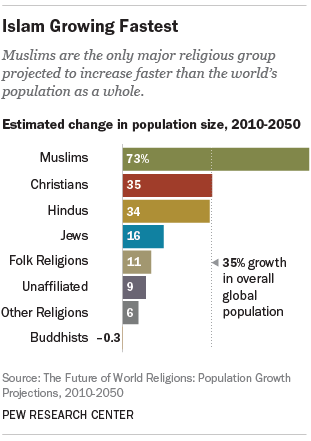
Global research outfit Pew Research Center has predicted that India will replace Indonesia, with currently the world’s largest Muslim population of 311 millions or 11% of global total, while Hindus will be about 1.3 billion (130 crore).
However, Muslims are expected to grow faster than Hindus as they have the youngest median age and the highest fertility rates. In 2010, the median age of Indian Muslims was 22 and Hindus was 26 and for Christians 28. An average Muslim woman has an average of 3.2 children, compared with 2.5 for Hindus and 2.3 for Christians, the report said.
Indian Muslims may grow faster than Hindus, from 14.4% in 2010 to 18.4% in 2050 but Hindus will still be more than 3-in-4 Indians (76.7%) and they account for the five largest Muslim populated countries – India, Pakistan, Indonesia, Nigeria and Bangladesh put together.
In 2010, Christians constituted approximately 2.5% and they may make up 2.2% by 2050. The report also mentioned the religious strife in India since its Independence in 1947 and the death of Mahatma Gandhi and late PM Indira Gandhi on similar grounds.
Another recent Pew Research Center report said religious restrictions found in India will be of the highest levels with social hostilities in the world. It referred to Prime Minister Narendra Modi, who it said has been dogged by allegations of religious intolerance, stemming from anti-Muslim violence in the state of Gujarat as then state Chief Minister in 2002, that left 2,000 people killed.
At the global level, the Pew Research center’s report said from 1.6 billion in 2010 constituting 23%, Muslims will exceed the number of Christians by the end of the century, if current demographic trends continue. , the number of Muslims is expected to exceed the number of Christians by the end of this century.
US President Donald Trump’s nominee for National Intelligence, Dan Coats, told the Senate Hearing Committee that he was “shocked” to learn India’s space agency successfully launched more than 100 satellites in one go, saying that the US cannot afford to be laggard.
“I was shocked the other day to read that India, on one rocket launch, deposited more than 100 satellites in space,” said Coats during his confirmation hearing for the position of Director of National Intelligence on Tuesday.
“They may be small in size with different functions but one rocket can send up, I think it was 104 platforms,” said Mr Coats, who will be supervising even the CIA.
In fact, out of 104, 96 satellites were for the US companies and most of them were launched for Planet Labs Inc, a San Francisco-based Earth-imaging company.
The successful launch of 104 has relegated even the US which had created a record in 2014 launching 37 satellites in a single go. All 104 satellites were lofted off by India’s PSLV rocket in a precisely timed method and all the 104 were put in their respective orbits in a span of 18 minutes, each travelling at 27,000 kmph.
The Asian Development Bank (ADB) and the Government of India signed in New Delhi $375 million in loans and grants to develop 800-kilometer Visakhapatnam-Chennai Industrial Corridor, which is the First Phase of a planned 2,500–kilometer long East Coast Economic Corridor (ECEC).
The Corridor is expected to spur development on India’s eastern coast in line with the Government of India’s Make in India policy to stimulate manufacturing, and Act East policy to integrate the Indian economy with Asia’s dynamic global production networks.
ADB approved $631 million in loans and grants in September 2016 to develop the Visakhapatnam-Chennai Industrial Corridor and approved loans comprise a $500 million multi-tranche facility to build key infrastructure in the four main centers along the corridor – Visakhapatnam, Kakinada, Amaravati, and Yerpedu-Srikalahasti in the State of Andhra Pradesh.
The First Tranche of $245 million was signed on Tuesday, February 28, 2017 that will finance sub-projects to develop high-quality internal infrastructure in 2 of the 4 nodes of the corridor–Visakhapatnam and Yerpedu-Srikalahasti.
Another component of the approved ADB funds signed on 23.02.2017 was a $125 million policy-based loan that will be used for capacity development of institutions engaged in corridor management, provide support to enhance ease of doing business and for supporting industrial and sector policies to stimulate industrial development.
“ADB is supporting an industrial corridor development approach that involves creation of efficient transport, and reliable water and power supplies in the industrial clusters along with a skilled workforce, to be backed by industry-friendly policies that improve ease of doing business for integration of local economy with global production networks,” said L. B. Sondjaja, Deputy Country Director of ADB’s India Resident Mission.
“We estimate that by 2025, annual industrial output along the corridor will increase fourfold to $64 billion from about $16 billion in 2015 if investment opportunities are maximized over the next few years,” he added.
The project is an important milestone in the process of developing the corridor and realizing the objectives of Make in India. We sincerely hope that the project will complement the ongoing efforts of the Government of Andhra Pradesh to enhance industrial growth and create high-quality jobs,” said Raj Kumar, Joint Secretary (Multilateral Institutions), in the Ministry of Finance, who signed the loan agreement for Government of India.
The project agreement was also signed by Hema Munivenkatappa, Special Secretary to Government (Finance) on behalf of the Government of Andhra Pradesh.
Along with the ADB loans, agreement was also signed for a $5 million grant from the multi-donor Urban Climate Change Resilience Trust Fund that is managed by ADB to build climate change resilient infrastructure. The Government of India will provide extra funding of $215 million to the $846 million project.
Among the outputs envisaged under the $245 million tranche 1 loan include strengthening and widening of a 29.6-kilometer section of state highway to four lanes to improve connectivity from Kakinada Port to National Highway 16, investments in smart water management in Visakhapatnam to reduce nonrevenue water and provide continuous water supply, upgrading 7 power substations to supply high-quality and reliable power supply to Visakhapatnam, Naidupeta, and Yerpedu-Srikalahasti industrial clusters, and effluent treatment facility in Atchutapuram and Naidupeta clusters.
The tranche 1 loan will have a 25-year term, including a grace period of 5 years, a 20-year straight line repayment method at an annual interest rate determined in accordance with ADB’s LIBOR-based lending facility.
A Financing Agreement for IDA credit of US$ 63 million for the “Tejaswini” Socio-Economic Empowerment of Adolescent Girls and Young Women Project” was signed in New Delhi last week with the World Bank.
The Financing Agreement was signed by Mr. Raj Kumar, Joint Secretary, Department of Economic Affairs, Ministry of Finance on behalf of the Government of India and Mr. Junaid Kamal Ahmad, Country Director, World Bank (India) on behalf of the World Bank.
A Project Agreement was also signed by Mr. Mukhmeet Singh Bhatia, Principal Secretary, Department of Women, Child Development, Government of Jharkhand and Mr. Junaid Kamal Ahmad, Country Director, World Bank.
The project seeks to empower the adolescent girls with basic life skills and thereafter provide further opportunities to acquire market driven skill training or completion of secondary education, depending on the inclination of the beneficiary.
The project will be delivered in 17 Districts of Jharkhand. The project has three main components, (i) Expanding social, educational and economic opportunities (ii) Intensive service delivery (iii) State capacity-building and implementation support. About 680,000 adolescent girls and young women in the project Districts are expected to benefit from the program. The closing date for the project is 30th June, 2021.