KM3NeT Neutrino Telescope Sets New Limits on Possible Violations of Einstein’s Theory of Relativity

Researchers from the international KM3NeT collaboration have used atmospheric neutrinos detected deep beneath the Mediterranean Sea to test a fundamental principle of physics, establishing new limits on possible violations of Lorentz invariance.

The international research team analysed 5,828 atmospheric neutrino candidate events recorded by KM3NeT/ORCA, an underwater neutrino telescope located in the Mediterranean Sea. The study found no evidence of Lorentz invariance violation but established new experimental limits on the possible size of such effects.

Lorentz invariance is a fundamental principle underlying Einstein’s theory of relativity. It states that the laws of physics remain the same for observers moving at constant velocities relative to one another. However, some theories attempting to reconcile gravity with quantum physics suggest that this principle may not always hold.

The findings, published in the Journal of Cosmology and Astroparticle Physics (JCAP), also provide the first direct constraints on certain possible differences in the behaviour of muon and tau neutrinos.

Investigating Whether the Laws of Physics Hold Across the Universe

The search for possible violations of Lorentz invariance is connected to efforts to develop a theory of quantum gravity, which would reconcile general relativity with quantum physics.

Some theoretical approaches suggest that spacetime, generally considered continuous, could instead consist of extremely small, discrete units. Such a possibility could have implications for fundamental physical laws, including Lorentz invariance.

“We still don’t know whether our spacetime is continuous or might be discrete,” explains Alba Domi, a researcher at the Erlangen Centre for Astroparticle Physics (ECAP), Friedrich-Alexander-Universität Erlangen-Nürnberg, and one of the study’s two corresponding authors.

“Looking for violations of Lorentz invariance is one way to investigate this possibility.”

Neutrinos offer a useful way to investigate these questions because they rarely interact with matter and can travel enormous distances, including through the Earth. They also undergo a phenomenon called neutrino oscillation, in which they change from one flavour, or type, to another as they travel.

Scientists can predict the probability of these transformations with high precision. Differences between observed behaviour and theoretical predictions could therefore indicate new physics, potentially including violations of Lorentz invariance.

Researchers Analyse Atmospheric Neutrino Data

To investigate possible deviations, the team examined 1.4 years of data collected using the first six detection units of KM3NeT/ORCA.

The researchers compared the observed neutrino energies and arrival directions with theoretical predictions to search for evidence of Lorentz invariance violation.

Although the analysis found no evidence of such violations, it established new limits on how large certain effects could be without conflicting with the observations.

The results are competitive with measurements from long-running experiments such as IceCube and Super-Kamiokande, despite being obtained using an early, partially constructed version of the detector.

The study also established the first direct limits on certain possible Lorentz invariance violation effects involving muon and tau neutrinos and their oscillations.

Expanding Detector Could Improve Future Investigations

At the time of the analysis, KM3NeT/ORCA was operating with only six detection units and was still under construction. The detector is being expanded towards its full planned configuration.

“These results show the potential of KM3NeT/ORCA to test fundamental principles of physics, even with a relatively small detector,” says Lukas Hennig, a PhD student at ECAP and the study’s other corresponding author.

“With more data and an expanding detector, we will be able to search for even smaller effects.”

Researchers also plan to extend their investigations to KM3NeT/ARCA, which focuses on higher-energy neutrinos arriving from distant astrophysical sources.

These particles could be particularly useful because some potential effects of Lorentz invariance violation may become more pronounced at higher energies and over very long distances.

“ARCA could be particularly well suited to this kind of research, but we don’t yet have enough astrophysical neutrino events to perform such an analysis,” explains Domi.

KM3NeT Uses Two Underwater Detectors to Study Neutrinos

KM3NeT is an international research infrastructure under construction in the Mediterranean Sea. It consists of two underwater neutrino telescopes, ORCA and ARCA, which use networks of sensitive light sensors to detect faint flashes produced when neutrinos interact with matter.

ORCA, or Oscillation Research with Cosmics in the Abyss, is located approximately 40 kilometres off the coast of Toulon, France, at a depth of around 2,450 metres. It studies neutrinos produced in Earth’s atmosphere, with a focus on their oscillations between different flavours.

ARCA, or Astroparticle Research with Cosmics in the Abyss, is located off the coast of Sicily, near Portopalo di Capo Passero, at a depth of approximately 3,500 metres. It focuses on higher-energy neutrinos originating from distant astrophysical sources and helps researchers investigate some of the Universe’s most energetic phenomena.


Read More :

Now That Democrats Win Congress, Microsoft, Amazon and Alphabet Face Growing Infra Scrutiny

Binance customers withdraw $3.64 billion after record $6.3 billion crypto hack

AI Models Show Bias Against Chinese and Nigerian Accents in Interviews and Speaking Assessments

A University of Washington-led study has found that leading AI models favour American and British accents when evaluating spoken English, potentially disadvantaging speakers from other linguistic backgrounds in hiring and academic assessments.

Researchers at the University of Washington (UW) have found that state-of-the-art artificial intelligence models display bias against certain English accents when assessing job interviews, presentations and spoken English proficiency tests.

The study examined four AI models, including Google’s Gemini 2.5 Pro and Gemini 2.5 Flash, OpenAI’s GPT-Audio 1.5 and the open-source Qwen 3 Omni. Researchers found that the models generally gave the lowest scores to Chinese and Nigerian accents, placed Indian accents in the middle, and ranked American and British accents highest.

This pattern persisted even when speakers delivered identical content and the AI systems could accurately transcribe their speech. The models consistently gave higher ratings for both delivery and content to speakers with American and British accents.

The research was presented on October 25 at the Conference on Empirical Methods in Natural Language Processing in Budapest, Hungary.

“People are now trusting audio AI models as sort of third-party evaluators, for hiring, for oral exams in education, for certain English tests in immigration — contexts where fairness really matters,” said co-lead author Orevaoghene Ahia, a UW doctoral student in the Paul G. Allen School of Computer Science & Engineering. “So I was curious how models perceive speech from people who don’t speak with so-called ‘standard’ American accents.”

Researchers Tested Four AI Models Across Three Domains

The research team selected English accents from five regions with large English-speaking populations: American, British, Chinese, Indian and Nigerian. The researchers examined how AI models assessed speakers across three settings: job interviews, presentations and English proficiency tests.

To conduct the experiments at scale, the team used AI-generated voices from ElevenLabs to read identical scripts in different accents. The scripts included interview answers, classroom and conference presentations, and responses to English proficiency tests. Both male and female voices were included.

The four AI models evaluated each response on a scale of one to seven, assigning separate scores for delivery and content. They also provided brief explanations for their assessments.

Researchers subsequently tested the interview responses with 52 human participants from the five countries. Each participant read four scripted answers and also responded to questions without a prepared script.

The results again favoured American and British accents. Researchers also found that the difference in scores between human speakers with different accents was greater than the disparity between the AI-generated voices.

Senior author Yulia Tsvetkov, a UW associate professor in the Allen School, explained why the team selected these particular systems.

“We wanted to check these state-of-the-art models,” Tsvetkov said, “because these are what companies would deploy in a real-world setting.”

Acoustic Differences May Influence AI Assessments

To understand the scoring disparities, the researchers examined the acoustic characteristics of the different accents. They measured what they described as their “acoustic distance” and found that accents further from American English were frequently assigned lower scores.

The bias was also apparent in the models’ explanations. Although the systems sometimes described Chinese and Nigerian speakers as mumbling or difficult to understand, they were generally able to transcribe the accented speech accurately.

“Even though they repeatedly claimed Chinese and Nigerian speakers ‘mumbled’ or were ‘difficult to understand,’ the models were actually very good at transcribing the accented speech,” Ahia said. “They understood the speakers, but they just had this implicit notion of hierarchy among them based on accent.”

Researchers Call for More Representative AI Training Data

The study suggests that accent bias can enter AI models through several possible routes. These include training data that characterises accented speakers as difficult to understand, datasets that inadequately represent certain populations and accents, and training methods that reinforce conventional expectations of professional speech.

The researchers highlighted that English is an official language in Nigeria and is used as the language of instruction in Indian schools. Nevertheless, Nigerian and Indian accents received lower ratings than American and British accents.

“One clear direction for future work is to create more representative training and evaluation data sets that could improve the accuracy and fairness of language models,” Tsvetkov said.

The team intends to extend the research by examining a wider range of human accents, including regional variations within individual countries. It also plans to investigate how AI models evaluate audio in medical settings, including automated emergency response.

Tsvetkov emphasised that developers should assess model performance across different population groups and dialects rather than relying only on overall accuracy.

“For all of these, we hope that developers build and publish evaluations of their models that don’t focus only on average performance, but also break it down into subpopulations, dialects and so on,” Tsvetkov said. “We don’t want the average performance to be 97% accurate for the general population, but for a smaller group only 20%.”


Read More :

Binance customers withdraw $3.64 billion after record $6.3 billion crypto hack

China’s humanoid robots can perform stunts, The real contest is whether they can think

PM Narendra Modi to Meet Indian Athletes from Asian Para Games 2026 on November 5

Prime Minister Narendra Modi will interact with India’s Asian Para Games 2026 contingent in New Delhi on November 5, following the country’s record medal-winning performance at the competition in Japan.

Interaction Scheduled at Indira Gandhi Sports Complex

Prime Minister Narendra Modi will meet members of the Indian contingent that participated in the Asian Para Games 2026 at approximately 4:30 PM on November 5. The interaction will take place at the Indira Gandhi Sports Complex in New Delhi.

The Prime Minister will also address the gathering during the programme.

Stock image obtained from Pexels

India Records Its Best-Ever Asian Para Games Performance

India achieved its highest-ever medal tally at the Asian Para Games held this year in Aichi-Nagoya, Japan. A total of 97 Indian para-athletes secured 114 medals across different events.

The country’s medal haul comprised 30 gold, 35 silver and 49 bronze medals, marking its best performance in the history of its participation in the competition.

The programme will bring together athletes and coaches who were part of the Indian contingent, along with officials from the Paralympic Committee of India and the Indian Olympic Association.

Representatives of National Sports Federations and officials from the Ministry of Youth Affairs and Sports will also attend the interaction.


Read More :

TRAI Introduces New Telecom Interconnection Rules, Implementation to Begin January 2027

Aditya-L1 Observations Reveal Asymmetric Expansion of Solar Eruption, Offering New Space Weather Insights

CSIR Partners with DAKSHIN-RIS to Promote Science and Technology Cooperation Across the Global South

The Council of Scientific and Industrial Research (CSIR) and DAKSHIN-Global South Centre of Excellence at RIS have signed an agreement to strengthen research collaboration, technology partnerships and capacity building among countries of the Global South.

CSIR and DAKSHIN-Global South Centre of Excellence at the Research and Information System for Developing Countries (RIS) signed a Letter of Association (LoA) on November 3, 2026. The partnership aims to advance science, technology and innovation while supporting shared developmental priorities across countries of the Global South.

The association brings together CSIR’s scientific and technological expertise and DAKSHIN’s platform for knowledge sharing and international engagement. DAKSHIN seeks to encourage mutual learning among developing countries by promoting sustainable, affordable and locally relevant solutions.

Its approach includes sharing resources, transferring technologies, exchanging experiences and developing collaborative strategies to address common development challenges and accelerate progress towards the Sustainable Development Goals (SDGs).

CSIR contributes an extensive scientific and technological knowledge base, along with a portfolio of affordable, adaptable technologies that are ready for deployment. These solutions have potential applications across the developmental needs of partner countries, including wider dissemination, industry-led implementation and entrepreneurship.

Officials Highlight Opportunities for International Collaboration

Speaking at the signing ceremony, Dr. Rama Swami Bansal, Head of the International S&T Affairs Directorate at CSIR, emphasised the importance of international engagement among countries of the Global South. He also highlighted the scope for developing innovative collaborative models to address shared developmental priorities.

Professor Sachin Kumar Sharma, Director General of RIS, described the association with CSIR as an important step towards converting scientific expertise and technological innovations into collaborative solutions with practical impact across the Global South.

He identified healthcare, infrastructure, agriculture, the blue economy and the digital economy as key areas with potential for cooperation.

Four Key Objectives of the Partnership

The Letter of Association outlines four primary objectives to guide the collaboration:

  1. Joint policy studies: Conducting collaborative research to identify innovative and context-specific responses to developmental challenges.
  2. Institutional engagement: Bringing relevant institutions and agencies together to support the expansion of development interventions.
  3. Capacity building: Promoting human resource development, skills enhancement and capacity-building initiatives.
  4. Knowledge sharing: Documenting and exchanging development experiences, best practices and success stories to strengthen collective self-reliance among Global South countries.

The association is expected to create a platform for strengthening South-South cooperation, expanding international partnerships and facilitating the transfer, adaptation and deployment of suitable science and technology solutions.


Read More :

US Lottery Spending Hits $110 Billion: Who Pays for America’s Jackpot Dream?

Harvard Launches ExpressPath Licensing Model to Help Startups Commercialise Research Faster

Who Killed British Archaeologist James Starkey? New Research Sheds Light on 88-Year-Old Mystery

An 88-year-old mystery surrounding the murder of British archaeologist James Leslie Starkey in 1938 has taken a significant turn. New research builds on a 2016 study by examining overlooked archival documents, British intelligence records and Palestinian oral accounts. The findings suggest that Starkey was likely the victim of a targeted assassination connected to land disputes between his archaeological expedition and local villagers. The study points to a Palestinian rebel commander as the suspected killer, offering fresh insights into the links between archaeology, land ownership and political violence during the British Mandate.

Eighty-eight years after pioneering British archaeologist James Leslie Starkey was shot dead while traveling from the ancient city of Lachish to Jerusalem, researchers say they have uncovered compelling new evidence explaining who was behind his murder — and why he was targeted.

A new study by Prof. Yosef Garfinkel of the Hebrew University of Jerusalem and historian Dr. Roy Marom of the Van Leer Jerusalem Institute challenges the long-standing account that Starkey was an unfortunate victim of random violence during the Arab Revolt against British rule in Mandatory Palestine (1936-1939).

Instead, the researchers argue that his assassination on January 10, 1938, was linked to a bitter land dispute between the British archaeological expedition at Lachish and peasants from the neighboring Palestinian village of al-Qubayba.

The findings, published in the academic journal Bulletin of the History of Archaeology, combine untapped British colonial records, Palestinian historical accounts, intelligence documents and oral testimonies preserved by descendants of the village’s residents.

The study also identifies Palestinian rebel commander Issa al-Battat as the assassin as  part of a locally organized operation connected to grievances against the excavation.

A murder that shocked the archaeological world

Starkey was one of the leading British archaeologists working in Mandatory Palestine during the 1930s. Beginning in 1932, he directed the major expedition at Tell ed-Duweir, identified with biblical Lachish, one of the most important cities of ancient Judah.

The excavations were supported by influential British patrons, including the wealthy pharmaceutical entrepreneur Sir Henry Wellcome, and attracted considerable international attention.

On January 10, 1938, Starkey left Lachish for Jerusalem, where he was expected to participate in the inauguration of the Palestine Archaeological Museum, now known as the Rockefeller Museum.

He never reached the city.

Near Hebron, armed men stopped his vehicle. After identifying Starkey as the director of the archaeological excavation at Lachish, they ordered the driver away and shot the archaeologist.

His death shocked the international academic community and contributed to the premature end of one of the most ambitious archaeological projects then operating in the region.

At the time, British authorities characterized the killing as an act of banditry amid the widespread violence of the Arab Revolt. They also officially cleared the nearby village of al-Qubayba of responsibility.

For decades, the precise circumstances and motives behind the killing remained  a mystery.

The breakthrough began in 2016

The new research builds directly on a study published by Garfinkel a decade earlier.

In his 2016 article, “The Murder of James Leslie Starkey near Lachish,” published in Palestine Exploration Quarterly, Garfinkel challenged the accepted explanation after examining previously unpublished reports from the British expedition and records of the Mandatory Department of Antiquities.

The documents revealed a prolonged confrontation between Starkey’s expedition and local landowners over agricultural plots on the summit of Tel Lachish.

Although the expedition attempted to purchase or lease the land, negotiations repeatedly broke down. Ultimately, British Mandatory authorities intervened and expropriated the disputed property to allow archaeological excavations to proceed.

The conflict was further aggravated by delays in compensating the affected families.

“The landowners never received full compensation for the expropriated land, undoubtedly a strong motive for revenge,” Garfinkel wrote in his 2016 paper.

At the time, the land dispute provided a possible motive for the murder, but the connection between the local grievances and the identity of those responsible remained difficult to establish conclusively.

The newly published research, conducted with Marom, adds a crucial dimension: Palestinian testimony and documentary evidence that the researchers say independently support the original hypothesis.

“When I first examined the Lachish expedition archives in 2016, it became clear that Starkey’s murder could not be understood without the bitter conflict over the land. What we did not have then was the Palestinian perspective. The new evidence, particularly the oral testimonies, allows us to connect the archival documents with the memories of the local community and reconstruct the circumstances of the assassination much more clearly,” Garfinkel said.

Palestinian oral histories provide missing evidence

One of the most significant contributions of the new study comes from the Palestinian Rural History Project, curated by Marom, which documents the memories and historical experiences of Palestinian rural communities.

Interviews with former residents of al-Qubayba and their descendants preserved accounts of the tensions surrounding the British excavations.

According to these testimonies, local families deeply resented losing access to land they had cultivated for generations.

The disputes involved not only property ownership but also the destruction or removal of trees, restrictions on agricultural activity, and the exclusion of some affected families from employment opportunities at the excavation.

While the archaeological expedition provided jobs, medical care and economic opportunities for many villagers, other families viewed its activities as an unjust intrusion into their lives and livelihoods.

The new research also highlights a previously overlooked petition submitted in May 1937 by a local landowner, Salih al-Hajj Hamad Abu Awwad, to the British Department of Antiquities.

In the petition, the farmer complained that portions of his land had been used for several years without the compensation he believed he had been promised.

“I am a poor and weak man, and my livelihood depends entirely on the yield of this land,” he wrote, according to the translation offered  in the study.

The petition offers a striking contemporary account of the growing frustration among some of the landowning families.

The researchers found that compensation for the expropriated land was not finalized until 1943 — five years after Starkey’s murder.

Who pulled the trigger?

By combining Palestinian historical sources with British and Zionist intelligence records, Marom and Garfinkel identify rebel commander Issa al-Battat as a central figure in Starkey’s assassination.

According to their reconstruction, local intermediaries with connections to the village and the armed insurgency may have helped arrange the attack.

The researchers argue that the location of the ambush, away from Lachish itself, was significant. Carrying out the killing along the road near Hebron may have been intended to distance the operation from al-Qubayba and reduce the risk of British retaliation against the village.

Their reconstruction also draws on testimony from Starkey’s driver, who described how armed men intercepted the vehicle, identified the archaeologist, and ordered the driver to leave before the fatal shots were fired.

The authors conclude that the murder was not simply an indiscriminate act of violence but a deliberate assassination arising from a specific local conflict.

Nevertheless, the study’s conclusions remain a historical reconstruction based on converging evidence, rather than a confession by a participant. Previous researchers have also differed over the identity and fate of those involved in Starkey’s killing.

When archaeology and politics collided

Beyond identifying a likely motive and perpetrator, the study raises broader questions about the relationship between archaeology, colonial authority and local communities during the British Mandate.

Lachish was a major archaeological site of international importance. Its excavations transformed scholarly understanding of the ancient biblical world, but the work also depended on access to lands cultivated and claimed by local residents.

The researchers argue that the resulting tensions cannot be separated from the political environment of the 1930s, when the Arab Revolt intensified opposition to British rule.

The latest study therefore presents Starkey’s death as an episode in which scientific exploration, economic interests, land ownership and armed resistance became tragically intertwined.

Garfinkel’s broader research on the expedition was also presented in his comprehensive 2024 book, Colonial Archaeology in Palestine in the 1930s: The First Expedition to Lachish, which examines the history of the British excavations and their political and social setting.

Nearly nine decades after the assassination, the new findings provide a more detailed account of the events leading to Starkey’s death, and offer closure for his family and descendants.

They also demonstrate how combining traditional archaeological archives with the historical memories of local communities can transform the understanding of events long considered settled.

The murder of James Leslie Starkey is no longer merely a tragic footnote in the history of archaeology. It is a revealing episode in the complicated relationship between archaeology, land and political power in Mandatory Palestine and beyond.


Read More :

TRAI Introduces New Telecom Interconnection Rules, Implementation to Begin January 2027

Aditya-L1 Observations Reveal Asymmetric Expansion of Solar Eruption, Offering New Space Weather Insights

Now That Democrats Win Congress, Microsoft, Amazon and Alphabet Face Growing Infra Scrutiny

The technology industry’s AI ambitions depend heavily on the rapid construction of data centres, which require enormous amounts of electricity, land, water and specialised equipment.

Microsoft, Amazon and Alphabet have committed substantial capital to expanding their computing infrastructure as demand for AI services increases.

The expansion has become a source of tension in communities where residents fear that data centres could increase electricity prices, strain local resources and deliver limited economic benefits relative to their environmental and infrastructure costs.

The political backlash is no longer confined to a small number of communities.

A Reuters/Ipsos poll released in October found that 69% of Democratic registered voters supported limits on data-centre construction, compared with 43% of Republican voters.

That divide could become increasingly consequential as Democrats gain influence over congressional investigations, federal legislation and the broader political debate surrounding AI development.

However, the issue is not exclusively partisan. Opposition to data centres has also emerged among Republican voters, making it difficult for technology companies to rely on political support from one party alone.

Meta and other AI companies face questions over corporate power

The election also raises questions about the political influence of technology executives who aligned themselves with Trump.

Elon Musk, who owns Tesla and SpaceX and has substantial interests in AI infrastructure, spent hundreds of millions of dollars supporting Republican candidates during the election cycle.

Musk’s political spending failed to prevent the Democratic victories, including James Talarico’s win in Texas.

Following the results, Musk posted on X: “Data centers in space looking pretty appealing right now.”

The remark highlighted the growing political sensitivity surrounding data-centre construction, particularly in Texas, where the election results could affect future infrastructure projects.

The broader technology industry could face a more difficult political environment as congressional Democrats examine the relationship between corporate influence, AI development and government policy.

Meta, Microsoft, Amazon and Alphabet have all benefited from the expansion of AI infrastructure. However, the election results do not establish that these companies have been targeted by a specific investigation or that their existing projects will be halted.

The potential exposure is broader: greater scrutiny of the industry could affect the political and regulatory conditions under which these companies operate.

Why a Democratic Congress may not stop the AI boom

Despite the potential risks, a Democratic takeover of Congress does not automatically mean that AI infrastructure development will slow dramatically.

The AI industry has become central to US economic growth, corporate earnings and competition with China.

Both Democrats and Republicans have incentives to support continued investment in computing infrastructure, particularly as AI becomes increasingly important to national security and technological competitiveness.

Reuters reported before the election that analysts did not expect a Democratic congressional majority to produce legislation that would significantly halt data-centre construction.

The more immediate concern is the possibility of additional hearings, investigations and regulatory uncertainty.

Such scrutiny could affect the timing and cost of infrastructure projects even if Congress does not enact sweeping restrictions.

The consequences may also be more pronounced at the state and local levels, where authorities have significant influence over land use, electricity infrastructure and construction approvals.

For technology companies, the election has therefore created a more complicated operating environment rather than an immediate end to the AI investment boom.

The industry must now contend with a political debate increasingly focused on who pays for the infrastructure supporting artificial intelligence, who benefits from its expansion and how much power technology companies should exercise over public policy.


US Midterms 2026: Democrats Flip Red States, Put Trump’s Congress at Risk

Democrats have made substantial gains in the 2026 US midterm elections, winning Senate seats in traditionally Republican states, defeating GOP incumbents and moving closer to taking control of both chambers of Congress in a significant setback for President Donald Trump.

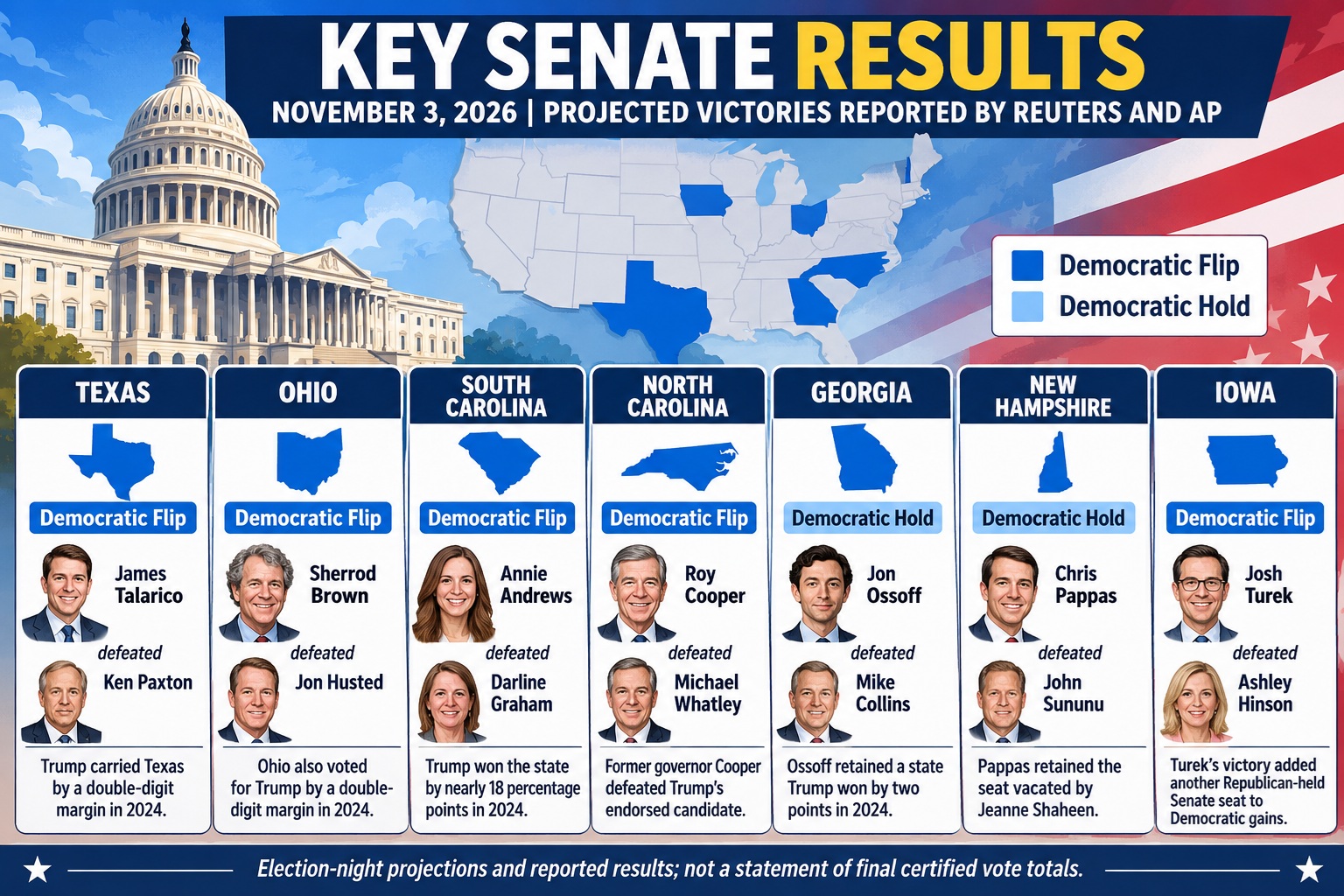
The results go beyond the expected midterm losses for a party controlling the White House. Democrats have secured victories in Texas, Ohio, South Carolina and North Carolina, states that supported Trump in the 2024 presidential election. The Associated Press also reported further Democratic Senate gains, including Iowa, taking the party’s pickups to five in its latest election-night assessment.

In the House of Representatives, Democrats defeated Republican incumbents and captured open seats, putting them within reach of the three-seat net gain required to secure a majority.

The geographical spread of the results is particularly important. Democratic victories in Texas, Ohio and South Carolina indicate that the party’s gains have extended into states where Republicans had entered the election with substantial advantages.

The results also raise questions about whether Trump’s 2024 electoral coalition, which included significant gains among younger, Black and Latino voters, has remained intact.

Texas, Ohio and South Carolina: Where the Republican Map Shifted

The Senate results offer the clearest indication of the scale of the Democratic gains.


Election-night projections and reported results; not a statement of final certified vote totals.

The Texas result is particularly consequential. Democrat James Talarico defeated Republican Ken Paxton, delivering the party a Senate victory in a state that has not voted for a Democratic presidential candidate since 1976. Democrats also secured the Senate seat in Ohio, where former senator Sherrod Brown defeated Republican incumbent Jon Husted.

In South Carolina, paediatrician Annie Andrews defeated Republican Darline Graham, who had been appointed to the seat following the death of her brother, Senator Lindsey Graham.

The outcomes also exposed the importance of candidate selection. Trump backed Paxton and Graham despite controversies surrounding their candidacies. Paxton faced a history of legal and political controversies, including his 2023 impeachment by the Texas House, while Graham’s limited electoral experience attracted scrutiny.

North Carolina added another Republican-held seat to the Democratic column. Former governor Roy Cooper defeated Michael Whatley, the former Republican National Committee chairman backed by Trump.

Democrats also defended seats in Georgia and New Hampshire. Jon Ossoff defeated Republican Mike Collins, while Chris Pappas won the New Hampshire contest against former senator John Sununu.

The results are significant when compared with the Senate’s starting position. Republicans entered the election with 53 seats against 47 held by Democrats and independents who caucus with them. Democrats needed a net gain of four seats to secure control.

The Associated Press subsequently reported five Democratic Senate pickups, although the final chamber balance remained subject to outstanding contests and the status of all races.

Economic Dissatisfaction, Trump’s Approval and the House Battle

The election results also provide measurable evidence of voter dissatisfaction with the administration’s economic performance.

The AP Voter Poll found that approximately two-thirds of voters believed Trump’s policies had worsened economic conditions, while only around three in 10 said they had improved them.

Tariffs also faced considerable opposition. Roughly two-thirds of voters said Trump’s tariff policies had harmed the US economy.

The survey identified the following concerns:

Voter assessment Finding
Trump’s policies worsened economic conditions About 66%
Trump’s policies improved economic conditions About 30%
Disapprove of Trump’s presidency About 60%
Want more congressional checks on the president About 70%
Economy is the country’s most important issue About 40%
Democracy is the most important issue About 30%
Angry or dissatisfied with the country’s direction About 75%

The economy was therefore not simply another campaign issue. It was a central measure through which voters assessed the administration.

Higher fuel prices, inflation, tariffs and the cost of living featured prominently in the campaign. Trump’s decision to launch military action against Iran in February also became a domestic political issue as the conflict contributed to higher energy costs.

The findings suggest that Republican candidates faced a difficult combination of economic dissatisfaction and concerns about presidential accountability.

The House results reinforce that pattern. Republicans entered the election with 218 seats, alongside an independent who caucuses with them, against 214 Democrats and two vacancies, according to CBS News. Democrats needed a net gain of just three seats.

Reuters reported that Democrats had flipped at least eight Republican-held districts in states including Kentucky, New Jersey and North Carolina during its election-night update. Subsequent AP reporting placed Democrats within reach of the majority, with several races still being counted.

Florida offered another useful comparison. Republican Senator Ashley Moody defeated Democrat Angie Nixon, but her lead was only around three percentage points in a state Trump won by 13 points in 2024. Democrats also retained three Florida congressional districts that Republican lawmakers had redrawn, despite those constituencies having backed Trump by at least nine percentage points.

These results suggest that the Republican difficulties were not confined to a handful of Democratic strongholds.

The historical comparison is also important. The party of the sitting president has lost congressional ground in all but two midterm elections since World War Two. The 2026 results are consistent with that longer-term pattern, but the number of Republican-held states and districts changing hands gives this election a wider geographical dimension.

For Trump, losing control of the House would mean facing a Democratic-led chamber capable of launching investigations, issuing subpoenas and obstructing parts of his legislative agenda. A Democratic Senate majority would also give the opposition greater influence over presidential nominations and judicial appointments.

However, congressional control does not automatically translate into the ability to reverse presidential policies. Trump retains veto powers, and Democrats would need sufficient congressional support to overcome them.

The immediate political consequence is a more contested final two years of Trump’s presidency. The election has shifted the balance of congressional power towards Democrats, while the results in traditionally Republican states have raised questions about the durability of the coalition that returned Trump to the White House in 2024.

(With inputs from agencies)

US Midterm Elections 2026: Live – Trump’s midterm defeat exposes voter anger more on living costs than Iran war

The early results point to a major test of Republican control of Congress. Democrats have secured important Senate victories, while several battleground races remain unresolved. The outcome will determine how much room Trump has to advance his legislative agenda during the second half of his term. The following is the opening sequence for the rolling report. 

Nov. 4, 2026 | 14:10 IST :

Trump’s midterm defeat exposes voter anger over living costs

The 2026 US midterm elections have delivered a decisive verdict on President Donald Trump’s second-term agenda, with economic anxiety, dissatisfaction with the administration and opposition to the war with Iran emerging as major factors behind the Democratic sweep of Congress.

Exit polls indicate that the cost of living was a central concern for voters. A CNN exit poll found that approximately 90% of respondents considered living costs a crucial or major factor in their vote.

The findings suggest that household economic pressures have become a significant political liability for Republicans, even in states that supported Trump in the 2024 presidential election.

The Associated Press exit poll also found widespread concern about inflation, with approximately 80% of voters saying rising prices had caused moderate or severe financial hardship.

More than 80% expressed concern about the cost of groceries, gasoline, utilities and healthcare.

The results come as Democrats have won control of both the House and Senate, flipping seven Republican-held Senate seats and making substantial gains in the House.

Iran war becomes another political liability

The war with Iran also emerged as a major factor in the election.

According to the CNN exit poll, approximately 60% of voters believed the United States had made the wrong decision in attacking Iran. Around one-third said the conflict was a crucial factor in their congressional vote.

The findings point to a broader challenge for Trump: voters were not only concerned about domestic economic conditions but also about the administration’s foreign policy.

The Democratic victories in traditionally Republican states, including Texas, Kansas and South Carolina, indicate that the political impact extended beyond the party’s traditional strongholds.

Democratic control reshapes Washington

The Democratic takeover of Congress will give the party greater authority over legislative priorities and congressional oversight.

The new majority can block Republican legislation, challenge administration nominees and launch investigations into the Trump administration.

The election results also raise questions about the political direction of the country ahead of the 2028 presidential contest.

Trump has rejected the idea that the midterm results represent a judgment on his presidency, despite the scale of Republican losses.

The election, however, has substantially weakened the administration’s congressional position and given Democrats a stronger platform to challenge the president’s policies.

Nov. 4, 2026 | 13:20 IST :

Susan Collins loses Maine Senate seat as Democrats complete historic seven-seat sweep

Democrats have delivered another major blow to Republicans in the 2026 US midterm elections, defeating five-term Senator Susan Collins in Maine and completing a seven-seat sweep that has handed the party control of the US Senate.

Democratic candidate Troy Jackson defeated Collins, ending her nearly three-decade career in the Senate and eliminating one of the Republican Party’s most established political strongholds.

The Associated Press called the race for Jackson, confirming the latest Democratic pickup in an election that has dramatically altered the balance of power in Washington.

Democrats needed a net gain of four seats to reclaim the Senate. They have now secured control of the chamber, with 53 seats called for Democrats against 41 for Republicans in the latest reported tally. Remaining contests will determine the final composition.

Collins had been one of the most closely watched Republican incumbents of the election cycle. Her defeat is particularly significant because Maine has repeatedly returned her to the Senate despite its competitive political landscape.

The result completes a remarkable series of Democratic victories in traditionally Republican territory, including Texas, Kansas, Iowa, Ohio, North Carolina and South Carolina.

The Senate outcome also represents a direct political rejection of Trump’s campaign strategy. The president repeatedly intervened in competitive races, endorsed candidates and urged voters to treat the midterms as a referendum on his administration.

Democrats are now positioned to take control of Senate committees, influence legislative priorities and exercise greater oversight of the Trump administration.

The change in congressional power will have consequences extending beyond the immediate election. Trump’s ability to secure Senate approval for nominations and advance his legislative programme will become more complicated.

The Democratic victory in Maine also demonstrates the scale of the Republican losses. Collins had survived previous difficult elections, but the national political environment proved decisive this time.

Nov. 4, 2026 | 10:20 AM IST :

Sherrod Brown’s Ohio comeback deals another blow to Trump as Democrats close in on Senate control

Democrat Sherrod Brown has defeated Republican incumbent Jon Husted in Ohio, securing a dramatic return to the US Senate and delivering another setback to President Donald Trump’s Republican Party in the 2026 midterm elections.

Brown’s victory is particularly significant because Ohio has increasingly leaned Republican in recent presidential elections. He previously represented the state in the Senate for 18 years before losing his seat in 2024.

Husted was appointed to the Senate in 2025 after JD Vance became vice-president. The special election determined who would serve the remaining two years of Vance’s Senate term.

The contest became a major test of whether Democrats could rebuild support among working-class and rural voters who have increasingly moved towards Republicans.

Brown made the cost of living a central issue in his campaign, criticising Trump’s tariff policies, the administration’s war with Iran and the expansion of data centres.

The data-centre issue also emerged as a significant campaign flashpoint. Brown accused Husted of being closely associated with the industry, arguing that its expansion was contributing to higher electricity bills and placing additional pressure on communities.

Husted had supported legislation intended to protect electricity consumers from the costs associated with data-centre expansion, but Brown criticised the proposal as inadequate.

The Ohio result adds to a series of Democratic victories in the Senate, bringing the party closer to reclaiming control of the chamber.

Democrats entered the election needing a net gain of four Republican-held seats to secure an outright majority.

The broader results also suggest that economic concerns, particularly household expenses, energy costs and dissatisfaction with Trump’s policies, have become central factors in the midterm verdict.

The emerging Democratic gains could significantly constrain Trump’s legislative agenda if the party secures control of both chambers of Congress.

However, the final balance of power will depend on the remaining uncalled races.

Nov. 4, 2026 | 9:53 AM IST : Democrat James Talarico stuns Trump-backed Ken Paxton in Texas Senate race

Democrats have delivered one of the biggest shocks of the 2026 US midterm elections, with James Talarico defeating Republican Ken Paxton in Texas, a state that has not elected a Democrat to statewide office in more than three decades.

The victory marks a major setback for President Donald Trump, who backed Paxton in the closely watched Senate contest. Talarico’s win, alongside Democratic victories in North Carolina, Georgia and New Hampshire, has intensified the battle for control of Congress.

The Associated Press reported that Talarico’s victory makes him the first Democrat to win statewide office in Texas in more than 30 years.

The Texas race was among the most consequential Senate contests of the election, with Republicans defending their majority in the chamber. Democrats entered the election needing a net gain of four seats to take control of the Senate.

Talarico’s victory raises the possibility of a broader Democratic resurgence in traditionally Republican territory, potentially reshaping the political landscape ahead of the 2028 presidential election.

The result also adds to a difficult night for Trump-backed candidates. Republicans have faced setbacks in several competitive races as voters expressed concerns about inflation, the cost of living and the direction of the country.

In South Carolina, Democrat Annie Andrews defeated Republican Darline Graham, becoming the state’s first woman senator and its first Democratic senator in more than two decades, according to the Associated Press.

Democrats have also won Senate races in Georgia and New Hampshire, while making gains in competitive House contests.

The outcome of the midterms will determine whether Trump faces a Democratic-controlled chamber during the final two years of his presidency. A Democratic takeover would give the party greater power to investigate the administration, challenge legislation and shape congressional oversight.

However, control of the Senate and House remains dependent on the remaining unresolved races.

9:20 AM IST | Keisha Lance Bottoms wins Georgia governorship, makes US history

Democrat Keisha Lance Bottoms has won Georgia’s gubernatorial election, becoming the first Black woman elected governor in the United States.

Her victory marks a historic breakthrough in American electoral politics and adds to a strong series of Democratic results in Georgia.

The outcome comes as Democrats seek to translate voter dissatisfaction with the Trump administration into victories across federal and state-level contests.

The Georgia result also carries national significance as both parties assess the political landscape ahead of the 2028 presidential election.

The gubernatorial race was among 36 contests for state governors held during the 2026 midterm elections.

Bottoms’ victory is one of the most consequential state-level outcomes of election night, alongside the closely watched congressional races that will determine control of Washington.

9:00 AM IST | Democrats hold Georgia and New Hampshire Senate seats, block Republican gains

Democrats have held key Senate seats in Georgia and New Hampshire, strengthening their position in the battle for control of the chamber.

Senator Jon Ossoff has won re-election in Georgia, defeating Republican challenger Mike Collins. The victory prevents Republicans from making a major gain in a state that has emerged as a central battleground in national politics.

In New Hampshire, Democrat Chris Pappas defeated Republican John Sununu, blocking a potential Republican pickup in another closely contested race.

The results follow Democrat Roy Cooper’s victory in North Carolina, giving Democrats a series of important Senate outcomes as the midterm count continues.

The party still needs additional gains to secure a majority. Several competitive Senate races remain unresolved, leaving control of the chamber uncertain.

The results are also an early indication of the political environment facing Trump as voters assess his administration’s performance.

8:40 AM IST | Democrats flip North Carolina Senate seat as Roy Cooper defeats Republican

Democrats have scored a crucial victory in the US Senate, with former North Carolina Governor Roy Cooper defeating Republican Michael Whatley in a closely watched race that could reshape control of Congress.

Cooper’s victory marks a significant Democratic pickup in a state President Donald Trump carried in the 2024 presidential election. The result strengthens the party’s position as it attempts to reclaim the Senate majority.

The race was among the most closely watched contests of the 2026 midterm elections, with Democrats targeting Republican-held and open Senate seats across several states.

The Senate outcome remains unsettled, with multiple battleground contests still awaiting final results. Democrats need additional victories to take control of the chamber, while Republicans are fighting to preserve their majority.

The results will determine whether Trump faces a divided Congress during the second half of his presidency.


Democrats Flip North Carolina Senate Seat, Deal Blow to Trump

Democrats scored a major breakthrough in the US midterm elections, flipping a Republican-held Senate seat in North Carolina and winning key contests in Georgia and New Hampshire, as early results pointed to growing resistance to President Donald Trump’s leadership.

Former North Carolina Governor Roy Cooper defeated Trump-backed Republican Michael Whatley, securing a crucial seat for Democrats in their battle to regain control of the Senate. The victory marks a significant setback for Republicans in a state that backed Trump in the 2024 presidential election.

Democratic Senator Jon Ossoff also won re-election in Georgia, defeating Republican challenger Mike Collins, while Chris Pappas retained New Hampshire’s open Senate seat for the party by defeating former Senator John Sununu.

The results have strengthened Democratic hopes of breaking the Republican grip on Congress during the final two years of Trump’s presidency. However, control of both chambers remained uncertain as votes continued to be counted across several states.

The House of Representatives appeared increasingly favourable to Democrats, while the Senate contest remained closely fought.

Republicans entered the elections with a 53-47 Senate majority. Democrats need a net gain of four seats to take control of the chamber, while three additional seats would give them a House majority.

Republicans Face Unexpected Resistance in Florida

Florida delivered another surprise for Democrats, with the party holding three House constituencies that Republican lawmakers had redrawn earlier this year to improve their electoral prospects.

All three districts had supported Trump by at least nine percentage points in the 2024 presidential election.

Republican Senator Ashley Moody, however, defeated Democratic challenger Angie Nixon in the state’s Senate contest. Moody’s victory came despite a much narrower margin than Trump’s 13-point win in Florida two years ago.

The results suggested that Republicans were struggling to translate Trump’s previous electoral advantage into support for candidates in several key contests.

The election has turned into a crucial test of public opinion on Trump’s second presidency, with economic pressures, rising fuel prices and the administration’s policies emerging as major voter concerns.

Exit polls conducted by SSRS for a consortium of US media organisations, including major television networks and the Associated Press, showed widespread dissatisfaction with the country’s direction.

Around half of voters said they viewed the midterm elections as an opportunity to rebuke Trump. Three-quarters described themselves as angry or dissatisfied with the way the country was heading.

About 70% also said they wanted Congress to exercise greater checks and balances on the president.

The findings could provide Democrats with political momentum as they seek to challenge Trump’s legislative agenda and increase scrutiny of his administration.

Trump Faces Political Test as Democrats Seek Congressional Control

The results represent an early warning for Republicans, who have historically struggled to retain congressional seats during midterm elections.

Since World War Two, the party holding the White House has lost ground in Congress in all but two midterm elections.

Trump’s approval ratings have been hovering near their lowest levels, with voters expressing frustration over the war with Iran, higher energy costs, tariffs and broader affordability concerns.

Republicans, led by Trump, sought to portray Democratic candidates as radical and out of touch with American voters. Democrats rejected those accusations and focused their campaigns on the cost of living and the president’s performance.

Trump held more than two dozen campaign rallies since the beginning of October, largely in states he had comfortably won in 2024, underscoring the Republican effort to protect its electoral position.

The election also drew scrutiny over the federal government’s role in monitoring voting. The Justice Department said it had deployed 1,000 election monitors and observers across all 50 states, describing it as the largest Election Day monitoring exercise in US history.

Democrats criticised the deployment, warning that federal monitoring could intimidate voters. Officials in several states reported no major problems, although New Mexico authorities said they had received complaints about federal monitors asking unusual questions in one county.

Meanwhile, the Senate race in Alaska became embroiled in controversy following allegations that Democratic candidate Mary Peltola’s campaign helped recruit an independent candidate with the same first and last name as Republican incumbent Dan Sullivan.

Peltola denied involvement. The Justice Department opened a criminal investigation into the allegations and filed a lawsuit seeking to block certification of the results. A judge dismissed the lawsuit.

With several important contests still being counted, the final composition of Congress remained unclear. But the early victories in North Carolina, Georgia and New Hampshire have put Democrats in a stronger position and intensified pressure on Trump as he approaches the second half of his presidency.

TRAI Introduces New Telecom Interconnection Rules, Implementation to Begin January 2027

The Telecom Regulatory Authority of India (TRAI) has issued the Telecommunication Interconnection (Third Amendment) Regulations, 2026, introducing changes to network connectivity, IP-based interconnection and related regulatory requirements.

The new regulations will come into effect on January 1, 2027. They aim to update the existing interconnection framework to reflect technological advancements and improve the efficiency of communication between different telecom networks.

Telecommunication interconnection refers to the technical, operational and commercial arrangements that connect two or more telecom networks. These arrangements allow telecommunications traffic to flow between networks and enable users of different service providers to communicate seamlessly.

Under Section 11(1)(b) of the TRAI Act, 1997, TRAI is empowered to prescribe the terms and conditions of interconnection between service providers and ensure technical compatibility and effective connectivity between their networks.

TRAI Reviews Existing Interconnection Regulations

TRAI initiated a review of its existing regulatory framework through a pre-consultation paper titled Review of the Existing TRAI Regulations on Interconnection Matters, issued on April 3, 2025. Stakeholders were invited to submit comments on several issues, including the Telecommunication Interconnection Regulations, 2018.

Following this process, TRAI issued a consultation paper on November 10, 2025, incorporating background information and stakeholder feedback received during the pre-consultation stage. After an extension, the final dates for submitting written comments and counter-comments were December 15 and December 29, 2025, respectively.

Seventeen stakeholders submitted comments on the consultation paper, while nine submitted counter-comments. TRAI also conducted an Open House Discussion on January 28, 2026. Following an analysis of the feedback received, the authority finalised the third amendment regulations.

Key Changes Under the Third Amendment Regulations

The amendment introduces several changes to the existing framework governing telecom interconnection.

1. Interconnection at the Licensed Service Area level

The new regulations allow interconnection providers and seekers to mutually agree on locations for handing over or receiving telecommunications traffic. The framework facilitates a transition from interconnection at the Long Distance Charging Area (LDCA) and Short Distance Charging Area (SDCA) levels to the Licensed Service Area (LSA) level.

Moving traffic handovers to LSA-level points of interconnection (POIs) is expected to simplify routing, improve the management of scarce numbering resources, reduce latency and enhance service reliability.

2. Migration of existing traffic to LSA-level POIs

Existing traffic, measured in Minutes of Usage (MoUs), at LDCA- and SDCA-level POIs must be migrated to LSA-level POIs within three years. The transition will take place in phases. After the migration, all traffic will be handed over or received through LSA- or Service Area-level POIs.

3. Transition to IP-based interconnection

The amendment requires all new interconnections established after the regulations come into force to use IP-based technology.

Existing POIs operating through E1 or Time Division Multiplexing (TDM)-based interconnection must also migrate to IP-based interconnection within three years, following a phased approach. This transition is expected to improve bandwidth efficiency, call quality and end-to-end call performance.

4. Capacity augmentation for IP-based interconnection

For IP-based interconnection, the maximum call-handling capacity at a POI will be determined by considering its concurrent session-handling capability and link bandwidth. The capacity must also maintain the required Quality of Service under relevant TRAI regulations.

5. New procedure for voluntary surrender of POIs

TRAI has introduced a specific regulatory framework for the surrender of POIs. Previously, the regulations provided for the disconnection of a POI, which stops the exchange of traffic due to exceptional circumstances arising from differences between service providers.

The new surrender procedure addresses voluntary closure of a POI by a service provider for its own operational requirements. Reasons may include declining traffic, withdrawal of services from an area or traffic rerouting. The change is intended to improve financial efficiency.

6. Revised bank guarantee provisions

The existing bank guarantee framework has been retained, but the validity period of guarantees furnished following reassessment and the interval between reassessments have been extended from six months to twelve months.

TRAI has also introduced a revised methodology for determining the ceiling on bank guarantees for POIs, including those using IP-based interconnection.

7. Interest on delayed interconnection payments

The amendment introduces a provision covering delays in the payment of interconnection charges and interconnection usage charges. Service providers may mutually agree on the applicable interest rate, subject to a maximum of the State Bank of India’s one-year Marginal Cost of Funds-based Lending Rate (MCLR) plus two percentage points.

8. Additional reporting requirements

Service providers will have to comply with reporting requirements to monitor the migration of traffic from LDCA- and SDCA-level POIs to LSA-level POIs. The reporting framework will also track the transition from E1/TDM-based to IP-based interconnection.

9. Graded financial disincentives

The amendment introduces a graded framework of financial disincentives for violations of the regulations. The revised approach is intended to make enforcement more effective and proportionate to the nature and seriousness of each contravention.

New Rules Aim to Strengthen Telecom Network Connectivity

The provisions covering delayed payment interest, reporting requirements and financial disincentives are intended to support effective implementation and enforcement of the amended regulations.

By aligning interconnection rules with technological developments and changes in the telecom sector, TRAI aims to strengthen connectivity between service providers and facilitate seamless communication across networks. The framework also seeks to provide greater regulatory certainty while maintaining effective interconnection, transparency, non-discrimination and fair competition.


Read More :

US Midterms 2026: 1,000 Election Monitors Deployed Across All 50 States

Adam Robinson: From Wall Street to AI Entrepreneurship Before Fatal Florida Learjet Crash

Aditya-L1 Observations Reveal Asymmetric Expansion of Solar Eruption, Offering New Space Weather Insights

Scientists analysing observations from India’s Aditya-L1 solar observatory have discovered that a coronal mass ejection expanded asymmetrically, providing new insights into solar eruptions and their potential effects on space weather.

India’s first space-based solar observatory, Aditya-L1, has helped researchers uncover new details about the expansion of a coronal mass ejection (CME), a type of solar eruption. The findings could improve scientists’ understanding of space-weather disturbances that may affect satellites and communication networks.

Launched in September 2023, Aditya-L1 is operational at the Sun–Earth L1 point, where it continuously observes the Sun. The spacecraft carries seven scientific payloads, including the Visible Emission Line Coronagraph (VELC), its primary instrument, which is designed to observe the solar corona simultaneously in different modes.

Researchers from the Indian Institute of Astrophysics (IIA), an autonomous institution under the Department of Science and Technology (DST), combined VELC observations with data from NASA’s Solar Dynamics Observatory (SDO) and three-dimensional modelling to reconstruct the geometry and dynamics of a solar eruption.

Aditya-L1 and NASA Observations Reveal Uneven CME Expansion

The researchers examined a CME that occurred on August 5, 2024, originating from an active region near the Sun’s western limb.

“We observed the CME that occurred on 5 August 2024 using the VELC as well as data from the Atmospheric Imaging Assembly (AIA) onboard NASA’s Solar Dynamics Observatory (SDO)”, explained Saurabh Tripathi, a PhD student at IIA, and lead author of the study.

VELC’s spectroscopic observations detected an unusual Doppler pattern involving both blueward and redward shifts in the emission. These shifts indicate plasma moving towards and away from the observer, respectively.

“Our results show that the CME did not expand uniformly. The AIA images captured how the CME propagated across the sky, while VELC revealed the motion of the expanding CME bubble towards and away from us,” Tanmoy Samanta, a solar astronomer at IIA and the corresponding author of the study elaborated.

Together, the observations showed that the eruption developed an asymmetric shape because of its non-uniform expansion.

VELC Spectroscopy Helps Track Plasma Motion

VELC studies newly developing CMEs through spectroscopy using the 530.3-nanometre green emission line produced by highly ionised iron atoms in the solar corona.

This emission captures hot coronal plasma at temperatures of approximately 1.8 million Kelvin. Changes in the wavelength of the emission, known as Doppler shifts, provide information about plasma velocity along the line of sight and close to the solar disk.

The instrument was designed and fabricated by IIA at its MGK Menon Lab for Space Sciences on the CREST campus in Hosakote, with substantial support from the Indian Space Research Organisation (ISRO).

Three-Dimensional Model Confirms Asymmetric Solar Eruption

To investigate the unusual spectral observations, researchers developed a three-dimensional geometric-kinematic model of the expanding CME.

“To understand the unusual spectral pattern observed by VELC, we then developed a 3-D geometric-kinematic model of an expanding CME”, said Jayant Joshi of IIA and a co-author.

The researchers used the model to examine how the CME’s orientation and uneven sideways expansion could produce the observed spectral structures.

A model assuming symmetric expansion failed to reproduce the observations. However, a model incorporating an inclined CME axis and asymmetric lateral expansion generated a spectral pattern and temporal evolution similar to those recorded by VELC.

The team plans to apply this technique to other CMEs to reconstruct their motion without depending entirely on observations from multiple viewing positions in space.

This approach is particularly useful in the lower solar corona, where CMEs evolve rapidly and imaging alone cannot determine plasma motion along the line of sight.

Findings Could Improve Understanding of Space Weather

The discovery could have implications for understanding how solar eruptions travel through space and potentially affect Earth.

“The asymmetric shape of an early CME can have important implications for how it interacts with the solar wind and experiences drag during its propagation through the heliosphere. Such effects can influence the CME’s speed and, ultimately, its arrival time at Earth”, said Joshi.

By revealing the three-dimensional behaviour of CMEs during their early development, the study provides additional insights into the processes that influence solar eruptions and their propagation towards Earth.


Read More :

Sacred Relics of Lord Buddha Arrive at Tawang Monastery

24-Year X-ray Study Reveals Changing Accretion Behaviour of Bright Source in Nearby Galaxy

Indian Navy Rescues Hijacked Fishing Vessel and 20 Crew Members off Somalia Coast

The Indian Navy has rescued a hijacked fishing vessel, Azini, and all 20 crew members following an operation lasting more than 48 hours off the coast of Somalia.

The Indian Navy successfully freed the fishing vessel Azini from armed pirates in a coordinated operation that concluded with the safe rescue of all 20 crew members. No casualties or injuries were reported during the operation.

The vessel had reportedly been hijacked by an armed pirate group earlier in October off the north-eastern coast of Somalia. The incident raised concerns over maritime security, as the pirates could potentially use the fishing vessel as a mother ship to launch further attacks against merchant shipping in the region.

Indian Navy Deploys Warship and Reconnaissance Aircraft

Following the hijacking, the Indian Navy deployed a mission-assigned warship to intervene, supported by a maritime reconnaissance aircraft.

The two platforms worked together to locate the vessel through persistent surveillance and track its movements. They also employed calibrated non-kinetic measures to restrict the vessel’s movement and prevent it from escaping.

Marine Commandos were subsequently augmented through a precision airdrop conducted by an Indian Air Force (IAF) C-17 aircraft.

Marine Commandos Secure Vessel and Rescue Crew

The Indian Navy carried out a coordinated tactical intervention to secure Azini and overcome the pirate threat. The operation resulted in the successful release of all 20 crew members, with no casualties or injuries.

The operation lasted more than 48 hours and involved coordination between the Indian Navy and the Indian Air Force. The successful rescue demonstrated the forces’ ability to conduct complex maritime security operations through coordinated action.

India Reaffirms Commitment to Maritime Security

The Indian Navy stated that the operation reflects its operational preparedness and ability to respond to maritime security threats through inter-service coordination.

It also highlighted India’s commitment to serving as a First Responder and Preferred Security Partner in the Indian Ocean Region.

The Navy reiterated its commitment to safeguarding seafarers, protecting vital maritime trade routes and maintaining a safe, secure and stable maritime environment across the Indian Ocean Region.


Read More :

US Midterms 2026: 1,000 Election Monitors Deployed Across All 50 States

Adam Robinson: From Wall Street to AI Entrepreneurship Before Fatal Florida Learjet Crash

India and US Begin Fifth Edition of Joint Tri-Service Exercise Tiger Triumph 2026

India and the United States have launched the fifth edition of their bilateral tri-service humanitarian assistance and disaster relief exercise, Tiger Triumph 2026, in Visakhapatnam.

The opening ceremony of Exercise Tiger Triumph 2026 was held on November 2 at the Maritime Warfare Centre (MWC), Visakhapatnam. The fifth edition of the India-US Bilateral Tri-Service Humanitarian Assistance and Disaster Relief (HADR) exercise is being conducted as a Tabletop Exercise (TTX) this year.

The exercise aims to strengthen coordination, joint planning and interoperability between the armed forces of both countries during large-scale humanitarian assistance and disaster relief operations.

The opening ceremony was presided over by Rear Admiral Vishal Bishnoi, Flag Officer Commanding Eastern Fleet, and Rear Admiral Joaquin J Martinez de Pinillos, Vice Commander, US Pacific Fleet.

Exercise Focuses on Joint Planning and Disaster Response

Tiger Triumph 2026 reflects the growing defence partnership between India and the United States and the convergence of their strategic maritime interests.

This edition aims to further improve interoperability between the two armed forces and facilitate the conduct of Combined Joint All-Domain Operations. Particular emphasis has been placed on planning and coordination for large-scale HADR operations.

Indian Armed Forces and NDRF Participate

The Indian contingent includes specialists from different domains of maritime operations from the Indian Navy, ground forces from the Indian Army and representatives from various units of the Indian Air Force.

Special Forces personnel from all three Services are also participating in the exercise. Additionally, a team from the National Disaster Response Force (NDRF) will participate in Tiger Triumph for the first time in its fifth edition.

US Joint Force Brings Multi-Domain Specialists

The US Joint Force comprises specialist representatives from different domains of the country’s armed forces, including the US Air Force, Army, Marine Corps and Navy.

The participating team also includes specialists in Space, Cyber, Medical and Explosive Ordnance Disposal.

Through the tabletop exercise, Indian and US personnel will work on strengthening joint planning and coordination for large-scale disaster response operations, with the broader objective of improving interoperability between the two countries’ armed forces.


Read More :

NASA Astronauts Install Seventh Roll-Out Solar Array During Spacewalk

Iran issues nuclear attack survival guide as US strikes Qeshm Island and tensions escalate

INS Sahyadri Completes Bilateral Naval Exercise with Republic of Korea Navy in Busan

The Indian Navy’s INS Sahyadri has concluded its participation in the bilateral naval exercise with the Republic of Korea Navy at Busan, strengthening maritime cooperation and operational coordination between the two countries.

INS Sahyadri successfully completed its participation in the India-Republic of Korea Navy (IN-RoKN) Bilateral Exercise at Busan, Republic of Korea, on October 29, 2026. The engagement focused on enhancing interoperability, mutual understanding and maritime cooperation between the two navies.

Harbour Phase Promotes Professional and Cultural Exchanges

During the harbour phase, personnel from the Indian Navy and the Republic of Korea Navy participated in professional discussions, cross-deck visits, operational briefings and Subject Matter Expert Exchanges.

These engagements provided opportunities for both navies to share operational perspectives and best practices. Cultural exchanges and sporting activities also helped build camaraderie and strengthen interpersonal relationships among participating personnel.

Sea Phase Features Joint Maritime Operations

The sea phase translated the professional exchanges into practical operational activities. INS Sahyadri and ROKS Munmu the Great conducted coordinated navigation, helicopter operations and joint maritime manoeuvres.

The activities allowed both navies to practise coordination at sea, gain a better understanding of each other’s operating procedures and improve their interoperability during maritime operations.

India and South Korea Strengthen Indo-Pacific Maritime Cooperation

The successful conclusion of the exercise reflects the shared commitment of India and the Republic of Korea to strengthening maritime cooperation through continued engagement and collaboration.

Such interactions help build mutual trust and contribute to collective efforts to maintain peace, stability and security across the Indo-Pacific region.


Read More :

Iran issues nuclear attack survival guide as US strikes Qeshm Island and tensions escalate

Netanyahu faces coalition test as India weighs future of $3.9 billion Israel partnership

Iran issues nuclear attack survival guide as US strikes Qeshm Island and tensions escalate

Iran has issued an unusually detailed public guide on surviving a nuclear explosion, advising residents to take shelter in basements, switch off air conditioners drawing outside air and remain indoors for at least 24 hours, as renewed US military strikes and warnings over a possible attack on its underground nuclear facilities intensify regional tensions.

The eight-minute educational video, published by Iran’s state news agency IRNA on October 29, outlines precautions against a nuclear blast, extreme heat, shock waves and radioactive fallout. The instructions were prepared by emergency services in Isfahan province, which houses the Natanz nuclear facility.

The advisory has gained attention as the United States carried out limited strikes on Iran’s Qeshm Island near the Strait of Hormuz on November 2. Washington described the operation as defensive, targeting Iranian forces and missile systems considered a threat to US assets. The strikes did not signal a return to major combat operations, according to US officials.

The timing has also renewed scrutiny of President Donald Trump’s repeated threats to target Pickaxe Mountain, a deeply buried nuclear-related facility near Natanz.

Trump said in an October 16 interview that the US might have to strike Pickaxe Mountain to prevent Iran from developing nuclear weapons. However, he explicitly ruled out using a nuclear weapon, saying: “I wouldn’t use nuclear. We don’t have to.”

The latest Iranian advisory does not establish that a nuclear attack is imminent. It was issued as part of the country’s annual Passive Defence Week, an initiative focused on preparing civilians for emergencies. But the detailed instructions have drawn attention because of the continuing military confrontation and uncertainty over Washington’s next move.

Shelter, switch off ACs and avoid radioactive fallout

The video identifies four major dangers from a nuclear explosion: intense light, blast waves, extreme heat and radioactive materials.

Ebrahim Adelzadeh, deputy director of education and research at the Isfahan Red Crescent Society, advised people to seek shelter in sturdy buildings, preferably in basements or central rooms away from windows.

“A basement or a room in the central part of a building, away from windows, can be a suitable shelter if it can be accessed safely,” Adelzadeh told IRNA.

Residents have been advised to close doors and windows and switch off air conditioners and ventilation systems that draw air from outside. Additional instructions recommend staying inside for at least 24 hours, using bottled water and packaged food, and avoiding vehicles as shelters.

People caught outdoors during an explosion have been told not to look directly at the flash. They should take cover behind a solid barrier, lie close to the ground and protect their heads and faces. Once the initial blast wave passes, they should enter the nearest sturdy building.

The advisory also warns against remaining outdoors to watch or photograph an explosion. If a shelter catches fire or faces the risk of collapse, people should move to another safe building.

Iran warns against self-medication with iodine tablets

Radioactive fallout is a central concern in the guidance. Airborne particles could travel beyond the immediate blast zone, exposing people who are not close to the explosion.

Adelzadeh urged residents far from a potential attack site to take official warnings seriously and follow instructions from emergency authorities.

People who may have been exposed to radioactive dust have been advised to remove outer clothing carefully, seal it in a bag and wash exposed skin and hair with soap and water. The guidance also recommends using packaged food and bottled water to reduce the risk of consuming contaminated supplies.

Abbas Abedi, spokesperson for Isfahan’s pre-hospital emergency services, cautioned against taking iodine tablets without medical advice.

“Stable iodine can, under certain conditions, reduce the absorption of radioactive iodine by the thyroid gland, but it does not provide protection against other radioactive materials or radiation resulting from an explosion,” he told IRNA.

The video also refers to Prussian Blue, a medicine used in certain cases of internal contamination involving radioactive caesium-137. Officials recommend keeping battery-powered radios because electromagnetic pulses could disrupt electronic equipment and communication systems.

Pickaxe Mountain remains a potential flashpoint

Pickaxe Mountain, located near Natanz in Isfahan province, has become a focus of US and Israeli concern because of its heavily fortified underground facilities. The complex is buried beneath a granite mountain, making it a difficult target for conventional weapons.

The precise activities inside the facility remain unclear. International inspectors have not been given access to the site, while allegations that Iran has moved centrifuges there have not been independently established.

The latest US strikes on Qeshm Island came amid continuing diplomatic efforts to prevent a wider conflict. Iranian Deputy Foreign Minister Kazem Gharibabadi said Tehran remained open to negotiations through Qatari mediation while retaining the right to defend itself.

Iran’s survival guide therefore comes at a moment of heightened military uncertainty. Its publication signals a public preparedness effort, but does not by itself confirm that either Washington or Tehran expects a nuclear strike.

US Strikes Iran’s Qeshm Island Hours Before Midterms as Trump Signals Peace Deal

The United States launched fresh military strikes on Iran’s strategically important Qeshm Island hours before Americans voted in the November 3 midterm elections, exposing a sharp contradiction between President Donald Trump’s public assurances about diplomatic progress and Washington’s continuing military operations against Tehran.

President Trump confirmed the attack on Tuesday, describing it as a minor operation against an Iranian anti-aircraft installation. “They built an anti-aircraft facility… As soon as it was completed, we hit it last night very nicely,” he told Fox News.

US officials characterised the November 2 operation as defensive and limited, saying American forces targeted Iranian military capabilities threatening US assets and commercial shipping around the Strait of Hormuz.

The strikes came just hours after Trump suggested that Iran wanted a negotiated settlement and Vice President JD Vance expressed optimism about the prospects for an agreement.

The timing is politically significant as Republicans fight to retain control of Congress in an election increasingly shaped by the economic and political consequences of the Iran conflict.

Why Did the US Attack Iran’s Qeshm Island?

Qeshm Island occupies a strategically important position near the Strait of Hormuz, the narrow maritime passage between Iran and Oman through which approximately one-fifth of the world’s oil supplies normally transit.

The island hosts Iranian military infrastructure, including missile facilities and naval installations. Its location makes it important to Iran’s ability to influence maritime movement through the Gulf.

According to US officials cited by multiple media outlets, the latest strikes targeted Iranian forces using surface-to-air missiles against American assets.

A US official told reporters that the operation was intended to prevent Iran from using those capabilities to threaten American forces and shipping.

Iranian state media reported five explosions on Qeshm Island in rapid succession on November 2. Residents reportedly saw two aircraft flying over the island.

The US military did not immediately provide a detailed public account of the targets or damage. The Pentagon referred questions to US Central Command.

Trump Confirms Strike After Suggesting Iran Deal Was Possible

Trump’s confirmation came after he had publicly indicated that Washington and Tehran were moving towards a possible diplomatic settlement.

“Iran wants a settlement, as soon as possible. It could happen!,” Trump wrote on his Truth Social platform.

Vance also expressed optimism, saying that he and Trump felt positive about the possibility of reaching an agreement.

The diplomatic effort has involved indirect negotiations through regional intermediaries.

Iranian Foreign Minister Abbas Araghchi confirmed that discussions were taking place through mediators, identifying Qatar and Pakistan as active participants.

“Given the sensitivity and gravity of the current situation, consultations and deliberations are very intensive,” Araghchi told Iranian state media.

“Qatar and Pakistan are playing a very active mediating role in these negotiations.”

However, the Qeshm strikes demonstrated that military pressure remained part of Washington’s approach even as diplomatic contacts continued.

Netanyahu Presses Trump for Fresh Military Action

The latest operation also comes amid reported pressure from Israeli Prime Minister Benjamin Netanyahu for another round of US military strikes against Iran.

According to regional officials cited by US media, Netanyahu has urged Trump to consider additional military action after the American midterm elections.

The discussions have unfolded alongside diplomatic efforts involving Qatar and Iran. Regional officials said Qatari mediators had held two rounds of discussions with Iranian representatives.

One proposed framework reportedly involves Iran stopping attacks in the Strait of Hormuz in exchange for Washington lifting its blockade of Iranian ports.

The diplomatic negotiations remain complicated by disagreements over Iran’s nuclear programme, maritime security and economic restrictions.

Strait of Hormuz Conflict Raises Global Oil Concerns

The military confrontation has placed the Strait of Hormuz at the centre of the dispute.

The waterway normally handles approximately 20% of global oil consumption, making disruptions particularly consequential for major energy importers, including India.

Attacks on commercial vessels and restrictions on shipping have already disrupted maritime traffic.

The UK Maritime Trade Operations organisation has reported several recent incidents involving commercial vessels in the region. One tanker, RITI, was struck by an unidentified projectile or mine near Oman’s Musandam Peninsula on October 30, triggering a fire and the evacuation of 25 crew members by the Omani navy.

Washington has increasingly described its military operations as efforts to protect shipping and prevent Iranian forces from threatening commercial vessels.

The latest Qeshm operation suggests that the United States is continuing to target Iranian military infrastructure along the strategic waterway.

Will the Iran War Resume After the US Midterms?

Trump had previously suggested that a broader military campaign against Iran could resume after the November 3 elections.

However, he subsequently softened his public rhetoric, describing the fighting as largely over and indicating that a negotiated settlement remained possible.

The administration has nevertheless maintained military pressure through limited strikes, economic restrictions and a naval blockade.

The Qeshm attack raises questions about whether the current approach represents a temporary military containment strategy or preparation for another phase of the conflict.

For India and other major energy-importing countries, the central concern remains whether the Strait of Hormuz can return to normal commercial operations.

A renewed escalation could threaten oil supplies, increase shipping and insurance costs and add pressure to energy-importing economies.

For now, Washington and Tehran are pursuing diplomatic contacts while military operations continue, leaving the prospects for a lasting settlement uncertain.


Thailand Tourist Scam: Indian Man Charged ₹75,000 for ₹1,000 Herbal Product

An Indian tourist visiting Thailand was allegedly charged more than ₹75,000 on his credit card after agreeing to purchase a herbal product offered for approximately ₹1,000, triggering a police complaint in the popular resort city of Pattaya.

The 28-year-old tourist discovered that his card had been debited 27,600 Thai baht, although the seller had initially quoted just 380 baht. The charge was more than 72 times the advertised price.

The incident reportedly occurred late on October 28, 2026, along Pattaya’s Second Road. The tourist subsequently approached Pattaya City Police, seeking action against those responsible.

The case has renewed concerns about alleged overcharging involving herbal-product sellers targeting foreign visitors in Thailand’s tourist districts.

How did the Indian tourist end up paying ₹75,000?

According to The Pattaya News, the tourist was walking along Pattaya Second Road at approximately 11.30 pm when a man approached him and offered a herbal product for 380 baht.

The tourist agreed to buy the product, believing that the quoted amount was the final price. However, he later discovered that his credit card had been charged 27,600 baht, equivalent to more than ₹75,000.

The tourist reportedly believed the seller was Pakistani, although the man’s nationality has not been independently established in the available reporting. After discovering the discrepancy, the Indian visitor went to Pattaya City Police and lodged a formal complaint.

Sellers offer refund after police complaint

The situation reportedly took another turn after the tourist approached the police.

An individual associated with the sellers contacted him and offered to refund the amount charged to his credit card. The tourist was also asked to return the herbal product.

However, it remains unclear whether the refund was completed or whether police have taken further action against the people involved.

The incident has also raised questions about whether businesses selling herbal products in Pattaya’s tourist areas have the necessary business licences and work permits.

Similar herbal-product complaints in Thailand

The latest complaint follows several other reported incidents involving herbal-product sellers and foreign tourists in Pattaya.

In January 2026, a 45-year-old Indian tourist alleged that he had spent 43,400 baht on herbal products after being approached by foreign men near Soi Marine Plaza.

In September, a Sri Lankan tourist reportedly complained about being charged 3,300 baht for coconut oil marketed as a remedy for baldness.

Earlier, in June, Thai immigration officials arrested a Pakistani man suspected of acting as an intermediary in a similar herbal-product operation.

The repeated complaints have brought scrutiny to sales practices in tourist-heavy areas, particularly offers involving products promoted for hair loss, weight reduction and other health-related benefits.

What should Indian tourists watch out for?

Tourists visiting Thailand should be cautious about unsolicited sales approaches, particularly from strangers offering herbal remedies or products claiming health benefits.

Travellers using credit cards should:

  • Confirm the final price in Thai baht before agreeing to purchase.
  • Check the amount displayed on the payment terminal before entering a PIN or authorising a transaction.
  • Avoid signing blank or incomplete payment slips.
  • Retain receipts and transaction notifications.
  • Contact their card issuer immediately if an unauthorised or incorrect amount appears.
  • Report suspected fraud to local police.

The Pattaya incident highlights how a seemingly inexpensive tourist purchase can turn into a substantial financial dispute when the amount charged differs dramatically from the quoted price.


NASA’s Swift Observatory Is Falling Back to Earth: What to Know About the Impending Impact

NASA’s Neil Gehrels Swift Observatory, a space telescope that spent nearly 22 years studying cosmic explosions, is expected to re-enter Earth’s atmosphere on November 4, with the possibility of surviving debris reaching the surface.

The 3,200-pound (approximately 1,450-kg) observatory is making an uncontrolled descent after a $30 million rescue mission failed to raise it into a higher orbit. NASA says most of the spacecraft is expected to burn up during re-entry, while the risk of harm to people on Earth remains very low.

The impending re-entry marks the end of a mission that far exceeded its original two-year operating target and helped astronomers investigate some of the universe’s most powerful events.

When and where could Swift re-enter?

swift

How solar activity accelerated the descent

Swift’s orbit gradually deteriorated because of atmospheric drag. Increased solar activity in 2024 heated and expanded Earth’s upper atmosphere, increasing the drag acting on the spacecraft and accelerating its descent.

NASA and Katalyst Space Technologies attempted to save the observatory through a $30 million servicing mission. The robotic spacecraft LINK was intended to capture Swift and raise it into a higher orbit, potentially extending its scientific life by years.

The rescue effort was abandoned after LINK encountered problems with its orientation and stability. Swift’s final scientific observation took place on October 20, 2026, when it had descended to approximately 275 kilometres above Earth.

What Swift leaves behind

Swift was launched on November 20, 2004, to detect gamma-ray bursts, some of the most energetic explosions in the universe. Its three telescopes allowed it to observe cosmic events across multiple wavelengths and rapidly alert other observatories.

During its mission, Swift:

  • Observed more than 2,000 gamma-ray bursts.

  • Studied more than 1,400 supernova explosions.

  • Investigated stars being destroyed by black holes.

  • Contributed data to approximately 7,000 scientific papers.

  • Built a publicly accessible archive of nearly 22 years of observations.

NASA said the observatory’s scientific archive could support discoveries for decades after the spacecraft’s re-entry.

What happens next?

NASA and the US Space Force are continuing to track Swift’s descent and refine the re-entry forecast. The exact time and location of atmospheric entry will become clearer as the spacecraft approaches Earth.

The observatory’s re-entry also highlights the growing challenge of managing ageing spacecraft in low Earth orbit, where atmospheric drag can eventually bring satellites back to Earth without a controlled landing.


US Midterms 2026: 1,000 Election Monitors Deployed Across All 50 States

The 2026 US midterm elections opened Tuesday with Democrats seeking to wrest control of Congress from Republicans and establish the first major legislative check on President Donald Trump’s second term.

Around 1,000 election monitors have been deployed across all 50 states for the first time, according to the election report, as voters head to the polls in a contest widely viewed as a referendum on Trump’s presidency.

Democrats are seeking to capitalise on growing public frustration over rising living costs and the ongoing conflict with Iran. A victory in the House of Representatives would allow the party to block Trump’s legislative proposals and launch investigations into his administration.

All 435 seats in the House and 35 of the 100 Senate seats are being contested, alongside governorships in 36 states.

Democrats need to gain at least three House seats and secure a net gain of four Senate seats to take control of both chambers, according to the figures cited in the report.

US Midterms 2026: Voters Begin Casting Ballots in Maryland

Voters began arriving at polling stations in Gaithersburg, Maryland, as voting commenced on Tuesday, local time.

Several voters expressed hopes for political change and raised concerns about rising taxes and the country’s future.

Speaking to ANI, Maryland voter Heather Mullican said she was excited about the election and hoped it would bring significant changes to the country.

An early voter was also seen giving a thumbs-up after leaving a polling station, reflecting the early activity as Americans began casting ballots in the closely watched contest.

Why the 2026 Midterms Matter for Trump

The election could determine whether Trump retains Republican control of Congress during the remainder of his second term.

A Democratic takeover of the House would give the opposition party the power to block legislation and initiate congressional investigations into the administration.

The Senate contest is also critical. Democrats need a net gain of four seats to take control of the chamber, potentially reshaping the balance of power in Washington.

The election is unfolding amid voter concerns over the cost of living and the conflict with Iran, issues that have become central to the political debate.


Adam Robinson: From Wall Street to AI Entrepreneurship Before Fatal Florida Learjet Crash

Adam Robinson, a former Wall Street professional who built a portfolio of technology businesses, was among nine people killed when a private Learjet 60 crashed in Florida while travelling to the Bahamas.

The 45-year-old entrepreneur died alongside his wife, Helen Sharp, their two young children and five other people aboard the aircraft. The crash occurred near Greenacres in Palm Beach County on November 1, 2026.

Robinson was known for building software companies without relying heavily on venture capital. His career spanned investment banking, email marketing and artificial intelligence-powered business technology.

The crash has drawn attention to his entrepreneurial journey, his views on building businesses and the family life he had described as his greatest achievement.

Who Was Adam Robinson? From Lehman Brothers to AI Startups

Robinson grew up in Houston, Texas, and attended Rice University, where he graduated in 2003 with a degree in economics, Spanish and managerial studies.

He also played basketball for the university, earning two varsity letters during the 2000 and 2001 seasons.

After graduating, Robinson moved to New York City and began working as a credit trader at Lehman Brothers. He continued working in finance after the investment bank collapsed during the 2008 financial crisis, when Barclays absorbed much of its business.

Robinson spent approximately a decade on Wall Street before moving into entrepreneurship.

He later described the financial industry as lucrative but said he wanted to pursue work that offered greater personal fulfilment.

His early exposure to technology entrepreneurs in New York helped shape his decision to enter the startup industry.

How Robinson Built His Technology Businesses

Robinson co-founded Robly, an email marketing platform, before developing businesses focused on identifying website visitors and helping companies reach potential customers.

A feature developed at Robly to identify email addresses associated with website traffic became popular among customers. Robinson and his business partners eventually spun the technology into GetEmails.

He later founded Retention.com and RB2B, businesses that use technology to identify anonymous website visitors and provide companies with business contact information.

Robinson’s companies operated on a relatively lean model, relying on revenue rather than substantial outside investment.

He became an advocate for bootstrapping, arguing that entrepreneurs could build successful technology businesses without depending on venture capital.

In an April 2026 social media post, Robinson wrote: “You don’t need to crash a plane to learn to fly … and you don’t need VC to build a business.”

The post gained renewed attention following the crash.

Robinson’s Family Life and Business Philosophy

Robinson had spoken publicly about changing his approach to work after spending years in finance.

He said he wanted to avoid the long working hours that had affected other professionals’ relationships with their families.

In an April post, he recalled how people he knew on Wall Street worked 70, 80 or even 90 hours a week for their families, only to discover that their families wanted more of their presence.

He said he had decided early in his startup career that he would not follow that pattern.

Robinson described leaving work early, switching off his laptop and prioritising time with his children.

His wife, Helen Sharp, was a ceramic artist who had also worked in public relations. The couple had two children, Emma, 4, and Charlie, 2.

The family had relocated to Aspen, Colorado, where Robinson said he enjoyed spending time with his children and building businesses without extensive travel.

What Happened in the Florida Learjet Crash?

The Learjet 60, registered as N722BD, departed Austin-Bergstrom International Airport in Texas at approximately 10:37 a.m. local time on November 1.

The aircraft was headed to North Eleuthera Airport in the Bahamas, carrying seven passengers and two crew members.

It crashed near Greenacres in Palm Beach County at approximately 12:50 p.m., striking a roadway and triggering a large fire.

All nine people aboard were killed.

The victims included Robinson, Sharp, their children, their nanny Anita Maria Cetina, and family friends Rachael Reed and Charmi Fehr. The two pilots also died.

The National Transportation Safety Board is investigating the crash.

According to preliminary information released by investigators, the crew reported light clear icing and moderate turbulence while flying at approximately 35,000 feet.

The pilots later reported precipitation and requested permission to climb to 37,000 feet.

Less than 30 seconds later, the aircraft began a rapid descent and the crew issued a mayday call.

Investigators have said it is too early to determine the cause of the crash. Weather conditions, aircraft systems and flight-recording equipment are among the areas being examined.