

Democrats have made substantial gains in the 2026 US midterm elections, winning Senate seats in traditionally Republican states, defeating GOP incumbents and moving closer to taking control of both chambers of Congress in a significant setback for President Donald Trump.
The results go beyond the expected midterm losses for a party controlling the White House. Democrats have secured victories in Texas, Ohio, South Carolina and North Carolina, states that supported Trump in the 2024 presidential election. The Associated Press also reported further Democratic Senate gains, including Iowa, taking the party’s pickups to five in its latest election-night assessment.
In the House of Representatives, Democrats defeated Republican incumbents and captured open seats, putting them within reach of the three-seat net gain required to secure a majority.
The geographical spread of the results is particularly important. Democratic victories in Texas, Ohio and South Carolina indicate that the party’s gains have extended into states where Republicans had entered the election with substantial advantages.
The results also raise questions about whether Trump’s 2024 electoral coalition, which included significant gains among younger, Black and Latino voters, has remained intact.
Texas, Ohio and South Carolina: Where the Republican Map Shifted
The Senate results offer the clearest indication of the scale of the Democratic gains.
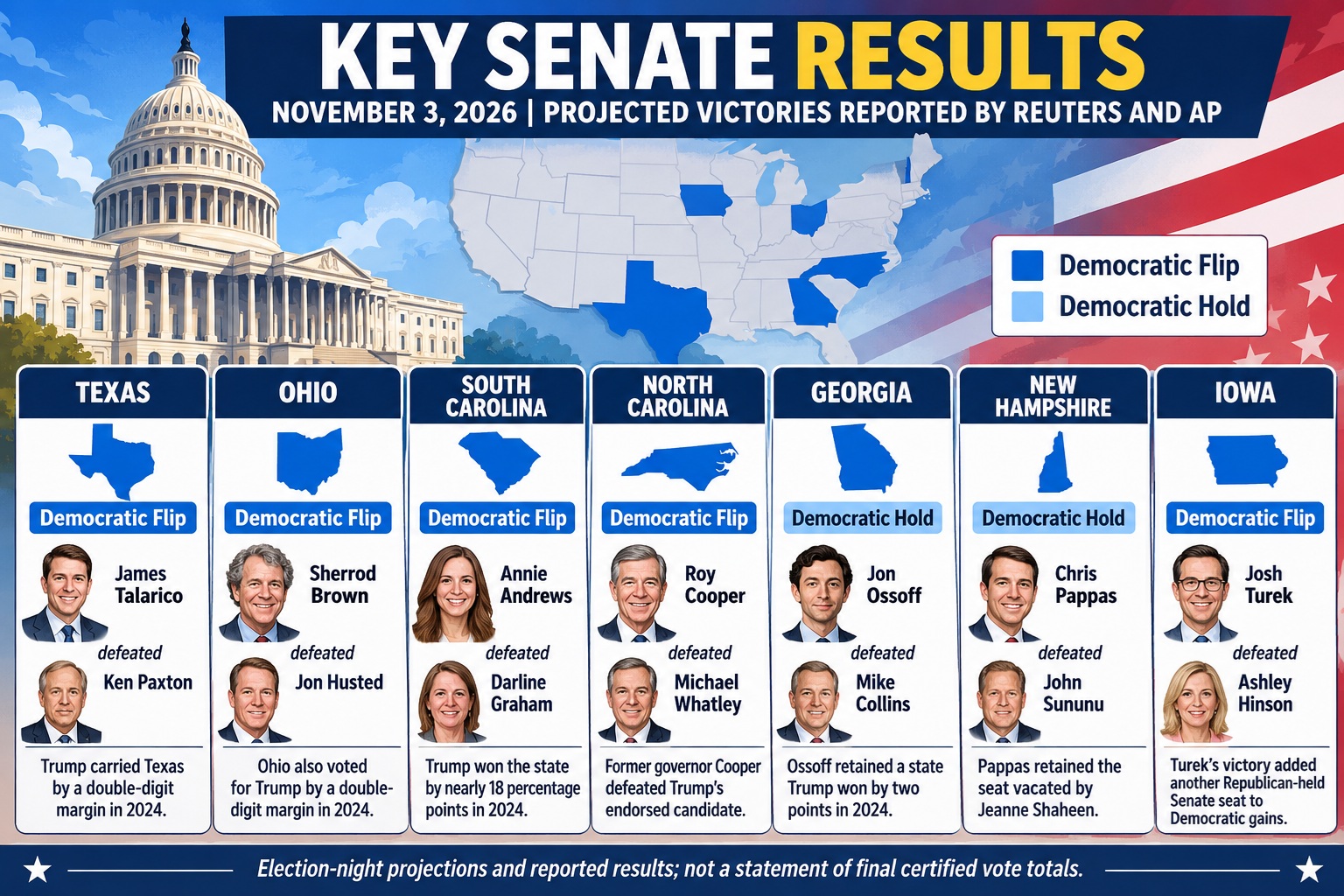

Election-night projections and reported results; not a statement of final certified vote totals.
The Texas result is particularly consequential. Democrat James Talarico defeated Republican Ken Paxton, delivering the party a Senate victory in a state that has not voted for a Democratic presidential candidate since 1976. Democrats also secured the Senate seat in Ohio, where former senator Sherrod Brown defeated Republican incumbent Jon Husted.
In South Carolina, paediatrician Annie Andrews defeated Republican Darline Graham, who had been appointed to the seat following the death of her brother, Senator Lindsey Graham.
The outcomes also exposed the importance of candidate selection. Trump backed Paxton and Graham despite controversies surrounding their candidacies. Paxton faced a history of legal and political controversies, including his 2023 impeachment by the Texas House, while Graham’s limited electoral experience attracted scrutiny.
North Carolina added another Republican-held seat to the Democratic column. Former governor Roy Cooper defeated Michael Whatley, the former Republican National Committee chairman backed by Trump.
Democrats also defended seats in Georgia and New Hampshire. Jon Ossoff defeated Republican Mike Collins, while Chris Pappas won the New Hampshire contest against former senator John Sununu.
The results are significant when compared with the Senate’s starting position. Republicans entered the election with 53 seats against 47 held by Democrats and independents who caucus with them. Democrats needed a net gain of four seats to secure control.
The Associated Press subsequently reported five Democratic Senate pickups, although the final chamber balance remained subject to outstanding contests and the status of all races.
Economic Dissatisfaction, Trump’s Approval and the House Battle
The election results also provide measurable evidence of voter dissatisfaction with the administration’s economic performance.
The AP Voter Poll found that approximately two-thirds of voters believed Trump’s policies had worsened economic conditions, while only around three in 10 said they had improved them.
Tariffs also faced considerable opposition. Roughly two-thirds of voters said Trump’s tariff policies had harmed the US economy.
The survey identified the following concerns:
| Voter assessment | Finding |
|---|---|
| Trump’s policies worsened economic conditions | About 66% |
| Trump’s policies improved economic conditions | About 30% |
| Disapprove of Trump’s presidency | About 60% |
| Want more congressional checks on the president | About 70% |
| Economy is the country’s most important issue | About 40% |
| Democracy is the most important issue | About 30% |
| Angry or dissatisfied with the country’s direction | About 75% |
The economy was therefore not simply another campaign issue. It was a central measure through which voters assessed the administration.
Higher fuel prices, inflation, tariffs and the cost of living featured prominently in the campaign. Trump’s decision to launch military action against Iran in February also became a domestic political issue as the conflict contributed to higher energy costs.
The findings suggest that Republican candidates faced a difficult combination of economic dissatisfaction and concerns about presidential accountability.
The House results reinforce that pattern. Republicans entered the election with 218 seats, alongside an independent who caucuses with them, against 214 Democrats and two vacancies, according to CBS News. Democrats needed a net gain of just three seats.
Reuters reported that Democrats had flipped at least eight Republican-held districts in states including Kentucky, New Jersey and North Carolina during its election-night update. Subsequent AP reporting placed Democrats within reach of the majority, with several races still being counted.
Florida offered another useful comparison. Republican Senator Ashley Moody defeated Democrat Angie Nixon, but her lead was only around three percentage points in a state Trump won by 13 points in 2024. Democrats also retained three Florida congressional districts that Republican lawmakers had redrawn, despite those constituencies having backed Trump by at least nine percentage points.
These results suggest that the Republican difficulties were not confined to a handful of Democratic strongholds.
The historical comparison is also important. The party of the sitting president has lost congressional ground in all but two midterm elections since World War Two. The 2026 results are consistent with that longer-term pattern, but the number of Republican-held states and districts changing hands gives this election a wider geographical dimension.
For Trump, losing control of the House would mean facing a Democratic-led chamber capable of launching investigations, issuing subpoenas and obstructing parts of his legislative agenda. A Democratic Senate majority would also give the opposition greater influence over presidential nominations and judicial appointments.
However, congressional control does not automatically translate into the ability to reverse presidential policies. Trump retains veto powers, and Democrats would need sufficient congressional support to overcome them.
The immediate political consequence is a more contested final two years of Trump’s presidency. The election has shifted the balance of congressional power towards Democrats, while the results in traditionally Republican states have raised questions about the durability of the coalition that returned Trump to the White House in 2024.
(With inputs from agencies)