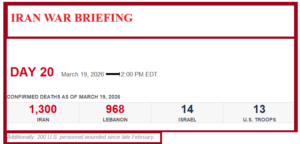
Iran War Update: Day 20 Witnesses Steep Surge in Brent Crude at $116

Iranian forces struck energy infrastructure across the Gulf on Thursday, triggering sharp movements in global oil and gas markets and widening a conflict that has now claimed more than 2,200 lives across four parties in 20 days. Brent crude, the international benchmark, surged past $116 a barrel while European gas prices rose more than 30 percent in a single session, as traders priced in the risk of prolonged supply disruption across the world’s most critical energy corridor.

The Trump administration responded on two fronts: a direct threat to destroy one of the world’s largest gas reserves if Iranian attacks on Qatari infrastructure continued, and a separate signal that Washington was prepared to release sanctioned Iranian oil to keep prices in check.
Energy and Market Impact

Brent crude closed above $116 a barrel on Thursday, a level not seen since the early months of Russia’s invasion of Ukraine in 2022, driven by Iranian attacks on Qatari LNG sites and widening threats to Gulf energy facilities. European gas prices climbed more than 30 percent in the same session.

The immediate trigger was “extensive” damage to Qatari LNG facilities, confirmed by state-owned QatarEnergy. Qatar supplies roughly one-fifth of the world’s LNG, making its export terminals among the most price-sensitive infrastructure in the global energy system. Any sustained outage there amplifies cost pressure across European importers still managing reduced Russian pipeline volumes.

Compounding market anxiety is Iran’s ongoing effective blockade of the Strait of Hormuz, through which passes a critical share of the world’s seaborne oil. The U.S. Navy has reported 20 commercial vessels targeted in or around the Strait since Iranian operations began, with seven fatalities and four crew members still unaccounted for.

Treasury Secretary Scott Bessent indicated the administration was weighing a partial sanctions waiver to release approximately 140 million barrels of Iranian oil, described as roughly two weeks of supply, currently immobilised in and around the Strait. “We will be using the Iranian barrels against the Iranians to keep the price down,” Bessent told Fox News.

Iran and the Gulf States

Iran’s Islamic Revolutionary Guard Corps (IRGC) issued advance evacuation warnings before launching strikes against what it described as “U.S.-linked” energy facilities across the Gulf. Saudi Arabia and Kuwait confirmed that drones struck three oil refineries. The UAE reported Iranian missiles directed at the Habshan gas facilities and the Bab oil field, both close to Abu Dhabi; Habshan was shut down after debris impacts, according to local officials.

Tehran framed the strikes as retaliation for Israeli attacks on Iranian coastal gas infrastructure connected to the South Pars field, carried out on Wednesday. South Pars is a joint Iranian-Qatari offshore reserve and Iran’s primary domestic gas source. President Trump warned publicly that the United States would “massively blow up” the South Pars Gas Field if Tehran continued targeting Qatari LNG sites, while distancing Washington from the preceding Israeli strikes.

Israel and Lebanon

Israel reported striking an Iranian military helicopter in Hamadan, in western Iran. In Lebanon, the Israel Defense Forces said operations in the south killed more than 20 Hezbollah fighters in the previous 24-hour period. Lebanese health authorities put the country’s total death toll at 968, as Israeli ground forces continued advancing north through southern Lebanon and conducting strikes on Hezbollah-linked districts of Beirut.

Air raid sirens sounded across Israel on multiple occasions Thursday. Iranian state media reported that nine medium-range ballistic missiles fitted with cluster warheads were fired at targets in central and northern Israel. Cluster munitions disperse dozens to hundreds of sub-munitions across a wide area, creating a broader pattern of damage than a single warhead but with less precision.

U.S. Policy Outline

Defense Secretary Pete Hegseth declined to specify a timeline for ending U.S. involvement when speaking to reporters Thursday, saying only that the military was “on plan” and “on target.” Hegseth addressed reports that the Pentagon had submitted a request to Congress for $200 billion in supplemental funding, saying: “It takes money to kill bad guys.”

Reuters, citing four unnamed U.S. officials, reported that the White House was actively considering deploying thousands of additional troops to the region. The U.S. has recorded 13 military fatalities since operations began in late February and a further 200 wounded.

On the diplomatic front, Treasury Secretary Bessent’s comments about sanctioned Iranian oil represented the clearest public signal yet that Washington is prepared to use economic tools, including partial sanctions relief, to manage energy market fallout, even as the military campaign continues.

Escalation Signals

Several indicators suggest the conflict is broadening rather than contracting. The expansion of Iranian strikes from the Strait of Hormuz to Gulf state energy facilities marks a geographic widening of Tehran’s targeting. The deployment of ballistic missiles with cluster warheads against Israeli population centres represents an escalation in weapons type. The Pentagon’s $200 billion supplemental funding request, if approved by Congress, would authorise sustained operations well beyond the current posture.

The sole de-escalatory signal on Thursday came from the economic track: Bessent’s sanctions-relief proposal, if implemented, would release Iranian oil into global markets without lifting pressure on Tehran politically. Whether that distinction holds under further military escalation remains uncertain.

Middle East and Global Energy Markets; Why is Strait of Hormuz so important?

The IEA is reacting to the effects of the conflict in the Middle East on the energy market. The Strait of Hormuz holds significant effects on the world economy and the energy security and affordability through the disruption of oil and gas flows through the Strait of Hormuz, and energy infrastructure in the region.

The conflict in the area which started on 28 February has disrupted the streams of energy trade across the Strait causing the biggest supply shock in the history of the global oil market. The situation has also decreased the supply of liquefied natural gas (LNG) in the world by approximately 20%.

On 11 March, the IEA Member countries had unanimously agreed to conduct the largest ever emergency release of their oil stocks as a measure to contain the market shocks.

Current market backdrop

The prices of oil and natural gas have upsurged owing to the war. By 11 March, Brent crude futures have increased more than 25 per cent since the hostilities began on 28 February, and Dutch TTF, the European natural gas market, has increased by nearly 60 per cent. Oil products markets have also been especially hit such as the diesel and the jet fuel markets. The effects are being experienced worldwide.

Flows of crude and oil products via the Strait of Hormuz have fallen to a mere trickle of approximately 20 million barrels per day (mb/d) prior to the war and currently. Traffic paralyzed, little ability to circumvent the waterway of the crucible, and storage is filling, the Gulf Countries have reduced the overall production of oil by no less than 10 mb/d, as we have reported in our latest Oil Market Report, released on 12 March. Unless shipping traffic is quickly restored, loss of supply will continue to expand.

The gulf region is one of the major exporters of the refined oil products to world markets, especially to the middle distillates, used as diesel and jet fuel. In 2025, the gulf producers sold 3.3 mb/d of refined oil products and 1.5 mb/d of liquefied petroleum gas (LPG). Already more than 3 mb/d of refining capacity in the region has been shut down as a result of attacks and non-existent viable outlets to export.

The middle distillates markets globally have not been very tight in comparison with other products. Consequently, the refineries outside the area seem to have limited scope to pump more diesel and jet fuel to offset such losses in case of losses in supply on a lasting basis.

Global Markets(Wikipedia)

The oil consuming nations have large reserves of oil to overcome short time losses in supply. The international recorded stocks of crude and products are at present estimated to dominate above 8.2 billion barrels, the maximum amount since February 2021. Approximately 50 of these are in the advanced economies with 1.25 billion barrels of these in government emergency stock with an additional 600million barrels of industry stocks obligated by the government. These stocks are the foundation of the emergency collective action which IEA has declared on 11 March to provide more oil supply into the market.

The war has also greatly affected the LNG production in the Gulf region. The global natural gas markets were slowly rebalancing after a massive shock occurred after the invasion of Russia in Ukraine in February 2022. It is projected that a new wave of LNG capacity will be introduced between now and the end of this decade and this will change the dynamics of the markets. But the tightness in gas markets in the first two months of 2026, and empty storage at the end of the heating season in the Northern Hemisphere is poised to drive up the demand on LNG in much of the next few months.

A prolonged outage of production in the Ras Laffan plant in Qatar may further create a serious issue in this market tightness. On 2 March, an attack on the facilities brought about production shutdown. Ras Laffan delivered 112 billion cubic metres (bcm) of LNG, also 300 000 barrels per day of liquefied petroleum gas (LPG), and 180 000 barrels per day of condensate, making it by far the largest LNG plant in the world.

What is so special about the Strait of Hormuz?

Strait of Hormuz is a slender sea passage, which is located between the Arabian Peninsula and Iran, and, which links the Persian Gulf to the Gulf of Oman and the Arabian Sea. It is an important trade route and is the main outlet of oil and natural gas that are manufactured in Saudi Arabia, UAE, Kuwait, Qatar, Iraq, Bahrain and Iran.

It was estimated that in 2025 around 25% of the world seaborne oil trade passed through the Strait, and there are few alternatives to oil flows avoiding the Strait of Hormuz. Crude pipelines only exist in Saudi Arabia and the UAE, which would potentially allow the rerouting to avoid the Strait with a capacity of 3.5 mb/d to 5.5 mb/d. Countries such as Iran, Iraq, Kuwait, Qatar and Bahrain are also dependent on the Strait to export the large percentage of their oil products.

In 2025, approximately 80 percent of the oil and oil products passing through the Strait was bound to Asia.

Besides that, more than 110 bcm of LNG went through the Strait of Hormuz in 2025. Approximately 93 percent of Qatar and 96 percent of the UAE LNG exports went across the Strait, which constitutes nearly a fifth of the entire LNG trade in the world. It does not have any other option of distributing these volumes to the market.

The majority of the LNG in the UAE and Qatar is shipped to Asia. In 2025, approximately 90 percent of the total amounts that get exported through the Strait of Hormuz was allocated to the Asian market. Just over 10% went to Europe.

Iran Rejects Claims of Allowing Indian Tankers Through Strait of Hormuz; Talks Still Underway, Says Jaishankar

Iran has categorically denied reports suggesting it gave special permission for India-flagged oil tankers to pass through the Strait of Hormuz, dismissing the claims as unfounded amid the ongoing conflict that has choked the vital shipping lane since late February.

The controversy erupted yesterday when several Indian news outlets reported that Tehran had quietly agreed to let Indian vessels transit the strait following a telephone conversation between External Affairs Minister S. Jaishankar and Iranian Foreign Minister Abbas Araghchi.

An Indian government source, speaking anonymously to Reuters, stated: “Iran will allow India-flagged tankers to transit the Strait of Hormuz, through which 40 percent of India’s crude imports pass.” The source pointed to the recent safe passage of two India-flagged ships, Pushpak and Parimal, as proof of the arrangement, while noting that vessels tied to the United States, Europe or Israel were still being blocked.

Tehran moved quickly to shoot down the story. An Iranian source told Reuters the matter was “sensitive” and no such deal had been reached. Another contact in Tehran, quoted by NDTV, was blunt: “No, it’s not true.” Iranian state-affiliated media echoed the denial, insisting no exemptions had been granted for Indian-flagged crude carriers.

Oil tankers bombed by Iran

The Strait of Hormuz has seen traffic plummet since the escalation began. Satellite data shows only a handful of commercial vessels crossing in recent weeks, with several tankers coming under drone and projectile attacks. While one Liberia-flagged tanker carrying Saudi crude did reach Mumbai recently (with an Indian captain on board), that does not confirm any broader policy change for India-flagged ships.

India remains heavily exposed. Roughly 40 percent of its crude and 90 percent of its LPG imports normally flow through the strait. At present, about 28 Indian vessels with 778 crew members are stuck in the Persian Gulf, and three Indian sailors have already lost their lives in related incidents, according to shipping sources.

India’s Ministry of External Affairs described early reports of a breakthrough as “premature,” stressing that talks on safe passage and energy security are continuing but no agreement has been finalized.

The closure has slashed global oil flows by an estimated 10–20 million barrels per day, sending prices soaring and unexpectedly boosting revenues for exporters like Russia. For now, the diplomatic back-and-forth has only added to the uncertainty hanging over one of the world’s most critical energy arteries.

US Energy Sec Chris Wright Quietly Deletes X Post on Navy Escorting Oil Tankers Cross Strait of Hormuz

U.S. Energy Secretary Chris Wright posted on X a little earlier today stating that the U.S Navy had escorted an oil tanker in the Strait of Hormuz, which is strategically important, in order to effectively guarantee that oil continued to flow into the world markets. The post was removed soon and it caused some confusion and quick backlash in the current U.S.-Israeli war against Iran.

The message that has been deleted mentioned that the Navy escort had done so to make sure that oil keeps flowing to world markets, as various sources and screenshots that were posted on social media confirm. The reason why Wright deleted the post is not clear, although the news outlets such as Reuters and others reported that no such escort operation had occurred. The U.S. Department of Defense and Central Command did not promptly confirm any escort operation and the claim to the passing of the Fox News was described by the military sources as not conforming to the reality.

Chris Wright

The conflict comes at a very sensitive moment when the traffic of tankers through the Strait of Hormuz, a narrow waterway between Iran and Oman through which about 20 percent of all the seaborne oil in the world passes, has been hard hit. Shipping has been much curbed by the skyrocketing war risk insurance rates, Iranian threats to attack ships, and a general caution among shipowners. Recent reports show that hundreds of tankers anchored or rerouted and some estimates show that millions of barrels of oil are trapped in the Persian Gulf.

The Revolutionary Guards of Iran were quick to disown the assertion. Spokesman Alimohammad Naini, who was quoted by the state media, termed it as a total lie and threatened to counter any movements of the U.S. or any other allied fleet with missiles and drones. Our missiles and drones will intercept any action of the US fleet and allies, said Naini.

Iran Puts Conditions Galore

It had the ability to momentarily affect the oil markets and some of the reports indicated that the prices dropped and then rose again above $80 per barrel as the deletion and the denials happened. This is after Wright had made previous remarks on TV that he minimized immediate dangers and that U.S. military activities were undermining the capacities of Iran to threaten shipping, and that flows would be restored soon again, possibly with naval escorts.

According to satellite and tracking information, the number of vessels passing through the Strait of Hormuz has reduced drastically since at the beginning of March and most of the tankers are concentrated in the relatively safer waters off the UAE and Oman.

The erasure has given rise to the speculation of miscommunication or prematureity in the administration since the administration of President Trump has indicated a number of times that it was willing to offer the protection of the commercial shipping should the conditions be in favor of it. But analysts observe that the masses of escorts are logistically difficult and dangerous considering the asymmetric threats of Iran. The trend highlights how unstable the world energy markets are during the conflict, as the oil prices fluctuate and the economic effects of the conflict continue to accumulate across the globe. More amendments are likely to follow with the Pentagon and the White House rectifying the discrepancy.

Amid Iran Tensions, US Asks India To Absorb Russian Oil Meant For China; What The Proposal Means For India?

• US suggested India absorb Russian oil waiting for Chinese refineries
• Over 100 million barrels of crude currently floating offshore
• Extra cargoes could benefit Indian refiners through discounted supply
• Move aimed at cooling global oil prices amid Middle East tensions

The United States has proposed that India reflect on absorbing over 100 million barrels of Russian oil which is already offshore to be transported to refineries in China, which Washington reckons will assist in alleviating the soaring oil prices amidst the threats of violence in the Middle East.

US Energy Secretary Chris Wright said the suggestion was part of a short-term effort by the Trump administration to stabilise energy markets unsettled by disruptions in the Middle East. Speaking in television interviews on CNN and CBS News, Wright said senior US officials had directly raised the idea with New Delhi.

“I did call up the Indians, as did Treasury Secretary Scott Bessent,” Wright said, noting that a large volume of Russian oil is currently idling at sea while waiting to be processed by Chinese refineries. According to Wright, more than 100 million barrels of Russian crude are effectively stuck in a queue offshore because of limited unloading capacity in China.

The proposal, he said, was to divert those cargoes to Indian refineries instead of leaving them anchored for weeks.

“Instead of having it wait six weeks to unload there, let’s just pull that oil forward, have it land at Indian refineries and tamp this fear of shortage of oil, tamp the price spikes and the concerns we see in the marketplace,” Wright said.

“This is simply a pragmatic step with a short time horizon,” Wright said. The US official emphasised that the outreach to India does not signal any shift in Washington’s broader policy toward Moscow.

“The United States’ policy towards Russia has not changed,” Wright said when asked whether the move contradicts Western efforts to reduce reliance on Russian energy.

Wright added that the global oil market remains fundamentally well supplied and that recent price spikes are largely driven by uncertainty rather than an actual shortage.

“The world is very well supplied with oil right now,” he said.

Tanker movement through the Strait of Hormuz, a key artery for global oil shipments, has begun to resume following disruptions linked to the Iran conflict, although traffic remains below normal levels.

“We’re nowhere near normal traffic right now, and it will take some time,” Wright said, adding that any disruption is likely to last weeks rather than months.

What It Means For India?

India has become one of the biggest purchasers of discounted Russian crude since the war in Ukraine changed the global energy trade in 2022. The Russian oil is currently taking up approximately a 1/3rd of the crude imports into India and assists Indian refiners to obtain supplies at prices which are usually lower than those of the producers found in the Middle East.

Should the Indian refiners intervene and absorb some of the oil that is already awaiting China, this may contribute to alleviating congestion in global supply chains and avoid another round of crude prices soaring. Analysts opine that more discounted cargoes may also enhance the company refining margins of companies like Indian Oil Corp, Reliance Industries and Nayara Energy, which have increased their consumption of Russian crude in the last three years.

Nevertheless, the concept is not fully unproblematic.

The refining system already used in India has the capacity to process the blend of crude grades and the high volume would require a larger refinery capacity, logistics and contracts in place. The shipping routes and insurance arrangements may also come into play especially with the complicated system of sanctions on Russian energy exports.

New Delhi has always justified its energy buying decisions with Russia by saying that it is vital to buy low-cost gas to support its economy. Indian officials have reiterated on several occasions that the country would purchase oil anywhere it could at good prices.

In the case of international markets, the diversion of cargoes that is lying offshore may assist in abating the so-called fear premium which has increased the oil prices in the recent Middle East tensions.

In the case of India, however, the scenario may provide it with another opportunity to consolidate its as one of the most versatile and opportunistic purchasers in the rapidly divided energy market.