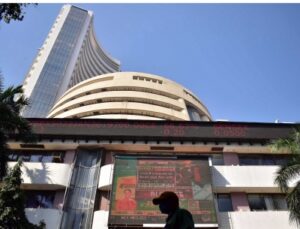
BSE Sensex is down by more than 300 points on Tuesday after a plunge of 845 points on Monday, continuing the declining trend amid concerns about general elections, geopolitical factors, and uncertainty in the markets.
Sensex is trading at 73,040 points, down by 358 points. Sensex is on the verge of falling below the 73K mark if the weakness persists. IT and financials are trading weak with Infosys, Bajaj Finserv, Indusind Bank, Ultratech Cement, L&T down more than 1 per cent.
Analysts expect economic and geopolitical issues to continue to weigh on markets in the near term. The economic factor is the rising US bond yields which reduces the prospects of rate cuts by the Fed this year. High bond yields are negative for risky assets like equity and will accelerate FII selling in emerging markets like India, they said.
Essentially the market is more concerned about the geopolitical issue.
Israel military chief vowed that “there will be a response to Iran’s attack on Israel” and it has increased the probability of escalation of tensions in the Middle East, evolving into a bigger scale.
As investors seek to wait and watch the developments. high quality large-caps are on corrections to make them fair. Large-caps in banking, IT, autos, capital goods, oil & gas and cement are advised as ideal for long-term investment, V K Vijayakumar, Chief Investment Strategist, Geojit Financial Services said.
Hyderabad-based businessman Sarath Chandra Reddy, the man whose revelations led to the arrest of BRS MLC K. Kavitha and Delhi CM Aravind Kejriwal over the past week, also paid Rs 55 crore to the Bharatiya Janata Party through electoral bonds, the data released on March 21 reflected.
Sarath Chandra Reddy won licences for five liquor retail zones under the excise policy that was implemented in Delhi from November 2021 to July 2022. He was arrested by the Enforcement Directorate on November 11, 2022 and four days later, Aurobindo Pharma, in which he is a director, paid Rs 5 crore to the BJP through electoral bonds, reports said.
After his bail in May 2023, Reddy turned approver and his firm paid another Rs 25 crore to the BJP through bonds on November 8, 2023. Also, two other companies connected to Aurobindo Pharma — Eugia Pharma Specialities Ltd and APL Healthcare Ltd are wholly-owned subsidiaries of Aurobindo Pharma — donated Rs 25 crore to the BJP.
The Enforcement Directorate has alleged that the “South Group”, which includes Reddy and others from Telangana and Andhra Pradesh, gave Rs 100 crore to AAP leaders, which it said was used by the party in 2022 Goa Assembly elections. ED further said that the loss to the Delhi government under this excise policy amounts to Rs 2,873 crore in revenues.
In Andhra Pradesh, Aurobindo Pharma donated to the Telugu Desam Party and In Telangana to BRS, according to the data available on Electoral Bonds.
The Nifty hit a new low, marking its lowest point in over a month, as it closed down by 1.08 percent or 238.3 points at 21,817.5 on Tuesday.
Trading volumes in the NSE cash market were modest at Rs. 0.83 lakh crore. Despite the negative advance-decline ratio at 0.36:1, the midcap index experienced a sharper decline compared to the Nifty.
In Asia, stock performance was mixed on Tuesday following the Bank of Japan’s decision to raise its benchmark interest rate for the first time in 17 years, signaling the end of its long-standing negative rate policy. This move by the Bank of Japan marks the termination of the world’s final negative interest rate policy in the country.
Analysts pointed out a breach of the Nifty’s support level at 21,745 could potentially intensify the downward trend, while resistance might be encountered around 21,905. The next significant support levels to monitor are around 21,500 within the next week. Any upward movement towards 22,000 could present a selling opportunity, they advise.
After a long period of consolidation, the Nifty experienced a significant downward breakout on Tuesday, closing lower by 238 points. From the opening bell, the market displayed weakness throughout the session on Tuesday. It may further decline shortly, analysts said.
The enigmatic figure behind Bitcoin’s creation, known as Satoshi Nakamoto, has captivated the imagination of the cryptocurrency community since the inception of Bitcoin. The potential unveiling of Nakamoto’s identity has spurred intense speculation and debate, prompting considerations about the ramifications for Bitcoin’s future.
Satoshi Nakamoto, the pseudonymous individual or group responsible for birthing Bitcoin, remains a mystery to this day. Despite numerous inquiries and investigations, the true identity behind this alias remains elusive. Nakamoto’s presence was notably active during Bitcoin’s genesis, with contributions ceasing around 2010, leaving behind a legacy veiled in anonymity.
The Elusive Bitcoin Holdings Estimates suggest that Satoshi Nakamoto may possess approximately 1.1 million BTC, though precise figures estimate it to be much lower. These holdings, valued between $43 billion to $80 billion, are presumed to be amassed from early mining rewards. However, verifying Nakamoto’s ownership with absolute certainty remains an insurmountable challenge.
Researchers at The University of New Mexico find digital cryptocurrency Bitcoin is more comparable to the impacts of extracting and refining crude oil than mining gold./CREDIT: University of New Mexico
To unmask the mysterious identity, numerous endeavors have come into vogue to uncover Satoshi Nakamoto’s identity, alongside claims from individuals purporting to be the elusive creator. Recent legal proceedings involving Craig Wright in the UK brought renewed attention to this quest. Despite Wright’s assertions, a UK High Court ruled decisively against his claim to be Nakamoto, affirming the prevailing mystery surrounding Bitcoin’s originator.
Implications for Bitcoin and the Market The hypothetical unmasking of Satoshi Nakamoto raises questions about Bitcoin’s future trajectory. Gady Kohanov, founder of BitcyClub, underscores the intentional obscurity surrounding Nakamoto’s identity as integral to Bitcoin’s allure and adoption.
“Poking the bear often leads to undesirable consequences,” warned Kohanov. “If the veil of secrecy surrounding Bitcoin’s creator is lifted, it could shatter the idealized image that many hold of the cryptocurrency,” he added. It could potentially undermine Bitcoin’s perceived security and appeal, disrupting investor confidence and leading to market volatility, he insisted.
Kohanov anticipates two plausible outcomes if Nakamoto’s identity were disclosed. Firstly, the mystique surrounding Bitcoin could diminish, tarnishing its reputation and eroding investor trust. Secondly, the unveiling could trigger market instability, potentially resulting in significant losses for existing investors.
Elon Musk is bent upon squeezing Twitter assets as he has placed hundreds of items from its San Francisco headquarters up for auction online, including the bird statue and other office assets.
In December 2022, after Musk revealed that Twitter spends $13 million a year on food service, and now the company said it will be selling at least 265 kitchen appliances online, and the bidding will start at just $25.
Wild to see the Twitter office on auction. Board room tables, phone booths, chairs, monitors… even the Twitter bird statue. Great memories from a different era. https://t.co/kLOx69ZbeIpic.twitter.com/BFfvFy6Pg4
The auction is online on the Heritage Global Partners’ website, the company administering the auction. Even, the company’s neon Twitter Bird light electrical display is currently priced at $22,500 with just under 10 hours left to bid.
A 190 cm planter in the shape of an @ symbol is already fetching $8,000. Moreover, the blue bird statue is currently priced at $20,500.
The auctions also include some of the kitchen appliances, including several high-end La Marzocco espresso machines and a fizzy drink fountain complete with an ice dispenser.
Twitter
The microblogging platform is also offloading a pair of Herman Miller coffee tables, which currently cost $2,200.
Last week, Musk, who failed to pay the rent for Twitter headquarters in San Francisco, asked its remaining staff in Singapore to stop coming to the office and work remotely as the company has reportedly failed to pay the monthly rent.
Twitter has been sued as it failed to pay $136,250 rent for its office space in San Francisco. Now, the company is planning to shed its co-working spaces in Delhi and Mumbai after Bengaluru and Singapore offices.
A special tea named ‘Manohari tea’ in Assam’s Dibrugarh district has been sold for Rs 1.15 lakh per kg at a private auction, compared to Rs.99,999 last year.
The proprietor of the tea estate, Rajan Lohia said that ‘Manohari Gold Tea’ fetched the price at an auction on the private portal ‘Tea Intech’ on Friday.
Due to a cap on the maximum selling price of tea being fixed at Rs one lakh per kg by the Tea Board India at Guwahati Tea Auction Centre (GTAC), he said they had to sell this year’s batch of tea at a private auction.
“It is the highest price fetched for tea at such auctions anywhere,” he said. Lohia informed that RK tea sales bought this one kg of special tea at this price.
Manohari Gold tea involves the cutting and rolling being done manually without any machines. The tea is made from a special clone, by plucking just the bud early morning – between 5 and 7.30 a.m. Monsoon time during June and July, according to Lohia.
Grown at the Manohari Tea Estate in the district of Dibrugarh, Assam, a unit of Suntok Tea Co. LLP, the tea variety is among the premium Assam teas and its taste is also different.
The Manohari tea, particularly its gold variety, had been fetching high prices at the GTAC over the years. It has set many records for the highest selling prices. In December 2021, Manohari Gold was sold for Rs 99,999 per kg through GTAC.
Joining the Big Tech layoff season, networking major Cisco has reportedly started laying off 5 per cent of its workforce, which is more than 4,000 employees as a part of its “rebalancing” act and “rightsizing certain businesses”.
Silicon Valley Business Journal reported that many workers took to TheLayoff.com and Blind portal to post about the job cuts at the company. “Impacted by Cisco layoffs!” one company employees said on Blind while another sought “Looking for immediate (software engineering) referrals. Any help would be sincerely appreciated. Thanks.”
However, Cisco did not directly comment on severance packages but said in a statement that “we didn’t take this decision lightly, and we will offer those impacted extensive support, including generous severance packages”.
In its first quarter earning report (Q1 2023) last month, Cisco reported $13.6 billion in revenue, up 6 per cent year over year. Chuck Robbins, Chairman and CEO of Cisco, merely said that he would “be reluctant to go into a lot of detail here until we’re able to talk to them. I would say that what we’re doing is rightsizing certain businesses”.
Cisco Chief Financial Officer Scott Herren had described the move as a “rebalancing” act.
Internet banking facility to be started for Regional Rural Banks’ customers.
Regulation of offline payment aggregators proposed.
Repo Rate hiked to 5.90%
The repo rate, the rate at which RBI lends money to commercial banks, has been hiked by 50 basis points again. Considering the prevailing adverse global environment, resilience in domestic economic activity, uncomfortably high inflation level, the RBI has hiked the policy repo rate by 50 basis points, to 5.40%.
Consequently, the standing deposit facility (SDF) rate stands adjusted to 5.65% and the marginal standing facility (MSF) rate and the Bank Rate to 6.15%. The Monetary Policy Committee has decided to remain focused on withdrawal of accommodation to ensure that inflation remains within the target going forward, while supporting growth, stated RBI Governor Shaktikanta Das.
The Governor announced a series of four additional measures, as given below.
1. Discussion paper on Expected Loss-Based Approach to be released for loan-loss provisioning by banks
Banks currently follow incurred-loss approach, where provisions are made after stress has actually materialized, this is to be replaced by a more prudent approach which requires banks to make provisions based on assessment of probable losses.
2. Discussion paper on securitization of Stressed Assets Framework (SSAF) to be released.
Revised framework for securitization of stressed assets was issued in Sep 2021, it has now been decided to introduce a framework for securitization of stressed assets, this will provide alternate mechanism for securitization of NPAs in addition to existing ARC route.
3. Internet banking facility for customers of Regional Rural Banks.
RRBs are currently allowed to provide internet banking facility to customers subject to fulfillment of certain criteria, to spread digital banking in rural areas, these criteria are being rationalized, revised guidelines to be issued separately.
4. Regulation of offline payment aggregators.
Online Payment Aggregators (PAs) have been brought under the purview of RBI regulations since March 2020. It is now proposed to extend these regulations to offline PAs, who handle proximity/ face-to-face transactions. This measure is expected to bring in regulatory synergy and convergence on data standards.
Growth Projection – 7.0% for 2022-23
The Governor informed that the central bank’s growth projection for the Indian economy for 2022-23 is projected at 7.0 per cent with Q2 at 6.3 per cent; Q3 at 4.6 per cent; and Q4:2022-23 at 4.6 per cent, with risks broadly balanced.
The growth for Q1 of 2023-24 is projected at 7.2 per cent.
Against the current challenging global environment, economic activity in India remains stable, stated the RBI Governor. “While real GDP in first quarter of this year turned out to be lower than expectations, it is perhaps the highest among major global economies”, he added.
Inflation
Inflation inched up to 7.0 per cent in August from 6.7 per cent in July, stated the RBI Governor. Global geopolitical developments are weighing heavily on the domestic inflation trajectory, he said.
The RBI Governor stated that monetary policy has to carry forward its calibrated action on policy rates and liquidity conditions consistent with the evolving inflation growth dynamics. It must remain alert and nimble, he stated.
Fraudsters use illegal telecom set-ups to route ISD calls received through internet (VoIP) illegally to domestic mobile and wireline customers in India. Illegal telecom setups primarily use internet connectivity on one side and connect to domestic mobile and landline network for distribution of call which is not allowed as per regulations. Such illegal setups pose security threat and revenue loss to the Government.
DoT field units in coordination with TSPs and law enforcement agencies were able to unearth operations of 30 such illegal telecom set-ups in last four months.
Telephone
Members of the public are requested to report such illegal establishments to DoT’s call centre. The call centre having number 1800110420/1963 has been set up for reporting the cases by public on receiving any international call displaying Indian mobile / landline number.
‘Nothing is more religious than serving the people in need’ says Vice President Jagdeep Dhankhar.
Dhankhar lauds the efforts of Bhagwan Mahaveer Viklang Sahayata Samiti (BMVSS) for their untiring efforts, Says, ‘BMVSS’ service for humanity reflects India’s civilisational ethos of sharing and caring’.
The Vice President, Shri Jagdeep Dhankhar today said that “there is nothing more religious than serving the people in need” and urged people to give back to society in their capacity.
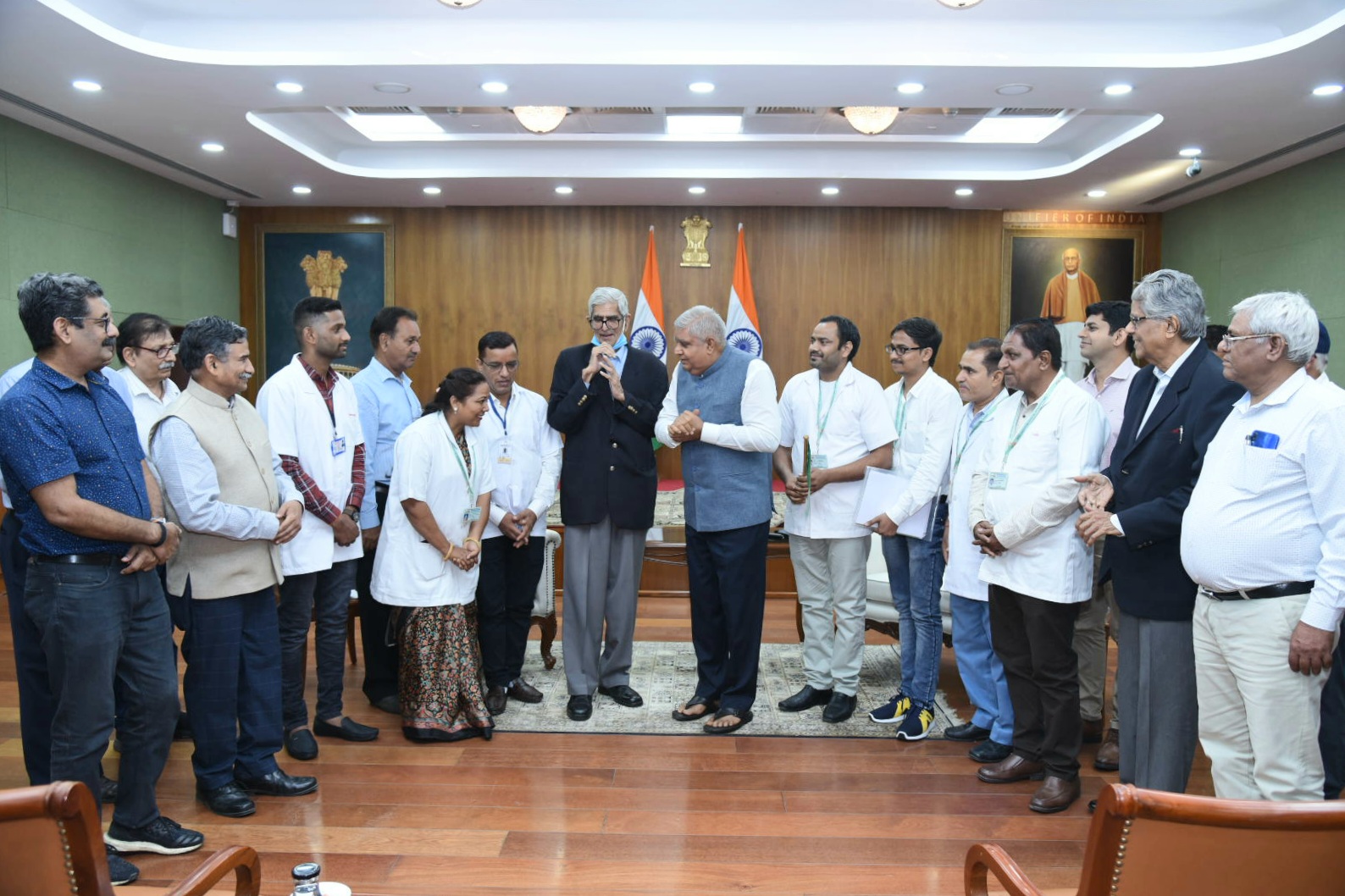
The Vice President flagged off a team of eight persons from Bhagwan Mahaveer Viklang Sahayata Samiti (BMVSS) going to Syria to set up an on-the-spot artificial limb (Jaipur Foot) fitment camp. The team will be setting up a camp in Damascus, Syria to provide 600 artificial limbs to amputees in 42 ensuing days.
The Vice President flagging off the team from Bhagwan Mahaveer Viklang Sahayata Samiti (BMVSS) to Syria to set up an on-the-spot artificial limb (Jaipur Foot) fitment camp from Upa-Rashtrapati Nivas today.
Lauding the efforts of BMVSS, Shri Dhankhar said the organisation, by popularising the Jaipur Foot around the world and providing their services free of cost, has demonstrated India’s civilisational ethos of sharing and caring. He said that, as with their other initiatives, the latest effort will also generate enormous good-will for India.
Shri Dhankhar complimented the team for their courage to take up the mission in Syria and wished them all success in their endeavours. He also interacted with the team from BMVSS, led by its founder, Shri D.R. Mehta and some of its beneficiaries using the Jaipur foot.
The Vice President interacting with the beneficiaries of Bhagwan Mahaveer Viklang Sahayata Samiti (BMVSS) using the Jaipur Foot at Upa-Rashtrapati Nivas today.
It is notable that the Prime Minister, Narendra Modi visited one such centre of BMVSS in Philippines in 2017, and the former Vice President, Shri M. Venkaiah Naidu inaugurated a fitment camp of BMVSS in Hanoi, Vietnam in 2019.
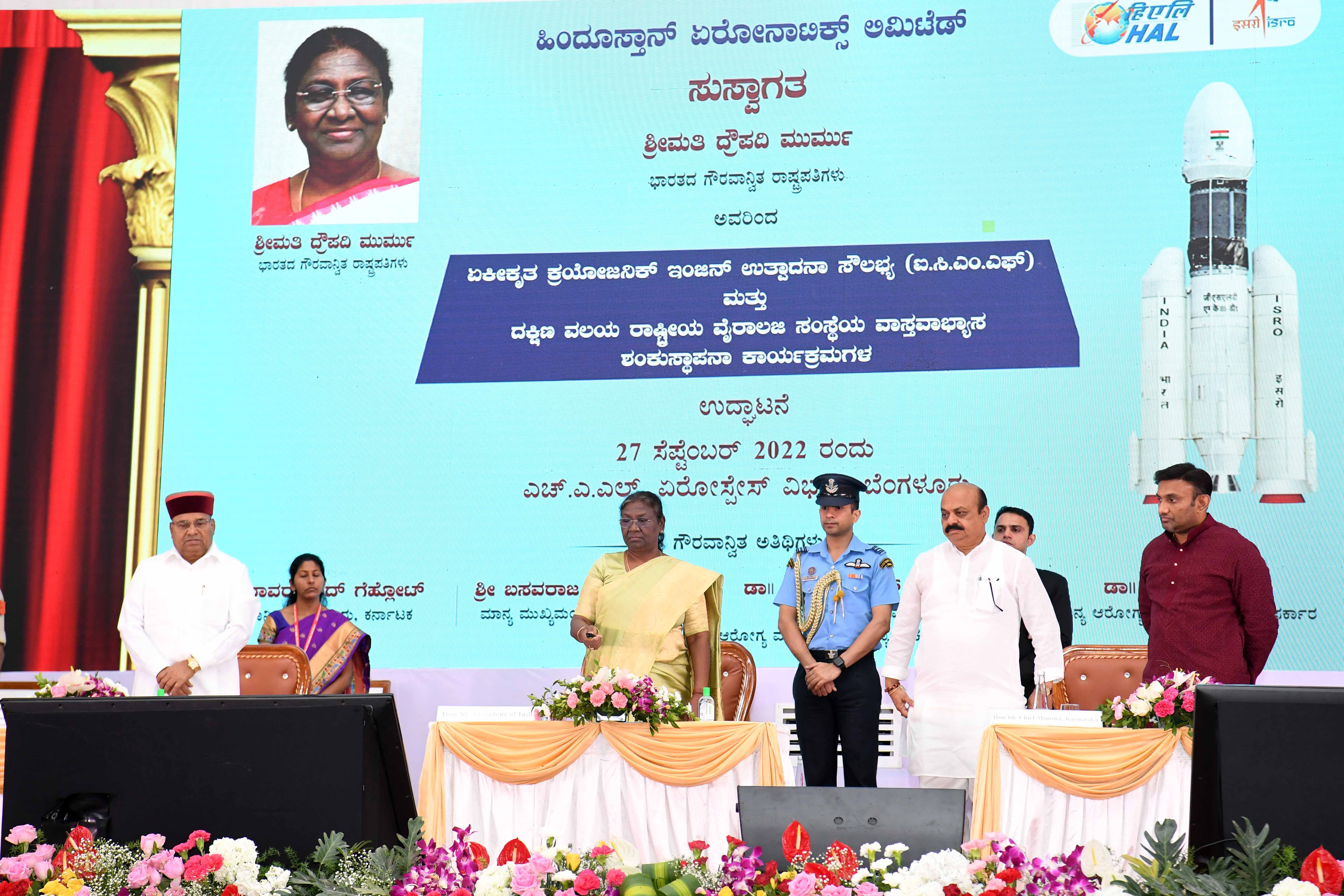
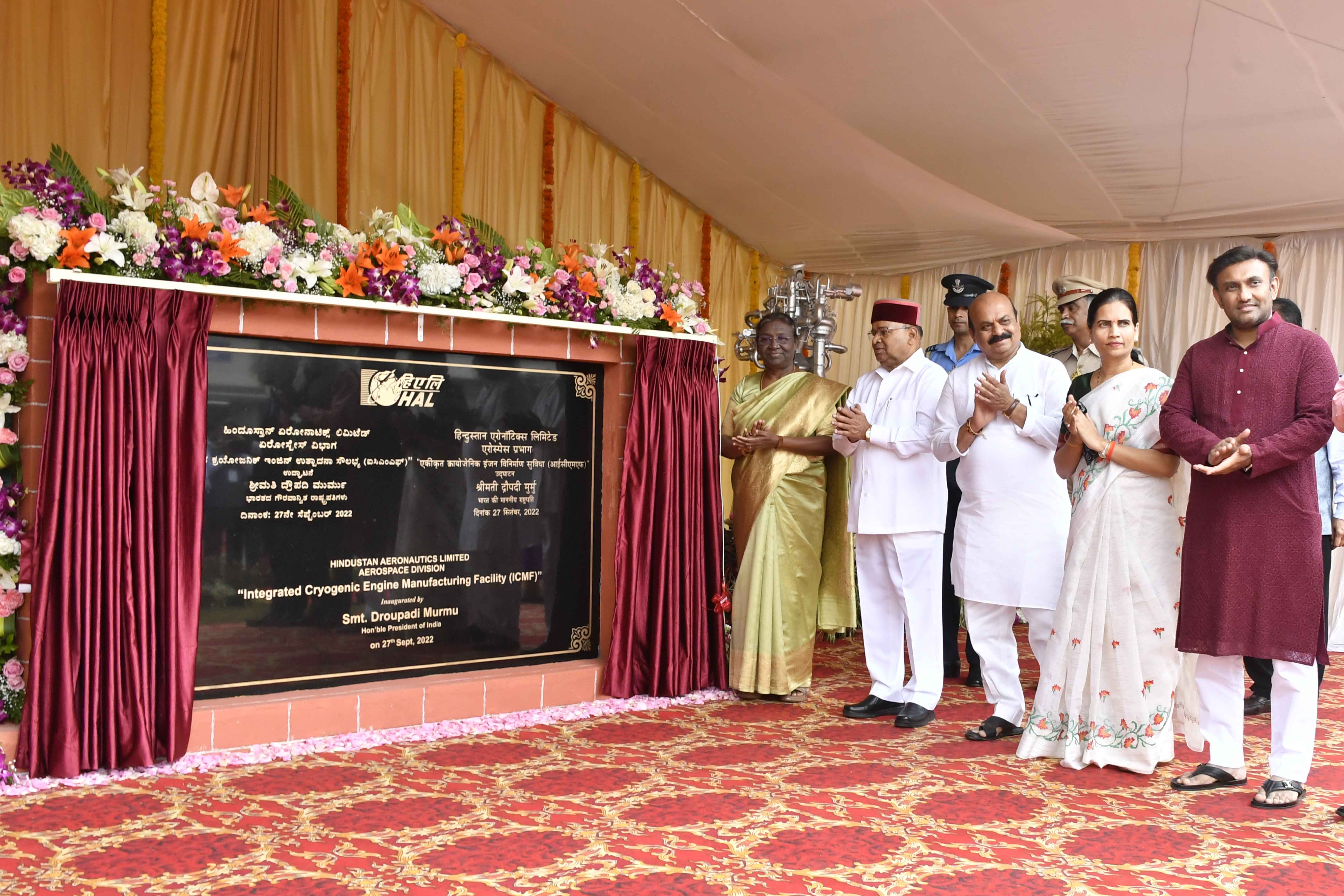
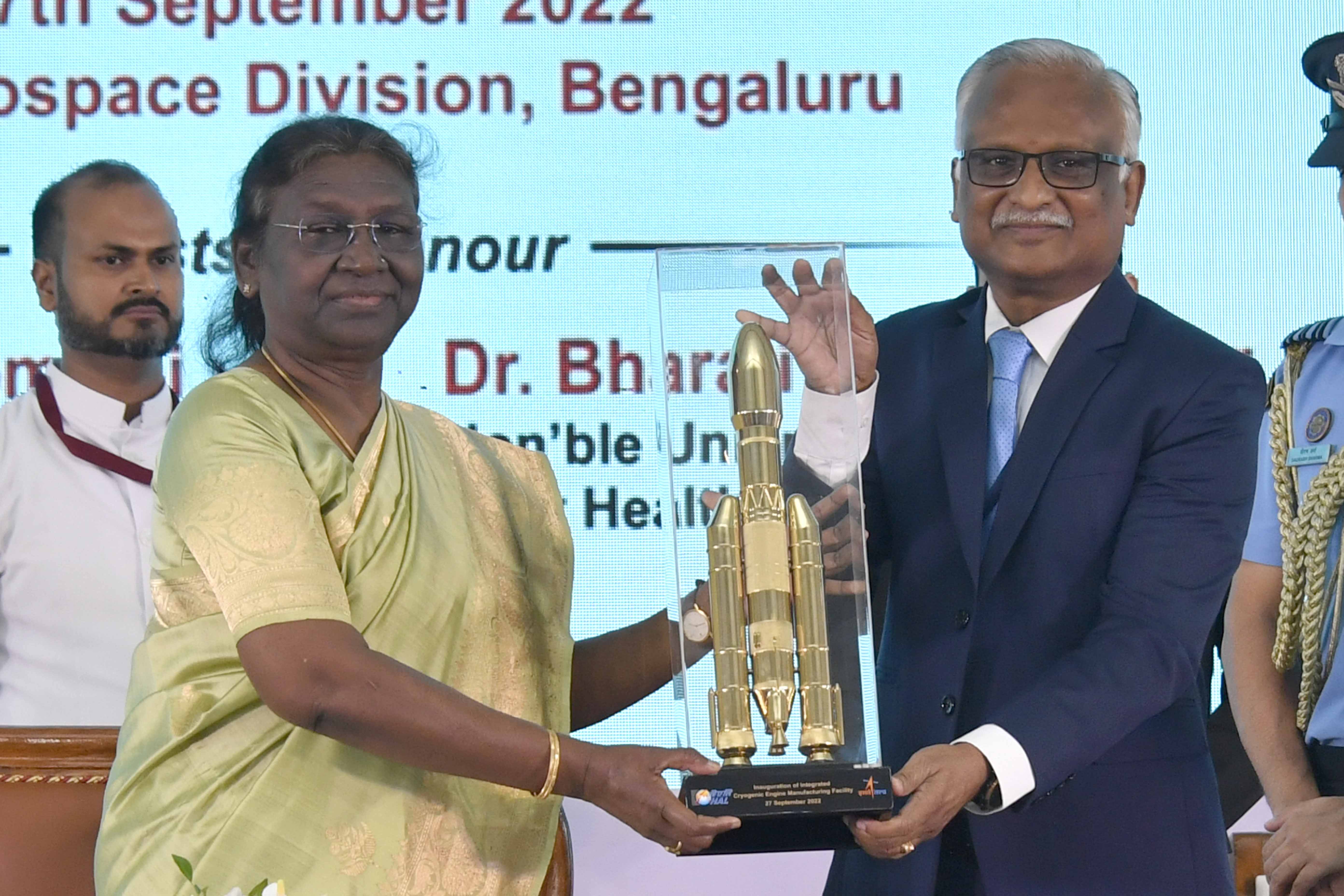
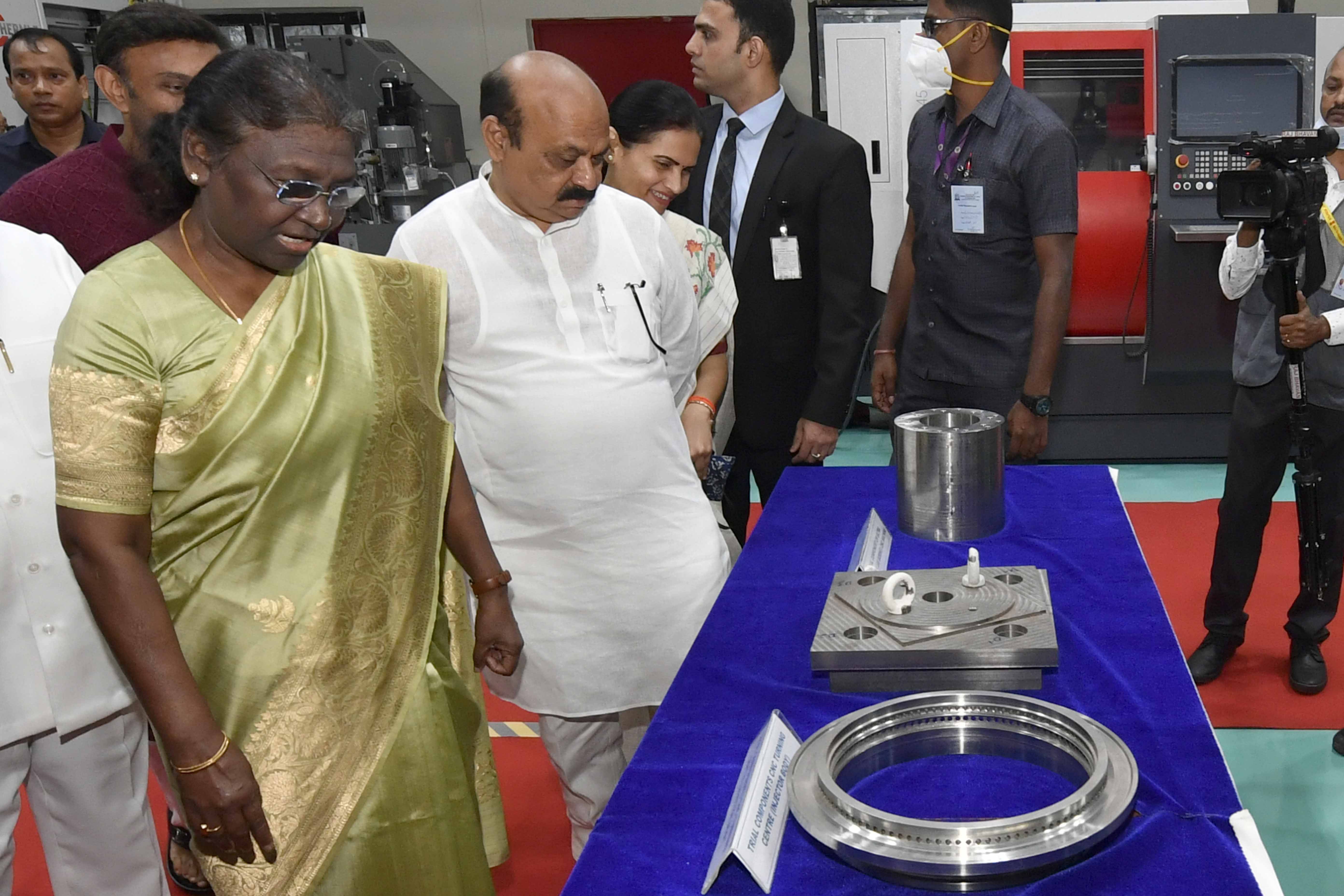
The President of India, Smt Droupadi Murmu, inaugurated the Integrated Cryogenic Engine Manufacturing Facility of Hindustan Aeronautics Limited (HAL) in Bengaluru today (September 27, 2022). She also laid the foundation stone for the Zonal Institute of Virology (South Zone) virtually on the occasion.
Addressing the gathering, the President said that inauguration of the Integrated Cryogenic Engine Manufacturing Facility is indeed a historic moment not only for HAL and ISRO, but also for the whole country to have a state-of-the-art facility to manufacture Cryogenic and Semi-cryogenic Engines. She said that HAL has contributed immensely to India’s self reliance in defence. It can be said that HAL has been the force behind the forces. HAL has time and again demonstrated its capabilities in research, development and manufacturing of various Aircraft Platforms.
The President said that ISRO has been the pride of the nation. When this institution started operations in the 1960s, India was still a young Republic, facing challenges of severe poverty and illiteracy. But there was immense potential. The rapid pace, with which ISRO has grown, caught the attention of even the most advanced and technologically developed countries. Sincere efforts and dedication of ISRO have made India emerge as the sixth country in the world to have Cryogenic Engine Manufacturing Capabilities.
The President said that HAL and ISRO together contribute to strategic defence and development. Both the organizations have played a major role in the development of various equipment and programmes which have reinforced the security and development of our country. HAL with its high end facility of manufacturing defence related equipment has proved to be an invaluable asset for our country.
The President said that the glorious past of HAL and ISRO gives us an assurance that these organisations will continue to play a significant and positive role in the future as India enters the Amrit Kaal. By 2047, when we will celebrate the 100 years of Independence, the world around us will have changed drastically. Just as we were in no position 25 years ago to imagine the contemporary world, we cannot visualise today how Artificial Intelligence and automation are going to transform life. We have completed 75 years as an independent country. We are looking ahead at the next 25 years as the period to re-imagine India and make it a developed country. It is our joint responsibility to ensure that the India of 2047 will be a much more prosperous and strong nation.
Speaking about the Covid pandemic, the President said that the resilience and extraordinary effort of our doctors and scientists helped us deal with the crisis. She noted that the Indian Council of Medical Research has provided exemplary support for effective COVID management and is expanding its research infrastructure. National Institute of Virology, Pune under Indian Council of Medical Research, is also taking all possible steps to increase R&D in the field of virology. She was happy to note that the National Institute of Virology has been designated as one of the collaborating laboratories of the World Health Organization. She said that the expansion of National Institute of Virology through Zonal Campuses across the country catering to the demands in the different geographical regions is praiseworthy.
E-commerce major Flipkart witnessed record number of shoppers at 1.6 million users per second the moment it opened the ninth edition of its ‘Big Billion Days 2022’ festive sales on Friday.
Attributing the huge rush to its opening to shoppers from tier 2 and smaller cities, the number of Flipkart Plus customers using Early Access saw huge rise from its last year’s record, said the comnpany.
Electronic devices such as laptops, smartwatches and true wireless wearables saw the highest demand, while makeup and fragrance category floowed next. The groceries too saw a significant rise in customers, said the company in a statement.
“This year’s event is special for many reasons, like the growing strength of our seller and partner ecosystem and the innovations that have enabled access to greater inclusivity and affordability for consumers,” said Manjari Singhal, Flipkart’s Senior Director of sales.
Shopsy, the e-commerce platform by Flipkart for Bharat, drew a majority of customers from tier 2 cities and beyond and the number of kiranas partnering with Flipkart for the festive sales deliveries grew from 27,000 in 2019 to 2 lakh in 2022.
The company is expecting a sales pitch in the first festive week to touch $5.9 billion this year and predictions are at $11.8 billion worth gross merchandise value (GMV) during the entire festive month.
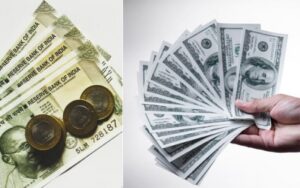
Though expected a little later, Indian rupee has plunged to its lowest today touching Rs.81 per US dollar, amid gloomy prospects of markets around the world in view of a steep rise in interest rates by the US Federal reserve by 0.75 percentage points, vowing to further hike in the future.
On Thursday, experts expected the Indian rupee to hit 82 levels in a month’s time but it has been precipitated on Friday to Rs. 80.71 and per US dollar by afternoon, it plummeted to Rs.81 level.
In fact, since August, the Indian rupee has been touching Rs.80 level before trying to emerge stronger against the American dollar.
Indian benchmark indice Sensex fell by 800 points as of 01:30 p.m. on Friday. which is at 58,314.78 points or 804.94 (1.36%) points down from the previus day, revealing the deep impact caused by the US Fed Reserve decision to hike interest rates steeply and its pledge to continue further to tame the inflation.
Nifty is also down to 17,407.05 or 222.75 points down (1.26%) today.
Stocks of Tata Steel, Sun Pharma, Hindustan Unilever Ltd (HUL), ITC, Dr. Reddy’s, Infosys, HCL Tech, Titan Company, and Maruti Suzuki were among top Sensex gainers. IndusInd Bank, Housing Development Finance Corporation (HDFC), M&M, Tech Mahindra, HDFC Bank, Axis Bank, Kotak Mahindra Bank were among top index draggers.
Tata Steel is in positive zone following the board’s approval on Friday to the scheme of amalgamation between seven of its group companies and itself.
Rupee to fall further: Experts
The Indian Rupee fell to its lowest level in 20 years reaching 80.81 per US dollar on Friday. The Indian Rupee fell to its lowest level against the greenback to 80.12 in August and again on Thursday, revealing the inherent weakness to go down further in value. Experts suggest that this time the Indian Rupee may weaken up to 82.00 level in the near future.
Following uproar among IT companies on many workers indulging in moonlighting, Wipro had warned against it and now took stern action firing 300 employees for moonlighting with its key rivals at the same time.
Wipro Chairman Rishad Premji said in Wednesday that the “reality is that there are people today working for Wipro and working directly for one of our competitors and we have actually discovered 300 people in the last few months who are doing exactly that.”
Speaking at the All India Management Association (AIMA) National Management Convention, Premji reiterated that moonlighting is a complete violation of integrity “in its deepest form.” Wipro has now terminated their employment for “act of integrity violation”.
Premji recently said that the concept of a second job to the regular job is “plain and simple” cheating. “There is a lot of chatter about people moonlighting in the tech industry. This is cheating — plain and simple,” he had tweeted.
There is a lot of chatter about people moonlighting in the tech industry. This is cheating – plain and simple.
As the issue of moonlighting or working elsewhere to make extra money in India is plaguing many tech giants after the Work From Home concession that entailed them work remotely, several Indian tech giants are facing the challenge to keep their workforce committed and focused.
The ethical issue has been raised by tech services giant Infosys first, followed by cloud Major IBM last Wednesday. Infosys has already made it clear that the practice is not ethical and the company may fire those who are moonlighting.
Rishad Premji
However, Wipro has become the first to fire its employees who are moonlighting. Infosys, IBM are still pondering the issue though they are with the industry against moonlighting.
IBM Managing Director Sandip Patel said, “All of our workers when they are employed, they sign an agreement which says that they are going to be working full-time for IBM. So moonlighting is not ethically right for them to get into.”
However, some startups are encouraging employees to opt for moonlighting or work outside their primary working hours. Swiggy has encouraged the practice but the traditional companies are calling it cheating and unethical and issued warning to employees from practising Moonlighting even in extra hours.
In one case, a techie who was interviewed by a Hyderabad-based company and hired in turn hired another techie to work on his behalf, while he is engaged in working on other projects. He has been summarily fired now but the issue has brought to light the glaring anomaly in misuse of a pact with the company.
Infosys has already warned employees that involvement in such practice can result in “disciplinary action including termination of employment”. “No two-timing, no moonlighting”, the company said in an internal memo.
Tech billionaire Elon Musk on Monday announced that Starlink, the satellite Internet division of his rocket company, is now active on all the continents, including Antarctica, connecting the entire world on one internet provision at a speed of around 50-200 Mbps.
On the microblogging site Twitter, Musk wrote, “Starlink is now active on all continents, including Antarctica. Another batch with lasers reaches orbit” he said after the deployment of 54 Starlink satellites was confirmed by the company.
Recently, a report said that the McMurdo Station in Antarctica has nearly 1,000 people living and working there during the summer and they already have satellite internet, which is not reliable in rough conditions.
There is currently a 17 Mbps link for everyone, according to the US Antarctic Program. But with Starlink, the internet service will be better and not patchy like earlier, the report had said.
The McMurdo Station blocks scientists from using Netflix and video calls, with the exception of Skype or FaceTime sessions once a week at a public kiosk or mission-critical communications.
Sep 17 (IANS) Aiming decriminalisation of offences, the Central Board of Direct Taxes (CBDT) on Saturday issued revised guidelines for compounding of offences under the Income Tax Act, 1961 with reference to various offences covered under its prosecution provisions.
Some of the major changes made for the benefit of taxpayers include making the offence punishable under Section 276 of the Act as compoundable. Further, the scope of eligibility for compounding of cases has been relaxed whereby the case of an applicant who has been convicted with imprisonment for less than 2 years being previously non-compoundable, has now been made compoundable. The discretion available with the competent authority has also been suitably restricted.
CBDT /Ians
As per the department, the time limit for acceptance of compounding applications has been relaxed from the earlier limit of 24 months to 36 months now, from the date of filing of the complaint. Besides, procedural complexities have also been reduced and simplified.
Officials said that specific upper limits have been introduced for the compounding fee covering defaults across several provisions of the Act. Additional compounding charges in the nature of penal interest at the rate of 2 per cent per month up to 3 months and 3 per cent per month beyond 3 months have been reduced to 1 per cent and 2 per cent, respectively.
Sep 16 (IANS) The British pound slumped to a 37-year low on Friday after new data showed that shoppers are pulling back spending as inflation squeezes household budgets, underscoring fears that the economy may already be shrinking, media reports said.
The currency fell below $1.14, its lowest since 1985, after the Office for National Statistics said that retail sales in August dropped 1.6 per cent month-over-month, the biggest decline since December 2021 and significantly worse than economists had expected, CNN reported.
“I think the UK is in recession already,” said Michael Hewson, chief market analyst at CMC Markets UK, CNN reported.
Pounds/IANS
The pound has been hammered by a string of weak economic data, but also the steep ascent of the US dollar, a safe haven investment that sees inflows in times of uncertainty. The greenback is now near its strongest level in about two decades against a basket of top currencies, bolstered by expectations of another big rate hike by the Federal Reserve next week, the report said.
But the economic outlook in the United Kingdom means the pound is suffering more than most. It has lost more than 15 per cent of its value against the dollar this year, compared to a 12 per cent decline in the euro.
Rupee-dollar/IANS
A plan by Prime Minister Liz Truss to subsidise energy bills for households and businesses could ease the pain this winter, but may not be enough to restore growth. The Bank of England forecast a lingering recession before her plan was announced.
Investors have also been unsettled by indications that the government will pay for its energy program, which could cost as much as $171 billion, by sharply increasing the UK national debt.
Equities market was falling sharply on Friday during the afternoon trade due to heavy sell-off in IT, PSU Banks, Auto stocks following weak Asian markets on concerns of global recession, dealers said.
At 2.10 p.m., Sensex was down 1050.03 points or 1.75 per cent at 58,883.98, and Nifty was trading 326.56 points or 1.83 per cent lower at 17,550.85.
Mahindra & Mahindra, Tech Mahindra, Ultratech Cement, TCS, Infosys, Wipro were major losers during the afternoon trade on Sensex.
Mumbai:People walk past the Bombay Stock Exchange (BSE) building in Mumbai / IANS
Nifty IT and BSE IT index were down 2.91 per cent and 2.69 per cent respectively. Nifty PSU Bank index was down 2.79 per cent and BSE Auto was down 3.25 per cent.
“Indian equity markets are witnessing some selling pressure after a long period of resilience. Global cues continuously remain weak as there is a sharp surge in the dollar index and US bond yields post US inflation numbers. We may continue to outperform, but we can’t remain in isolation for a long time. Global markets are looking nervous ahead of the FOMC meeting because there is talk of a 100 basis rate hike while a 75 basis rate hike was already discounted,” said Santosh Meena, Head of Research, Swastika Investmart Ltd.
Asian markets remained weaker on Friday due to growing fears of a global recession after the warnings by the World Bank and the International Monetary Fund.
MSCI’s broadest index of Asia-Pacific shares outside Japan was down 0.3 per cent. Australian shares were down 0.94 per cent on Friday, while Japan’s Nikkei stock index slipped 1.2 per cent.
Global Recession fears
The world may edge towards the global recession in 2023 as central banks across the world simultaneously hike interest rates to combat persistent inflation, the World Bank said.
The economies of the US, China, and the euro zone, were slowing and a slight hit to the global economy further would lead to recession.
“Technically, Nifty is facing resistance at the 18,100 level and it has slipped below its 20-DMA of 17,700 which may lead to some more selling pressure where 17,470-17,400 is an immediate demand zone then 17,150 is a sacrosanct support level. Bank Nifty is outperforming but yesterday it ended at a day’s low after hitting a fresh all-time high, which is a little disappointing. On the downside, 40,900-40,700 is an immediate demand zone; below this, 40,270 is the next important support level,” Meena added.
Indian billionaire Gautam Adani has now become the world’s second richest man, replacing Bernard Arnault on the Forbes list with a net worth of $155.5 billion.
The revised Forbes Real Time Billionaires List says Adani’s net worth rose by $5.2 billion, or by 3.49 per cent and slidly ahead of French tycoon Bernard Arnault and Amazon founder Jeff Bezos. Tesla founder Elon Musk continues to occupy the top position in the rich list.
Adani
In the top 10 list, Reliance Industries chairman Mukesh Ambani is the second Indian with a net worth of $92.2 billion, while other billionaires in the top ten list include Bill Gates, Larry Ellison, Warren Buffett, Larry Page and Sergey Brin.
On August 30, Adani had surpassed Louis Vitton boss Arnault to become the world’s third richest man, becoming the first Asian to be ranked among the top three billionaires.
The Adani Group consists of shipping ports, airports, kitchen, food essentials, oil among others.