World News in Brief: Violence in Somalia, cholera in Haiti, tax support for sustainable development

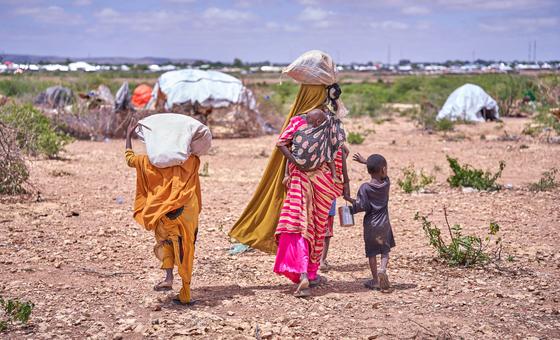
Clashes intensified in the town of Mahas in the Hiraan region, Hirshabelle state, on 26 July forcing the entire population – over 28,000 people – to flee their homes. 

Another 38,000 people were displaced in the Gedo region, Jubaland state, between 23 and 26 July, some of whom crossed into Kenya. 

Security concerns have forced seven health facilities in the Hiraan region to suspend operations, leaving thousands of people without essential healthcare and emergency services. Humanitarian access also has been restricted, particularly in areas that were already hard to reach.  

OCHA noted that only a limited number of aid partners are able to operate in these locations given the insecurity as well as financial constraints. Meanwhile, affected communities urgently need shelter, food, clean water, healthcare and protection. 

The situation is unfolding as aid agencies grapple with severe funding cuts. A $1.4 billion humanitarian plan for Somalia this year is around 16 per cent funded, with $229 million received to date.

Cholera haunts displaced families in Haiti

Cholera continues to impact the fragile public health system in Haiti, particularly in sites hosting displaced people where there is limited access to safe water and sanitation.

The Caribbean country is confronting multiple political, security and socio-economic crises, including rampant gang activity mainly in the capital, Port-au-Prince.  

The UN World Health Organization (WHO) said that between 13 and 19 July, 34 new suspected cholera cases were reported across six of the nation’s 10 departments. Most were linked to displacement sites. 

Five active transmission hotspots have been identified, including in Port-au-Prince and in the northern regions. 

Since December 2024, over 2,800 suspected cholera cases have been recorded across Haiti, with 91 laboratory-confirmed cases and 36 fatalities. 

Despite funding shortfalls, UN humanitarian partners continue to carry out key cholera prevention and response activities. 

Families in Artibonite department received water purification tablets and oral rehydration salt, for example, while partners in central Haiti have installed handwashing stations and scaled up community outreach. 

Experts to help countries create tax policies that advance sustainable development

Secretary-General António Guterres has appointed 25 experts to a UN committee to help countries design tax policies that advance their social, environmental and economic development objectives. 

The UN Committee of Experts on International Cooperation in Tax Matters supports governments in navigating complex policy trade-offs.  Its work provides countries with practical options and tools based on real-world experiences from tax systems across the globe. 

The 25 experts, who will serve for the 2025-2029 term, have diverse expertise in tax policy design and administration, as well as international tax cooperation. 

They represent various geographical regions and tax systems, and the majority are women, reflecting the UN’s commitment to strengthening inclusivity in tax leadership. 

Source link

Spain and Brazil push global action to tax the super-rich and curb inequality

Presented during the UN’s 4th International Conference on Financing for Development, taking place this week in Sevilla, the proposal highlights a growing problem: the richest individuals often contribute less to public finances than ordinary taxpayers, thanks to lower effective tax rates and legal loopholes.

“Our countries need more and more public revenues to meet their needs. Inequality is a problem everywhere, and the richest pay less than the middle class – even less than lower-income taxpayers,” said Spain’s Secretary of State for Finance Jesús Gascón, during a press conference at the conference venue, where temperatures have soared to record highs in recent days.

The two governments are calling on others to join a drive for a fairer, more progressive global tax system. They point to a stark reality: the wealthiest one per cent of the global population owns more than 95 per cent of humanity combined.

The Spanish Secretary of State for Finance Jesús Gascón (on screen) addresses a meeting at the Financing for Development conference in Sevilla, Spain.

Sharing knowledge, closing gaps

In today’s interconnected world, access to reliable data is essential. The initiative prioritises information sharing – between governments and tax authorities – to help expose gaps in tax systems, close loopholes, and combat evasion and avoidance.

Improving data quality and building national capacities for data analysis will help tax administrations identify where and how wealth is concentrated, how much is currently being paid, and what needs to change.

Though some progress has already been made, the countries say much more must be done and many more countries should come on board.

There’s a real need to know who the beneficial owners are behind companies and legal structures used to conceal wealth,” said Mr. Gascón. The initiative also proposes technical cooperation, training in data analytics, and peer review mechanisms to strengthen national tax systems.

A global wealth registry?

Spain and Brazil are even considering steps toward a global wealth registry – acknowledging that this would take time, political will, and major national efforts.

But the aim is clear: more transparency, more accountability, and fairer contributions from the richest.

We cannot tolerate the intensity of inequality, which has been increasing in recent years,” said Brazil’s Minister-Counsellor to the UN, José Gilberto Scandiucci denying that this was some kind of far-leftist agenda.

This is a moderate initiative to confront a very radical reality.”

The proposal forms part of the Seville Platform for Action, which is turbocharging voluntary actions to help reach the Sustainable Development Goals (SDGs) – currently way off track for the 2030 deadline.

G20 highlights ‘high worth’ factor

It also follows the 2024 agreement by the G20 industrialised nations who met in Rio, Brazil, last year – the first international accord to commit to a joint tax agenda for high-net-worth individuals.

A three-month work plan is now being drawn up, with regular meetings planned to track progress. The goal: bring more countries, international organisations and civil society on board to push forward tax reforms targeting the ultra-rich.

“If we want to effectively tax the super-rich, fight inequality and make our tax systems fairer and more progressive, we need political will – and we need to act within our means,” Mr. Gascón added.

Source link

CBDT issues new guidelines, help decriminalisation of offences

Sep 17 (IANS) Aiming decriminalisation of offences, the Central Board of Direct Taxes (CBDT) on Saturday issued revised guidelines for compounding of offences under the Income Tax Act, 1961 with reference to various offences covered under its prosecution provisions.

Some of the major changes made for the benefit of taxpayers include making the offence punishable under Section 276 of the Act as compoundable. Further, the scope of eligibility for compounding of cases has been relaxed whereby the case of an applicant who has been convicted with imprisonment for less than 2 years being previously non-compoundable, has now been made compoundable. The discretion available with the competent authority has also been suitably restricted.

CBDT /Ians

As per the department, the time limit for acceptance of compounding applications has been relaxed from the earlier limit of 24 months to 36 months now, from the date of filing of the complaint. Besides, procedural complexities have also been reduced and simplified.

Officials said that specific upper limits have been introduced for the compounding fee covering defaults across several provisions of the Act. Additional compounding charges in the nature of penal interest at the rate of 2 per cent per month up to 3 months and 3 per cent per month beyond 3 months have been reduced to 1 per cent and 2 per cent, respectively.


No Religious Bias in GST Law, Clarifies Finance Ministry but Silent on Exemption

Following uproar in social media that the Good s and services tax (GST) rolled out on July 1, 2017 was against the interests of temple trusts as taxes them heavily while obliterating the presence of Waqf Boards and Churches, the government has clarified that there is no such religious bais in GST.
“There are some messages going around in the social media stating that the temple trusts have to pay the GST while the churches and mosques are exempt. This is completely untrue because no distinction is made in the GST Law on any provision based on religion. We request to people not to start circulating such wrong messages on social media,” said the government in a statement.
Ironic but the ministry did not clarify whether Hindu temples, Sikh Gurudwaras, Mosques and Churches are expemted from GST for the services, especially for free food to pilgrims they provide. Secondly, the GST is silent on temple trusts or boards whose income was in the past exempted in several forms.
Otherwise, GST clearly states that Puja Samagri is exempt from taxation. The provision in GST reads:”Puja samagri including havan samagri will be under the Nil category. However, exact formulation for the same is yet to be finalized.” Taxation on temple trusts, waqf boards and churches will be finalized by the ministry soon.
The government has rolled out the GST from July 1 with a view to introduce uniform indirect taxation system throughout the country, while concessions are given to States in certain areas like entertainment tax that has led to closure of cinema theatres in Tamil Nadu.