“I was going to buy falafel,” says Mohammed Hassan. “On the way home, I looked up and saw a rocket heading towards me. I tried to run, but it was too fast. I found myself pinned to the wall, and my foot had been blown off.”
Brought to Al-Shifa Hospital in Gaza City, the young boy looks down at his heavily bandaged left leg, and the stump where his foot used to be.
In another area of the hospital, a small child, Maryam Abu Alba, is crying in pain. “The neighbour’s house was bombed, and their home was hit,” says her grandmother. “One of her legs had to be amputated, and metal plates had to be inserted into the other one, which was fractured. She is in severe pain.”
Earlier this year, the UN humanitarian aid coordination agency OCHA estimated that 4,500 new amputees require prosthetics, in addition to the 2,000 existing cases requiring maintenance and follow-up care, while about 24,000 injured people required rehabilitation.
Health facilities are overwhelmed with many patients undergoing multiple surgeries without adequate medical supplies, including anaesthesia.

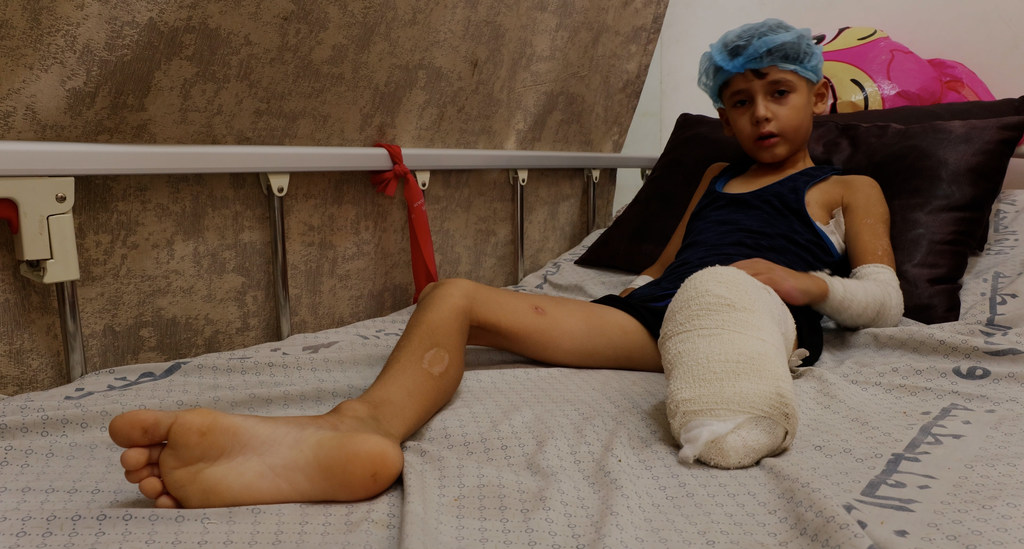
Palestinian child Mohammad Hassan sitting on a hospital bed in Gaza after his left leg was amputated by a strike.
Desperately seeking food
In May, as supply routes for UN humanitarian convoys were interrupted, the number of distribution points of aid dropped from 400 dotted across the Gaza strip to a handful of hubs operated by the Gaza Humanitarian Foundation.
Given the shortage of humanitarian aid and diminished capacity, thousands of Palestinians have been killed or injured since May while seeking food. Among the wounded are children and parents who, despite losing limbs, continue to search for food and water.
This comes as a UN-backed food security report has just concluded that famine is confirmed in Gaza governorate, where half a million people are trapped in conditions of starvation, malnutrition and death.
Ibrahim Abdel Nabi was one of the many Palestinians who headed to the hubs in the hope of finding desperately needed provisions for their families.
In his tent at a displacement site in the coastal Al-Mawasi area of Khan Younis, Mr. Nabi, surrounded by his wife and children, explains how the journey ended in disaster and life-changing injuries.
“When I arrived at the Al-Alam area, west of Rafah, I was hit by an explosive bullet in my leg. I was bleeding for about an hour and a half, and no one came to help me. They were all trying to find food for their children.”
Eventually, a group of people came to his rescue and took him to the nearby Red Cross hospital.
“I stayed there for about a month and a half, undergoing about 12 operations. I became malnourished and lost a lot of blood. Infection spread, and more of my leg had to be amputated.”
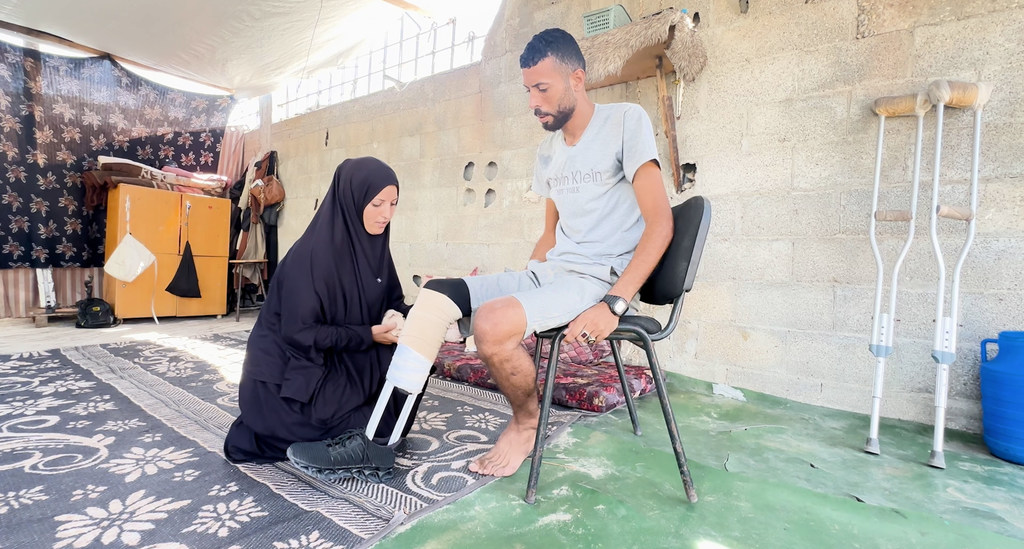
Ibrahim Abdel Nabi, a Palestinian displaced in Gaza, sitting on a chair while his wife helps him wear the handmade prosthetic limb.
‘I made my prosthetic leg’
As Mr. Nabi was trying to recover, he was aware that his family were still in need of food. Despite the pain, he decided to make a simple prosthesis from materials he could find to allow him to get back on his feet and make fresh attempts to find food and water.
“The prosthesis injures my leg,” he said. “It causes inflammation and increases the pain. We don’t have medical care or supplies, but I will use it no matter how much it hurts.”
As he speaks, Mr. Nabi’s wife begins to cry. “God willing, we will live through this experience,” she says.
Mr. Nabi gets up on crutches and heads to a nearby tent, where his wife helps him to put on the crude prosthesis.
“Don’t strain yourself,” she repeats, over and over. “Take your time. Walk slowly.”