Driven by hunger in Gaza, amputees are part of the collateral damage

“I was going to buy falafel,” says Mohammed Hassan. “On the way home, I looked up and saw a rocket heading towards me. I tried to run, but it was too fast. I found myself pinned to the wall, and my foot had been blown off.”

Brought to Al-Shifa Hospital in Gaza City, the young boy looks down at his heavily bandaged left leg, and the stump where his foot used to be.

In another area of the hospital, a small child, Maryam Abu Alba, is crying in pain. “The neighbour’s house was bombed, and their home was hit,” says her grandmother. “One of her legs had to be amputated, and metal plates had to be inserted into the other one, which was fractured. She is in severe pain.”

Earlier this year, the UN humanitarian aid coordination agency OCHA estimated that 4,500 new amputees require prosthetics, in addition to the 2,000 existing cases requiring maintenance and follow-up care, while about 24,000 injured people required rehabilitation.

Health facilities are overwhelmed with many patients undergoing multiple surgeries without adequate medical supplies, including anaesthesia.

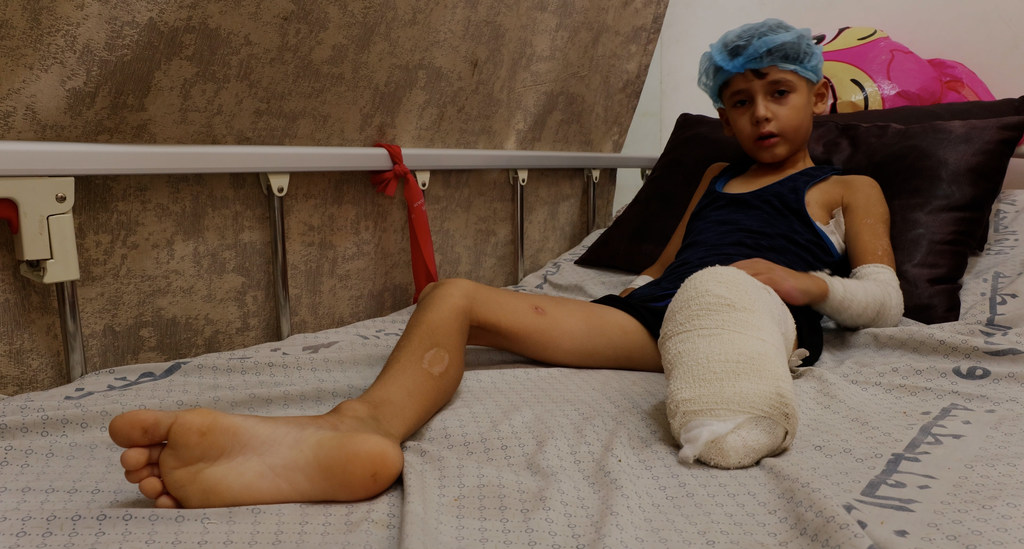
Palestinian child Mohammad Hassan sitting on a hospital bed in Gaza after his left leg was amputated by a strike.

Desperately seeking food

In May, as supply routes for UN humanitarian convoys were interrupted, the number of distribution points of aid dropped from 400 dotted across the Gaza strip to a handful of hubs operated by the Gaza Humanitarian Foundation.

Given the shortage of humanitarian aid and diminished capacity, thousands of Palestinians have been killed or injured since May while seeking food.  Among the wounded are children and parents who, despite losing limbs, continue to search for food and water.

This comes as a UN-backed food security report has just concluded that famine is confirmed in Gaza governorate, where half a million people are trapped in conditions of starvation, malnutrition and death.

Ibrahim Abdel Nabi was one of the many Palestinians who headed to the hubs in the hope of finding desperately needed provisions for their families.

In his tent at a displacement site in the coastal Al-Mawasi area of Khan Younis, Mr. Nabi, surrounded by his wife and children, explains how the journey ended in disaster and life-changing injuries.

“When I arrived at the Al-Alam area, west of Rafah, I was hit by an explosive bullet in my leg. I was bleeding for about an hour and a half, and no one came to help me. They were all trying to find food for their children.”

Eventually, a group of people came to his rescue and took him to the nearby Red Cross hospital.

“I stayed there for about a month and a half, undergoing about 12 operations. I became malnourished and lost a lot of blood. Infection spread, and more of my leg had to be amputated.”
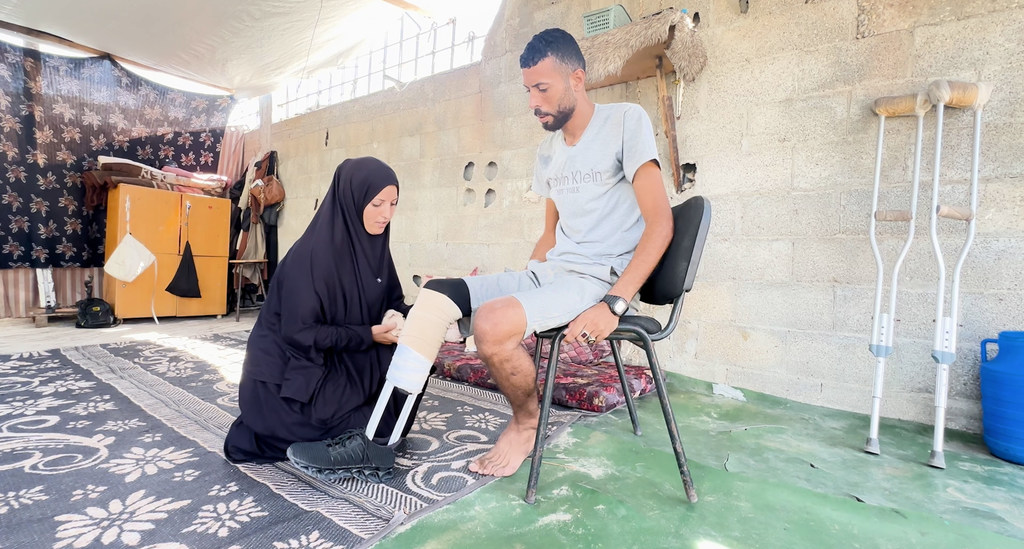
Ibrahim Abdel Nabi, a Palestinian displaced in Gaza, sitting on a chair while his wife helps him wear the handmade prosthetic limb.

‘I made my prosthetic leg’

As Mr. Nabi was trying to recover, he was aware that his family were still in need of food. Despite the pain, he decided to make a simple prosthesis from materials he could find to allow him to get back on his feet and make fresh attempts to find food and water.

“The prosthesis injures my leg,” he said. “It causes inflammation and increases the pain. We don’t have medical care or supplies, but I will use it no matter how much it hurts.”

As he speaks, Mr. Nabi’s wife begins to cry. “God willing, we will live through this experience,” she says.

Mr. Nabi gets up on crutches and heads to a nearby tent, where his wife helps him to put on the crude prosthesis.

“Don’t strain yourself,” she repeats, over and over. “Take your time. Walk slowly.”

Source link

A mandate for change: UN releases proposals for streamlining of tasks as part of major reform agenda

Mandates – requests or directives for action issued by the General Assembly, the Security Council and the Economic and Social Council – have multiplied significantly since 1945. Today, there are more than 40,000 active mandates, serviced by around 400 intergovernmental bodies. Together, they require more than 27,000 meetings a year and generate roughly 2,300 pages of documentation every day, at an estimated annual cost of $360 million.

A growing challenge

Mandates guide the UN’s work in over 190 countries and territories, from peacekeeping to humanitarian response and development. But many are outdated or overlapping, and their complexity is increasing. Since 2020, the average word count of General Assembly resolutions has risen by 55 per cent, while Security Council resolutions are now three times longer than they were 30 years ago.

“Let’s face facts,” said Secretary-General António Guterres during a briefing to the General Assembly on Friday, “we cannot expect far greater impact without the means to deliver. By spreading our capacities so thin, we risk becoming more focused on process than on results.”

A lack of coordination adds to the strain. Several UN entities cite the same mandates to justify separate programmes and budgets, leading to duplication and reduced impact. More than 85 per cent of mandates contain no provisions for review or termination. “Effective reviews are the exception, not the rule,” Mr. Guterres said. “The same mandates are discussed year after year – often with only marginal changes to existing texts.”

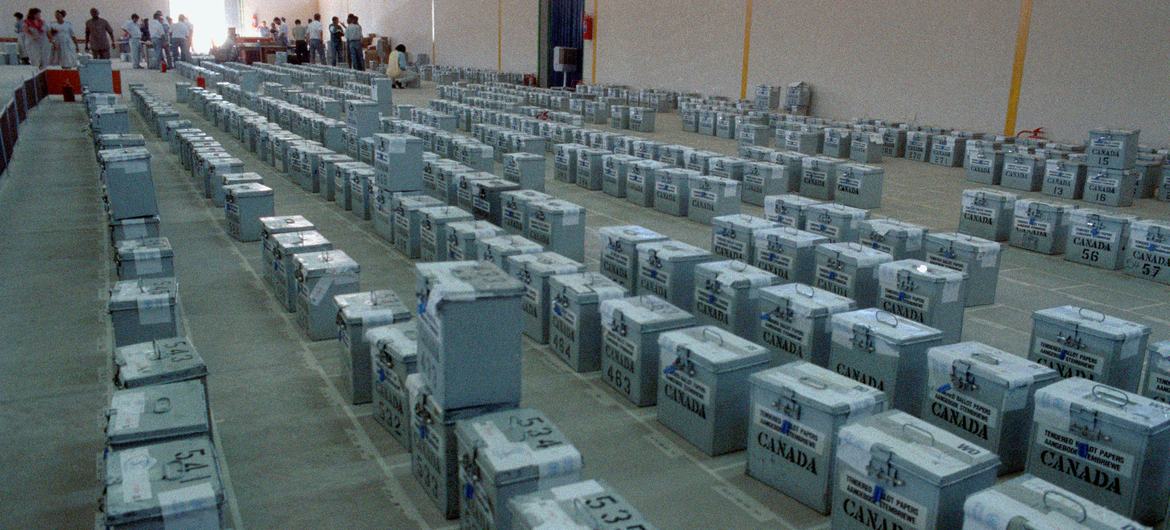
The UN has carried out mandates across the world including certifying the election in Namibia in 1989.

The UN80 Initiative: a systemic approach

The Report of the Mandate Implementation Review, released on 31 July, is part of the Secretary-General’s broader UN80 Initiative – a multi-year effort to modernize how the UN works. Rather than assess mandates individually, the report takes a “lifecycle” approach, looking at how mandates are created, implemented and reviewed, and proposing ways to improve each stage.

“Let me be absolutely clear: mandates are the business of Member States,” Mr. Guterres told the General Assembly. “They are the expression of your will. And they are the sole property and responsibility of Member States. The vital task of creating, reviewing or retiring them lies with you – and you alone. Our role is to implement them – fully, faithfully, and efficiently.”

“This report respects that division,” he added. “It looks at how we carry out the mandates you entrust to us.”

From creation to delivery

To address duplication and complexity, the report calls for digital mandate registries that make it easier to track what has been adopted across different bodies. It also encourages shorter, clearer resolutions with realistic resource requirements. “We cannot expect far greater impact without the means to deliver,” Mr. Guterres said.

The report also highlights the growing operational burden of meetings and reports. Last year, the UN system supported 27,000 meetings and produced 1,100 reports – three out of five on recurring topics. “Meetings and reports are essential,” Mr. Guterres said. “But we must ask: Are we using our limited resources in the most effective way?”

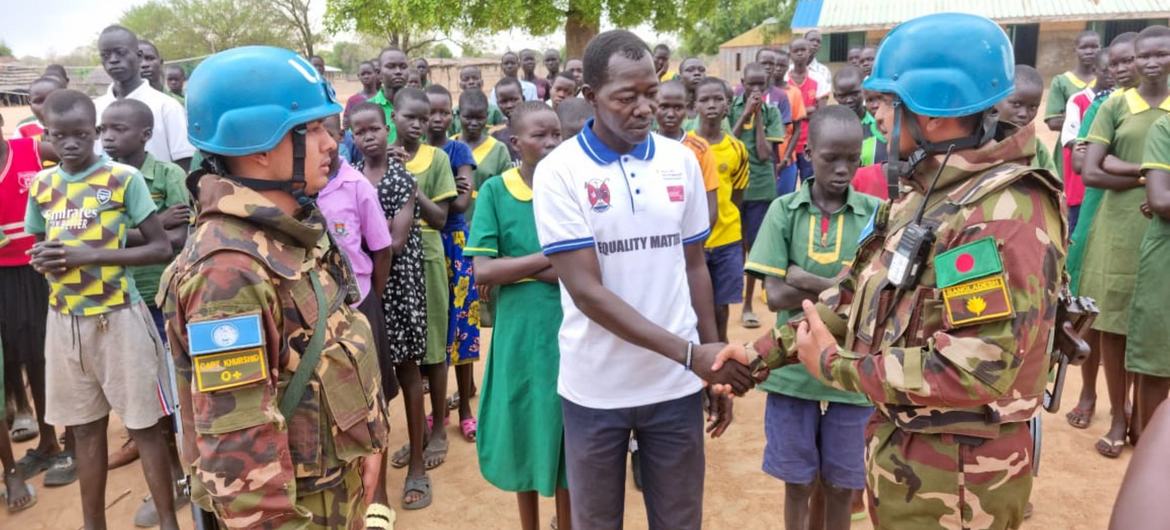
The UN peacekeeping mission in South Sudan, UNMISS, was mandated by the Security Council.

Funding and impact

Proposals include reducing the number of reports and meetings, streamlining formats and monitoring report usage to ensure relevance. The Secretary-General is also calling for stronger coordination among UN entities to avoid overlap and ensure each mandate is linked to clear deliverables.

The report warns that fragmented funding is undermining coherent delivery. In 2023, 80 per cent of the UN’s funding came from voluntary contributions, 85 per cent of which were earmarked. “Fragmented funding, combined with fragmented implementation, leads to fragmented impact,” said Mr. Guterres. “Each of us has a role to play to address this. And each of us must act on the levers within our control.”

Putting people first

For the Secretary-General, reforms are not only about process but about impact. “Mandates are not ends in themselves,” he said. “They are tools – to deliver real results, in real lives, in the real world.”

He praised UN staff as central to this effort. “None of the work in implementing mandates is possible without our staff – the women and men of the United Nations,” Mr. Guterres said. “Their expertise, dedication and courage are indispensable to this endeavor. If we are to improve how we implement mandates, we must also support and empower the people who carry them out.”

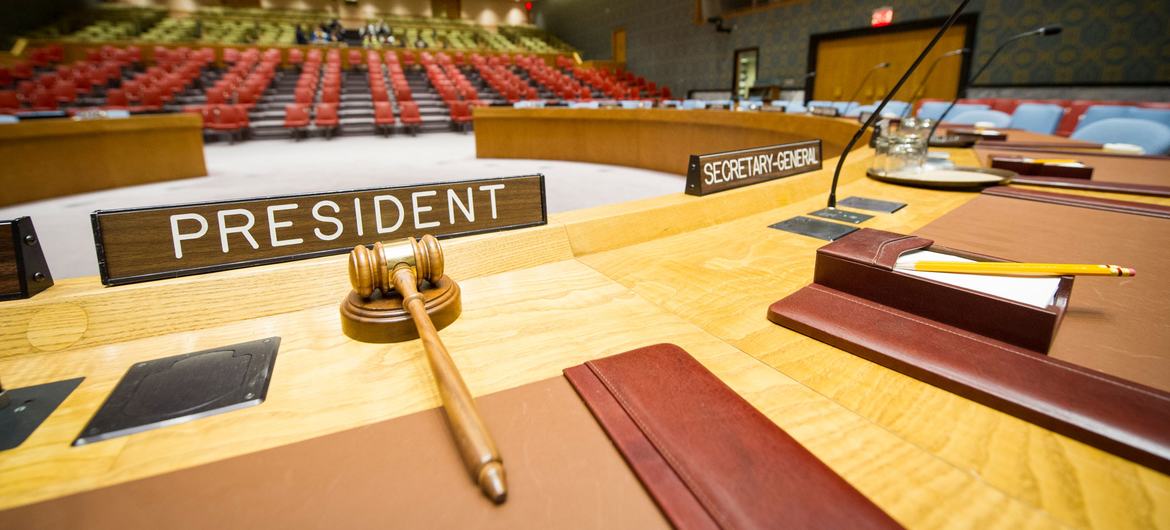
Many of the UN’s mandates are agreed at the Security Council at UN Headquarters in New York.

A call to Member States

In his concluding remarks, the Secretary-General underscored that the next steps must come from Member States. “The path forward is yours to decide,” he said. “My responsibility is to ensure that the Secretariat provides the capacities and inputs required by the course of action that you choose.”

The report invites Member States to consider a time-bound intergovernmental process to carry proposals forward and ensure that this effort succeeds where earlier ones have fallen short. The upshot, the report says, would be a more agile, coherent and impactful UN that is better at delivering programmes and services. 

Source link