Centre helps Manipur to organize pineapples export promotion show in Dubai

In a move towards harnessing export potential of naturally grown, organic certified fresh pineapples of North-Eastern Region (NER), centre, through Agricultural & Processed Food Products Export Development Authority (APEDA) organized an in-store export promotion programme in Dubai, United Arab Emirates (UAE) for Manipur’s pineapples among consumers.

The ‘in-store promotion show’ of organic certified fibre rich Kwe variety of pineapples from Manipur, was organized at the Lulu hyper market, Dubai’s largest supermarket in association with Manipur Organic Mission Agency (MOMA) of Government of Manipur. This event is part of government’s strategy to promote locally produced agricultural products in the international markets.

Manipur Organic Mission Agency (MOMA) has supported the sourcing of organic certified Kwe variety of pineapples directly from the farmers of Manipur.

pine apple/Photo:en.wikipedia.org

The Manipur pineapple, which is showcased with the support from APEDA, is fibre-rich sweetener from North Eastern Region (NER). The showcased pineapples are procured from Thayong Organic Producer Company Ltd in Imphal East district, Manipur.

At the in-store export promotion show, consumers were offered Manipur pineapple to taste the sweetness of the fruit. Northeast pineapple is one of the most important tropical fruits grown in the NER and the fibre-rich fruit is cultivated in almost all the region.

With a production of 134.82 metric tonne (MT) in 2020-21, Manipur ranks sixth in pineapple production having a share of 7.46 per cent in total production in India.

The top ten importing countries of Indian pineapples are UAE, Nepal, Qatar, Maldives, USA, Bhutan, Belgium, Iran, Bahrain and Oman. A quantity of 7665.42 MT of pineapples valued at USD 4.45 million was exported in the year 2021-22.

Manipur/Photo:en.wikipedia.org

With the intervention of APEDA, there has been a significant increase in the export of agricultural produce from NE states like Assam, Nagaland, Manipur, Mizoram, Tripura, Arunachal Pradesh, Sikkim and Meghalaya in the last few years.

Besides pineapple, the APEDA has also decided to take forward the promotion of other locally grown unique horticultural products from Manipur to the international market. The other unique products from Manipur are tamenglong orange, kachai lemon, black rice, etc.

Tripura was the first North Eastern state to export its ‘queen’ variety of pineapple to Dubai and Doha in 2018. Tripura’s pineapple was also exported to Bangladesh in 2020. Assam also made a debut in pineapple export to Dubai in 2019.

The NE region witnessed an 85.34 percent growth in the export of agricultural products in the last six years as it increased from USD 2.52 million in 2016-17 to USD 17.2 million in 2021-22. The major destination of export has been Bangladesh, Bhutan, the Middle East, the UK and Europe.

In the last three years, APEDA organised 136 capacity building programmes on export awareness across the different parts of NER. Highest, 62 capacity building programmes were held in NER in 2019-20, while 21 in 2020-21 and 53 such programmes were organised by APEDA in the year 2021-22. Apart from capacity building initiatives, APEDA facilitated 22 International Buyer-Seller Meets as well as trade fairs in NER in the last three years.

APEDA also organized a conference on the Export Potential of Natural, Organic and Geographical Indications (GI) Agro Products in Guwahati on June 24, 2022 to tap the abundant export potential of organic agricultural products from Assam and neighbouring states of NER.

APEDA aims at creating a platform in Manipur for the exporters to get the products directly from the producer group and the processors. The platform will link the producers and processors of Assam and exporters from other parts of the country that would expand the base of the export pockets in the North-Eastern states, including Manipur and increase the employment opportunities among the people of the state.

On the occasion, APEDA chairman Dr. M. Angamuthu stressed on promoting processed form of value-added pineapple to sustain in the global export market for a longer time period.

“We need to focus on promoting pineapple sourced from farmers in processed form in the Gulf countries through Lulu Group. It will help farmers in better price realization of their produce,” Dr Angamuthu said. Shri P Vaiphel, Additional Chief Secretary, Government of Manipur also attended the meet.

Big Bull Rakesh Jhunjhunwala left behind Rs. 50,000 Crore for family; 4th child gets a bit

Legal fraternity sources have revealed that top stockbroker and Big Bull Rakesh Jhunjhunwala has left a will which will provide direction and intent on his heirs and the handling of his colossal fortune, believed to be worth approximately Rs 50,000 crore.

He had arranged in his will to ensure his estate, including shares and property, is bequeathed to his wife and three children. In fact, he would often speak about his fourth child – charity – and a little part of his fortune will go to his favourite charities though the exact amount is not known.

His assets – direct holdings in listed and unlisted companies as well as immovable properties pass on to his wife and three children, said a person from the legal fraternity on condition of anonymity.

The Big Bull is known to own 35 company holdings with huge investments in: construction and contracting (11 per cent), miscellaneous (nine per cent), banks (private sector) (6 per cent), finance (general) (6 per cent), construction and contracting (civil) (6 per cent), pharmaceuticals (6 per cent), and banks (public sector) (3 per cent).

Jhunjhunwala has three children – daughter Nishtha (18) and twin sons, Aryamaan and Aryavir (13). He would call charity his fourth child.

While his listed holdings are reportedly worth Rs 50,000 crore, his immovable properties include a sea-facing building in Malabar Hill, Mumbai, purchased from Standard Chartered Bank for Rs 176 crore in 2013, and a holiday home in Lonavala.

Moreover, his long time legal associate Berjis Desai is reportedly the main executor of the will. The will be read out in the presence of his family after all the Hindu rituals are completed.

Desai, who is ex-managing partner of J Sagar Associates, has known the value investor for close to 25 years. He is now an independent legal counsel engaged in private client practice and also a co-investor in Jhunjhunwala’s new aviation venture Akasa Air.

Adani Group shares fall drastically after ‘debt trap’ warning

Adani Wilmar stock lost 3.86 per cent intraday to Rs 663 on Wednesday against the previous close of Rs 689.60 on BSE, on Tuesday when it closed 4.73 per cent lower from the previous close of Rs 723.85 on Monday.

Its market cap fell to Rs 87,338 crore on BSE. The stock has lost 24.57 per cent till date from record high amid debt trp warning by CreditSights.

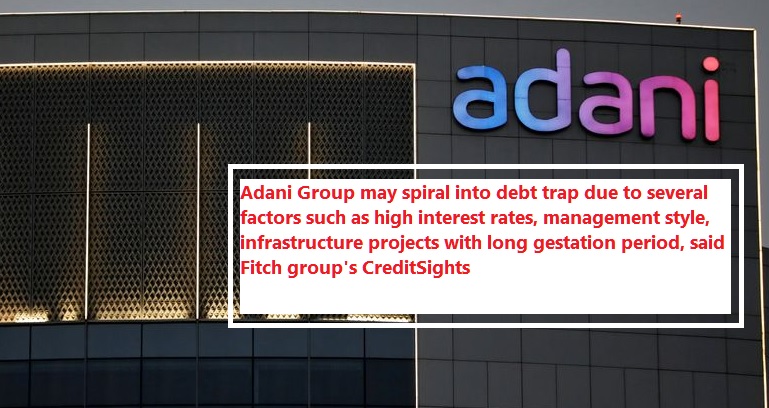
Adani Group, deeply overleveraged with numerous investments in capital-intensive businesses could land in “masive debt trap”, warned CreditSights, a Fitch Group’s debt research unit on Tuesday.

Currently, the conglomerate’s total debt is pegged at 2.3 trillion rupees ($28.80 billion). The conglomerate’s debt-funded growth plans could culminate in distress or default of its companies and impact the broader Indian economy in a “worst-case scenario”, the unit said.

Adani group debt trap warning

Shares in Adani Group companies including flagship Adani Enterprises, Adani Green Energy, Adani Ports, and Adani Power fell soon after the release of the report.

Shares of Adani Green, up about 170% in the last one year fell by 6.9%. Adani Power, which has seen five-fold increase in share price fell 5% on Tuesday.

The grim assessment comes at a time its group companies are investing in new sectors such as news media, telecom, cement and long-term infra projects.

As the interest rates are going up again, the heavy debt of the Adani companies may pose a risk due to the long gestation period of some infrastructure projects, CreditSights said in its report.

Another fact the research unit cited was “high key-man risk” in Gautam Adani’s absence as the management structure may find it inadequate to deal with.


Twitter saga continues after Zatko revelations; Parag ridicules false claims

Twitter’s Indian-origin CEO Parag Agrawal has lashed out at the company’s former security chief Peiter ‘Mudge’ Zatko terming his claims false and riddled with inaccuracies.

Reacting to ongoing saga over bots controversy with Zatko, who was fired in January, he said, “We are reviewing the redacted claims that have been published, but what we’ve seen so far is a false narrative that is riddled with inconsistencies and inaccuracies, and presented without important context.”

Zatko claimed that Twitter lied about the actual number of bots on its platform and misled federal regulators about users’ data safety, substantiating Tesla CEO Elon Musk’s takeover bid and withdrawal from the move.

“There are news reports outlining claims about Twitter’s privacy, security, and data protection practices that were made by Mudge Zatko, a former Twitter executive who was terminated in January 2022 for ineffective leadership and poor performance,” Agrawal said in an internal message sent to the staff.

Zatko also alleged that the Indian government forced the micro-blogging platform to hire a “government agent” and allow him access to users’ sensitive data, a claim that was trashed by Twitter.

Agrawal said that this is frustrating and confusing to read, “given Mudge was accountable for many aspects of this work that he is now inaccurately portraying more than six months after his termination”.

“But none of this takes away from the important work you have done and continue to do to safeguard the privacy and security of our customers and their data,” he told employees.

Zatko’s disclosure before SEC

According to Zatko’s disclosure before the US Securities and Exchange Commission (SEC), Twitter has “major security problems that pose a threat to its own users’ personal information, to company shareholders, to national security, and to democracy”.

Agrawal said that given the spotlight on Twitter, “we can assume that we will continue to see more headlines in the coming days — this will only make our work harder. We will pursue all paths to defend our integrity as a company and set the record straight.”

Wheat prices spike due to climate change: Study

Rising temperatures are harmful to wheat yields. However, crop yields do not provide a holistic vision of food security. The impacts of climate change on wheat price, livelihood and agricultural market fundamentals are also important to food security but have been largely overlooked.

An international research team has now estimated the comprehensive impact of climate change and extreme climate events on global wheat supply and the demand chain in a 2 ℃ warmer world by using a novel climate-wheat-economic ensemble modelling approach.

The effect of CO2 fertilization could cancel out temperature stress on crops, with a slightly greater wheat yield under 2 ℃ warming as a result. However, increases in global yield do not necessarily result in lower consumer prices. Indeed, the modelling results suggest that global wheat price spikes would become higher and more frequent, thus placing additional economic pressure on daily livelihood.

The findings, by scientists from six countries, were published in One Earth on August 19.

“This counterintuitive result is initially driven by uneven impacts geographically. Wheat yields are projected to increase in high-latitude wheat exporting countries but show decreases in low-latitude wheat importing countries,” said lead author ZHANG Tianyi, an agrometeorologist at the Institute of Atmospheric Physics, Chinese Academy of Sciences.

Co-author Karin van der Wiel, a climate scientist at the Royal Netherlands Meteorological Institute, further explained: “This leads to higher demand for international trade and higher consumer prices in the importing countries, which would deepen the traditional trade patterns between wheat importing and exporting countries.”

Earlier researchers pointed out that trade liberalization would help mitigate climate stress via improving market mobility. The current research team revealed that such policies could indeed reduce consumers’ economic burden from wheat products. However, the impact on farmers’ income would be mixed. For example, trade liberalization policy under 2 ℃ warming could stabilize or even improve farmers’ income in wheat exporting countries but would reduce income for farmers in wheat importing countries.

“These results would potentially cause a larger income gap, creating a new economic inequality between wheat importing and exporting countries,” said WEI Taoyuan, co-author and an economic scientist at the CICERO Center for International Climate Research. ZHANG further explained more dependence on imports could lower the wheat self-sufficiency ratio, thus causing a “vicious negative cycle” for wheat importing and less-developed countries in the long term.

“This study highlights that effective measures in trade liberalization policies are necessary to protect grain food industries in importing countries, support resilience, and enhance global food security under climate change,” said Frank Selten, a researcher at the Royal Netherlands Meteorological Institute and co-author of the study.