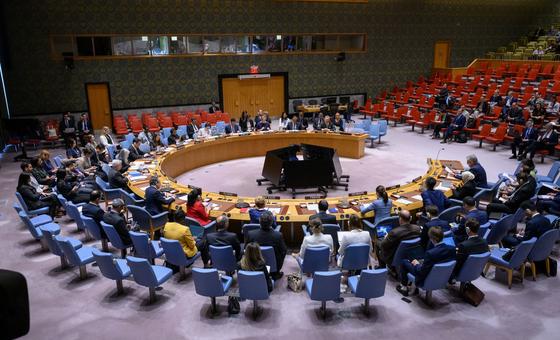
The Security Council is meeting in emergency session at Poland’s request at 3pm in New York, after some 19 Russian drones violated their and the North Atlantic Treaty Organization’s (NATO) airspace earlier this week. It marked the most serious incursion into NATO territory since Russia’s full-scale invasion of Ukraine began – and highlights the extent to which drone technology has reshaped tactics, logistics and strategy in wars worldwide. Follow the live coverage of the debate around the iconic horseshoe table below.
Currently underway in Stockholm from 24 to 28 August, the 35th World Water Week meeting highlights the crucial link between water and global warming, under the theme, Water For Climate Action.
At the core of sustainable development and basic human survival, safe drinking water is critical for socio-economic development, energy and food production – and healthy ecosystems.
Meanwhile, reliable water supply is also at the heart of adaptation efforts in an increasingly warming world.
Landlocked countries
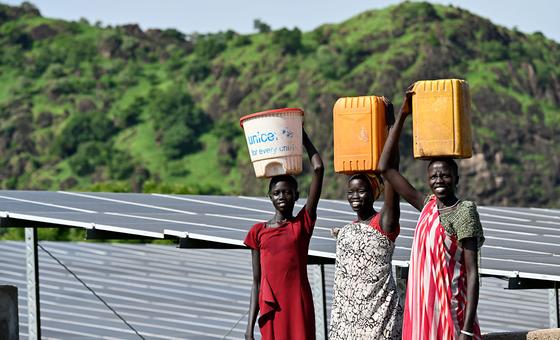
Improved access to water is creating new opportunities for people in some of the world’s most remote communities, particularly in landlocked developing countries (LLDCs).
On Wednesday, UN-Water – which coordinates the UN’s work on water and sanitation – will bring together LLDCs that have demonstrated substantial progress towards ensuring the availability and sustainable management of water and sanitation for all, in line with the UN Sustainable Development Goals (SGDs).
This session will provide an opportunity for other LLDCs to draw lessons from the progress made by Bhutan, Rwanda, and Saudi Arabia in ensuring safe drinking water and effective water management.
Innovative financing
The lack of safely managed water, sanitation and hygiene services, severely impacts human well-being, dignity and opportunities – especially for women and girls.
Indeed, contaminated water, inadequate sanitation, and poor hygiene practices are still undermining efforts to end extreme poverty and control disease outbreaks in the world’s poorest countries.
On Thursday, UN-Water and partners will galvanise donors and other key collaborators to address financing gaps in water and sanitation provision.
Discussions will focus on different models and building alliances to unlock innovative funding mechanisms for safer universal access.
The announcement came from UN culture agency (UNESCO) on Wednesday, as this year’s day was being celebrated in the capital of the United Arab Emirates (UAE), Abu Dhabi.
The focus there was on ‘Arabic Jazz’, a tapestry of musical traditions, which included the use of classical instruments from the region such as the oud, qanun and ney.
Following the jazz synthesis which ended on a high note in the UAE, the spotlight now turns to Chicago – where many would argue the golden era of jazz began as pioneers from New Orleans headed north during the 1920s.
The midwestern city will host the renowned All-Star Global Concert, directed by UNESCO Goodwill Ambassador Herbie Hancock, featuring some of the world’s most celebrated jazz artists.
“What better way for UNESCO to celebrate the 250th anniversary of the United States than by sharing its rich musical heritage with the world?” said Audrey Azoulay, UNESCO’s Director-General.
Rich jazz pedigree
Chicago has played a pivotal role in the evolution of the genre for over a century. In the 1920s, musicians journeyed up the Mississippi and found in Chicago a vibrant creative hub. Legends like Louis Armstrong, King Oliver, and Jelly Roll Morton helped define the “Chicago style” of jazz – marked by bold solos, improvisation, big band arrangements, and the rising prominence of the saxophone.
Today, the city remains a stronghold of jazz culture, home to renowned events such as the Chicago Jazz Festival and iconic venues including the Green Mill and the Jazz Showcase, which has been a cornerstone of the scene for 75 years.
Multiple Grammy Award-winning jazz pianist and Goodwill Ambassador for the UN Educational, Scientific and Cultural Organization (UNESCO), Herbie Hancock, performs at the inaugural International Jazz Day Concert at UN Headquarters. (2012)
UNESCO’s Goodwill Ambassador Herbie Hancock, a native of Chicago, reflected on what jazz has meant to him.
“It was in my high school auditorium in Chicago that I discovered jazz – an experience that ignited a lifelong passion,” he said. “Jazz opened doors to creativity, self-expression, and freedom.”
Events throughout the year
In addition to the Global Concert, Chicago will host a range of events throughout 2026 to celebrate International Jazz Day, including concerts, educational programmes, discussions, and community activities.
These will be organized in collaboration with the Chicago Jazz Alliance, the Ravinia Festival, the City of Chicago, the Illinois Arts Council, the State of Illinois, and other partners.
Launched by UNESCO in 2011, International Jazz Day is observed annually on April 30 in over 190 countries. It celebrates the power of jazz as a force for peace, intercultural dialogue, and human dignity.
Renowned Malayalam actress Mala Parvathy became the latest victim of an increasingly sophisticated cybercrime scam that has targeted several individuals. The scam involves fraudsters posing as police officers, accusing unsuspecting people of criminal activities in an attempt to extort money, from ordinary housewives to film stars to senior citizens and youngsters.
The recorded call says the recipient that her Aadhaar card or her phone number or PAN Card had been used to send a package containing passports, ATM cards, and a quantity of the drug MDMA to a foreign country. Once you respond, they send you a CBI notice and when called, they pass on the victim to another official.
The fraud has become so contagious that many innocent people are falling quick victims in disarray. “The caller was so convincing that I had no reason to doubt him. He said the situation was serious and could lead to severe legal consequences unless I took action immediately. He even sent me an identity card and connected me to another ‘official,’” actress Parvathy said.
The fraudster urged her to come to Mumbai for further investigation, but when she expressed her inability to travel, they escalated the pressure. “I was in shock when they sent me what looked like a CBI notice.”
Parvathy was lucky enough to immediately contact the Kerala Police. “The officer I spoke to confirmed that the call was likely made from a foreign country, making it difficult to trace,” she said. But how many victims are there who can turn to police immediately?
Steps To Do Against Fraudsters:
Call toll-free number (1930) or visit the website www.cybercrime.gov.in. To be precise, never respond to such calls but alert the cyberpolice in your state or call the number 1930 to make a complaint.
While the Kerala Police are conducting an extensive awareness campaign on social media to educate the public about such scams, “there is a need for a comprehensive financial ecosystem in place, which requires collaboration between the Centre and the Reserve Bank of India,” said Kerala chief minister Pinarayi Vijayan.
In a move towards harnessing export potential of naturally grown, organic certified fresh pineapples of North-Eastern Region (NER), centre, through Agricultural & Processed Food Products Export Development Authority (APEDA) organized an in-store export promotion programme in Dubai, United Arab Emirates (UAE) for Manipur’s pineapples among consumers.
The ‘in-store promotion show’ of organic certified fibre rich Kwe variety of pineapples from Manipur, was organized at the Lulu hyper market, Dubai’s largest supermarket in association with Manipur Organic Mission Agency (MOMA) of Government of Manipur. This event is part of government’s strategy to promote locally produced agricultural products in the international markets.
Manipur Organic Mission Agency (MOMA) has supported the sourcing of organic certified Kwe variety of pineapples directly from the farmers of Manipur.
pine apple/Photo:en.wikipedia.org
The Manipur pineapple, which is showcased with the support from APEDA, is fibre-rich sweetener from North Eastern Region (NER). The showcased pineapples are procured from Thayong Organic Producer Company Ltd in Imphal East district, Manipur.
At the in-store export promotion show, consumers were offered Manipur pineapple to taste the sweetness of the fruit. Northeast pineapple is one of the most important tropical fruits grown in the NER and the fibre-rich fruit is cultivated in almost all the region.
With a production of 134.82 metric tonne (MT) in 2020-21, Manipur ranks sixth in pineapple production having a share of 7.46 per cent in total production in India.
The top ten importing countries of Indian pineapples are UAE, Nepal, Qatar, Maldives, USA, Bhutan, Belgium, Iran, Bahrain and Oman. A quantity of 7665.42 MT of pineapples valued at USD 4.45 million was exported in the year 2021-22.
Manipur/Photo:en.wikipedia.org
With the intervention of APEDA, there has been a significant increase in the export of agricultural produce from NE states like Assam, Nagaland, Manipur, Mizoram, Tripura, Arunachal Pradesh, Sikkim and Meghalaya in the last few years.
Besides pineapple, the APEDA has also decided to take forward the promotion of other locally grown unique horticultural products from Manipur to the international market. The other unique products from Manipur are tamenglong orange, kachai lemon, black rice, etc.
Tripura was the first North Eastern state to export its ‘queen’ variety of pineapple to Dubai and Doha in 2018. Tripura’s pineapple was also exported to Bangladesh in 2020. Assam also made a debut in pineapple export to Dubai in 2019.
The NE region witnessed an 85.34 percent growth in the export of agricultural products in the last six years as it increased from USD 2.52 million in 2016-17 to USD 17.2 million in 2021-22. The major destination of export has been Bangladesh, Bhutan, the Middle East, the UK and Europe.
In the last three years, APEDA organised 136 capacity building programmes on export awareness across the different parts of NER. Highest, 62 capacity building programmes were held in NER in 2019-20, while 21 in 2020-21 and 53 such programmes were organised by APEDA in the year 2021-22. Apart from capacity building initiatives, APEDA facilitated 22 International Buyer-Seller Meets as well as trade fairs in NER in the last three years.
APEDA also organized a conference on the Export Potential of Natural, Organic and Geographical Indications (GI) Agro Products in Guwahati on June 24, 2022 to tap the abundant export potential of organic agricultural products from Assam and neighbouring states of NER.
APEDA aims at creating a platform in Manipur for the exporters to get the products directly from the producer group and the processors. The platform will link the producers and processors of Assam and exporters from other parts of the country that would expand the base of the export pockets in the North-Eastern states, including Manipur and increase the employment opportunities among the people of the state.
On the occasion, APEDA chairman Dr. M. Angamuthu stressed on promoting processed form of value-added pineapple to sustain in the global export market for a longer time period.
“We need to focus on promoting pineapple sourced from farmers in processed form in the Gulf countries through Lulu Group. It will help farmers in better price realization of their produce,” Dr Angamuthu said. Shri P Vaiphel, Additional Chief Secretary, Government of Manipur also attended the meet.