Protecting lives in a warming world: Health takes centre stage at COP30

As climate negotiations continue in the Amazonian city of Belém, Brazil, governments, UN agencies and partners have adopted the Belém Health Action Plan, placing an emphasis on addressing healthcare inequalities.

For updates on all the action and UN News coverage so far, head to our dedicated page here.

A planet heading to ‘intensive care’

The adoption took place on COP’s designated Health Day – a recognition that the climate crisis is also a health crisis.

“If our planet were a patient, it would be admitted to intensive care,” World Health Organization (WHO) Director-General Tedros Adhanom Ghebreyesus warned on the eve of the conference.

Extreme heat, floods, droughts and storms are not only environmental threats –they are driving disease outbreaks, food and water insecurity, and the disruption of essential health services.

A UNFPA mobile health clinic midwife assesses a pregnant woman at a displacement camp in Marib, Yemen.

Blueprint for resilience

Developed by the WHO, UN University (UNU) and other UN partners in collaboration with the Brazilian Government, the Action Plan sets out practical steps to integrate health into climate strategies

  • Strengthening health systems to withstand climate shocks
  • Mobilising finance and technology for adaptation and
  • Ensuring communities have a voice, promoting their participation in governance.

Brazil’s Health Minister Alexandre Padilha described the launch as “a crucial moment to demonstrate the strength of the health sector in global climate action”

© UNFCCC/Diego Herculano

Civil society demonstration at COP30

Solutions hub

Thursday’s high-level sessions in the main conference rooms are dominated by speeches and discussions about climate and health – but throughout COP30, the WHO-led Health Pavilion has been the hub for solutions and dialogue.

The topics covered at the pavilion range from AI to waste management, jobs, education and human rights – all from the perspective of health.

Friday in the pavilion will be dedicated to the Alliance for Transformative Action on Climate and Health, a WHO-led initiative to accelerate the transition to climate-resilient and low carbon health systems. 

Food Waste Breakthrough

Also today, the UN Environment Programme (UNEP) and its partners launched an initiative to cut food waste in half by 2030 and cut up to seven per cent of methane emissions as part of efforts to slow climate change.

UNEP notes that the world wastes more than one billion tonnes of food every year, contributing up to 10 per cent of global greenhouse gas emissions and accounting for up to 14 per cent of methane emissions, which is a short-lived climate pollutant that is 84 times more potent at warming the atmosphere than carbon dioxide over 20 years.

Funded by the Global Environment Facility, the UN Environment Programme will launch a $3 million, four-year global project to implement the targets of the Food Waste Breakthrough.  

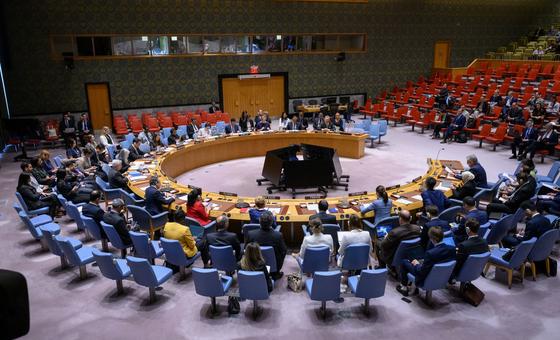
SECURITY COUNCIL LIVE: NATO allies rally round Poland in face of Russian incursion, as drone warfare takes centre stage

The Security Council is meeting in emergency session at Poland’s request at 3pm in New York, after some 19 Russian drones violated their and the North Atlantic Treaty Organization’s (NATO) airspace earlier this week. It marked the most serious incursion into NATO territory since Russia’s full-scale invasion of Ukraine began – and highlights the extent to which drone technology has reshaped tactics, logistics and strategy in wars worldwide. Follow the live coverage of the debate around the iconic horseshoe table below.

Source link

Climate change takes increasingly extreme toll on African countries

Extreme weather and climate change impacts are hitting every single aspect of socio-economic development in Africa and exacerbating hunger, insecurity and displacement,” the UN World Meteorological Organization (WMO) said on Monday.

WMO said that average surface temperature across Africa in 2024 was approximately 0.86°C above the 1991–2020 average.

North Africa recorded the highest temperature – 1.28°C above the 1991-2020 average; it is the fastest-warming sub-region of Africa.

Marine heat spike

Sea surface temperatures were also the highest on record. “Particularly large increases in sea surface temperatures have been observed in the Atlantic Ocean and Mediterranean Sea,” WMO said.
Data shows that almost the entire ocean area around Africa was affected by marine heatwaves of strong, severe or extreme intensity last year and especially the tropical Atlantic.

Head of WMO, Celeste Saulo, warned that climate change is an urgent and escalating problem across the African continent “with some countries grappling with exceptional flooding caused by excessive rainfall and others enduring persistent droughts and water scarcity”.

El Niño influence

Highlighting Africa’s particular vulnerability to our warming planet – caused mainly by rich nations burning fossil fuels – the UN agency said that floods, heatwaves and droughts forced 700,000 people out of their homes across the continent last year.

WMO also noted that the El Niño phenomenon was active from 2023 into early 2024 and “played major roles in rainfall patterns” across Africa.

In northern Nigeria alone, 230 people died in floods last September that swept across the capital of Borno state, Maiduguri, displacing 600,000, severely damaging hospitals and contaminating water in displacement camps.

Regionally, rising waters caused by torrential rains ravaged West Africa and impacted a staggering four million people. 

Conversely, Malawi, Zambia and Zimbabwe suffered the worst drought in at least two decades, with cereal harvests in Zambia and Zimbabwe 43 per cent and 50 per cent below the five-year average, respectively.

Heat shock

Heatwaves are also a growing threat to health and development and Africa, WMO said, noting that the past decade has also been the warmest on record. Depending on the dataset, 2024 was the warmest or second-warmest year.

Blistering temperatures already impact children’s education, with schools closing in March 2024 in South Sudan as temperatures reached 45°C. Worldwide, at least 242 million pupils missed school because of extreme weather in 2024, many of them in sub-Saharan Africa, according to the UN Children’s Fund, UNICEF.

Beyond education, rising temperatures across the continent are making Africa more water-scarce and food-insecure, with North African countries the hardest-hit.

South Sudan focus

Erratic weather patterns across Africa are also hindering farming, driving food insecurity and displacing people who have already had to flee war already, WMO explained.

Last October, for example, flooding affected 300,000 people in South Sudan – a hefty figure for a nation of 13 million, scarred by years of civil strife and where infrastructure is poor.

The disaster wiped out cattle, adding up to between 30 and 34 million farm animals – roughly two per inhabitant – and stagnant water fuelled diseases. Families who had been self-sufficient had to seek help once again.

“When someone slides back into being fed, it affects their dignity,” said Meshack Malo, South Sudan Country Representative for the UN Food and Agriculture Organization (FAO).

At the forefront of climate change, the troubled East African country is already dealing with a crippling economic crisis, mass displacement made worse by the war in neighbouring Sudan, as well as escalating tensions at home and pervasive violence.

Fighting in Sudan has derailed the South Sudanese economy, which relies on oil exports for 90 per cent of its national revenue, reports indicate.

Destructive cycle

When South Sudan is not hit by floods, it is plagued by drought.

“This cyclic change between floods and drought, makes the country affected almost a good part of the year,” said Mr. Malo.  

Flooding has worsened and become more intense and frequent in recent years.

“That means that any short rain then can easily trigger the flooding, because water and the soil remain quite saturated,” Mr. Malo added. “So that intensity and frequency makes this situation worse.”

With road access disrupted for aid trucks, UN agencies such as the World Food Programme (WFP) must airlift food assistance – a costly, impractical solution, as humanitarian funding dwindles.

Pushing back  

In the South Sudanese town of Kapoeta, the FAO has helped to reduce the number of dry months from six to two, by harvesting and storing water to protect crops at risk from climate change.  

“The impact of drought is no longer felt as much,” FAO’s Mr. Malo said, speaking to UN News from the capital, Juba.

Worth its salt

In countries that lack water resources for crop irrigation, climate resilience and adaptation are critical, Dr. Ernest Afiesimama of the WMO Regional Office for Africa in Addis Ababa, told journalists.

And while desalination – the process of removing salt from seawater – may be a solution for some, for many African nations it is not viable.

Rather than turning to desalination as a panacea, investing in adaptation measures including early warning systems for action and preparedness is urgently needed, environmental scientists say.  “Considering the challenges in sub-Saharan Africa, [desalination] presents a complex economic, environmental and social challenge, and there is a question about its long-term sustainability and equity,” said Dr. Dawit Solomon, Contributor at Accelerating Impacts of CGIAR Climate Research for Africa (AICCRA).  

“Africa is facing a high climate change bill. Imagine the continent which is struggling economically and then facing this additional risk multiplier,” Dr. Salomon added.


Source link

Jazz takes centre stage in Chicago for 2026

The announcement came from UN culture agency (UNESCO) on Wednesday, as this year’s day was being celebrated in the capital of the United Arab Emirates (UAE), Abu Dhabi.

The focus there was on ‘Arabic Jazz’, a tapestry of musical traditions, which included the use of classical instruments from the region such as the oud, qanun and ney.

Following the jazz synthesis which ended on a high note in the UAE, the spotlight now turns to Chicago – where many would argue the golden era of jazz began as pioneers from New Orleans headed north during the 1920s.

The midwestern city will host the renowned All-Star Global Concert, directed by UNESCO Goodwill Ambassador Herbie Hancock, featuring some of the world’s most celebrated jazz artists.

What better way for UNESCO to celebrate the 250th anniversary of the United States than by sharing its rich musical heritage with the world?” said Audrey Azoulay, UNESCO’s Director-General.

Rich jazz pedigree

Chicago has played a pivotal role in the evolution of the genre for over a century. In the 1920s, musicians journeyed up the Mississippi and found in Chicago a vibrant creative hub. Legends like Louis Armstrong, King Oliver, and Jelly Roll Morton helped define the “Chicago style” of jazz – marked by bold solos, improvisation, big band arrangements, and the rising prominence of the saxophone.

Today, the city remains a stronghold of jazz culture, home to renowned events such as the Chicago Jazz Festival and iconic venues including the Green Mill and the Jazz Showcase, which has been a cornerstone of the scene for 75 years.

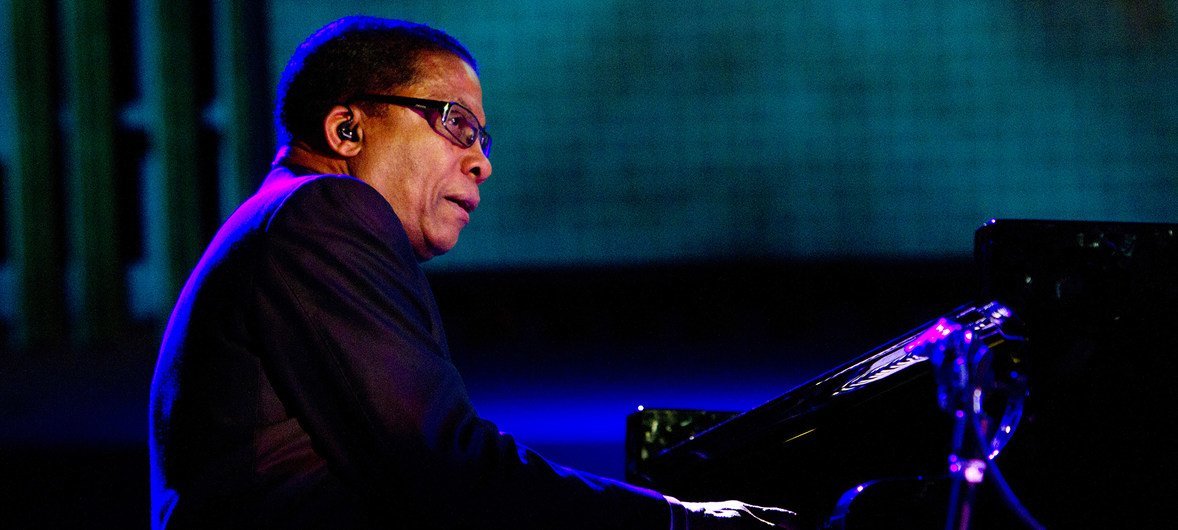
Multiple Grammy Award-winning jazz pianist and Goodwill Ambassador for the UN Educational, Scientific and Cultural Organization (UNESCO), Herbie Hancock, performs at the inaugural International Jazz Day Concert at UN Headquarters. (2012)

UNESCO’s Goodwill Ambassador Herbie Hancock, a native of Chicago, reflected on what jazz has meant to him.

It was in my high school auditorium in Chicago that I discovered jazz – an experience that ignited a lifelong passion,” he said. “Jazz opened doors to creativity, self-expression, and freedom.”

Events throughout the year

In addition to the Global Concert, Chicago will host a range of events throughout 2026 to celebrate International Jazz Day, including concerts, educational programmes, discussions, and community activities.

These will be organized in collaboration with the Chicago Jazz Alliance, the Ravinia Festival, the City of Chicago, the Illinois Arts Council, the State of Illinois, and other partners.

Launched by UNESCO in 2011, International Jazz Day is observed annually on April 30 in over 190 countries. It celebrates the power of jazz as a force for peace, intercultural dialogue, and human dignity.

Source link