The Unique Identification Authority of India (UIDAI) has entered into a partnership with MapmyIndia to integrate authorised Aadhaar service centres into the Mappls mobile application, a move aimed at simplifying access to Aadhaar-related services across the country.
The agreement, signed on April 1, 2026, will allow users to locate verified Aadhaar centres through the Mappls App, the navigation platform developed by MapmyIndia. The rollout is expected over the coming months.
Under the collaboration, UIDAI will provide authenticated data on Aadhaar centres, which will be digitally mapped and listed within the app. The integration is designed to ensure that users searching for Aadhaar services are directed only to authorised centres.
Search-Based Access To Verified Aadhaar Services
The feature will allow residents to identify centres based on specific services offered, including new enrolments for adults and children, as well as updates to address and mobile details.
By categorising centres according to services, the platform aims to reduce confusion for users who often rely on incomplete or unverified information when seeking Aadhaar services.
The initiative also seeks to address concerns around misinformation and unauthorised operators. By displaying only verified locations, UIDAI intends to create a single, reliable digital layer for Aadhaar service access.
Focus On Convenience And Digital Mapping
“UIDAI is always driven by resident centricity. This kind of collaboration will allow digital mapping of verified Aadhaar Centres across India and help people find the authorised Aadhaar centres easily,” said Bhuvnesh Kumar, Chief Executive Officer of UIDAI.
MapmyIndia will be responsible for integrating the data into its platform, ensuring accurate geolocation, consistent updates, and clear identification of Aadhaar centres within the app interface.
“It is a privilege to serve UIDAI and enable people with easy access to Aadhaar Centres, through the Mappls App,” said Rakesh Verma, Co-founder and Chairman and Managing Director of MapmyIndia.
Nationwide Access Through Aadhaar Seva Kendras
The initiative covers Aadhaar Seva Kendras (ASKs) and other authorised centres operating across India. These centres provide services including biometric enrolment, demographic updates, and document verification.
By embedding this network into a widely used navigation app, the collaboration aims to bridge the gap between physical service points and digital discovery tools.
The rollout is expected to make Aadhaar services more accessible, particularly for users unfamiliar with official centre locations or navigating multiple service providers.
India has identified over 8.5 million tonnes of rare earth oxide resources across coastal and inland regions, the government said on April 2, 2026, in Parliament. While the country holds domestic reserves, it remains dependent on imports for rare earth magnets due to processing and industrial gaps. A ₹7,280 crore incentive scheme aims to build local magnet manufacturing capacity and reduce reliance on foreign supply chains.
A mineral buried in coastal sands and inland deposits has quietly become central to India’s industrial ambitions. Rare earth elements, essential for everything from electric vehicles to defence systems, are now at the center of a policy push to turn geological potential into manufacturing strength.
The Atomic Minerals Directorate for Exploration and Research (AMD), a unit under the Department of Atomic Energy (DAE), has identified significant rare earth reserves across the country, according to a statement presented in the Rajya Sabha on April 2, 2026.
India holds approximately 7.23 million tonnes of in-situ total rare earth oxide equivalent embedded in 13.15 million tonnes of monazite, a mineral rich in thorium and rare earths. These deposits are spread across coastal “teri” sands, beach sands, and inland alluvial regions in states including Andhra Pradesh, Odisha, Tamil Nadu, Kerala, and West Bengal, among others.
In addition, about 1.29 million tonnes of rare earth oxide resources have been identified in hard rock terrains in parts of Gujarat and Rajasthan.
Why India Still Imports Rare Earth Magnets
Despite these reserves, the government acknowledged a critical gap. India is not dependent on other countries for rare earth minerals themselves, but it continues to rely on imports for rare earth magnets and related high-value products.
The reasons are structural and technical.
The ore grade of Indian deposits is relatively low, ranging between 0.056% and 0.058%, which makes extraction economically challenging. The presence of radioactive elements further complicates processing, requiring stricter handling protocols and increasing costs.
Environmental and regulatory constraints also limit mining. Coastal Regulation Zone (CRZ) rules, mangrove protections, forest cover, and habitation patterns have restricted large-scale extraction, effectively capping production volumes.
Equally significant is the absence of a strong midstream industry. India has limited capacity to convert refined rare earth oxides into metals, alloys, and finished magnets. This lack of downstream demand has historically dampened incentives to scale up extraction.
₹7,280 Crore Scheme Targets Full Supply Chain
To address these gaps, the Union Cabinet approved a scheme in November 2025 to promote the domestic manufacturing of sintered rare earth permanent magnets. The policy was formally notified in December 2025.
The scheme aims to establish 6,000 metric tonnes per annum of rare earth permanent magnet production capacity in India.
The total financial outlay stands at ₹7,280 crore. This includes ₹6,450 crore in sales-linked incentives over five years and ₹730 crore as capital subsidy to support the creation of manufacturing facilities.
Rare earth permanent magnets are among the strongest magnets available and are critical components in electric mobility, renewable energy systems such as wind turbines, advanced electronics, aerospace applications, and defence technologies.
The government’s objective is to build an end-to-end ecosystem. This includes processing rare earth oxides, producing metals and alloys, and manufacturing finished magnets within the country.
Strategic Push Includes Corridors and Pilot Plants
Alongside the incentive scheme, the government has initiated supporting infrastructure and pilot manufacturing efforts.
The Department of Atomic Energy has established a rare earth permanent magnet plant in Visakhapatnam, Andhra Pradesh. The facility produces about three tonnes of Samarium Cobalt magnets annually, a category of high-performance magnets used in strategic sectors such as defence and atomic energy.
The Union Budget for 2026–27 has also proposed dedicated Rare Earth Corridors in Odisha, Kerala, Andhra Pradesh, and Tamil Nadu. These corridors are expected to cluster mining, processing, and manufacturing activities to improve efficiency and attract investment.
The policy direction signals a shift from resource identification to industrial scaling.
Global Context and Domestic Stakes
Rare earth magnets sit at the heart of global supply chains for clean energy and advanced manufacturing. Countries with control over processing and magnet production hold significant leverage in sectors such as electric vehicles and defence systems.
India’s approach, as outlined in Parliament, reflects an attempt to bridge the gap between resource availability and industrial capability.
The statement was delivered by Jitendra Singh, Union Minister of State (Independent Charge) for Earth Sciences and Science and Technology, in the Rajya Sabha.
As the government moves to operationalize incentives and infrastructure, the focus now shifts to execution, industry participation, and the pace at which domestic manufacturing capacity can be built.
NASA confirmed the Artemis II crew completed the apogee raise burn on April 2, increasing Orion’s orbital high point. The mission now transitions toward a proximity operations demonstration that will test manual spacecraft control near another object. Engineers continue to monitor a minor onboard system issue as the crew prepares for the next phase.
The spacecraft climbed higher. The mission grew more precise.
The National Aeronautics and Space Administration confirmed that Artemis II successfully executed its apogee raise maneuver, a key step in refining the Orion spacecraft’s orbit around Earth. The burn, powered by the interim cryogenic propulsion stage’s RL10 engine, increased the spacecraft’s highest orbital point and aligned it for upcoming tests.
The maneuver follows earlier orbital adjustments and forms part of a carefully sequenced plan to prepare Orion for operations beyond low Earth orbit. NASA officials said the spacecraft remains in stable condition, with power generation and thermal systems operating within expected limits.
Artemis II apogee raise burn and orbit shaping
The apogee raise burn works in tandem with the previously completed perigee adjustment. Together, these maneuvers define the shape and altitude of Orion’s orbit, ensuring the spacecraft is positioned correctly for subsequent demonstrations and trajectory changes.
Mission controllers at Johnson Space Center continue to track performance data, confirming that propulsion and navigation systems responded as expected.
Ahead of the burn, astronauts also began configuring the spacecraft for sustained operations in orbit. That included routine system checks such as evaluating the onboard toilet system. During that procedure, the crew reported a blinking fault light, which engineers are now analyzing.
NASA has not indicated that the issue affects mission safety, but teams are working with the crew to identify its cause and resolve it.
Trajectory for Artemis II, NASA’s first flight with crew aboard SLS, Orion to pave the way for long-term return to the Moon, missions to Mars
Proximity operations demonstration and manual control testing
The next phase of Artemis II will focus on proximity operations, a critical test of Orion’s ability to maneuver near another spacecraft.
The demonstration will use the detached upper stage of the Space Launch System as a reference target. Astronauts will guide Orion, named Integrity, through a series of controlled movements to evaluate how the spacecraft performs under manual control.
Before the maneuver begins, communications will transition from NASA’s Near Space Network to the Deep Space Network, systems that support spacecraft from launch through deep-space operations.
During the approximately 70-minute exercise, Orion will approach the upper stage to within about 300 feet before pausing. The crew will then take manual control, using onboard hand controllers to make precise adjustments and assess responsiveness.
At a closer range of roughly 30 feet, astronauts will evaluate the spacecraft’s fine handling capabilities. These maneuvers will rely on the reaction control system thrusters located on Orion’s European-built service module.
NASA said the demonstration also includes an automated backflip maneuver, allowing Orion to reorient and face the target stage. The test will generate detailed data on navigation and control systems, including measurements from the spacecraft’s docking camera.
These data points are expected to inform future missions that require rendezvous and docking in lunar orbit, where traditional GPS systems are not available.
Preparing for future lunar operations
At the conclusion of the demonstration, Orion will execute an automated departure burn to safely distance itself from the upper stage. The stage will then perform a disposal maneuver, re-entering Earth’s atmosphere over a remote region of the Pacific Ocean.
NASA said the spacecraft’s systems remain stable as the crew transitions into this next phase. Solar arrays continue to generate power, and environmental conditions inside Orion remain within predicted ranges.
Public interest in the mission’s technical milestones remains high. “This is the kind of test that proves whether astronauts can really control the vehicle in deep space,” wrote Reddit user LunarOpsWatcher in a post with more than 1,100 upvotes, highlighting the importance of manual maneuvering capabilities.
Artemis II is designed as a test mission, but each milestone carries implications for future exploration. The proximity operations demonstration, in particular, addresses a key requirement for sustained human activity beyond Earth orbit.
With the apogee burn complete, Orion now moves into one of its most intricate tests yet.
NASA confirmed the Artemis II crew completed a perigee raise maneuver on April 2, refining Orion’s orbit around Earth. A brief communications loss occurred shortly after the burn but was quickly resolved with no reported impact on crew safety. The agency will hold a press conference from Kennedy Space Center as the mission prepares for its next orbital milestone.
A routine engine burn sharpened Artemis II’s orbit. Minutes later, mission control lost contact. Then the signal came back.
The National Aeronautics and Space Administration said the Orion spacecraft successfully completed its perigee raise maneuver, one of the key early steps in shaping its path around Earth. The burn used the interim cryogenic propulsion stage’s RL10 engine to lift the spacecraft’s lowest orbital point, refining its trajectory for later mission phases.
The maneuver followed earlier orbital adjustments and forms part of a sequence designed to prepare Orion for operations beyond low Earth orbit. NASA officials said the burn occurred as planned, with precise timing required to achieve the desired orbital change.
Artemis II perigee raise burn and orbital adjustments
The perigee raise maneuver increases the spacecraft’s minimum altitude during its orbit. Along with a separate apogee raise burn, which affects the highest orbital point, these adjustments create a stable and elongated orbit suitable for further testing.
NASA said these burns are critical in preparing Orion for a planned high Earth orbit phase lasting about 23.5 hours. During that period, astronauts and ground teams will conduct system checkouts before committing to the next stage of the mission.
The work is coordinated through mission control at Johnson Space Center, where engineers track propulsion performance, navigation data, and onboard systems in real time.
A view over the shoulders of NASA astronauts Victor Glover (left) and Reid Wiseman (right), pilot and commander, respectively, inside the Orion spacecraft as they participate in a proximity operations demonstration. This demonstration tests the spacecraft’s ability to manually maneuver relative to another spacecraft, the interim cryogenic propulsion stage, after separation, using its onboard navigation sensors and reaction control thrusters. NASA
Brief communication dropout under review
Shortly after completing the burn, ground teams experienced a temporary loss of communications with the spacecraft. NASA said controllers were unable to receive data from Orion or the crew for a brief period.
The interruption resolved quickly. Astronauts reported that they continued to hear communications from the ground throughout the event, indicating that onboard systems remained functional.
NASA said engineers are reviewing telemetry to determine the cause of the dropout. The agency has not indicated any impact on mission safety or trajectory.
Such communication gaps, while uncommon, are treated as high-priority review items during test missions. Artemis II, as a crewed test flight, is designed to expose and evaluate system behavior under real operating conditions.
NASA press conference and mission leadership
NASA will hold a post-launch press conference at 8 p.m. EDT from the Kennedy Space Center to provide further updates.
Scheduled participants include NASA Administrator Jared Isaacman, Associate Administrator Amit Kshatriya, Lori Glaze, who serves as acting associate administrator for the Exploration Systems Development Mission Directorate, and Norm Knight, director of the Flight Operations Directorate.
The briefing is expected to address the completed maneuver, the communication anomaly, and upcoming mission steps.
Public attention remains fixed on the mission’s progress. “Even a small signal loss gets people nervous, but that’s why they test,” wrote Reddit user SpaceTrackLive in a post that drew more than 900 upvotes, reflecting cautious optimism among spaceflight observers.
Next milestone: apogee raise burn and system checks
The next major step for Artemis II is the apogee raise maneuver. This burn will increase the highest point of Orion’s orbit, complementing the earlier perigee adjustment.
Together, these orbital changes define the spacecraft’s path before it transitions into high Earth orbit operations. NASA said this phase will allow for extended system verification and crew activity in preparation for the mission’s later trajectory toward the Moon.
Engineers view these incremental milestones as essential. Each burn, test, and anomaly review contributes to a broader goal: confirming that Orion can safely carry astronauts through deep space and back.
For now, Artemis II continues to move step by step. One maneuver completed, one anomaly under review, and another burn on the horizon.
Astronauts aboard NASA’s Artemis II mission completed a key proximity operations test on April 2 while orbiting Earth. The maneuver involved controlled movements around a detached rocket stage to evaluate spacecraft handling. With CubeSat deployments ahead and a minor onboard system issue under review, the crew is now preparing for a perigee raise burn to refine Orion’s orbit.
A shoebox-sized satellite deployment and a blinking fault light now share space in NASA’s latest Moon mission update.
The National Aeronautics and Space Administration confirmed that astronauts aboard Artemis II have completed one of the mission’s earliest and most technical tests. The crew piloted the Orion spacecraft, named Integrity, through a series of close-range maneuvers around a detached rocket stage, simulating scenarios required for future docking and deep-space operations.
The 70-minute exercise marked the mission’s proximity operations demonstration. Using the interim cryogenic propulsion stage, or ICPS, as a reference point, astronauts conducted controlled approach and retreat sequences to assess manual navigation capabilities in orbit.
At the end of the test, Orion executed an automated departure burn to safely distance itself from the stage. NASA said the ICPS will later perform a disposal burn, re-entering Earth’s atmosphere over a remote part of the Pacific Ocean.
A view over the shoulders of NASA astronauts Victor Glover (left) and Reid Wiseman (right), pilot and commander, respectively, inside the Orion spacecraft as they participate in a proximity operations demonstration. This demonstration tests the spacecraft’s ability to manually maneuver relative to another spacecraft, the interim cryogenic propulsion stage, after separation, using its onboard navigation sensors and reaction control thrusters. NASA
Orion proximity operations test and orbital maneuver plan
The proximity operations test is central to Artemis II’s role as a proving mission. Unlike future lunar landings, this flight focuses on validating systems and crew performance under real spaceflight conditions.
NASA officials said the demonstration provided critical data on how Orion behaves during manual piloting near another object. These conditions are expected to be essential for future missions involving docking, assembly, or logistics operations in lunar orbit.
The crew now turns to the next phase of orbital adjustments. After completing an earlier apogee raise maneuver, mission controllers are preparing for a perigee raise burn. This engine firing will increase the lowest point of Orion’s orbit around Earth, refining its trajectory for eventual translunar injection.
The sequence of burns shapes the spacecraft’s path before it departs Earth’s gravitational influence. These adjustments are necessary to ensure precision as the mission transitions toward its planned lunar flyby.
CubeSat deployments expand international science efforts
Alongside the crewed mission, Artemis II is carrying four CubeSats, compact satellites designed for scientific research and technology demonstrations.
These payloads, housed within the Space Launch System adapter, will deploy after separation from Orion. Each satellite represents an international collaboration and targets a different aspect of space science.
Argentina’s ATENEA CubeSat will study radiation shielding and communication systems. The Saudi Space Agency’s Space Weather CubeSat-1 will measure solar radiation and magnetic fields. Germany’s TACHELES mission will test components for future lunar logistics systems. South Korea’s K-Rad Cube will analyze radiation exposure and its biological effects across the Van Allen belts.
NASA describes CubeSats as small but versatile tools that can extend mission science at relatively low cost. Their deployment during Artemis II adds a layer of experimentation beyond the primary crewed objectives.
Toilet system issue under review during mission operations
Amid the technical milestones, engineers are also tracking a minor onboard issue.
During routine spacecraft configuration checks, the crew reported a blinking fault light in Orion’s toilet system. Mission control teams at Johnson Space Center are analyzing telemetry and working with astronauts to troubleshoot the problem.
NASA has not indicated that the issue poses a risk to crew safety or mission objectives. Such anomalies are not uncommon during test flights, where systems are evaluated under operational conditions for the first time.
The crew’s schedule includes carefully timed rest periods between mission activities. After a four-hour sleep cycle, astronauts are set to wake at 7 a.m. EDT to prepare for the upcoming burn, before returning to rest later in the day.
Public reaction to the update has reflected both enthusiasm and curiosity about the mission’s technical details. “It’s fascinating to see them actually test manual flying like this,” wrote Reddit user OrbitalWatcher, in a post that drew more than 1,200 upvotes, noting that such maneuvers are rarely visible to the public.
Preparing for deeper space operations
Artemis II continues to function as a systems validation mission, bridging the gap between uncrewed tests and future lunar landings.
Each milestone, from proximity operations to orbital burns, contributes to a broader objective. NASA aims to confirm that Orion and its supporting systems can reliably carry astronauts beyond low Earth orbit and back.
The upcoming perigee raise burn represents another step in that process. Once completed, it will help finalize the spacecraft’s orbit before the mission advances toward its lunar trajectory.
For engineers and mission planners, these incremental steps are essential. They provide the data needed to support more complex operations in future Artemis missions, including sustained human presence on the Moon.
The National Aeronautics and Space Administration launched four astronauts on April 2 from Kennedy Space Center in Florida aboard the Artemis II mission. The crew is set for a 10-day test flight around the Moon, marking the first human lunar flyby since the Apollo era. The mission aims to validate spacecraft systems and pave the way for future Moon landings and Mars exploration.
The countdown ended just after dusk in Florida. At 6:35 p.m. EDT on Wednesday, a new chapter in human spaceflight lifted off from Launch Pad 39B.
The National Aeronautics and Space Administration sent four astronauts toward the Moon aboard its Artemis II mission, marking the first crewed lunar journey in more than five decades. The launch took place at the agency’s Kennedy Space Center, the same historic ground that supported Apollo-era missions.
Aboard the Orion spacecraft were NASA astronauts Reid Wiseman, Victor Glover and Christina Koch, along with Canadian Space Agency astronaut Jeremy Hansen. The 10-day mission is designed as a test flight, with no lunar landing planned, but its implications extend far beyond a single journey.
“Today’s launch marks a defining moment for our nation and for all who believe in exploration,” NASA Administrator Jared Isaacman said in an official statement. “Artemis II builds on the vision set by President Donald J. Trump, returning humanity to the Moon for the first time in more than 50 years.”
Artemis II mission objectives and timeline
The mission began with the ignition of NASA’s Space Launch System (SLS), the most powerful rocket the agency has developed. About 49 minutes after liftoff, the rocket’s upper stage fired to place Orion into an elliptical orbit around Earth. A second burn is scheduled to push the spacecraft into a high Earth orbit extending roughly 46,000 miles from the planet.
From there, the spacecraft will separate and continue independently. Engineers confirmed that Orion deployed its solar arrays shortly after reaching space, allowing it to draw energy from the Sun.
The crew will spend about a day in high Earth orbit conducting system checks and a manual piloting demonstration. These early operations are designed to test the spacecraft’s handling and ensure its readiness for deeper space travel.
If all systems perform as expected, mission controllers at Johnson Space Center will authorize a translunar injection burn. This maneuver, lasting about six minutes, will send Orion on a trajectory toward the Moon.
NASA Associate Administrator Amit Kshatriya described the mission as a proving ground. “Artemis II is a test flight, and the test has just begun,” he said. “Over the next 10 days, the crew will put Orion through its paces so future missions can land on the Moon with confidence.”
Lunar flyby and scientific goals
The spacecraft is scheduled to reach the Moon for a flyby on April 6. During this phase, the astronauts will travel around the lunar far side, an area rarely seen directly by human eyes.
NASA officials said the lighting conditions during the flyby could provide enhanced visibility of surface features such as ridges, crater rims and slopes. The crew is expected to capture images and make observational reports that will inform future missions.
The mission also includes scientific experiments, including human health studies designed to assess how astronauts respond to deep-space conditions. These findings will contribute to planning for longer missions, including eventual journeys to Mars.
Alongside the primary mission, the rocket’s upper stage will deploy four CubeSats developed by international partners. These small satellites will conduct independent research and technology demonstrations, highlighting the global collaboration involved in Artemis.
Return to the Moon after Apollo
Artemis II is the first crewed mission in NASA’s Artemis program, which aims to establish a sustained human presence on the Moon. The last time astronauts traveled beyond low Earth orbit was during the Apollo program in the early 1970s.
The current mission does not include a landing, but it sets the stage for future Artemis missions that will attempt to place astronauts on the lunar surface. NASA has said the long-term goal is to build infrastructure that supports extended stays on the Moon.
The program also serves as a stepping stone for missions to Mars, with engineers using Artemis to test technologies and operational strategies required for deeper space exploration.
Public reaction to the launch reflected a mix of excitement and historical awareness. One widely shared comment on Reddit captured the moment’s significance. “We’re finally going back to the Moon with people on board,” wrote user AstroFan92 on a thread with more than 3,000 upvotes, calling it “a milestone that feels like history repeating itself in the best way.”
What comes next for Artemis
Following the lunar flyby, Orion will begin its return trajectory to Earth. The mission is expected to conclude with a splashdown in the Pacific Ocean. Recovery teams will retrieve the crew and spacecraft for post-mission analysis.
NASA officials describe Artemis II as a foundation mission. It tests life support systems, validates navigation and communication technologies, and confirms that astronauts can safely travel beyond low Earth orbit using the new spacecraft.
Future Artemis missions will build on these results. Planned objectives include landing astronauts on the Moon, establishing a long-term lunar presence, and eventually preparing for human exploration of Mars.
For now, Artemis II represents a return. Not just to the Moon, but to a scale of ambition that defined an earlier era of spaceflight.
Scientists in India have developed a method to reuse graphite from discarded lithium-ion batteries to improve fuel cell efficiency, according to a recent study. The research, conducted by the International Advanced Research Centre for Powder Metallurgy and New Materials, shows that recycled graphite can enhance catalyst performance and durability in fuel cells. The findings, published in ACS Sustainable Resource Management, point to a dual solution for battery waste and clean energy challenges.
A used lithium-ion battery, often discarded after years of service, may hold more value than previously thought.
Scientists have found a way to extract graphite from spent batteries and transform it into a high-performance material that improves how fuel cells operate, offering a potential bridge between waste management and clean energy systems.
The work was carried out by researchers at the International Advanced Research Centre for Powder Metallurgy and New Materials, an autonomous institute under the Department of Science and Technology.
Recycled graphite and the challenge of fuel cell efficiency
Fuel cells, particularly those used in clean energy applications, rely on catalysts to drive chemical reactions that generate electricity. One of the most critical reactions is the oxygen reduction reaction, or ORR, which directly affects efficiency.
Platinum-based catalysts are widely used for this purpose but face two major limitations. They are expensive, and their performance can degrade over time due to poisoning by carbon monoxide and interference from methanol in certain fuel cell systems.
At the same time, the rapid rise in lithium-ion battery usage has created a growing stream of waste, with graphite being a major component of discarded batteries.
Researchers have been exploring whether this waste material could be repurposed to address bottlenecks in fuel cell technology.
How the material was developed and tested
The research team recovered graphite from end-of-life lithium-ion batteries and chemically exfoliated it, a process that increases its surface area and introduces more active sites for chemical interaction.
They then carried out detailed characterization and electrochemical testing to evaluate how the material performed in ORR conditions, including its tolerance to methanol.
Unlike earlier studies that focused mainly on alkaline environments, this work demonstrated effective performance in acidic conditions, which are relevant for many commercial fuel cell systems.
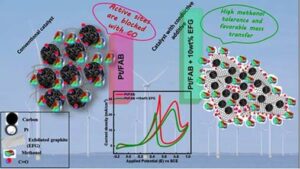
The exfoliated graphite was combined with platinum catalysts to form a conductive network that improved both electron flow and oxygen transport within the system.
Fig: Graphical illustration of the Pt–exfoliated graphite catalyst, with exfoliated graphite forming a conductive network that suppresses methanol crossover and CO poisoning, leading to improved oxygen reduction performance and durability PIB
Performance gains and durability improvements
The study identified an optimal composition of 10 percent exfoliated graphite by weight, which delivered improved performance and stability compared with conventional setups.
The material showed an ability to selectively adsorb methanol molecules, acting as a barrier that prevents unwanted reactions. This reduces methanol oxidation and limits carbon monoxide poisoning of the platinum catalyst.
As a result, the system maintained higher efficiency over longer operating periods.
Researchers said the improvement in methanol tolerance and catalyst protection could address a key challenge in Direct Methanol Fuel Cells, a technology considered promising for portable and stationary energy applications.
Linking battery recycling with clean energy goals
The findings highlight a potential pathway to address two growing concerns: battery waste and the cost and durability of fuel cell technologies.
By converting discarded graphite into a functional material, the approach reduces reliance on expensive catalyst components while creating value from waste.
The work also supports broader efforts to build sustainable energy systems by improving the performance of fuel cells, which produce electricity with lower emissions compared with conventional combustion-based technologies.
Scientists say further research and scaling efforts will be needed to translate laboratory results into commercial applications, but the study establishes a proof of concept for integrating recycling and energy innovation.
The approach reflects a shift toward circular material use, where components from one technology lifecycle are repurposed to enhance another, reducing environmental impact while advancing clean energy solutions.
India has achieved near-universal banking access, with 99.92% of villages now located within a 5 km radius of a banking outlet as of March 6, 2026. The government tracks this coverage through a GIS-based platform, while banks continue expanding services in uncovered areas under Reserve Bank of India guidelines. Officials say connectivity gaps and infrastructure challenges remain key hurdles in reaching the final fraction of villages.
A resident in a remote village no longer needs to travel long distances for basic banking. In most parts of India, access now lies within a few kilometers.
The government said 99.92% of villages across the country are covered by at least one banking outlet within a 5 km radius, marking near-universal access to formal financial services.
The data, updated as of March 6, 2026, is based on inputs uploaded by banks on the Jan Dhan Darshak platform, a geographic monitoring system used to map financial inclusion efforts nationwide.
Minister of State for Finance Pankaj Chaudhary shared the figures in a written reply in the Lok Sabha on Monday.
Jan Dhan Darshak app and how banking coverage is tracked
The government tracks banking access through the Jan Dhan Darshak, a Geographic Information System-based platform that maps the availability of banking outlets across the country.
Banks regularly upload location data for branches, business correspondents and service points, allowing authorities to monitor gaps in real time.
A banking outlet, as defined by the government, includes traditional bank branches, Business Correspondents who provide doorstep banking services, and the India Post Payments Bank network.
Officials say the platform enables targeted expansion by identifying underserved areas and guiding decisions on where new outlets are needed.
The data shows that 100% of villages in the union territory of Dadra and Nagar Haveli are now covered within the 5 km benchmark.
IT ministry
RBI guidelines and rollout in remaining uncovered areas
The expansion of banking infrastructure follows guidelines issued by the Reserve Bank of India, which mandate that extending services to unbanked areas is an ongoing process.
At the state level, rollout decisions are coordinated by State Level Bankers’ Committees and Union Territory Level Bankers’ Committees. These bodies work with state governments, banks and other stakeholders to identify gaps and plan expansion.
Banks evaluate proposals for new outlets based on regulatory guidelines, business plans and commercial viability. Surveys are often conducted before setting up services in new areas to assess demand and feasibility.
The process reflects a balance between policy objectives and operational constraints, particularly in geographically challenging regions.
Last-mile challenges: connectivity and infrastructure gaps
Despite the high coverage, officials identified key challenges that continue to slow expansion into the remaining uncovered areas.
Limited connectivity, particularly in remote or difficult terrain, remains a primary obstacle. Infrastructure constraints, including the lack of suitable premises for setting up outlets, also affect rollout.
These factors often increase operational costs and complicate service delivery, especially in sparsely populated regions.
The government’s approach has increasingly relied on flexible models such as Business Correspondents and digital banking channels to overcome these barriers.
Financial inclusion and the road ahead
The near-universal reach of banking services marks a significant milestone in India’s financial inclusion efforts, which have focused on bringing formal financial systems closer to rural populations.
Programs linked to bank accounts, direct benefit transfers and digital payments depend on the availability of accessible banking infrastructure.
Officials say the remaining gap, covering a small fraction of villages, will continue to be addressed through coordinated efforts between regulators, banks and state authorities.
As expansion moves into more difficult terrain, the pace may depend less on policy intent and more on solving logistical challenges that define last-mile connectivity in rural India.
Scientists from the Raman Research Institute have identified a possible cause behind irregular X-ray bursts from a distant space object, based on observations spanning 2001 to 2021. The study focuses on ULX M74 X-1, an ultraluminous X-ray source in the spiral galaxy M74, using data from NASA and European space telescopes. Researchers suggest that a wobbling accretion disk may explain the unusual and unpredictable flaring pattern observed over time.
A distant object in space has been flashing bursts of energy in a pattern that refuses to settle into rhythm. Indian scientists now think they know why.
Researchers at the Raman Research Institute in Bengaluru have analyzed years of observational data to explain the unusual behavior of a powerful X-ray source known as ULX M74 X-1. Their findings point to a wobbling disk of matter spiraling into a compact object, possibly a black hole or neutron star.
ULX M74 X-1 and the mystery of irregular X-ray flares
Ultraluminous X-ray sources, or ULXs, are among the brightest objects in the universe. They consist of a compact object such as a black hole or neutron star pulling in material from a companion star in what astronomers call an accreting binary system.
These systems can exceed the so-called Eddington limit, the theoretical cap on how bright an object can shine based on its mass. In some cases, ULXs surpass this limit by more than 100 times, making them key targets for astrophysical research.
The specific source studied, ULX M74 X-1, lies in the spiral galaxy M74 and first drew attention in the mid-2000s when scientists detected rapid bursts of energy, known as flares. These flares showed a repeating pattern, but not at consistent intervals, creating a puzzle that remained unresolved for years.
To investigate, the RRI team led by researcher Aman Upadhyay used archival data from Chandra X-ray Observatory and XMM-Newton, covering two decades of observations.
PIB
Spectral clues reveal shifting perspectives
The team analyzed both flaring and non-flaring states of the source by studying its spectrum, which maps the intensity of radiation across energy levels.
During flares, the data showed a distinct feature around one kilo-electronvolt, a unit used to measure X-ray energy. This feature suggests the presence of strong winds blowing off the accretion disk due to intense radiation pressure.
In such scenarios, the structure of the system creates a funnel-like region around its axis. When observed through this funnel, the system appears at a low inclination angle. When viewed through the surrounding wind, it appears edge-on, or at a higher inclination angle.
However, the non-flaring data told a different story. High-energy photons dominated the spectrum, indicating a direct view of the inner, brightest region of the disk without interference from wind.
This contrast suggested that the observer’s line of sight was not fixed, but changing over time.
Wobbling accretion disk explains irregular bursts
To reconcile the conflicting observations, researchers proposed that the accretion disk itself is wobbling, similar to a spinning top.
As the disk tilts and shifts, the wind surrounding it moves in and out of the telescope’s line of sight. This leads to periodic changes in brightness, producing flares that repeat but not at regular intervals.
Co-author Prof. Vikram Rana said the wobble could explain why the same object appears differently depending on when it is observed, offering a unified explanation for both flaring and non-flaring states.
The mechanism provides a physical model for understanding irregular variability in ULXs, which has been a long-standing question in high-energy astrophysics.
Black hole or neutron star: the central debate
The nature of the compact object at the center of ULX M74 X-1 remains uncertain.
Earlier studies suggested the presence of an intermediate-mass black hole, based on lower temperature readings of the accretion disk. However, the RRI team applied updated spectral models that describe the disk as having multiple temperature zones.
Using this approach, they estimated the object’s mass to be about seven times that of the Sun, placing it in the category of stellar-mass black holes.
At the same time, the observed characteristics also resemble those of neutron star ULXs, leaving open the possibility that the object could be a neutron star instead.
Researchers say future work will focus on detecting pulsations, which would confirm the presence of a neutron star.
Expanding understanding of extreme cosmic systems
The findings contribute to a broader effort to understand how matter behaves under extreme gravitational and radiation conditions.
By linking irregular flaring patterns to geometric changes in the accretion disk, the study offers a framework that could be applied to other ULXs showing similar behavior.
The research, published in The Astrophysical Journal, highlights how long-term observational data can reveal subtle dynamics in distant cosmic systems that are otherwise impossible to detect directly.
For scientists studying the most energetic objects in the universe, the work adds a new piece to a complex puzzle that continues to evolve with each observation.
India is strengthening water sports training and safety systems through national institutions and funding schemes, the government told Parliament on March 30, 2026. While several states have sought support for infrastructure and training, Karnataka has not submitted a proposal for coastal or district-level development. The effort includes training programs, safety standards and a national festival aimed at expanding participation in water sports.
A stretch of coastline can become a tourism hub with the right infrastructure. In Karnataka, that transformation has yet to begin on paper.
The Union government said no formal proposal has been submitted for developing water sports infrastructure in Coastal Karnataka or Dakshina Kannada district, even as other regions move to expand capacity.
Union Minister for Tourism and Culture Gajendra Singh Shekhawat disclosed the status in a written reply in the Lok Sabha on March 30, 2026, outlining how India is building its water sports ecosystem through training, funding and safety regulation.
NIWS training programs and India’s water sports capacity building
The National Institute of Water Sports, operating under the Indian Institute of Tourism and Travel Management, serves as the country’s nodal body for training and certification in water sports.
The institute conducts courses in scuba diving, surfing, parasailing, canoeing and related activities, focusing on skill development and safety compliance. Officials describe the training ecosystem as the foundation for scaling water-based tourism across India’s coastline and inland waterways.
Several states and union territories, including Andaman and Nicobar Islands, Gujarat and Odisha, have approached the institute to establish satellite centres aimed at building local capacity and ensuring safety standards.
These centres are expected to support both tourism growth and workforce development, particularly in regions already seeing demand for water-based recreational activities.
A Reddit user, posting under the handle “coastalsportsfan” in a discussion on adventure tourism with more than 800 upvotes, said trained operators “make or break the experience,” pointing to safety and certification as key factors in attracting international tourists.
Khelo India funding and sports infrastructure support
Parallel to training initiatives, the government is funding sports infrastructure through schemes such as the Khelo India Scheme and the National Sports Development Fund.
Under these programs, financial assistance has been provided for facilities including swimming pools, synthetic tracks, hockey fields and multipurpose halls across the country.
Karnataka has received approval for one swimming pool project under these schemes, according to the minister’s statement. The broader infrastructure pipeline spans multiple states, with project details available on official dashboards maintained by the Ministry of Youth Affairs and Sports.
While these projects are not limited to water sports, they contribute to the broader ecosystem needed to support aquatic training and competitive events.
PIB
Khelo India Water Sports Festival and participation push
The government has also begun promoting water sports through national-level events.
The first edition of the Khelo India Water Sports Festival was held in Srinagar, in the union territory of Jammu and Kashmir, from August 21 to August 23, 2025.
The event featured two competitive sports and three demonstration sports, drawing participation from 409 athletes along with support staff, technical officials and volunteers.
Officials said the festival was designed to increase visibility and participation in water sports, particularly among younger athletes and emerging talent pools.
The key features of the Khelo India Water Sports Festival (KIWSF) 2025 are as follows:
Demo: Water Skiing, Shikara Race & Dragon Boat (3 Sports)
Age Category: Open Age Category. Top three States in the Medal Tally: –
State
Gold
Silver
Bronze
Total
Madhya Pradesh
10
3
5
18
Odisha
4
5
1
10
Kerala
3
1
3
7
National waterways and untapped potential
India has declared 111 national waterways, many of which are already being used for water sports activities by state governments.
These include major rivers such as the Ganga, Godavari, Krishna and Narmada, as well as regional systems like the Mandovi and canal networks in Kerala.
Despite this existing activity, the Ministry of Tourism said no formal proposal has been received to develop water sports infrastructure specifically linked to these waterways at a national level.
Development in these areas largely depends on state-led initiatives, with central support contingent on project proposals meeting technical feasibility, risk assessment and environmental carrying capacity criteria.
Safety standards and state-level enforcement mechanisms
Safety remains a central component of the government’s approach.
The National Institute of Water Sports has developed standard operating procedures and safety guidelines for various activities. These have been adopted by several states and union territories in their adventure tourism policies.
Technical support has been extended to regions including Goa, Gujarat, Odisha and Puducherry.
Enforcement, however, is handled at the state level. Mechanisms vary by region and include tourist police units in Goa, dedicated enforcement teams in Andaman and Nicobar Islands and state-level adventure tourism committees in Gujarat and Odisha.
Compliance is monitored through inspections, audits and regulatory oversight by local authorities.
Proposal-driven expansion leaves gaps
The government’s approach to water sports infrastructure remains proposal-driven, with funding tied to submissions from states and other eligible entities.
Projects are evaluated based on completeness, technical feasibility and environmental considerations, including risk assessments for coastal zones, rivers, reservoirs and lakes.
In the absence of proposals, regions such as Coastal Karnataka remain outside the current expansion pipeline, even as other states move ahead with training centres and infrastructure planning.
The gap highlights the uneven pace of development in India’s water sports sector, where institutional support exists but implementation depends on state-level initiative.
As the government continues to build training systems, safety frameworks and funding channels, the next phase of growth may hinge less on policy and more on participation from states yet to enter the pipeline.
India is expanding its global cultural engagement through institutional partnerships, scholarship programs and a new manuscript digitization initiative announced in Parliament on March 30, 2026. The Ministry of Culture and the Indian Council for Cultural Relations are leading efforts across forums such as G20 and BRICS, while also funding festivals and academic exchanges worldwide. The push aims to strengthen bilateral ties, preserve heritage and widen access to Indian knowledge systems through a national digital repository.
A handwritten manuscript, preserved for centuries in fragile form, is now part of a digital archive accessible across borders. That transformation sits at the center of India’s expanding cultural diplomacy strategy.
The Ministry of Culture has stepped up efforts to project Indian arts, heritage and knowledge systems globally through structured agreements, festivals and academic exchanges, Union Minister for Culture and Tourism Gajendra Singh Shekhawat told Parliament in a written reply on March 30, 2026.
At the core of this push is a mix of traditional cultural outreach and new digital initiatives aimed at widening access to India’s civilizational legacy.
India cultural diplomacy programs and global forums engagement
India’s cultural outreach operates through formal mechanisms such as cultural agreements, Memorandums of Understanding on cultural cooperation and Cultural Exchange Programmes with partner countries.
These frameworks support structured collaboration in arts, heritage preservation and academic exchange, often coordinated through Indian diplomatic missions abroad. The Ministry also organizes and participates in multilateral cultural platforms including G20, BRICS, Shanghai Cooperation Organisation and South Asian Association for Regional Cooperation.
These forums provide opportunities for member nations to showcase cultural heritage alongside economic and political cooperation.
Through its Global Engagement Scheme, the Ministry supports “Festivals of India” abroad, which present Indian classical and contemporary art forms to international audiences. Grants are also extended to Indo-foreign cultural societies through Indian missions, enabling local-level cultural programming in host countries.
Officials say these efforts are designed to create sustained cultural presence rather than one-off events, with programming often aligned to diplomatic priorities.
Source: PIB
ICCR scholarships and global academic outreach
The Indian Council for Cultural Relations, which operates under the Ministry of External Affairs, plays a central role in executing India’s cultural diplomacy on the ground.
The council runs cultural centers worldwide and collaborates with foreign institutions to promote Indian arts, languages and traditions. It also deploys Chairs of Indian Studies in universities abroad in consultation with Indian missions, aimed at fostering academic engagement with Indian civilization.
These academic positions introduce structured coursework on Indian history, philosophy and cultural practices to foreign students, often forming long-term institutional partnerships.
Over the past three years, ICCR has sponsored 210 cultural troupes performing various Indian art forms in countries across multiple regions, according to the minister’s statement.
The council also administers one of the largest scholarship programs for international students in India. Each year, more than 4,000 scholarships are awarded under 21 schemes to students from 192 countries for undergraduate, postgraduate and doctoral studies.
These programs include disciplines such as Yoga and Ayurveda, alongside conventional academic fields, expanding India’s cultural footprint through education.
A Reddit user, posting under the handle “globallearner92” on a thread discussing international scholarships with over 1,200 upvotes, wrote that studying in India through ICCR “offered a deeper cultural immersion than any short-term exchange program,” highlighting the role of long-duration academic stays in shaping perceptions of the country.
Gyan Bharatam and digital preservation of manuscripts
Alongside international outreach, the Ministry has launched “Gyan Bharatam,” a national initiative focused on rediscovering and digitizing India’s manuscript heritage.
The program aims to survey, document, conserve and publish manuscripts while creating a National Digital Repository (NDR) that allows access for researchers, educators and the public.
Officials describe the initiative as an effort to treat manuscripts not as static archival material but as “living sources of knowledge,” integrating them into contemporary academic and cultural discourse.
The initiative includes scientific conservation techniques and digitization processes designed to preserve fragile documents while making them widely accessible.
The effort aligns with global heritage preservation frameworks such as the UNESCO Memory of the World Programme, which promotes safeguarding historically significant documents including manuscripts, rare books and audio-visual records.
India has recently secured recognition under this program for works such as the Bhagavad Gita and the Natyashastra, reflecting international acknowledgment of its documentary heritage.
Cultural diplomacy as a tool for bilateral ties
The combined approach of cultural programming, academic exchange and digital preservation is positioned as a long-term strategy to deepen India’s engagement with other countries.
Government officials state that these initiatives contribute to mutual understanding and strengthen bilateral relationships by building people-to-people connections alongside formal diplomacy.
The integration of traditional cultural outreach with digital platforms marks a shift in how cultural heritage is presented and accessed globally.
From physical festivals and academic chairs to digitized manuscripts available worldwide, India’s cultural diplomacy is increasingly spanning both physical and digital spaces.
The expansion reflects a broader effort to position cultural heritage as a central component of international engagement, with institutions like ICCR and initiatives such as Gyan Bharatam forming the backbone of that strategy.
The Board of Control for Cricket in India has announced the second phase schedule for the TATA IPL 2026, with 50 matches set from April 13 to May 24 across 12 Indian cities. The league resumes with Sunrisers Hyderabad facing Rajasthan Royals in Hyderabad. The phase includes eight double-headers and will determine playoff contenders, with venues for knockout matches yet to be confirmed.
The race to the IPL playoffs is about to enter its decisive stretch.
The Board of Control for Cricket in India on Saturday released the schedule for the second phase of the TATA Indian Premier League 2026, outlining the remaining 50 league matches to be played between April 13 and May 24 [1].
The fixtures span 12 venues across India, setting up a packed calendar as teams push for playoff qualification in the final weeks of the league stage.
IPL 2026 second phase schedule dates venues and opening match
The tournament resumes on April 13 with Sunrisers Hyderabad taking on Rajasthan Royals in Hyderabad, marking the start of a crucial run of matches [1].
Games in this phase will be hosted in Bengaluru, Mumbai, Chennai, Kolkata, Delhi, Ahmedabad, Hyderabad, Lucknow, Jaipur, Dharamshala, Raipur and New Chandigarh.
The wide spread of venues reflects the league’s pan-India footprint as teams travel extensively during the closing stretch of the season.
Double headers timings and team home venues in IPL 2026
The second phase includes eight double-headers, with afternoon matches scheduled at 3:30 PM IST and evening games at 7:30 PM IST [1].
Several franchises will split their home fixtures across multiple venues.
Punjab Kings will host matches in New Chandigarh and Dharamshala, including three games in the hill venue. Rajasthan Royals are set to play four home matches in Jaipur.
Royal Challengers Bengaluru will stage three home games in Bengaluru while also hosting two matches in Raipur, adding a neutral venue dynamic to their schedule.
Playoff race intensifies as league stage enters final stretch
With only league matches remaining before the playoffs, the second phase is expected to shape the final standings.
Teams will compete across cities in quick succession, with limited turnaround time between matches, increasing the importance of squad depth and travel management.
The playoff venues have not yet been announced, the BCCI said, with details expected at a later stage [1].
For fans, the coming weeks promise a dense schedule and high-stakes encounters as franchises jostle for position in the points table.
The second phase will ultimately determine which teams advance to the knockout rounds and remain in contention for the IPL 2026 title.
Google India and the Board of Control for Cricket in India have partnered to integrate AI-powered insights into the TATA IPL 2026, both in live broadcasts and Google Search. Announced ahead of the new season, the move will allow fans to access real-time analysis, historical comparisons and interactive queries during matches. The collaboration reflects a broader shift toward data-driven, conversational sports viewing.
Cricket fans watching the Indian Premier League this season may find themselves asking questions mid-match and getting answers instantly.
Google India and the Board of Control for Cricket in India have announced a partnership that will bring AI-powered analysis into the TATA Indian Premier League 2026, marking a new phase in how fans interact with the game.
Under the agreement, Google Search’s AI Mode has been named an official premier partner for the tournament, with features designed to deliver conversational insights during live matches and beyond.
AI Mode integration in IPL 2026 broadcast and Google Search
For the first time, AI-driven analysis will be integrated directly into the IPL’s live broadcast, alongside traditional commentary and visuals.
Fans will also be able to access the same insights through Google Search, asking detailed questions about gameplay, strategy and player performance as matches unfold.
The system is designed to go beyond basic score updates, offering tactical breakdowns and contextual explanations in real time.
Supporters could, for example, ask why Jasprit Bumrah is effective in high-pressure overs or how Abhishek Sharma approaches aggressive opening batting, with AI-generated responses drawing on match data and historical patterns.
Deeper fan engagement through historical and tactical analysis
The partnership also opens up access to past matches and long-term performance comparisons.
Fans can explore historical rivalries, revisit key moments and analyze strategies used by leading captains such as Rohit Sharma and MS Dhoni.
AI Mode enables follow-up queries, allowing users to drill into specific aspects such as captaincy decisions, player mentorship or match-turning moments.
It can also generate curated summaries of recent games, highlighting key plays like decisive catches or momentum shifts in closely contested matches.
Officials say AI reflects changing fan behavior
Devajit Saikia said the integration reflects how fans increasingly seek deeper engagement with the sport.
“IPL has always been the heartbeat of Indian cricket, and this collaboration with Google India to integrate AI Mode into Search will fundamentally transform the fan experience,” he said.
From Google’s side, Shekar Khosla pointed to the sustained popularity of cricket-related searches.
“Cricket fans are not just passive viewers but are active experts,” he said, adding that AI tools can help them explore the game beyond traditional formats.
Beyond matches: AI for planning, fitness and fan culture
The partnership extends beyond match analysis.
Google Search will continue to serve as a hub for match-day planning, allowing users to find venues such as sports cafés for group viewing or explore player fitness routines and training methods.
This broader integration reflects how the IPL experience increasingly spans digital, social and real-world interactions.
A shift toward conversational sports viewing
The collaboration signals a wider transformation in sports consumption, where fans move from passive viewing to interactive participation.
By combining live data, historical context and conversational AI, the IPL 2026 experience aims to create a more immersive connection between fans and the game.
As the season unfolds, the effectiveness of these tools will likely shape how similar technologies are adopted across other major sporting events.
A new study from Tulane University finds that postmenopausal women with higher cardiovascular risk face significantly greater odds of fractures, especially hip fractures. Using the American Heart Association’s PREVENT score, researchers tracked more than 21,000 women and found risk nearly doubled in high-risk groups. The findings suggest heart health metrics could help flag fracture risk earlier, though more research is needed.
A routine heart risk assessment may offer clues about something far beyond the heart.
Researchers at Tulane University report that postmenopausal women with elevated cardiovascular risk are significantly more likely to suffer major bone fractures, including hip injuries that often lead to long-term disability [1]. The study, published in The Lancet Regional Health – Americas, analyzed data from more than 21,000 participants in a long-running U.S. health study
For women already navigating the health changes of menopause, the findings point to a deeper biological connection between heart health and bone strength.
PREVENT score study shows strong link between heart risk and fractures
The researchers used the American Heart Association’s PREVENT score, a tool designed to estimate a person’s 10-year risk of cardiovascular disease, to group women into risk categories ranging from low to high
Women in the highest cardiovascular risk group had a 93 percent greater risk of hip fracture compared with those in the lowest-risk group. Those in the intermediate category faced a 33 percent higher risk
The association extended beyond hip fractures. Elevated cardiovascular risk also correlated with fractures in other major areas such as the spine, forearm and shoulder, particularly in bones weakened by osteoporosis.
“We were surprised by the magnitude associated with hip fracture risk,” said Rafeka Hossain, lead author of the study and a researcher at Tulane University School of Medicine
The connection appeared strongest in women under 65, suggesting that cardiovascular risk may signal vulnerability earlier than traditional fracture screening tools detect.
Why heart health and bone health may be connected
Scientists have long observed overlaps between cardiovascular disease and bone loss, but the mechanisms remain under investigation.
The new study adds weight to the idea that shared biological processes may drive both conditions. Researchers point to chronic inflammation, oxidative stress and disruptions in calcium regulation as possible links.
Reduced blood flow to bones due to atherosclerosis, a condition marked by plaque buildup in arteries, may also weaken bone structure over time. Hormonal shifts after menopause, especially declining estrogen levels, can further increase risk for both heart disease and osteoporosis.
An estimated one in three women over age 50 will experience a fracture related to bone loss in their lifetime, underscoring the scale of the issue
Earlier fractures seen in high-risk cardiovascular group
The study also found differences in how quickly fractures occurred.
Among women classified as high cardiovascular risk, hip fractures happened sooner, with a median time of about 15 years. In contrast, women in the low-risk group experienced fractures closer to 20 years on average
That gap suggests cardiovascular risk may not only increase the likelihood of fractures but also accelerate their onset.
What the findings could mean for screening and prevention
Researchers say the PREVENT score, developed by the American Heart Association in 2024, could eventually serve as an additional tool to identify women who may benefit from bone density testing or specialist referral
For now, standard fracture risk tools remain the primary method for clinical decision-making. The study’s authors caution that more research is needed before cardiovascular risk scores are incorporated into routine bone health screening.
Still, the overlap between the two conditions opens the door to more integrated prevention strategies.
“Many of the same factors that protect your heart also help protect your bones,” Hossain said, citing exercise, diet, smoking cessation and management of chronic conditions such as diabetes and high blood pressure
A growing focus on whole-body risk in aging women
The findings reflect a broader shift in medicine toward understanding how systems in the body interact rather than treating conditions in isolation.
Cardiovascular disease and osteoporosis are both common, costly and often silent until serious events occur. Identifying shared risk factors could allow clinicians to intervene earlier and more effectively.
For postmenopausal women, the message is less about adding new tests and more about connecting existing ones.
A heart risk score, long used to prevent heart attacks and strokes, may also offer a window into bone health.
U.S. cardiology groups have released updated cholesterol guidelines for the first time since 2018, urging earlier screening and more aggressive LDL reduction. The recommendations, published in leading medical journals and presented March 28 in New Orleans, aim to curb cardiovascular disease by identifying risk sooner and tailoring treatment. Doctors say the changes could shift prevention strategies toward younger adults and high-risk groups.
A routine cholesterol test may soon come earlier in life for millions of Americans.
The American College of Cardiology and the American Heart Association have updated their joint clinical guideline on cholesterol management, marking the first revision since 2018 [1]. The guidance was published in the Journal of the American College of Cardiology and Circulation, with a formal presentation scheduled for March 28 at the cardiology group’s annual scientific session in New Orleans
At its core, the update pushes for earlier screening, lower targets for low-density lipoprotein cholesterol, and a more individualized approach to assessing cardiovascular risk.
Early cholesterol screening recommendations and family risk focus
The new guideline emphasizes screening people sooner, especially those with a family history of heart disease or inherited lipid disorders.
For individuals with familial hypercholesterolemia, a genetic condition that causes very high LDL cholesterol, screening is now recommended as early as age 9 or younger [1]. The shift reflects growing evidence that cardiovascular risk can begin decades before symptoms appear.
“We know that lower LDL cholesterol levels are better when it comes to reducing the risk of heart attacks, strokes and congestive heart failure,” said Roger S. Blumenthal, who chaired the guideline writing committee [1].
The update also calls for a one-time measurement of lipoprotein(a), or Lp(a), a genetically influenced lipid linked to elevated heart disease risk. Levels above 125 nanomoles per liter are associated with about a 40 percent higher risk, with risk doubling at higher concentrations, according to the guideline
PREVENT risk calculator replaces older model for long-term prediction
A major change in the guideline is the introduction of a new risk assessment tool called Predicting Risk of Cardiovascular Disease Events, known as PREVENT.
The calculator estimates both 10-year and 30-year risks for heart attack and stroke, expanding on the previous pooled cohort equation that focused mainly on 10-year outcomes in adults over 40.
PREVENT incorporates additional health indicators, including blood sugar and kidney function, offering a broader picture of cardiovascular risk. It draws on data from 6.6 million individuals, compared with about 26,000 used in the earlier model
The tool is recommended for use starting at age 30, signaling a shift toward earlier intervention.
“Shifting the paradigm toward proactive prevention strategies earlier in life can meaningfully change the trajectory of cardiovascular disease,” said Seth Martin, a member of the writing committee [1].
Lower LDL cholesterol targets and expanded treatment options
The guideline sets more aggressive LDL cholesterol targets depending on a patient’s risk level.
For people without cardiovascular disease, optimal LDL levels remain below 100 milligrams per deciliter. Those at intermediate risk are advised to aim below 70 milligrams per deciliter, while high-risk individuals should target levels under 55 milligrams per deciliter.
These thresholds reflect a growing consensus that “lower is better” when it comes to LDL cholesterol.
The recommendations also expand treatment options beyond statins, the longstanding first-line therapy. Additional medications include ezetimibe, bempedoic acid and PCSK9 inhibitors, injectable drugs used when statins alone are insufficient
Clinicians are encouraged to tailor treatment plans based on individual risk profiles, rather than relying on a one-size-fits-all approach.
Broader definition of cardiovascular risk and “risk enhancers”
The updated guideline introduces a wider set of “risk enhancers” to refine decision-making.
These include chronic inflammatory conditions such as rheumatoid arthritis, pregnancy-related complications like preeclampsia, and early menopause. Family history and ancestry also factor into risk calculations.
Doctors may use additional tests to guide treatment decisions for patients with borderline or intermediate risk. These include measuring high-sensitivity C-reactive protein, a marker of inflammation, and coronary artery calcium scans to detect plaque buildup in arteries
The guidance also addresses specific populations, including pregnant or lactating women, older adults over 75, and patients with conditions such as diabetes, chronic kidney disease, HIV infection or cancer.
Lifestyle remains central to prevention strategy
Despite advances in testing and treatment, the guideline reinforces longstanding advice on lifestyle.
Healthy eating, regular physical activity, avoiding tobacco, maintaining a healthy weight and getting enough sleep remain foundational to managing cholesterol levels.
Blumenthal noted that 80 percent to 90 percent of cardiovascular disease is linked, at least in part, to modifiable risk factors
That statistic underscores the continued importance of prevention strategies that begin outside the clinic.
A shift toward earlier intervention in cardiovascular disease
The update arrives as cardiovascular disease remains the leading cause of death in the United States. About one in four U.S. adults has elevated LDL cholesterol, a major contributor to atherosclerosis, the buildup of plaque in arteries that can lead to heart attack or stroke
By focusing on earlier screening and long-term risk, the guideline signals a shift in how clinicians approach prevention.
Instead of reacting to disease in midlife or later, the new approach aims to identify risk earlier and intervene sooner.
For patients, that may mean discussing cholesterol levels and heart health well before symptoms appear.
Researchers at Stockholm University have identified a long-theorized critical point in supercooled water at about minus 63 degrees Celsius and 1,000 atmospheres, using advanced X-ray laser experiments. The discovery, published in Science, helps explain why water behaves differently from other liquids, including why ice floats and why water expands as it cools. Scientists say the finding could reshape understanding of water’s role in climate, biology and planetary systems.
Water, a substance so familiar it fills glasses and oceans alike, has long defied basic rules that govern other liquids. Now, scientists say they have pinpointed a hidden state that may explain why.
Researchers at Stockholm University report experimental evidence of a “critical point” in supercooled water, a condition reached at roughly minus 63 degrees Celsius and pressures about 1,000 times higher than Earth’s atmosphere. The findings appear in the journal Science
The work offers a physical explanation for water’s well-known anomalies, from the way ice floats to the unusual way liquid water expands when cooled below 4 degrees Celsius.
Supercooled water critical point discovery and X-ray laser method
The team used ultrafast X-ray pulses generated at facilities in South Korea to observe water before it froze, capturing changes that occur in fractions of a second [2].
“What was special was that we were able to X-ray unimaginably fast before the ice froze and could observe how the liquid-liquid transition vanishes and a new critical state emerges,” said Anders Nilsson, a professor of chemical physics at Stockholm University
Scientists have debated the existence of such a critical point for decades. Earlier theories proposed that water could exist in two distinct liquid forms under extreme conditions, but direct experimental confirmation remained elusive.
The new observations show that at low temperatures and high pressures, water can indeed shift between two liquid phases with different molecular structures. At a specific threshold, that distinction disappears entirely. This marks the critical point.
Why water behaves differently from other liquids
Most liquids become denser as they cool. Water does the opposite below 4 degrees Celsius, expanding as temperatures drop further.
That anomaly explains why ice floats. Solid ice is less dense than liquid water, allowing it to sit on the surface rather than sink. This property plays a crucial role in sustaining aquatic life during winter.
The study suggests that these unusual behaviors stem from fluctuations between two competing liquid structures. Near the critical point, water rapidly shifts between these states, creating instability across a wide range of temperatures and pressures.
“It is these fluctuations that give water its unusual properties,” the researchers noted
In practical terms, the influence of this critical point extends far beyond extreme laboratory conditions. According to the study, even ordinary water at room temperature carries signatures of this underlying instability.
Liquid-liquid transition and implications for science
Water’s ability to exist in two liquid phases sets it apart from most substances. At low temperatures and high pressures, molecules arrange themselves in different bonding networks, forming distinct liquid states.
As temperature rises and pressure drops, these differences vanish, leaving a single uniform phase. This transition zone creates a region of instability that affects measurable properties such as compressibility and heat capacity.
Researchers also observed that molecular motion slows dramatically near the critical point.
“It looks almost that you cannot escape the critical point if you entered it, almost like a Black Hole,” said Robin Tyburski, a member of the research team
The analogy reflects how systems behave near critical transitions, where fluctuations become large and persistent.
Longstanding scientific debate over water’s anomalies
The origins of water’s unusual behavior have been debated for more than a century, dating back to early studies by Wilhelm Röntgen, who first explored water’s structural peculiarities in the late 19th century [3].
Over time, multiple theories emerged. Some suggested that hydrogen bonding networks alone explained the anomalies. Others proposed more complex phase behavior, including the existence of a hidden critical point.
The new findings provide experimental support for the latter view, potentially settling a longstanding scientific question.
Broader impact on climate, biology and planetary science
Scientists say the implications extend beyond physics.
Water’s behavior influences everything from ocean circulation to protein folding in living organisms. Understanding its fundamental properties could refine climate models and improve predictions about how water behaves under extreme conditions, such as deep within planets.
“It’s amazing how amorphous ices, such an extensively studied state of water, happened to become our entrance to the critical region,” said Aigerim Karina
The ability to study water without it freezing was key to the breakthrough. Advances in X-ray laser technology allowed researchers to probe fleeting states that were previously inaccessible.
“It was a dream come true to be able to measure water under such low temperature condition without freezing,” said Iason Andronis
Questions about water and life remain open
The discovery also raises broader questions about the relationship between water and life.
Water at everyday conditions exists in a state influenced by this critical behavior. Scientists note that no known life can exist without water, and water itself exists in a supercritical-like regime shaped by these fluctuations.
“I find it very exciting that water is the only supercritical liquid at ambient conditions where life exists,” said Fivos Perakis ,
Researchers caution that further work is needed to understand the full implications.
Future studies will focus on how this critical point affects chemical reactions, biological systems and large-scale environmental processes.
The Ministry of Information and Broadcasting issued accessibility guidelines for OTT platforms on February 6, 2026, requiring features for hearing and visually impaired audiences. The rules mandate captions or sign language for hearing-impaired users and audio descriptions for visually impaired viewers on new content. The announcement was made in the Rajya Sabha by Minister of State L. Murugan. The move aims to make digital streaming content more inclusive across India.
Streaming platforms in India are now required to rethink how their content is presented, not just what they show.
The Ministry of Information and Broadcasting has issued a new set of accessibility guidelines aimed at ensuring that films, series, and other digital content can be accessed by viewers with hearing and visual impairments.
The guidelines, released on February 6, 2026, apply to publishers of online curated content, commonly known as OTT platforms. They establish both mandatory features and a phased implementation schedule for compliance.
OTT accessibility rules mandate captions and audio description
Under the new framework, all newly published content must include at least one accessibility feature for each category of disability.
For viewers with hearing impairment, platforms must provide options such as closed captioning, open captioning, or Indian Sign Language interpretation. For visually impaired audiences, content must include audio descriptions that narrate visual elements of a scene.
These requirements are designed to ensure that accessibility is integrated into content at the point of release, rather than added later.
The guidelines also outline a structured rollout timeline, allowing platforms to align production workflows with the new standards.
Government statement in Rajya Sabha on OTT accessibility policy
The policy details were presented in Parliament by Minister of State for Information and Broadcasting L. Murugan in response to a question raised by Member of Parliament Maya Naroliya.
The ministry said the objective is to make audio visual content accessible to a broader segment of the population, particularly those who face barriers in consuming standard formats of digital media.
The guidelines have been made publicly available through the ministry’s official website under its policy documents section.
Push for inclusive digital media and compliance expectations
The move reflects a wider shift toward accessibility in digital services, as governments and regulators increasingly emphasize inclusion in technology and media.
OTT platforms have expanded rapidly in India over the past decade, becoming a primary source of entertainment across languages and regions. The new rules bring accessibility into that growth trajectory.
For content creators and platforms, the guidelines introduce new compliance requirements that will affect production, post-production, and distribution processes.
For viewers, particularly those with disabilities, the changes are expected to expand access to mainstream entertainment and information.
The guidelines position accessibility not as an optional feature but as a baseline requirement for digital content distribution in India’s evolving media landscape.
The Government of India has reduced excise duty by ₹10 per litre on petrol and diesel with immediate effect following a sharp rise in global crude prices. The move, announced amid a surge from about $70 to $122 per barrel in March 2026, is aimed at supporting state-run oil companies while keeping retail fuel prices unchanged. The decision follows disruptions linked to conflict in West Asia and seeks to ensure supply stability across India. The policy also includes a new export levy on diesel.
The price on the fuel pump did not move. Behind the scenes, the economics shifted sharply.
India’s decision to cut excise duty on petrol and diesel by ₹10 per litre comes at a moment when global crude prices have climbed rapidly, reshaping fuel markets across continents. Over the past month, benchmark crude rose from roughly $70 to $122 per barrel, a jump of nearly 75 percent driven by supply disruptions linked to tensions in West Asia.
For Indian consumers, the immediate impact is stability. Retail prices remain unchanged. For the country’s oil marketing system, the change is more consequential.
Fuel excise cut offsets mounting OMC under recoveries
The excise reduction is not being passed on as a price cut at petrol pumps. Instead, it directly reduces the financial burden carried by public sector oil marketing companies.
These companies, including Indian Oil Corporation, Bharat Petroleum Corporation and Hindustan Petroleum Corporation, have continued supplying fuel at prices below their cost of procurement.
At current international levels, under recoveries are estimated at about ₹26 per litre on petrol and ₹81.90 per litre on diesel. The combined daily loss absorbed by these firms is around ₹2,400 crore.
The ₹10 per litre excise cut offsets a portion of these losses, easing pressure on company balance sheets while allowing retail prices to remain steady.
This approach shifts the fiscal burden from consumers to the government. Lower excise collections reduce revenue, but they prevent a direct pass-through of global price volatility to households and businesses.
Global fuel price surge and India’s price stability strategy
Fuel prices have risen sharply in many parts of the world since the latest oil shock began. According to government data, prices have increased by 30 to 50 percent across South and South-East Asia, about 30 percent in North America, and roughly 20 percent in Europe.
India has diverged from that trend by holding retail prices steady, a strategy that relies on a combination of tax adjustments and loss absorption by public sector companies.
The policy reflects a broader approach seen during earlier global disruptions, including the period following the Russia Ukraine conflict 2022, when similar measures were used to limit domestic price increases.
Minister for Petroleum and Natural Gas Hardeep Singh Puri said the government faced a choice between raising prices or absorbing the impact.
“The Government had two choices: either increase prices drastically for citizens of Bharat as all other nations have done, or bear the brunt on its finances so that the Indian citizen is insulated from international volatility,” Puri said.
He added that the decision was taken to reduce the losses faced by oil marketing companies during a period of elevated global prices.
Diesel export levy introduced to secure domestic supply
Alongside the tax cut, the government has introduced an export levy on diesel. The measure aims to discourage refiners from diverting supply to international markets where prices are currently higher.
By prioritizing domestic availability, the policy seeks to ensure that fuel supplies at Indian pumps remain uninterrupted despite global market pressures.
The move reflects a balancing act between commercial incentives and domestic energy security. High global prices can make exports more attractive for refiners, but reduced domestic supply could lead to shortages or price spikes within the country.
India’s latest intervention underscores the scale of the current oil shock and its ripple effects across national economies. By absorbing part of the impact through fiscal measures, the government is attempting to stabilize both supply and pricing in a volatile global environment.
Researchers from Kobe University have identified how magma reservoirs beneath giant caldera volcanoes refill, based on a study of the Kikai caldera. The findings, published in Communications Earth & Environment in 2026, show that fresh magma is injected into reservoirs rather than left over from past eruptions. The work draws parallels with massive systems like the Yellowstone caldera and Toba caldera, offering new insight into how such volcanoes evolve after eruptions.
The crater left behind after a supervolcano erupts can stretch for miles, a scar formed when vast volumes of magma are expelled in a single event. What happens next, beneath that quiet surface, has long remained uncertain.
A new study from Kobe University offers a clearer picture. It suggests that the magma chambers of these giant caldera volcanoes do not simply retain leftover material. Instead, they are gradually refilled by new injections of magma rising from deeper within the Earth.
That distinction matters for scientists trying to understand how and when these volcanoes might erupt again.
Kikai caldera magma reservoir mapping using seismic surveys
The research focused on the Kikai caldera, located mostly underwater off southern Japan. Its last major eruption around 7,300 years ago is considered the largest of the Holocene epoch, the current geological period.
The site’s underwater setting provided a rare advantage. It allowed scientists to conduct detailed, large-scale surveys of the subsurface using controlled seismic techniques.
Working with the Japan Agency for Marine-Earth Science and Technology, researchers deployed airgun arrays to generate seismic waves and ocean-bottom seismometers to track how those waves moved through the Earth’s crust.
These measurements revealed a large reservoir beneath the caldera that is composed largely of magma. Its size and position indicate that it corresponds to the same reservoir involved in the ancient eruption.
“Due to its extent and location it is clear that this is in fact the same magma reservoir as in the previous eruption,” said geophysicist Nobukazu Seama.
New magma injection replaces remnants from past eruptions
While the reservoir occupies the same region, the material inside it appears to be new.
Over the past 3,900 years, a lava dome has been forming at the center of the caldera. Chemical analysis of material from this dome and other recent activity shows a composition different from the magma ejected in the ancient eruption.
That difference led researchers to conclude that the current magma is not simply leftover from the previous event.
“This means that the magma that is now present in the magma reservoir under the lava dome is likely newly injected magma,” Seama said.
The finding supports what researchers describe as a “magma re-injection model,” in which fresh material gradually replenishes emptied reservoirs over thousands of years.
This process changes how scientists interpret signals from volcanoes. Instead of looking for signs of residual magma building pressure, attention shifts to how new magma enters and accumulates.
Implications for Yellowstone and other supervolcano systems
The study’s implications extend beyond Japan. Giant calderas such as Yellowstone in the United States and Toba in Indonesia share similar structural features, including large shallow magma reservoirs.
“This magma re-injection model is consistent with the existence of large shallow magma reservoirs beneath other giant calderas like Yellowstone and Toba,” Seama said.
Understanding how these reservoirs refill is central to predicting volcanic behavior. Supervolcano eruptions are rare but can have global consequences, affecting climate, ecosystems, and human activity.
Despite their scale, the processes leading up to such eruptions remain poorly understood. Scientists know that these volcanoes can erupt again, but the timing and triggers are difficult to determine.
The new model offers a framework for tracking those processes over time, particularly by monitoring how magma is supplied to reservoirs after major eruptions.
Toward improved monitoring of future giant eruptions
Researchers say the next step is refining the tools used in this study to better observe magma movement beneath the Earth’s surface.
“Our ultimate goal is to become better able to monitor the crucial indicators of future giant eruptions,” Seama said.
For now, the findings provide a clearer view of what happens after a supervolcano erupts. The surface may appear quiet, but deep below, new magma is slowly rebuilding the conditions for the next chapter in the volcano’s life cycle.