More young lives lost and devastated in Russia attacks on Ukraine: UNICEF

The development came as Ukrainian President Volodymyr Zelensky and a group of European leaders arrived in Washington to meet President Donald Trump, who held talks on a possible peace deal to end the war with President Vladimir Putin of Russia last Friday.

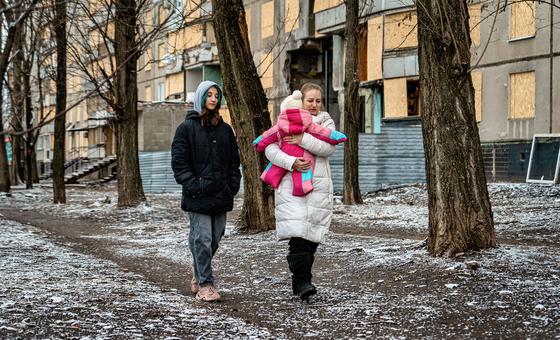
“More young lives lost and devastated in brutal attacks in Ukraine,” UNICEF said in an online post condemning the attacks. “End attacks on populated areas. Protect children.”

Destruction in Kharkiv

Footage released by the Ukrainian authorities showed an apartment complex in Kharkiv with a massive hole in the shattered roof and upper floors, where fires had been extinguished.

Kharkiv is located in the northeast of the country and just 30 kilometres (18.6 miles) from the Russian border. Ukraine’s second city has suffered heavy destruction and repeated shelling since Russia’s full-scale invasion began on 24 February 2022.

Meanwhile, a separate Russian attack on the southern city of Zaporizhzhia left three dead and approximately 20 injured, according to the Ukrainian authorities, who said they had shot down 88 drones and missiles launched overnight.

A recent update from UN human rights monitors in Ukraine noted that July saw the highest number of civilian casualties in the country since May 2022, with 286 killed and 1,388 injured.

“Aerial bombs caused the biggest rise [and] short-range drones made up 24 per cent of casualties,” said the Human Rights Monitoring Mission in Ukraine (HRMMU).

Russian troops’ push

The increase in the number of civilian casualties between June and July 2025 mainly took place in areas controlled by the Ukrainian Government along frontlines. This indicated the “intensive military efforts by Russian armed forces to capture territory”, the UN monitors explained.

And although long-range missile strikes and other munitions caused about 20 per cent fewer casualties in July compared with June, they were responsible for almost 40 per cent of all non-combatant deaths and injuries, including in the cities of Dnipro, Kharkiv and Kyiv.

Short-range drones were the second leading cause of civilian casualties, accounting for nearly one in four death and injuries (64 killed and 337 injured)said HRMMU.

As in June, nearly all civilian casualties (98 per cent) occurred in areas controlled by the Ukrainian authorities. Civilian casualties were recorded across 18 regions of Ukraine and the city of Kyiv.
Source link

SECURITY COUNCIL LIVE: Ambassadors debate safety of civilians with 36,000 lives lost during conflict last year

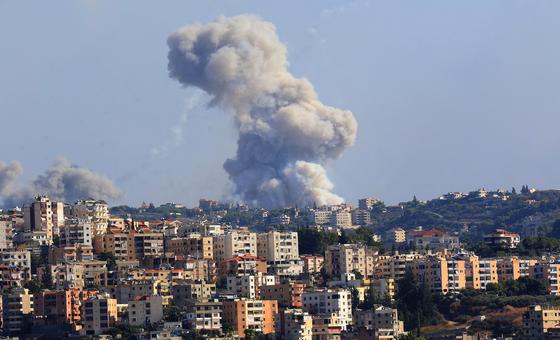
We’re live as the Security Council convenes for its annual open debate on the protection of civilians in armed conflict, with briefings from UN relief chief Tom Fletcher and the head of UN Women Sima Bahous. Ambassadors will discuss evolving threats, including use of heavy weapons and the rise of lethal autonomous killing machines such as drones. The UN has documented a spike in deaths, with Gaza, Lebanon, Myanmar, Sudan and Ukraine among the hardest-hit. Mobile app users can follow here.

Source link

Funding cuts in Afghanistan mean ‘lives lost and lives less lived’

Many women came to the clinic who had walked multiple hours to receive maternal care – some of them with their newborns and some heavily pregnant.

And then there were the health workers themselves, committed to serving those in need in hard-to-reach areas of the impoverished Taliban-controlled nation.

‘Off the radar’

These were some of the scenes witnessed up close by Andrew Saberton, Deputy Executive Director with the UN’s reproductive health agency (UNFPA), on a mission to assess the impact of the recent steep funding cuts.

“I saw and understood the devastating impacts that the massive cuts to UNFPA will have in one of the world’s greatest humanitarian crises, a crisis which may be off the radar of the news but remains one of the world’s greatest crises,” Mr. Saberton told journalists in New York on Wednesday.

During his trip, the senior official visited UN-supported services in Kabul, Bamyan and the border between Afghanistan and Pakistan.

He hoped to understand the difference that UNFPA is making in Afghanistan while also getting a better sense of the impact of funding cuts.

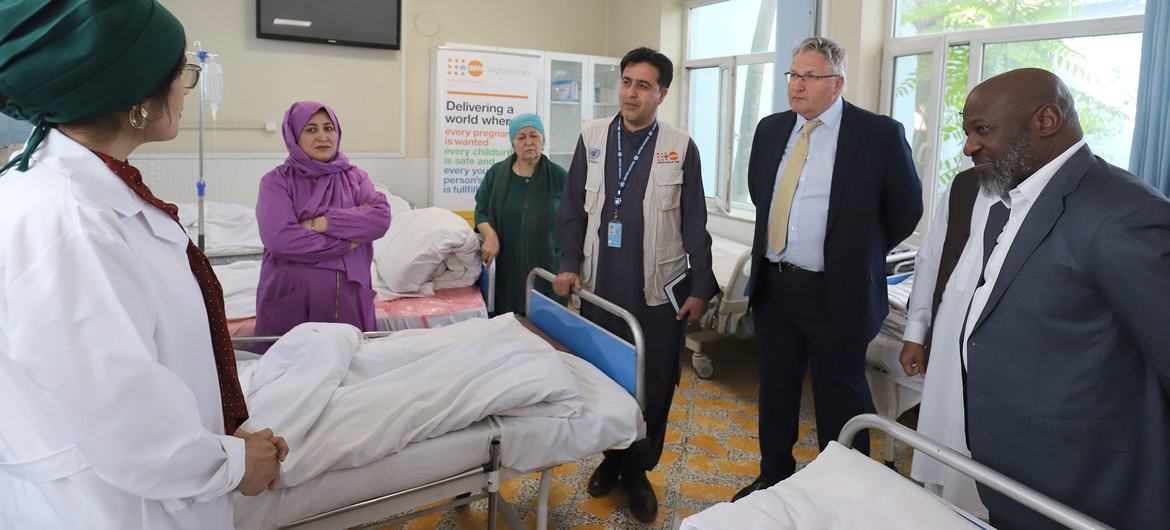
Andrew Saberton (second right), UNFPA Deputy Executive Director for Management, visits the obstetric fistula ward in Kabul, Afghanistan, where survivors receive care.

Budget slashed

The United States has recently announced cuts of approximately $330 million to UNFPA worldwide, $102 million of which will directly impact UNFPA’s work in Afghanistan, according to Mr. Saberton.

Most of this funding would have been used towards the provision of family health and mobile care, both of which are essential in Afghanistan which already has one of the highest maternal mortality rates in the world.

This funding would also have gone towards the providing much needed psychosocial support.

He estimates that 6.9 million women and children in Afghanistan will be affected by the cuts. Moreover, UNFPA will only be able to support approximately 400 of the current 900 health clinics that it supports in Afghanistan, each of which provides life-saving care.

Providing aid with few resources

Despite these challenges, Saberton emphasized that UNFPA will remain in Afghanistan and will continue providing life-saving care.

“UNFPA will be staying to deliver, but we cannot sustain our response without help. We need urgent support to keep these services running and to protect the dignity, health and lives of Afghan women and newborns,” he said.

Source link