“It is time to abolish human exploitation once and for all and to recognise the equal and unconditional dignity of each and every individual,” Ms. Azoulay said.
The Day is intended to inscribe the tragedy of the slave trade in the memory of all peoples.
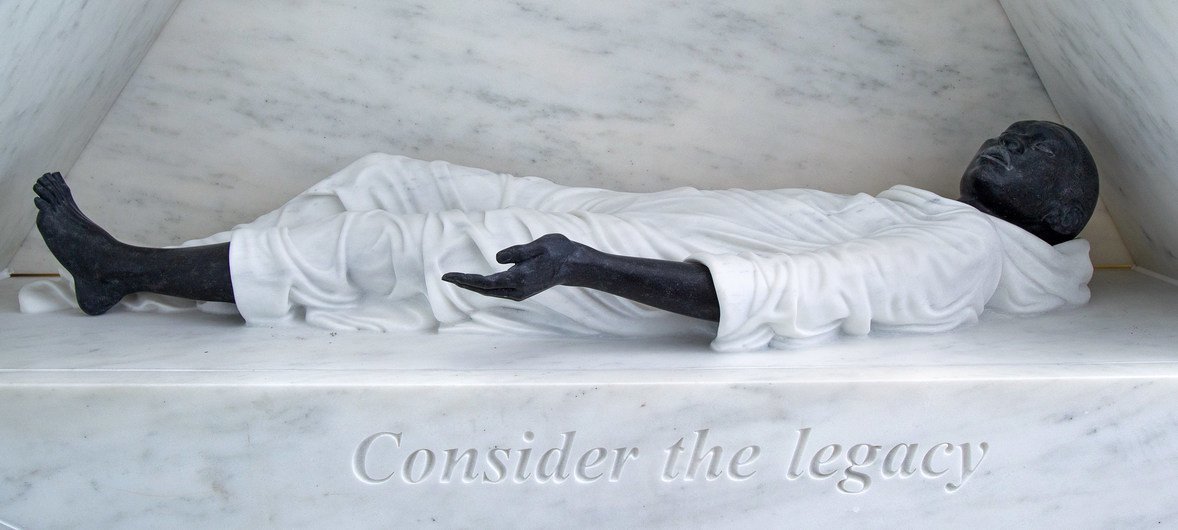
Details from Ark of Return, the permanent memorial at UN Headquarters to acknowledge the tragedy and consider the legacy of slavery and the transatlantic slave trade.
‘The fight is not over’
Echoing the goals of UNESCO’s intercultural project The Routes of Enslaved Peoples, it should offer an opportunity for collective consideration of the historic causes, the methods and the consequences of this tragedy and for an analysis of the interactions to which it has given rise between Africa, Europe, the Americas and the Caribbean, said the UN agency, which leads the annual commemoration.
UN Deputy Secretary-General Amina Mohammed said that while the Day honours the victims of the transatlantic slave trade, “the fight is not over.”
“Modern slavery persists,” she stated. “Let’s confront injustice, past and present and uphold the dignity and rights of every person.”
On the night of 22 to 23 August 1791, in then Saint Domingue, now Haiti, saw the beginning of the uprising that would play a crucial role in the abolition of the transatlantic slave trade.
Against this background, the International Day is commemorated around the world. It was first celebrated in a number of countries, including in 1998 in Haiti and in 1999 on Gorée Island in Senegal, where millions of enslaved people had been forced onto ships to cross the ocean.
“Today, let us remember the victims and freedom fighters of the past so that they may inspire future generations to build just societies,” UNESCO’s Ms. Azoulay said.
Marking its 30th anniversary, ISA is the world’s authority on the deep-sea beyond national jurisdiction. Washington may have passed an order on deep-sea licensing in international waters earlier this year, but the authority’s chief Leticia Carvalho said the United States, which is not an ISA member, “is going at it alone”.
“The rest of the world is united and cohesive and all behind of the rule of the law and the International Seabed Authority,” Ms. Carvalho told UN News. “ISA is a super power. We have all the knowledge, we have the ability given by the law, we have the mandate.”
Indeed, under international law, the deep seabed beyond national jurisdiction belongs to no single nation, Ms. Carvalho said, inviting the United States to join ISA.
To address these concerns, ISA has been drafting a mining code as a way to ensure that the deep-sea remains protected and does not turn into the “Wild West” of exploitation, she said.
Read our explainer on ISA and why it matters now here.
Costly search for rare minerals
Rare minerals needed to satiate demands for producing tech items from batteries to solar panels have driven interest in the deep-sea and what it offers. From cobalt to zinc, a plethora of rare earth minerals have been observed by explorations of the ocean floor.
ISA has issued 31 contracts for mineral exploration to 21 firms from 20 countries as of 2024, according to the UN’s World Economic Situation and Report 2025. While commercial mining in international waters has not yet commenced, pending the finalisation of an international code for deep-sea mining by the ISA, right now, countries can pursue deep-sea mining within their own territorial waters or “exclusive economic zones”.
Even after the international code is in place, those engaged in deep-sea mining will continue to face major challenges due to high capital requirements and operational costs relative to conventional mining and the enormous technical uncertainties associated with the unique problems surrounding mining on the ocean floor, according to the UN report.
“We must bring together our global efforts in climate action, biodiversity preservation and marine protection,” he said in a message marking ISA’s anniversary, commending its commitment to finding balanced and effective solutions. “The deep ocean remains one of our last frontiers. It holds great promise, but also requires great caution.”
For 30 years, the authority has helped protect this shared realm through peaceful, sustainable and inclusive governance, and today, it is navigating complex challenges with care and clarity, he said, emphasising that “as we mark this milestone, let us advance cooperation grounded in science, and keep working together to safeguard the ocean for the benefit of all people, everywhere.”
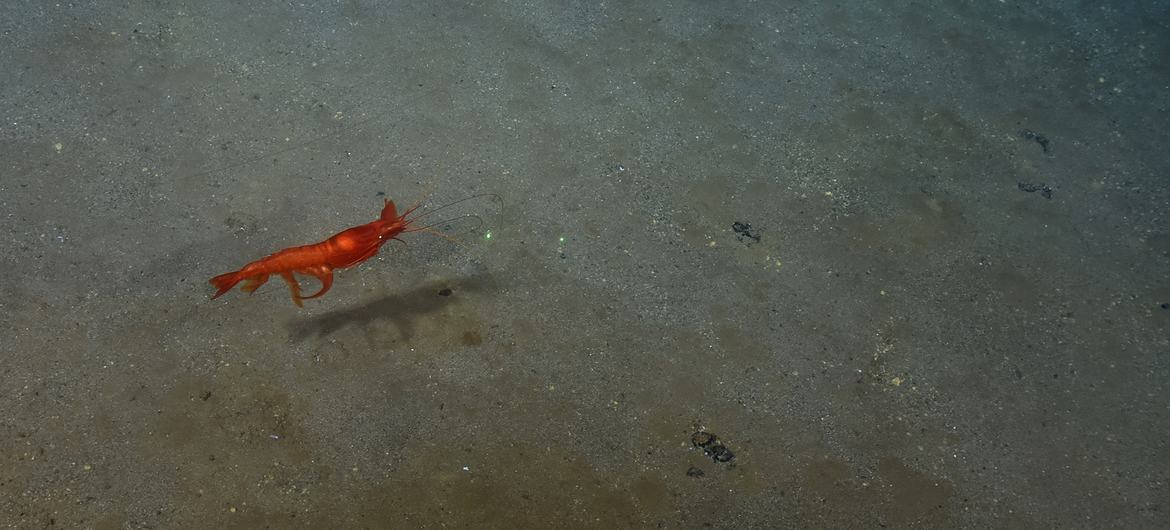
The deep-sea contains a plethora of life and rare earth minerals.
Mining code and more
In addition to achieving progress on a draft mining code at its ongoing annual session at headquarters in Kingston, Jamaica, ISA launched its Deep-Sea Biobank last month in a bid to preserve and share knowledge.
The initiative aims to collect and preserve samples from the ocean floor that will benefit all nations, especially developing countries, Ms. Carvalho said, adding that the goal is to study the minerals, exploration and exploitation potential, but also to preserve and to study biodiversity and genetics.
“The future that I see is we need to really take care, cherish [and] nurture the deep-sea,” Ms. Carvalho said. “The future of ISA is stronger, enhanced, wider and wiser. We will know much more than we know now.”
One of the most serious threats to wildlife biodiversity, in addition to the climate crisis, is the illegal killing and trafficking of animals and plants. Despite many laws against the black-market wildlife trade, it is considered to be one of the most lucrative illicit industries in the world.
Animals, especially endangered and threatened species, are often exploited and sold for their pelts or used as medicine, aphrodisiacs, curios, food and spiritual artifacts.
In a new study published in Global Change Biology, Arizona State University researchers estimate that more than 1.1 million sea turtles have been illegally killed and, in some cases, trafficked between 1990 and 2020. Even with existing laws prohibiting their capture and use, as many as 44,000 sea turtles were exploited each year over the past decade in 65 countries or territories and in 44 of the world’s 58 major sea turtle populations.
Hawksbills turtle/Photo:en.wikipedia.org
Despite the seemingly large number of poached turtles, the study shows that the reported illegal exploitation of sea turtles declined by approximately 28% over the last decade —something that surprised the researchers. They initially expected to see an overall increase in reported poaching.
“The decline over the past decade could be due to increased protective legislation and enhanced conservation efforts, coupled with an increase in awareness of the problem or changing local norms and traditions,” says Kayla Burgher, co-first author of the study and a doctoral student in ASU’s environmental life sciences program in the School of Life Sciences.
In addition to the slight decline, the researchers found that most of the reported illegal exploitation over the past decade occurred in large, stable and genetically diverse sea turtle populations.
Jesse Senko, co-first author of the study and an assistant research professor with the ASU School for the Future of Innovation in Society says this discovery may be a silver lining to the high number of turtles illegally exploited. “What this means is that most of these sea turtles came from healthy, low-risk populations, which suggests that, with a few exceptions, current levels of illegal exploitation are likely not having a major detrimental impact on most major sea turtle populations throughout the world’s oceans.”
Sea turtle/Photo:en.wikipedia.org
Our assessment also did not include eggs or turtle products, such as bracelets or earrings made from sea turtle shells that could not be easily attributed to individual turtles,” says Senko.
The study revealed additional patterns and trends that may assist in determining conservation management priorities. For example, Vietnam was the most common country of origin for illegal sea turtle trafficking, while China and Japan served as destinations for nearly all trafficked sea turtle products. Similarly, Vietnam to China was the most common trade route across all three decades.
Across the 30-year study period, 95% of poached sea turtles came from two species — green and hawksbill turtles — both of which are listed under the U.S. Endangered Species Act. Also, Southeast Asia and Madagascar emerged as major hotspots for illegal sea turtle take and trade, particularly for critically endangered hawksbills, which are prized in the illicit wildlife trade for their beautiful shells.
“Our assessment is an important foundation for future research and outreach efforts regarding illegal sea turtle exploitation. We believe this study can help conservation practitioners and legislators prioritize conservation efforts and allocate their resources to best help protect sea turtle populations from harmful levels of exploitation worldwide,” says Burgher.
“Increased support for governments lacking the resources to protect sea turtles is needed, along with support for communities to sustain human well-being in the face of restrictions or bans on sea turtle exploitation. We must develop conservation strategies that benefit both people and turtles,” says Senko.