How AI, gaming and virtual worlds are reshaping Holocaust remembrance

“At the moment, we have an incredibly dispersed and diverse landscape of memory-making, and the more digital we get, the most diverse it gets,” Professor Victoria Grace Richardson-Walden, Director of the Landecker Digital Memory Lab at the University of Sussex, told UN News.

As Holocaust survivors age and first-hand testimony becomes rarer, educators, researchers and designers are increasingly turning to emerging technologies to preserve memory, foster empathy and engage younger generations far beyond museums and classrooms with narrative-driven games and immersive virtual spaces allowing users to not only observe history but interact with it.

© World Jewish Congress/Ohad Kab

Landecker Digital Memory Lab, University of Sussex, participates at a panel discussion: “Technology, Memory, and the Future of Holocaust Remembrance”, at UN Headquarters in New York.

The challenge is no longer whether new technologies should be used, but whether they will be used thoughtfully enough to ensure that memory endures for generations to come as these modern tools open new – and sometimes uncomfortable – questions about interactivity, responsibility and historical truth.

From taboo to tool: ‘Video games and the Holocaust are mainstream’

Long considered the last taboo of Holocaust representation, video games are now increasingly part of the conversation as research-led approaches have seen studios starting to work closely with historians, educators and archives, opening space for designers like Luc Bernard, whose The Light in the Darkness video game follows a Jewish family in Nazi-occupied France.

It doesn’t have a Hollywood ending; I decided to show the real story, which was that most Jews during the Holocaust were murdered.

“It doesn’t have a Hollywood ending; I decided to show the real story, which was that most Jews during the Holocaust were murdered,” said Mr. Bernard, who is currently working on the director’s cut, funded by the Claims Conference and META, which will include the original vision he intended with extra scenes going deeper into the story.

“It’s no longer a taboo subject,” Mr. Bernard said. “Video games and the Holocaust are mainstream.” 

The Light in the Darkness has reached audiences well beyond traditional educational settings, with the average gamer age of 35 among players from countries such as Saudi Arabia that have engaged strongly with the story, he said.

“People relate to the characters, and it’s resonated more with them than even movies around the Holocaust,” he said. “That’s just the power of videogames or any form of art. It depends on how you direct it.”

© World Jewish Congress/Ohad Kab

Luc Bernard, game designer, participates at panel discussion “Technology, Memory, and the Future of Holocaust Remembrance” at UN Headquarters in New York.

Building resilient digital memory

The current landscape requires a fundamental rethink of how Holocaust memory is produced and sustained in the digital age, from interactivity to what it means when users engage with the past in these spaces, said Ms. Richardson-Walden, whose work brings together educators, researchers, policymakers, technology companies and memory institutions worldwide.

Indeed, collaboration is essential, including to ensure Holocaust memory remains resilient as digital formats multiply, she added.

“Without all coming together, we are wasting resources, we are spreading our human resources, our financial resources, our technologies and our time really thinly,” she cautioned, adding that one of the greatest risks lies not in technology itself but in how digital projects are funded.

In addition, short-term initiatives, from apps to virtual exhibitions, are often expensive and quickly become obsolete as software changes causing projects to “break and disappear” alongside the digitised materials, metadata and knowledge behind it, she said. “It’s just all gone.”

Rethinking interactivity and risk: ‘You can’t change the narrative’

Instead, Ms. Richardson-Walden called for investment in shared digital infrastructure. Aligned databases, common standards and permanent digital expertise within institutions would allow memory organizations to adapt quickly as new technologies emerge, whether in gaming, virtual reality or artificial intelligence (AI).

Interactivity is often misunderstood, particularly in discussions about video games, with fears that users might be able to make changes to what happened in the Holocaust, she said.

“But, anyone in the gaming industry understands that is an illusion of agency,” she said. “You can’t change the narrative.”

The Light in the Darkness: Director’s Cut.

AI risks: Catching up with the tech world

At the same time, Ms. Richardson-Walden warned of genuine risks in the current digital environment, especially with the rapid spread of generative AI. Holocaust-related content circulates widely online, making it vulnerable to monetisation without historical understanding or ethical oversight.

“People know the Holocaust performs well online,” she explains. “Holocaust is a well-talked-about subject. People know about it. People want to talk about it, which is great, but also a problem in this sphere because that means it can be monetised.”

Listen to an interview with Professor Victoria Grace Richardson-Wald: 

Pointing to the mass production of AI images on social media, she said “we need to find a way to catch up with the tech world’s speed slightly because otherwise the policy, the discussions we’re having will be so far behind the reality that they’ll become kind of meaningless.”

Catching up with the tech world

Both Mr. Bernard and Ms. Richardson-Walden emphasised that responsibility for digital Holocaust memory extends beyond individual creators, with technology companies, funders and governments working with educators and creatives to develop ethical, sustainable approaches. 

“These conversations used to happen in fringe spaces,” Mrs. Richardson-Walden says, following a panel debate around technology, memory and the future of Holocaust Remembrance at the UN Headquarters in New York.

Connective Holocaust Commemoration Expo 2025 at the University of Sussex, UK.

Now, international forums, including the United Nations, have an important role in turning discussion into coordinated action, 

Watch the Technology, Memory and the Future of Holocaust Remembrance panel discussion at the UN here.

Source link

International Day for Remembrance of Slave Trade: ‘Time to abolish exploitation once and for all’

“It is time to abolish human exploitation once and for all and to recognise the equal and unconditional dignity of each and every individual,” Ms. Azoulay said.

The Day is intended to inscribe the tragedy of the slave trade in the memory of all peoples.

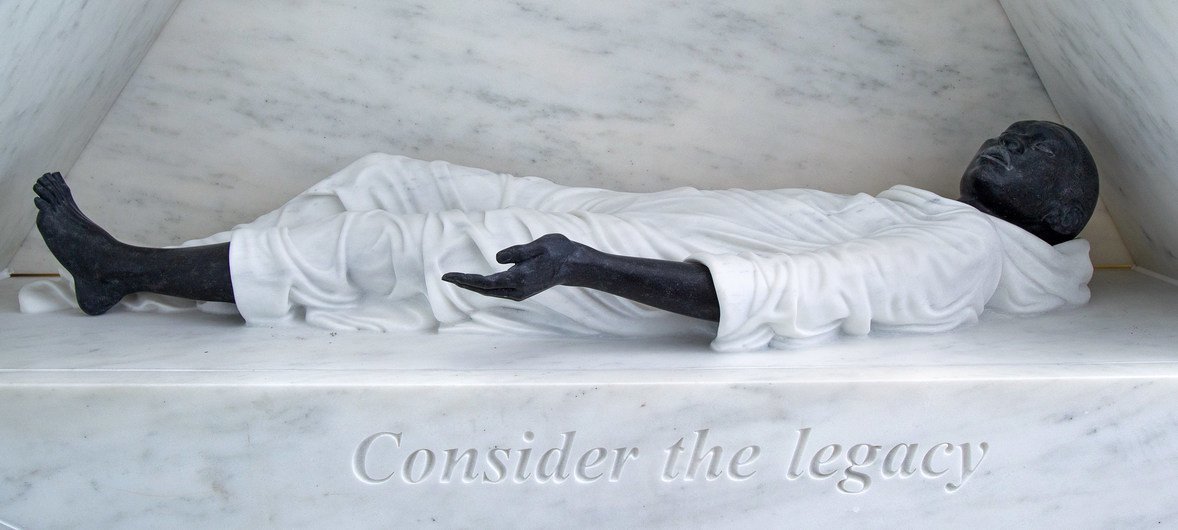
Details from Ark of Return, the permanent memorial at UN Headquarters to acknowledge the tragedy and consider the legacy of slavery and the transatlantic slave trade.

‘The fight is not over’

Echoing the goals of UNESCO’s intercultural project The Routes of Enslaved Peoples, it should offer an opportunity for collective consideration of the historic causes, the methods and the consequences of this tragedy and for an analysis of the interactions to which it has given rise between Africa, Europe, the Americas and the Caribbean, said the UN agency, which leads the annual commemoration.

UN Deputy Secretary-General Amina Mohammed said that while the Day honours the victims of the transatlantic slave trade, “the fight is not over.”

“Modern slavery persists,” she stated. “Let’s confront injustice, past and present and uphold the dignity and rights of every person.”

For its part, the UN works towards these goals, including through its Outreach Programme on the Transatlantic Slave Trade and Slavery, established in 2007.

Uprising led to abolition

On the night of 22 to 23 August 1791, in then Saint Domingue, now Haiti, saw the beginning of the uprising that would play a crucial role in the abolition of the transatlantic slave trade.

Against this background, the International Day is commemorated around the world. It was first celebrated in a number of countries, including in 1998 in Haiti and in 1999 on Gorée Island in Senegal, where millions of enslaved people had been forced onto ships to cross the ocean.

“Today, let us remember the victims and freedom fighters of the past so that they may inspire future generations to build just societies,” UNESCO’s Ms. Azoulay said.

Source link