Despite Demonetisation, December Foreign Tourists Growth Stands at 13.6%

Indian tourism sector has seen 13.6% growth in Foreign Tourist Arrivals (FTAs) in December 2016 over the same period in 2015 and US accounts for highest share of tourist arrivals followed by Bangladesh and UK in December 2016, said the Ministry of Tourism in a statement.

The tourism sector earned Rs.16,805 crore in Foreign Exchange in December 2016, which shows that the sector recorded growth despite the claims that demonetisation had affected the overall foreign tourist arrivals.

Ministry of Tourism compiles monthly estimates of Foreign Tourist Arrivals (FTAs) on the basis of Nationality-wise, Port-wise data received from Bureau of Immigration (BOI) and Foreign Exchange Earnings (FEEs) from tourism on the basis of data available from Reserve Bank of India. The following are the important highlights regarding FTAs and FEEs from tourism during the month of December, 2016.

Foreign Tourist Arrivals (FTAs) in December, 2016 were 10.37 lakh as compared to 9.13 lakh during the month of December, 2015 and 8.85 lakh in December, 2014. There has been a growth of 13.6% in December, 2016 over December, 2015.

Overall, foreign tourist arrivals for the calendar year 2016 were 88.90 lakh with a growth of 10.7% as compared to 80.27 lakh with a growth of 4.5% in January- December, 2015 over January- December, 2014.

The Percentage share of Foreign Tourist Arrivals (FTAs) in India during December, 2016 among the top 15 source countries was highest from USA (18.33%) followed by , Bangladesh (13.02%), UK (11.71%), Australia (5.43%), Russian Fed (4.18%),Canada (4.13%), Malaysia (3.38%), Germany (2.80%), China (2.53%), Sri Lanka (2.25%), Singapore (2.12%), France (2.01%), Japan (1.79%), Afghanistan (1.38%) and Nepal (1.34%).

The Percentage share of Foreign Tourist Arrivals (FTAs) in India during December 2016 among the top 15 ports was highest at Delhi Airport (27.77%) followed by Mumbai Airport (19.80%), Haridaspur Land check post (7.16%), Chennai Airport (7.13%), Goa Airport (5.64%), Bengaluru Airport (5.43%), Kolkata Airport (4.31%), Cochin Airport (4.17%), Hyderabad Airport (3.42%), Ahmadabad Airport (3.11%), Trivandrum Airport (1.81%), Gede Rail (1.59%), Trichy Airport (1.59%), Amritsar Airport (1.06%), and Gaya Airport (0.84%).

Foreign Exchange Earnings (FEEs) from Tourism during the month of December, 2016 were Rs.16,805 crore as compared to Rs. 14,152 crore in December, 2015 and Rs.12,988 crore in December, 2014. The growth rate in FEEs in rupee terms during December, 2016 over December, 2015 was 18.7% as compared to the growth of 9.0% in December, 2015 over December, 2014.

In the entire year 2016, foreign exchange earnings from tourism in rupee terms were Rs. 1,55,650 crore with a growth of 15.1% as compared to Rs. 1,35,193 crore with a growth of 9.6% during January- December, 2015 over January- December, 2014.

The figures in US$ terms during the month of December, 2016 were US$ 2.475 billion as compared to FEEs of US$ 2.126 billion during the month of December, 2015 and US$ 2.069 billion in December, 2014. and the growth rate in December, 2016 over December, 2015 was 16.4% compared to the growth of 2.8% in December, 2015 over December, 2014.

The earnings from tourism in US$ terms during January- December, 2016 were US$ 23.146 billion with a growth of 9.8% as compared to the US$ 21.071 billion with a growth 4.1% during January- December, 2015 over January- December, 2014, said the ministry in a statement.

After World Bank, IMF Too Downgrades India Growth Story Post-Demonetization

after the traumatic brakes on India growth story due to demonetisation, India will see a GDP loss of 1% in the current fiscal year and 0.4% next year, said IMF within days after the World Bank downgraded India growth estimate.

The International Monetary Fund (IMF) estimates India’s growth rate for the current fiscal year to 6.6% from its previous estimate of 7.6% due to what it termed a “temporary negative consumption shock” from demonetization.

“In India, the growth forecast for the current (2016-17) and next fiscal year were trimmed by one percentage point and 0.4 percentage point, respectively, primarily due to the temporary negative consumption shock induced by cash shortages and payment disruptions associated with the recent currency note withdrawal and exchange initiative,” the IMF said in its latest World Economic Outlook (WEO).

But China with 6.7% will be the fastest growing economy surpassing India now with 0.1 percentage point more. The revised estimate for China to 6.5%, 0.3 percentage point above the October forecast was attributed to continued policy support.

In 2018, China’s growth rate is projected to be 6% against India’s 7.7%. The global growth for 2016 is now estimated at 3.1% as per the October 2016 forecast.

Economic activity in both advanced economies and emerging market and developing economies (EMDEs) will accelerate in 2017-18, with global growth projected to be 3.4% and 3.6%, respectively, said IMF keeping its October forecast in tact.

Earlier, even the World Bank decelerated India’s GDP growth for 2016-17 fiscal to 7% from its previous estimate of 7.6% citing the impact of demonetization. But it said India would regain momentum in the following years with a growth of 7.6% and 7.8% due to a reform initiatives.

Maurice Obstfeld, Economic Counsellor and IMF Research Department Director, at a news conference was upbeat on China growth story.

“Our China growth upgrade for 2017 is a key factor underpinning the coming year’s expected faster global recovery. This change reflects an expectation of continuing policy support; but a sharp or disruptive slowdown in the future remains a risk given continuing rapid credit expansion, impaired corporate debts, and persistent government support for inefficient state-owned firms,” he said.

In light of the US economy’s expected momentum coming from new President-elect Donald Trump’s policies may likely shift the next two-year projections for US growth, IMF said.

World Bank Provides $48 Million for Nagaland Health Project

A financing agreement for IDA credit of US$48 million for the ‘Nagaland Health Project’ was signed with the World Bank in New Delhi on Monday.

The Financing Agreement was signed by Mr. Raj Kumar, Joint Secretary, Department of Economic Affairs on behalf of Government of India and Mrs. Genevieve Connors, Acting Country Director, World Bank (India) on behalf of the World Bank.

A Project Agreement was also signed by Dr. L. Watikala, Principal Director, Directorate of Health and Family Welfare, Government of Nagaland and Ms. Genevieve Connors, Acting Country Director, World Bank.

The project envisages to improve health services and increase their utilization by communities in targeted locations in the state of Nagaland. Communities in targeted locations will benefit from project activities at the community and health facility levels while the state as a whole will benefit from improvements in higher-level of system-wide investments, said a statement.

The project will directly benefit about 600,000 people and support and complement existing systems and mechanisms involving communities under the National Health Mission. The project will be completed by 31st March, 2023.

The project has two components — community action for health and nutrition, where it is designed to empower communities to oversee, manage, and improve HNP services and their utilization. An incentive strategy will be used whereby funding will be nutrition-related services and practices.

In turn, communities will use the incentives for activities and investments that are important to them and have potential impacts on health and nutrition. The component will have a major focus on knowledge and skill building of Village Health Committees and other stakeholders at the community level, including women’s groups and Village Councils, said World Bank in a statement.

The second component is the health system development. This component will support improvements in the management and delivery of health services, including both facility-specific and system-wide investments.

In November, World Bank provided the Government of India, $470 million for the six north eastern states of Assam, Manipur, Meghalaya, Mizoram, Nagaland, and Tripura to augment their power transmission and distribution (T&D) networks.

India, Mauritius Sign MoU on Fisheries, Cooperatives

India signed an MoU with Mauritius on Monday to cooperate in fisheries and cooperatives in agro industry, fisheries and dairy sector.

India’s Union Minister of Agriculture Radha Mohan Singh and Minister of Business, Enterprise and Cooperatives, Govt. of Mauritius, Mr. Soomilduth Bholah signed on MoU for Cooperation in the field of Cooperatives, in New Delhi on Monday.

The MoU will enable the two countries to collaborate in this vital sector and can significantly benefit thousands in Mauritius. India has also offered to exchange its expertise and technology with Mauritius in agro industry, fisheries and dairy sector.

The two ministers expressed satisfaction at the historic, time-tested relationship between India and Mauritius which is anchored in linkages of culture and ancestry has grown from strength to strength over the years, adding that frequent high level visits have added significant momentum to the bilateral relationship between the two countries.

India is enhancing ties with Mauritius and alst year, INS Tabar, a stealth frigate visited Port Louis, Mauritius from 10-13 March. The primary aim of the visit was to participate in the Mauritius National Day celebrations and strengthen the existing bonds of friendship.

In May-June 2016, Indian Naval Sailing Vessel Mhadei (INSVMhadei) with an all-women crew undertook two voyages to Port Louis, Mauritius as part of the first two open-ocean voyages of the Navy’s all-women crew of Mhadei, who are currently training to undertake a circumnavigation of the globe in 2017.

Sale of Tickets for Republic Day Parade Begins

The tickets for viewing the Republic Day Parade at Rajpath on 26th January and Full Dress Rehearsal of Beating the Retreat Ceremony at Vijay Chowk on 28th January will be available at seven Departmental Sale Counters, said a statement.

The price of tickets for the Republic Day Parade on 26th January 2017 are Rs.500 for reserved seats and Rs.100 and Rs.20 for unreserved seats. The tickets for the Beating the Retreat Ceremony (Full Dress Rehearsal) on 28th January 2017 are in the category of Rs.50 and Rs.20 and does not have reserved seats.

Tickets are available at seven Departmental Sale Counters. These counters are located at North Block round about, Pragati Maidan (Gate No. 1), Jantar Mantar (Main Gate), Shastri Bhawan (near Gate No. 3), India Gate (near Jamnagar House), Red Fort (near police picket) and Sena Bhavan (Gate No. 2).

For Members of Parliament, a special counter has also been set up in Parliament House (Reception Office). The above sale counters are open till January 25, 2017 from 1000hrs to 1230 hrs and 1400hrs to 1630hrs. For the Full Dress Rehearsal of Beating the Retreat Ceremony the tickets will also be available on 27th and 28th January 2017 from 1000hrs to 1630hrs.

However, on 28 January 2017 the counters will close by 1500hrs due to commencement of Beating the Retreat (Rehearsals). From 23 to 25 January 2017, ticket counters of Sena Bhawan, Jantar Mantar, India Gate and Shastri Bhawan will remain open till 1900hrs. No ticket counters will remain open on 26 January 2017, the day being the Republic Day.

The tickets are sold on production of Aadhaar Card, Voter Card or Identity Cards issued by Government of India or State Governments only. Payment for tickets will also be accepted by Credit/Debit Cards.

Oxfam Asks India to Introduce Inheritance Tax

The top 62 billionaries of the world own 50% of world wealth while in India, the top 57 billionaires own what 70% of the population owns, said an Oxfam study that was released on Monday, showcasing rising income inequality, which portends more conflicts and rise in crime worldwide. The London-based non-profit asked India to introduce inheritance tax to end the alarming inequality.

The report titled ‘An economy for the 99 per cent’ said the total global wealth has been calculated at $255.7 trillion, of which about $6.5 trillion was held by billionaires such as Bill Gates ($75 billion), Amancio Ortega ($67 billion) and Warren Buffett ($60.8 billion) among others. In India, it said 84 billionaires own wealth of $248 billion out of the total wealth of $3.1 trillion, led by Mukesh Ambani ($9.3 billion), Dilip Shanghvi ($16.7 billion) and Azim Premji ($15 billion). The total Indian wealth in the country stood at $3.1 trillion.

“Over the next 20 years, 500 people will hand over $2.1 trillion to their heirs, a sum larger than the GDP of India, a country of 1.3 billion people,” Oxfam said, magnifying the fact that the poorest half of the world has less wealth than had been previously thought.

It was critical that the richest 10% of the population in China, Indonesia, Laos, India, Bangladesh and Sri Lanka have seen their share of income increase by more than 15% in the last two decades, while the poor have lost 15% of their income during the same period.

A top IT firm CEO in India earns 416 times higher the salary of a typical employee in his company and in terms of dividend too, the distribution of profits is hovering around 50% in India compared to more than 70% elsewhere, Oxfam said. It advised the Indian government to end wealth inequality, end poverty and introduce inheritance tax, increase the rate of wealth tax among others.

“Indian government must eliminate tax exemptions and not further reduce corporate tax rates. Governments must support companies that benefit their workers and society rather than just their shareholders,” Oxfam said in its report.

PMO Distances from KVIC Calendar; Amazon Row on Gandhi Slippers Persists

The country’s Khadi and Village Industries Commission (KVIC) which has issued a calendar and diary depicting PM Narendra Modi in front of a charkha replacing Mahatma Gandhi was asked for an explanation by the Prime MInister’s Office, which said no permission was sought from the PMO on the claendar.

The PMO said officials have sought explanation from the Ministry of Micro, Small and Medium Enterprises on the issue, which was vehemently criticised by Congress vice-president Rahul Gandhi and Delhi Chief Minister Arvind Kejriwal among others for usurping the nation’s icon Mahatma Gandhi in branding row.

Meanwhile, on external misuse of Gandhi’s image by slipper vendors on Amazon, the economic affairs secretary has sent out an unofficial warning to Amazon to behave when it comes to Indian sentiments.

Amazon, which is emerging as the second largest e-commerce platform in India with the company pledging to invest about $5 billion in the next five years is caught in the row for the second time after last week’s warning by External affairs Minister Sushma Swaraj on using triclour on doormats.

In his tweet, economic affairs secretary Shaktikanta Das said: “Amazon, better behave. Desist from being flippant about Indian symbols and icons. Indifference will be at your own peril.”

Later, he clarified that the tweet was in his personal comment as a citizen of India and said nothing more should be read into it. He later said, “Remain committed to economic reforms,ease of doing business and open trade. Sometimes get touchy when our icons are involved.”

Ministry of External Affairs Spokesperson Vikas Swarup said the Ambassador in Washington has been instructed “to convey to Amazon that while providing a platform for third party vendors, they should respect Indian sensitivities and sentiments.”

However, the Gandhi slippers which were on sale on Amazon US website have been replaced with slippers showing Gandhi’s vague quotes on life. Similarly, Dalai Lama slippers are also on display on Amazon.

Death of Delhi-Returned US Woman with High Resistant Bacterial Infection Evokes Concern

An American woman who returned from New Delhi after she was allegedly infected by a superbug finally succumbed to the highly resistant bacterial infection called Klebsiella Pneumoniae that was found to have resisted 14 known anti-bacterial drugs on her during the treatment. Irony was that a treatment called fosfomycin, approved in Europe, was not approved in the US still.

The 70-year-olod woman was diagnosed with carbapenem-resistant Enterobacteriaceae (CRE), a fatal multidrug-resistant organism on her return from Delhi and was admitted to an acute care hospital. The CRE, identified as Klebsiella pneumoniae from her wound specimen was sent to the US Centres for Disease Control (CDC) where test confirmed the presence of New Delhi metallo-beta-lactamase (NDM-1).

In antimicrobial testing, it was shown that the isolate was resistant to 26 different antibiotics, including all aminoglycosides and polymixins, which is given as a last-resort antibiotics. With no treatment options, the US woman died in September last year. Prior to her return, she lived in Delhi for two years and had been hospitalised at least three times for right femur fracture and once for hip fracture.

NDM-1 was originally identified in 2009 in a Swedish patient who had been hospitalised in India and research showed that the infection could spread in the hospital environment. It has been described by the World Health Organization as "an urgent threat to human health."

Prof. Laura Piddock from the University of Birmingham, said there is a need to be flexible to use antibiotics licensed for use in other countries to avoid repetition of the death of the Delhi-returned woman.

Colourful Dances, School Children to Enthrall Republic Day Parade – 2017

School children in unforms and colourful dances enthrall Republic Day every year but this year’s parade will have just one school with 162 students performing the key dance on the national tri-colour with the theme ‘Tiranga Sakshi Hai’.

Their performance is being choreographed to convey how our national flag has been a witness to the glorious tales of our freedom fighters, formation of Indian democracy, the endless affection of Indians, women empowerment, and such countless achievements, said the organisers in a statement.

In all, over 600 boys and girls are participating in this year’s Republic Day Celebrations with three cultural items from Directorate of Education, Delhi Government and another from South Central Zone Cultural Centre, Nagpur.

Another 150 students of Sarvodaya Kanya Vidyalaya, Chirag Delhi will render a song and dance in tribute to the youth of our country who have led the country to the path of success and development. The song is based on the spirit of patriotism to inspire the youth to take the country to new heights of development, said the organisers. It ends with a map formation during the performance denoting India’s unique feature – ‘Unity in Diversity’.

The Chief of the Air Staff, Air Chief Marshal B.S. Dhanoa along with AFWWA President, Mrs Kamalpreet Dhanoa visited NCC Republic Day Camp 2017, in New Delhi on January 09, 2017.(PIB Photo)

Another event by 165 students drawn from South Central Zone Cultural Centre, Nagpur will portray the ‘Saila Karma’ dance, which is popular tribal dance for the harvest season in Madhya Pradesh. It starts with the worship of Sun God.

Saila is the popular dance of the Gond Tribe of Dindori District in Madhya Pradesh. It also shows some of the dancers in disguise as scarecrow, which is a useful element to protect the crops from wild invaders. Saila is accompanied by rural instruments like Mandal, Timki, Flute and with the melodies of folk songs, with its colourful-decorated costumes, turns into a centre of attraction.

Also 150 school students from Mount Abu Public School, Sector-5, Rohini, Delhi will perform a dance based on Assam Nritya Shaili or ‘Sattriya’, which seeks to honour the Supreme Power that instils positivity and vitality in our lives. With the rhythm of Takori, the children will create a holy environment to realize the omnipresence of the Almighty and celebrate the unique creation of God, said the statement.

Amazon Replaces Gandhi’s Face with His Quotes on Slippers Now

As Indian PM Narendra Modi replaced Gandhi’s face on Khadi calendar of 2017, the US e-commerce giant Amazon has gone a step ahead to sell slippers with Gandhi face on them, ridiculing the face of India.

Called ‘Gandhi flip flops’, Amazon describes them as “foam rubber flip flops” with Gandhi face and priced $16.99 (Rs.1,200). This is the second time Amazon is trying to deface Indian icon after its earlier bid to sell doormats with the Indian flag Tricolour on them.

Gandhi slippers page replaced after media hue and cry on Amazon


After a stern warning from Indian External Affairs Minister Sushma Swaraj, Amazon took down all products disrespecting the Tricolour from its Canadian website. But within a week Gandhi flip flops have appeared on its US website selling beach slippers with Gandhi’s face printed on them “professionally.”

When the Indian media flashed the news, the page was removed but the name of Gandhi flip flops remains and a quote by Gandhi was imprinted on them instead of his face. The new tagline reads: “Live as if you were going to die tomorrow” on the left slipper and on the right slipper, it reads: “Live as if you were to live forever”. The second message has Gandhi name next to it.

Gandhi slippers with his quotes replaced his image on Amazon now

The US Amazon also sports Dalai Lama slippers with his quotes:”If you want others happy, practice compassion” and “If you want to be happy, practice compassion” with Dalai Lama name on the right side slipper. The company Musewear may be getting free publicity from the idiotic disrespect given to Indians and Tibetans but Amazon gets the flak finally.

Even Dalai Lama is not spared on Amazon slippers’ sale pitch

In fact, Amazon, which is capturing the Indian market as second biggest e-commerce retailer in its apology to the External Affairs Ministry last week said, “After learning of the product’s listing, we immediately removed them from the Canadian website and implemented measures to ensure that these products could not be sold on any of our other marketplace or websites.”

The Indian government has asked its Ambassador in Washington to sensitize Amazon and Amazon is likely to come under flak in India too once the issue gets wider attention among its trusted buyers online.


Move Home to Change Habits, to Keep up New Year Resolution: Study

Though 41% of Americans make New Year’s resolutions, only 9% said they were successful in keeping them.

According to research being presented at the Society for Personality and Social Psychology (SPSP) Annual Convention 20176, the time for successful habit change is not based on the calendar, but on big changes to our everyday lives like moving to a new home.

Since changing your habits is very difficult, you can change the factors around the habit such as location or context, creating a “discontinuity effect,” said Bas Verplanken, professor of social psychology at the University of Bath.

On Why New Year’s resolutions don’t work, they said, “Changing from December 31st to January 1st is not a dramatic discontinuity. Many resolutions are made on December 31st, and go down the drain on January 2nd.”

The New Year may be a nice moment to mark the start of a new phase, but the point of the discontinuity effect is that the change in behavior is embedded in other changes. “In the case of moving to a new home for instance, people may need to find new solutions for how to do things in the new house, where and how to shop, commute, and so on. All of these aspects are absent when talking about New Year resolutions,” said Verplanken.

Verplanken studied the behaviors of over 800 people, half of whom had recently moved and half of whom had been at the same home for several years. Participants responded to questions on 25 environment related behaviors including water and energy use, commuting choices, and waste.

According to his research, people who received an intervention and had recently relocated reported more change eight weeks later on these 25 questions’ score level compared to participants who had not recently relocated.

These results were consistent in spite of the strength of previous habits and views. Verplanken will present his talk on Friday, January 20, 2017 at the SPSP Annual Convention.


Gondwanaland Never Isolated for 30 Million Years: New Study

Gondwana land or Indian subcontinent that remained isolated for 30 million years before thrusting itself north to give rise to Himalayas — is not a theory in tact but there are some missing middle in it, showed a research by a group of researchers from Germany, Poland and India.

Based on tiny insect fossils near Surat, which are similar to fossils found in Europe and China, they said these insects could have moved across the ocean along with island-hopping birds. Known as ‘biting midges’, these insects measure less than a millimeter long and were found fossilized in amber, a tree resin in the Cambay basin near Surat in Gujarat.

The paleontologists estimated their age at 54 million years ago, which coincides with the previously thought period when Indian plate was purportedly isolated and surrounded by oceans. As the Indian subcontinent harbours unique species of flora and fauna, which reflect no exchange with other regions, leading to the belief that India remained isolated for millions of years due to continental drift.

Scientists assumed that the supercontinent Gondwana later drifted into parts giving away to current South America, Africa, Antarctica, Australia, Madagascar, besides India in due course of geological history. Then the upward thrust towards the north east resulted in its collision with the Eurasian plate. But disproving the entire theory, scientists now cite amber in Surat.

“Certain midges that occurred in India at this time display great similarity to examples of a similar age from Europe and Asia,” said lead author Frauke Stebner from the Steinmann Institute at the University of Bonn, Germany.

He has mined for amber in seams of coal near Surat that left for archaeological survey after mining was done. These small midges were found encased in tree resin 54 million years ago in the form of fossils and their descendants can still be found today in Germany in meadows and forests. These insects attack animals and humans in swarms and suck the blood.

“There was significant conformity with biting midges in amber from the Baltic and Fushun in north-east China,” reports Stebner, who studied 38 of them from the Surat coal mine, which collates the new theory that the Indian subcontinent was not isolated for 30 million years.

The research study had its Indian contribution from Hukam Singh, a scientists at the Birbal Sahni Institute of Paleosciences, Lucknow and the study was published in journal PLOS ONE.

PM Greets as India Celebrates Sankranti, Pongal, Bihu, Uttarayan

As different regions of India celebrate the first festival of the calendar year, PM Narendra Modi has greeted the people, on the occasion of various festivals across India.

“Today people across India are celebrating various festivals. My greetings to everyone celebrating these auspicious festivals!,” he said adding festival-wise greetings.

“Makar Sankranti greetings. May this day bring joy & prosperity in everyone’s lives,” goes to Telugu and Kannada speaking people in three southern states of Andhra Pradesh, Telangana and Karnataka.

Then in Hindi, he added: “मकर संक्रांति की शुभकामनाएं। इस पावन पर्व पर सभी के जीवन में खुशहाली और संपन्नता आए।”

For Tamil Nadu people, he said, “Wishing my Tamil friends a happy & blessed Pongal,” and added the Tamil version as “என் தமிழ் நண்பர்கள் அனைவருக்கும் மகிழ்ச்சியான மற்றும் ஆசி நிறைந்த பொங்கல் வாழ்த்துகள்.”

For the northeastern state of Assam, he greeted: “On the special occasion of Magh Bihu, my greetings to the people of Assam and the Assamaese version read:”মাঘ বিহুৰ এই পৱিত্ৰক্ষণত, অসমবাসীলৈ মোৰ আন্তৰিক শুভেচ্ছা জনাইছো৷”

For his own state people or Gujaratis, he has sent out greetings as “Uttarayan greetings to the people of Gujarat” with the Gujarati versin reading, “આપ સૌને ઉતરાયણ પર્વ ની હાર્દિક શુભકામનાઓ!”

“These and many other festivals celebrated across India add great colour and happiness in our lives. This diversity is India’s greatest strength.

May these festivals bring abundance of happiness and prosperity in the lives of our hardworking farmers”, the Prime Minister said.

PM Greets on Sankranti, Pongal, Bihu, Uttarayan

As different regions of India celebrate the first festival of the calendar year, PM Narendra Modi has greeted the people, on the occasion of various festivals across India.

“Today people across India are celebrating various festivals. My greetings to everyone celebrating these auspicious festivals!,” he said adding festival-wise greetings.

“Makar Sankranti greetings. May this day bring joy & prosperity in everyone’s lives,” goes to Telugu and Kannada speaking people in three southern states of Andhra Pradesh, Telangana and Karnataka.

Then in Hindi, he added: “मकर संक्रांति की शुभकामनाएं। इस पावन पर्व पर सभी के जीवन में खुशहाली और संपन्नता आए।”

For Tamil Nadu people, he said, “Wishing my Tamil friends a happy & blessed Pongal,” and added the Tamil version as “என் தமிழ் நண்பர்கள் அனைவருக்கும் மகிழ்ச்சியான மற்றும் ஆசி நிறைந்த பொங்கல் வாழ்த்துகள்.”

For the northeastern state of Assam, he greeted: “On the special occasion of Magh Bihu, my greetings to the people of Assam and the Assamaese version read:”মাঘ বিহুৰ এই পৱিত্ৰক্ষণত, অসমবাসীলৈ মোৰ আন্তৰিক শুভেচ্ছা জনাইছো৷”

For his own state people or Gujaratis, he has sent out greetings as “Uttarayan greetings to the people of Gujarat” with the Gujarati versin reading, “આપ સૌને ઉતરાયણ પર્વ ની હાર્દિક શુભકામનાઓ!”

“These and many other festivals celebrated across India add great colour and happiness in our lives. This diversity is India’s greatest strength.

May these festivals bring abundance of happiness and prosperity in the lives of our hardworking farmers”, the Prime Minister said.

President Pranab Mukherjee lighted the fire on the occasion of Lohri at Rashtrapati Bhavan.

In his message, Vice President of India, Mr. M. Hamid Ansari has greeted the people that the auspicious festivals are associated with the harvest season and reflect the underlying unity of our country.

“I extend my warm greetings and best wishes to all our citizens on the auspicious occasion of Makar Sankranti and Pongal.

Makar Sankranti symbolizes ‘Uttarayan’ or the beginning of the northward journey of the Sun. Celebrated with different names in all over the country, the festivals of Makar Sankranti and Pongal are associated with harvest season and reflect the underlying unity of our country. May the festivals bring prosperity, peace and harmony in everyone’s life,” he said.


Demonetization a Gamechanger, Says Law Minister

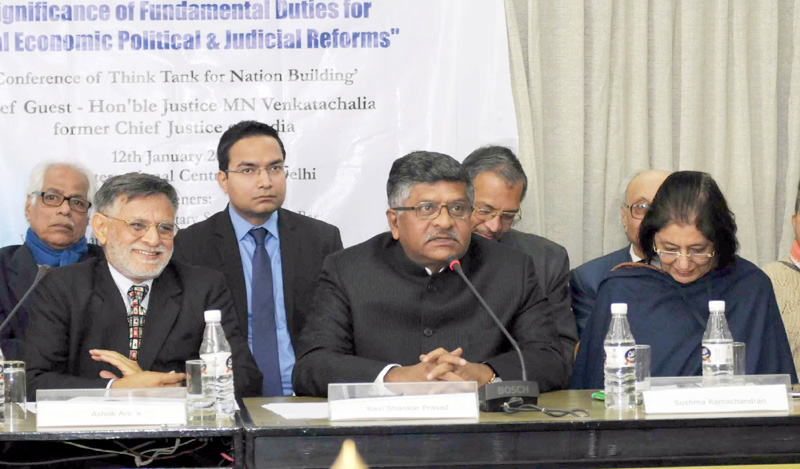
Demonetization has resulted in sharp decline in terror funding, hawala trade, supari killings and human trafficking of young girls as sex slaves, mainly from Nepal and the North East, said Union Law and IT Minister Ravi Shankar Prasad on Thursday speaking at a seminar.

Addressing the seminar, jointly organized by the Press Club of India, Indian Women Press Corps and the Supreme Court Lawyers’ Conference, he said that a new India, much stronger will emerge, transcending the barriers of caste, creed and religion with the November 8 decision of scrapping old Rs.500 and Rs.1000 notes.

Indicating that the government would not hesitate to take steps to widen the tax base, he said that development was not possible without enlarging the tax kitty as there was “only about Rs.5 lakh crore in the kitty of Finance Minister for development” before the demonetisation move, which he said would grow rapidly now.

“Every government comes and goes. Our government is transformative government and tools of technology are actively aiding the good governance. There are 110 crore Aadhar cards and 104 crore mobile connections today. Digital governance means faster delivery and even poor and illiterate people in rural areas are showing a new confidence in embracing the digital technology which has given a new vision of hope,” the Law and IT Minister said.

The Union Minister for Electronics & Information Technology and Law & Justice Ravi Shankar Prasad addressing the seminar jointly, organised by the PCI, IWPC and the Supreme Court Lawyers Conference, in New Delhi on January 12, 2017. (PIB Photo)

He also cited examples of Imran Khan, a mathematics teacher from a school in Alwar, Rajasthan whose mobile apps had benefitted 40 lakh children and a woman Satama Devi, a beedi worker from Telangana who had learnt how to use Skype to talk to her grandson in Dubai. “People like these are change agents. They believe in this new fast emerging India,” he noted.

The minister said that Aadhar enabled bank payments through smart phone would prove to be a “game changer” and a tool of empowerment. He said that out of 125 crore people only 3.7 crore pay taxes and 99 lakh file Income Tax returns but have no taxable income, two crore people show annual income of Rs. 6 lakh and only 24 lakh have an annual income of Rs. 10 lakh and above. The Law and IT Minister said that a panel, led by Justice Sri Krishna, had been set up to give a report within three months on making India a hub of arbitration.

Former Chief Justice of India M. N. Venkatachaliah who presided over the seminar on “Fundamental Duties and Economic and Judicial Reforms” stressed upon social evolution and education of young minds who can build a better India.

Pinaka Guided Rocket Successfully Test-Fired

The Pinaka Rocket converted to a Guided Pinaka was successfully test-fired from Launch Complex-III, ITR, Chandipur on Thursday, said the ministry of defence in a statement.

The Pinaka Rocket Mark-II, which evolved from Pinaka Mark-I is equipped with a navigation, guidance and control kit and has been transformed to a Guided Pinaka, which has considerably enhanced the range and accuracy of the rocket.

The test-firing has met all mission objectives with the radars, electro-optical and telemetry systems tracked at Chandipur facility that monitored the vehicle all through its flight-path. The Guided Pinaka is developed jointly by ARDE Pune, RCI Hyderabad and DRDL Hyderabad. ITR Chandipur provided the range and launch support for the successful test-firing.

Pinaka is a multiple rocket launcher produced by the Defence Research and Development Organisation (DRDO) for the Indian Army. The system has a maximum range of 40 km for Mark-I and 65 km for Mark-II, and can fire a salvo of 12 HE rockets in 44 seconds. The system is mounted on a Tatra truck for mobility and it was used during the Kargil War effectively. On an average 5,000 missiles are being produced every year while the current one is an advanced version with enhanced range and accuracy.

Dr. K.M. Rajan, Director ARDE, Pune, Mr B.H.V.S. Narayana Murthy, Director, RCI, Hyderabad, Dr. B.K. Das, Director, ITR, Chandipur and Mr R. Appavuraj, Director, PXE, Chandipur monitored the launch operations and an Armed Forces team witnessed the flight test.

Indian defence minister Manohar Parrikar has congratulated the DRDO, industry and the Armed Forces for the successful flight-test and he was joined by top defence officials P.K. Mehta, DG (ACE) and Dr. S. Christopher, Secretary, Deptt. of Defence R&D and Chairman of DRDO.

[ tags pinaka rocket, test fired, drdo, chandipur test range]

Festival of India to be Held in Ghana

Indian mission in Ghana will hold a Festival of India in four cities of Ghana from January 25 to March 16, 2017 as part of bilateral knowledge share initiative.

The activities of the Festival include amalgamation of Indian classical dances, Sufi & Folk Music, and Saptarang – confluence of seven classical dance forms culminating in Vande Matram.

To complete the experience, a Food Festival, Yoga and Meditation, Film Festival will also be organised during the Festival.

The Festival events will be held in four cities of Accra, Kumasi, Cape Coast, Takoradi in Ghana. Earlier, similar festival was held in February in South Africa last year with several classical dancers performing on February 18, 2016.

In Cambodia too, a similar Festival of India was held this month to commemorate the relations between the two Asian countries reflecting both the ancient Buddhist period and present era.

These festivals are organised by the MInistry of Culture in collaboration with the Ministry of External Affairs and the Indian missions abroad.

India, Kenya to Renew Ties as President Kenyatta Visits New Delhi

Welcoming Kenyan President Uhuru Kenyatta’s visit to India, Indian Prime Minister Narendra Modi, who had visited Kenya 6 months ago, said common belief in democratic values, shared developmental priorities and the warm currents of the Indian Ocean bind both the countries.

“In our discussions today, President and I reviewed the full range of our relationship. During my visit to Kenya last year, we had identified deepening of economic cooperation as one of the key focus areas of our efforts. In this context, expansion of bilateral trade, greater flow of capital between two economies, and stronger developmental partnership are a priority,” said Mr. Modi welcoming the Kenyan President’s delegation to New Delhi on Wednesday.

On Tuesday, President Kenyatta led a strong and high level delegation to the eighth Vibrant Gujarat Global Summit, where he was able to connect with the Indian businesses over investment opportunities in Kenya. “We want, and will encourage, industry and business in both countries to take lead in exploiting opportunities in healthcare, tourism, information technology, agriculture, blue economy and energy,” said Mr Modi.

Later on Wednesday, the Kenyan President met Indian President Pranab Mukherjee.

The Joint Business Council meeting today (Thursday) is likely to work out further commercial engagement through specific projects, cooperation on trade facilitation measures, including standardization and related areas. A Line of Credit Agreement of $100 million signed for agricultural mechanisation was signed on Wednesday, besides exploring a long term arrangement with Kenya for production and import of pulses.

“In the health sector, Bhabhatron machine has been delivered to the Kenyatta National Hospital for cancer treatment. Related capacity building of the Kenyan doctors is being undertaken under our India Africa Forum Summit initiative. Partnership in Education is creating new connections between our people. We have a strong relationship with the University of Nairobi, where a Chair for Indian Studies has been established by ICCR, and renovation of its library is also being undertaken with Indian assistance. On energy, we value Kenya’s support to the International Solar Alliance, and our joint efforts to harness the energy of the sun to power our economic growth,” said Mr Modi.

India, Israel Move Closer in Horticulture Sector

An Israeli delegation led by the Agriculture and Rural Development Minister of Israel, Mr. Uri Ariel met Indian Union Agriculture Minister Radha Mohan Singh on Wednesday to discuss bilateral cooperation in agriculture.

Both sides expressed their commitment to further strengthen bilateral relations in the field of Agriculture which is manifested by the fact that the third phase of Action Plan for 2015-18 in the field of Horticulture has recently been finalized by the two countries.

Under this program, as many as 27 Centres of Excellence (CoEs) in the cultivation of various fruits and vegetables, in 21 states, are being set up, out of which 15 CoEs are completed.

Further, both sides vowed to embark upon newer areas of cooperation at the Government to Government and Business to Business levels between the two countries to strengthen the relationship.

E-Tourists Double in Dec. 2016 Despite Demonetisation

The number of foreign tourists who arrived in India using e-visa doubled to 1,62,250 in December 2016 compared to 1,03,617 during the month of December 2015, registering a growth of 56.6 percent, though expectations were that the demonetisation would have affected the overall tourism sector in November and December 2016.

Britain (22.4%) continues to occupy top slot followed by USA (16.4%) and Russia (7.7%) in the order of foreign tourists who availed e-tourist visa facility last month, said the latest figures released by the government, without pondering on the demonetisation issue that rocked the whole nation. The facility of e-Visa has been made available to the citizens of 161 countries, arriving at 16 International Airports in India.

Some of the figures speak for themselves for the increase in tourists in December 2016:

In the month of December 2016, a total of 1,62,250 foreign tourists arrived on e-Tourist Visa as compared to 1,03,617 during the month of December, 2015 registering a growth of 56.6%.

In the calendar year from January to December 2016, a total of 10,79,696 tourists arrived on e-Tourist Visa as compared to 4,45,300 during January-December 2015, registering a growth of 142.5%.

The high growth may be attributed to introduction of e-Tourist Visa for 161 countries as against the earlier coverage of 113 countries, said a government statement.

The percentage shares of top 10 source countries availing e-Tourist Visa facilities during December, 2016 were:

UK (22.4%),
USA (16.4%),
Russia (7.7%),
China (5.3%),
Australia (4.6%),
France (4.1%),
Germany (4.0%),
South Africa (3.7%),
Canada (3.7%) and
Republic of Korea (2.0%).

The percentage shares of top 10 ports in tourist arrivals on e-Tourist Visa during December, 2016 show that the national capital still leads in attracting the tourists or being the first point of visit to the country, followed by Mumbai and Goa. All other destination airports still attract tourists in sigle digit percentage points.

New Delhi Airport (36.6%), Mumbai Airport (23.1%), Dabolim (Goa) Airport (13.6%), Chennai Airport (6.0%), Bengaluru Airport (5.1%),Kochi Airport (4.7%), Kolkata Airport (2.5%), Hyderabad Airport (2.4%), Trivandrum Airport (1.9%) and Ahmadabad Airport (1.7%).

India has Nobel Potential But Lacks Nurturing Scientists

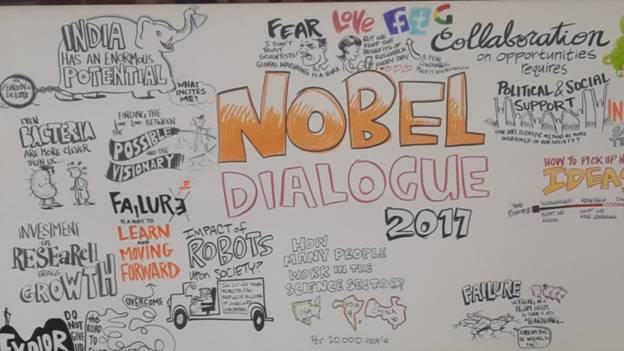
India has a great potential to be a scientific power and should invest more in basic and fundamental researches, said several Nobel laureates who spoke to a huge gathering of scientists, students and general public as a part of the first Nobel Prize Series being held in Ahmedabad in conjunction with the biennial summit of Vibrant Gujarat on Tuesday.

The Programme, Nobel Dialogue, saw active participation of 9 renowned scientists and Nobel Laureates including Dr. Venkatraman Ramakrishnan, Nobel Prize winner in Chemistry, Dr. Richard Roberts, Nobel Prize Laureate in Physiology or Medicine, Dr. Harold Varmus, Nobel Prize Laureate in Physiology or Medicine, Dr. Randy Schekman, Nobel Prize Laureate in Physiology or Medicine, David Gross, Nobel Prize Laureate in Physics, Dr. Ada Yonath, Nobel Prize Laureate in Chemistry, Dr. Serge Haroche, Nobel Prize Laureate in Physics and Dr. William E Moerner Nobel Prize Laureate in Chemistry.

Interesting discussions ranging from getting rid of mosquitoes to tackle malaria, research for finding out new vaccines, genetic modification of food crops and the need for strengthening education particularly science education were discussed at these two sessions.

The first dialogue was introduced and moderated by the Secretary, Department of Biotechnology, Government of India Prof. K. Vijay Raghavan and the second by the Deputy Chairman, Nobel Foundation Dr Goran K Hansson. Several students and Scientists posed interesting questions to Nobel Laureates.

Dr. Venkatraman Ramkrishnan pointed out that there is a lot of scope for research on vaccines in India. Dr. Richards Roberts pointed out that 125 Nobel Laureates have signed in favor of Genetically modified food crops and that opposition against them is unjustifiable as about 800 million people world over go without food every night.

Dr. Randy Schekman said that India with a history of having had Nalanda University over 1,000 years before the first university in other parts of the world came up, should think of having a high quality affordable education system. The Laureates said that they shared their ideas with the Prime Minister at a dinner meeting that they had with Narendra Modi on Monday evening.

The dialogue is part of the Nobel Prize Series, India 2017, inaugurated by Prime Minister Narendra Modi, on Monday, 9th January. The Nobel Prize Series Science Exhibition was also inaugurated at the Science City in Ahmedabad.

As a run-up to these events, a nationwide Ideathon contest was organised that invited ideas from students that could address any challenges faced by society. The ideas were reviewed by a panel of experts and about 150 students from across the country were selected and have been invited to participate and meet with the Nobel Laureates.

A Memorandum of Understanding was signed last year by Nobel Media and the Department of Biotechnology (DBT), Ministry of Science and Technology, Government of India for hosting Nobel Prize Series in India for the next five years.

After this agreement, a trilateral Memorandum of Understanding was signed between the Department of Biotechnology of Government of India, the Government of Gujarat and the Nobel Media. Accordingly, the first of the Nobel Prize Series, India 2017 is being held as a prelude to Vibrant Gujarat to demonstrate how science and discovery underpins all enterprise and human well-being under the overall theme of “Science Impacts Lives”. See below a drawing released by PIB on the occasion.

As a part of the Nobel Prize Series, India 2017 lectures are also to be held in Delhi and Bengaluru on 12th and 13th January, 2017.