

“Cooperatives are a system that enables the South Sudanese to improve their livelihoods, but at the same time also contributes to the economy… this is the only way for South Sudan to move out of poverty,” said Louis Bagare project manager of cooperatives at the Food and Agriculture Organization (FAO) in South Sudan.
He was speaking ahead of the International Day of Cooperatives, which is celebrated every 5 July, and which highlights how cooperatives enable people to provide for their basic needs in contexts where individuals working alone is insufficient.
A path to peace
In South Sudan, the potential of cooperatives extends beyond economic empowerment.

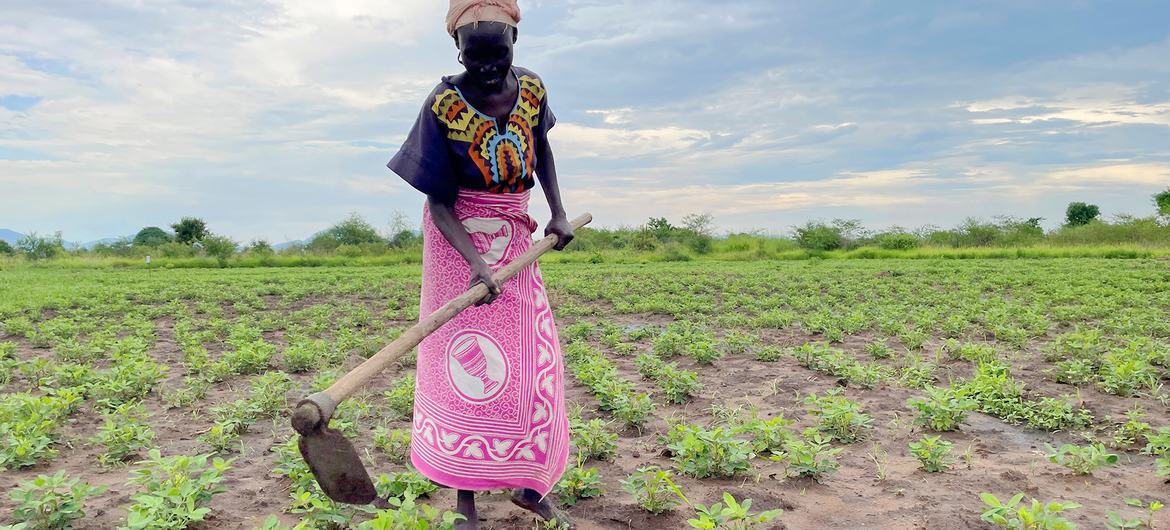
A farmer in South Sudan tills her land.
“Cooperatives are one of the avenues that can bring peace and stability to South Sudan,” said Mr. Bagare.
For over a decade, South Sudan has faced many intersecting challenges. Following its independence in 2011, a civil war broke out, concluding in 2018 with a peace agreement. But this peace is more fragile than ever.
Looting and intercommunal violence, mainly perpetrated by young people, continues to be an ever-present concern for many communities which already face catastrophic food insecurity and continual climate shocks.
In this context, cooperatives provide a ray of hope.
“Cooperatives really changed the mindset of our people and brought stability to the country,” said Deng William Achiek, director for rural producers in South Sudan’s Ministry of Agriculture and Food Security.
But what is it about cooperatives that may usher in a lasting peace?
A voluntary and democratic group
Cooperatives are voluntary economic organizations in which members share in the risk, work and income.
“A cooperative is a democratic, social association of people who, as individuals, cannot improve their status of living and social status … But once they come together in a cooperative, then, they can raise the standard of their living,” said Oneil Yosia Damia, the Director-General for Cooperative Development in South Sudan.
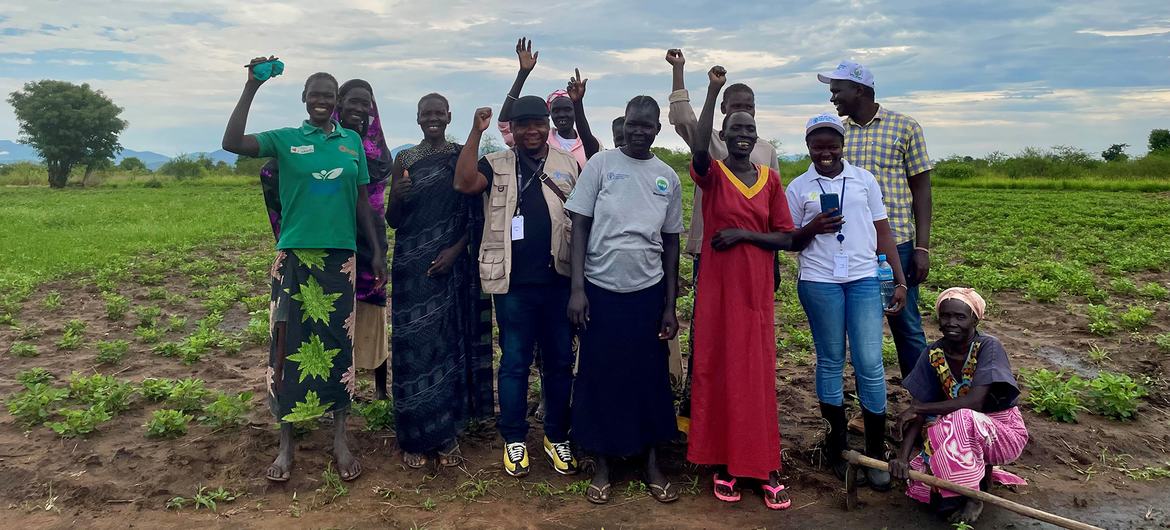
A cooperative of women farmers in South Sudan has been trained in seed production by FAO.
FAO’s Louis Bagare believes that this sort of democratic approach to governance at a local level will trickle up to the national level and encourage more widespread buy-in to a democratic form of governance across South Sudan.
Income, not guns
In addition to providing a model of democratic governance, cooperatives also enable economic growth and development, providing communities — especially young people — a viable and sustainable alternative to looting.
“When, especially the youth, are engaged in productive activities that generate income, they will not have the interest to pick a gun to go and fight or to rob and loot,” Mr. Bagare said.
In South Sudan, the communities which form cooperatives often do not have enough individual resources to maintain a sustainable livelihood, a reality which pushes youth towards violent looting for survival.
“When [community members] work together, when they bring ideas together, when they bring resources together, it is much easier for them to overcome their livelihood challenges,” Mr. Bagare said.
Mr. Bagare also explained that banks are more willing to invest in groups and organizations like FAO are more likely to provide support to cooperatives. But ultimately, the goal is that this will not be long-term.
“The focus is on building their capacity so that they can be able to create lives,” Mr. Bagare said.
A historic structure in the world’s youngest country
In South Sudan, there are cooperatives of every shape and size. Overwhelmingly, these cooperatives are agricultural but some also produce soap, bread and textiles. The history of South Sudan is populated with examples of this type of work.
“Cooperatives are not something which has come from nowhere. It has been part of the culture of South Sudan,” Mr. Bagare said.
Mr. Daima referred to the “golden era” of cooperatives which existed before the civil war in 2011. He said that his office within the Ministry of Agriculture and Food Security is working diligently to get back to that time.
“I want our cooperatives to be as busy as bees. This is the spirit of oneness, of unity,” Mr. Daima said.
Mr. Bagare hopes for a future in South Sudan where cooperatives become a part of every economic sector — not just agriculture.
“If we are able to work together, we can become better people tomorrow. But the moment that we continue to only fight with each other, we will continue to destroy ourselves.”