
DRDO, Indian Army test successfully Surface to Air Missiles

Defence Research and Development Organisation (DRDO) and Indian Army have successfully completed six flight-tests of Quick Reaction Surface to Air Missile (QRSAM) system from Integrated Test Range (ITR) Chandipur off the Odisha coast. The flight tests were conducted as part of evaluation trials by the Indian Army.

The flight-tests were carried out against high-speed aerial targets mimicking various types of threats to evaluate the capability of the weapon systems under different scenarios, including long range medium altitude, short range, high altitude manoeuvring target, low radar signature with receding & crossing target and salvo launch with two missiles fired in quick succession. The system performance was also evaluated under day and night operation scenarios.
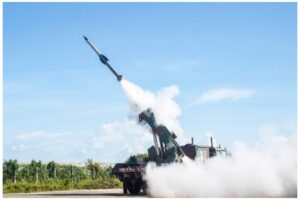
During these tests, all the mission objectives were met establishing pin-point accuracy of the weapon system with state-of-the-art guidance and control algorithms including warhead chain. The performance of the system has been confirmed from the data captured by a number of Range instruments like Telemetry, Radar and Electro Optical Tracking Systems (EOTS) deployed by ITR. Senior officials from DRDO and the Indian Army participated in the launches.

These tests were conducted in the final deployment configuration consisting of all indigenously-developed sub-systems, including the missile with indigenous Radio Frequency (RF) seeker, mobile launcher, fully automated command and control system, surveillance and multi-function Radars. The uniqueness of the QRSAM weapon system is that it can operate on the move with search and track capability & fire on short halt. This has been proven during the mobility trials conducted earlier.
Raksha Mantri Shri Rajnath Singh has complimented DRDO and Indian Army on the successful flight trials. He exuded confidence that the QRSAM weapon system will be an excellent force multiplier for the Armed Forces.

Secretary, Department of Defence R&D and Chairman DRDO has congratulated the teams associated with the successful series of trials and said that the system is now ready for induction into the Indian Army.

India Successfully Testfires ATGM Nag Missile

The Anti-Tank Guided Missile Nag was successfully flight tested today in the desert ranges of Rajasthan. The Fire and Forget 3rd generation ATGM Nag is incorporated with many advanced technologies including the Imaging Infrared Radar (IIR) Seeker with integrated avionics, a capability which is possessed by few nations in the world.

The capabilities of the top attack ATGM Nag is unique in nature and in today’s mission it successfully destroyed the target. The test has been carried out by DRDO Scientists of the Dr. A.P.J. Abdul Kalam Missile Complex at Hyderabad, DL Jodhpur, HEMRL and ARDE at Pune.

Also the ground systems were developed by the Ordnance Factory, BEL and L&T. Senior officials from the Armed Forces participated in the tests. Director General (Missiles and Strategic Systems) Dr. G. Satheesh Reddy witnessed the launch and said “The successful flight test of 3rd generation ATGM Nag further strengthens the country’s defence capabilities.”

A number of DRDO developed weapon systems, platforms, dual use equipment have been accepted and inducted in the Indian Armed Forces and Paramilitary Forces. Some of the notable successful tests completed and inducted are Tejas fighters, Airborne Early Warning and Control System (AEW&C) System, Akash Weapon System, SONAR systems, Varunastra Torpedo, Bharani Weapon Locating Radar (WLR), Nuclear Biological Chemical (NBC) Recce Vehicle, AGNI-V, Long Range Surface to Air Missile (LRSAM), Medium Range Surface to Air Missile (MRSAM), NAG, Advanced Towed Array Gun (ATAG), Wheeled Armoured platform (WhAP), RUSTOM-II MALE Unmanned Aerial Vehicle, etc.

The production value of DRDO developed products, cleared by the Defence Acquisition Council has grown by 60 per cent in the last three years to approximately ₹ 2,57,000 crore from nearly Rs. 1,61,000 crore. The export potential of DRDO developed systems has also increased manifolds and this year export of torpedo stands at US$ 37.9 million. This is a step towards achieving self-reliance in critical defence systems and realisation of the Prime Minister’s vision of ‘Make in India’.


Sri Lankan Navy Commander Visits Delhi, to Proceed to Goa, Kochi Next

Vice Admiral RC Wijegunaratne, Commander of the Sri Lanka Navy, who is on an official visit to India from 29 January to 02 February 2017, held bilateral discussions with Admiral Sunil Lanba, Chief of the Naval Staff and other senior officials of the Indian Navy on 30 January 2017.

The Admiral is also scheduled to meet the Chief of the Air Staff, Chief of the Army Staff as well as the Director General, Indian Coast Guard, the Minister of State for Defence and Defence Secretary have also been scheduled as part of his official meetings in New Delhi.

Naval cooperation between India and Sri Lanka has been traditionally strong, encompassing a wide span which includes operational interactions through bilateral exercises, Training, Port Calls, Hydrographic co-operation, Special Forces interactions, Capability Building and Capacity Augmentation initiatives. Two Advanced Offshore Patrol Vessels (AOPVs) are also being constructed for the Sri Lankan Navy at Goa Shipyard Limited.

In addition to New Delhi, the Admiral is also scheduled to proceed to Goa where he will be visiting Naval War College and Goa Shipyard Limited besides interacting with Flag Officer Commanding Goa Area.

The Admiral would later visit the Training Command of the Indian Navy based at Kochi, where he would be briefed on training aspects and would also visit various training facilities/ professional schools. During his visit to Kochi, the Admiral would also interact with Sri Lankan Naval personnel undergoing training in India.

The Commander, Sri Lankan Navy’s visit follows closely on the visit of the Chief of Naval Staff, Admiral Sunil Lanba’s visit to Sri Lanka wherein he also participated in the 7th International Maritime Conference, Galle Dialogue 2016.

Pinaka Guided Rocket Successfully Test-Fired

The Pinaka Rocket converted to a Guided Pinaka was successfully test-fired from Launch Complex-III, ITR, Chandipur on Thursday, said the ministry of defence in a statement.

The Pinaka Rocket Mark-II, which evolved from Pinaka Mark-I is equipped with a navigation, guidance and control kit and has been transformed to a Guided Pinaka, which has considerably enhanced the range and accuracy of the rocket.

The test-firing has met all mission objectives with the radars, electro-optical and telemetry systems tracked at Chandipur facility that monitored the vehicle all through its flight-path. The Guided Pinaka is developed jointly by ARDE Pune, RCI Hyderabad and DRDL Hyderabad. ITR Chandipur provided the range and launch support for the successful test-firing.

Pinaka is a multiple rocket launcher produced by the Defence Research and Development Organisation (DRDO) for the Indian Army. The system has a maximum range of 40 km for Mark-I and 65 km for Mark-II, and can fire a salvo of 12 HE rockets in 44 seconds. The system is mounted on a Tatra truck for mobility and it was used during the Kargil War effectively. On an average 5,000 missiles are being produced every year while the current one is an advanced version with enhanced range and accuracy.

Dr. K.M. Rajan, Director ARDE, Pune, Mr B.H.V.S. Narayana Murthy, Director, RCI, Hyderabad, Dr. B.K. Das, Director, ITR, Chandipur and Mr R. Appavuraj, Director, PXE, Chandipur monitored the launch operations and an Armed Forces team witnessed the flight test.

Indian defence minister Manohar Parrikar has congratulated the DRDO, industry and the Armed Forces for the successful flight-test and he was joined by top defence officials P.K. Mehta, DG (ACE) and Dr. S. Christopher, Secretary, Deptt. of Defence R&D and Chairman of DRDO.

[ tags pinaka rocket, test fired, drdo, chandipur test range]

Indo- Maldives Joint Military Exercise Begins in Maldives

A 14 days joint training exercise of the Indian Army and the Maldives National Defence Force commenced today with the Opening Ceremony at

File Photo: Visit of Foreign Minister of Maldives to India (August 15-16, 2016) (MEA)

in Maldives.

The training contingents comprised of a platoon strength from BIHAR Regiment and a similar strength of the Maldivian National Defence Force. Senior military observers of both the countries will be witnessing the validation phase of the Exercise.

Exercise EKUVERIN – 2016 will be the 7th edition of Joint Exercise and is in continuation of a series of joint Exercises between the Indian Army and Maldivian National Defence Force. The previous edition of the Exercise was held at Trivandrum, India in 2015.

The aim of the Joint Exercise is to acquaint both forces with each other’s operating procedures in the backdrop of amphibious and counter insurgency/ Counter terrorism environment as also to enhance the existing military relationship between the Indian Army and the Maldivian National Defence Force.

The Indian Army contingent had landed at Male International Airport on 14 Dec 2016 on a C-130 military aircraft of the Indian Air Force. The exercise aims to enhance the interoperability between the Indian Army and Maldivian National Defence Forces in conducting joint operations and cement bonds of friendship between the two countries.

The joint military exercise named ‘Exercise EKUVERIN’ alternatively in India and Maldives with participation of an Infantry platoon from each side.