World News in Brief: IOM warning for Sudan returnees, Nipah virus alert for India, food security in Afghanistan

They did so despite extensive damage to housing, basic services, vital infrastructure, and an uncertain future. 

The highest number of returns were recorded in Khartoum State, where more than 1.3 million people have made the journey home, followed by nearby Aj Jazirah State, according to IOM’s latest data.

Pockets of security

IOM says the number of returnees is rising, signaling pockets of perceived relative security in parts of the country. 

Overall, 83 per cent of returnees had been internally displaced, while 17 per cent returned from neighbouring countries, including Egypt, South Sudan, and Libya, as well as from the Gulf States. 

However, across areas in Darfur and Kordofan where violence continues to escalate, increased displacement has been recorded.

IOM warns that without adequate resources and renewed efforts toward peace, millions of families will remain trapped in protracted displacement and instability.

WHO: India on alert with two cases of Nipah virus in January

India has confirmed two cases of the sometimes-fatal Nipah virus this month in the eastern state of West Bengal, according to an update by the World Health Organization (WHO). 

This is the seventh documented Nipah outbreak in India and the third in West Bengal, following outbreaks in 2001 and 2007.

The infected individuals are a male and a female nurse working at the same private hospital. As of last week, the male patient is recovering, while the female patient remains in critical condition.

Nipah is a virus transmitted mainly from bats to humans, sometimes through contaminated food or close contact. It can also spread from animals such as pigs to humans, and in some cases between people.

Nipah virus infection can range from asymptomatic illness to severe respiratory disease and fatal encephalitis.

Low transmission risk

 Historically, Nipah outbreaks in the WHO Southeast Asia Region have been limited to Bangladesh and India, occurring sporadically or in small clusters. There have been no known instances of international spread through travel.

WHO says India has demonstrated its capacity to manage previous outbreaks well and public health measures are currently being implemented.

As of 27 January, no additional cases have been detected. The national government has deployed an outbreak response team to West Bengal to work closely with state authorities.

For Nipah, no licensed vaccine or treatment is currently available, making early detection and prevention essential.

$100 Million initiative launched to strengthen food security in Afghanistan

In Afghanistan, the UN food agency (FAO) and the Asian Development Bank (ADB) are implementing a $100 million initiative to bolster food and nutrition security and restore agricultural livelihoods for more than one million vulnerable people over the next two years.

Backbone of the economy

Although agriculture remains the backbone of Afghanistan’s rural economy, it continues to face challenges such as low productivity, restricted market opportunities, and repeated natural disasters. 

The project will reach over 151,000 households – that’s just over a million people – including returnees, host communities, and disaster-affected families. 

With millions of Afghans already facing mounting pressures and at risk of slipping into deeper acute food insecurity and malnutrition, there is an urgent need for sustained investment that goes beyond emergency response to strengthen long-term resilience.

In 2026, 17.4 million people are projected to face acute food insecurity, including 4.7 million classified as being in the emergency phase – just one away from famine conditions. 

FAO has supported about 5.6 million people since 2022. 

Through its partnership with ADB, millions more rural households will gain the tools and resources needed to produce food, safeguard livestock, and secure their families’ nutrition.

Source link

Even Viruses may have “eyes and ears” on us: New UMBC research

New UMBC-led research in Frontiers in Microbiology suggests that viruses are using information from their environment to “decide” when to sit tight inside their hosts and when to multiply and burst out, killing the host cell. The work has implications for antiviral drug development.

A virus’s ability to sense its environment, including elements produced by its host, adds “another layer of complexity to the viral-host interaction,” says Ivan Erill, professor of biological sciences and senior author on the new paper. Right now, viruses are exploiting that ability to their benefit. But in the future, he says, “we could exploit it to their detriment.”

Not a coincidence

The new study focused on bacteriophages—viruses that infect bacteria, often referred to simply as “phages.” The phages in the study can only infect their hosts when the bacterial cells have special appendages, called pili and flagella, that help the bacteria move and mate. The bacteria produce a protein called CtrA that controls when they generate these appendages. The new paper shows that many appendage-dependent phages have patterns in their DNA where the CtrA protein can attach, called binding sites. A phage having a binding site for a protein produced by its host is unusual, Erill says.

Even more surprising, Erill and the paper’s first author Elia Mascolo, a Ph.D. student in Erill’s lab, found through detailed genomic analysis that these binding sites were not unique to a single phage, or even a single group of phages. Many different types of phages had CtrA binding sites—but they all required their hosts to have pili and/or flagella to infect them. It couldn’t be a coincidence, they decided.

The ability to monitor CtrA levels “has been invented multiple times throughout evolution by different phages that infect different bacteria,” Erill says. When distantly related species demonstrate a similar trait, it’s called convergent evolution—and it indicates that the trait is definitely useful.

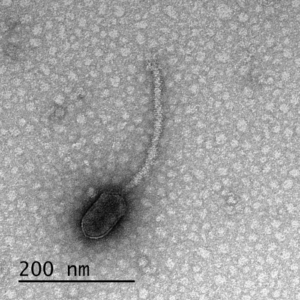
A delta bacteriophage, the first identified in a new study in Frontiers in Microbiology to have binding sites for CtrA, a protein produced by the bacteriophage’s host that regulates the production of pili and flagella. The presence of these binding sites only in phages that require their host cells to have pili/flagella in order to infect them suggests that the phage is monitoring the presence of this protein in order to “decide” whether to stay put or replicate and emerge from its host cell./CREDIT:Tagide deCarvalho/UMBC

Timing is everything

Another wrinkle in the story: The first phage in which the research team identified CtrA binding sites infects a particular group of bacteria called Caulobacterales. Caulobacterales are an especially well-studied group of bacteria, because they exist in two forms: a “swarmer” form that swims around freely, and a “stalked” form that attaches to a surface. The swarmers have pili/flagella, and the stalks do not. In these bacteria, CtrA also regulates the cell cycle, determining whether a cell will divide evenly into two more of the same cell type, or divide asymmetrically to produce one swarmer and one stalk cell.

Because the phages can only infect swarmer cells, it’s in their best interest only to burst out of their host when there are many swarmer cells available to infect. Generally, Caulobacterales live in nutrient-poor environments, and they are very spread out. “But when they find a good pocket of microhabitat, they become stalked cells and proliferate,” Erill says, eventually producing large quantities of swarmer cells.

So, “We hypothesize the phages are monitoring CtrA levels, which go up and down during the life cycle of the cells, to figure out when the swarmer cell is becoming a stalk cell and becoming a factory of swarmers,” Erill says, “and at that point, they burst the cell, because there are going to be many swarmers nearby to infect.”

Listening in

“Everything that we know about phages, every single evolutionary strategy they have developed, has been shown to translate to viruses that infect plants and animals,” he says. “It’s almost a given. So if phages are listening in on their hosts, the viruses that affect humans are bound to be doing the same.”

There are a few other documented examples of phages monitoring their environment in interesting ways, but none include so many different phages employing the same strategy against so many bacterial hosts.

This new research is the “first broad scope demonstration that phages are listening in on what’s going on in the cell, in this case, in terms of cell development,” Erill says. But more examples are on the way, he predicts. Already, members of his lab have started looking for receptors for other bacterial regulatory molecules in phages, he says—and they’re finding them.

New therapeutic avenues

The key takeaway from this research is that “the virus is using cellular intel to make decisions,” Erill says, “and if it’s happening in bacteria, it’s almost certainly happening in plants and animals, because if it’s an evolutionary strategy that makes sense, evolution will discover it and exploit it.”

For example, to optimize its strategy for survival and replication, an animal virus might want to know what kind of tissue it is in, or how robust the host’s immune response is to its infection. While it might be unsettling to think about all the information viruses could gather and possibly use to make us sicker, these discoveries also open up avenues for new therapies.

“If you are developing an antiviral drug, and you know the virus is listening in on a particular signal, then maybe you can fool the virus,” Erill says. That’s several steps away, however. For now, “We are just starting to realize how actively viruses have eyes on us—how they are monitoring what’s going on around them and making decisions based on that,” Erill says. “It’s fascinating.”

Related: http://dx.doi.org/10.3389/fmicb.2022.918015

Scent, sweat from human skin attract disease-spreading mosquitoes

Mosquitoes that spread Zika, dengue and yellow fever are guided toward their victims by a scent from human skin. The exact composition of that scent has not been identified until now.

A UC Riverside-led team discovered that the combination of carbon dioxide plus two chemicals, 2-ketoglutaric and lactic acids, elicits a scent that causes a mosquito to locate and land on its victim. This chemical cocktail also encourages probing, the use of piercing mouthparts to find blood.

This chemical mixture appears to specifically attract female Aedes aegypti mosquitoes, vectors of Zika as well as chikungunya, dengue, and yellow fever viruses. This mosquito originated in Africa, but has spread to tropical and subtropical regions worldwide, including the U.S.

Mosquitoes use a variety of cues to locate their victims, including carbon dioxide, sight, temperature, and humidity. However, Cardé’s recent research shows skin odors are even more important for pinpointing a biting site.

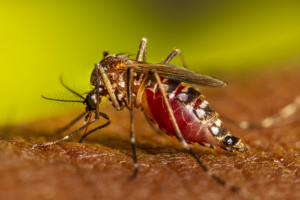
Aedes aegyptii mosquito biting a person./CREDIT CDC

“We demonstrated that mosquitoes land on visually indistinct targets imbued with these two odors, and these targets aren’t associated with heat or moisture,” Cardé said. “That leaves skin odor as the key guiding factor.”

Given the significance of odor in helping mosquitoes successfully feed on humans, Cardé wanted to discover the exact chemicals that make our scent so potent for the insects. Part of the equation, lactic acid, was identified as one chemical element in the odor cocktail as long ago as 1968.

Since then, several studies have identified that carbon dioxide combined with ammonia, and other chemicals produced by humans also attract these mosquitoes. However, Cardé, who has studied mosquitoes for 26 years, felt these other chemicals were not strong attractants.

Methods that chemists typically use to identify these chemicals would not have worked for 2-ketoglutaric acid, Cardé said. Gas chromatography, which separates chemicals by their molecular weight and polarity, would have missed this acid.

“I think that these chemicals may not have been found before because of the complexity of the human odor profile and the minute amounts of these compounds present in sweat,” said chemist Jan Bello, formerly of UCR and now with insect pest control company Provivi.

Searching for mosquito attractors, Cardé turned to Bello, who extracted compounds from the sweat in his own feet. He filled his socks with glass beads and walked around with the beads in his socks for four hours per odor collection.

Credit: MINDY TAKAMIYA/KYOTO UNIVERSITY ICEMS

“Wearing the beads felt almost like a massage, like squeezing stress balls full of sand, but with your feet,” said Bello. ‘The most frustrating part of doing it for a long time is that they would get stuck in between your toes, so it would be uncomfortable after a while.”

The inconvenience was worth the investment. Bello isolated chemicals from the sweat deposited on the sock beads and observed the mosquitoes’ response to those chemicals. In this way, the most active combination emerged.

Future studies are planned to determine whether the same compound is effective for any other mosquitoes, and why there is such variation in how individuals are apt to be bitten. “Some are more attractive than others to these mosquitoes, but no one’s yet established why this is so,” Cardé said.

Though this discovery may not lead to insights for the development of new repellants, the research team is hopeful their discovery can be used to attract, trap, and potentially kill disease-spreading mosquitoes.

New ecology tools predict disease transmission among wildlife, humans

The rate that emerging wildlife diseases infect humans has steadily increased over the last three decades. Viruses, such as the global coronavirus pandemic and recent monkeypox outbreak, have heightened the urgent need for disease ecology tools to forecast when and where disease outbreaks are likely.

A University of South Florida assistant professor helped develop a methodology that will do just that – predict disease transmission from wildlife to humans, from one wildlife species to another and determine who is at risk of infection.

The methodology is a machine-learning approach that identifies the influence of variables, such as location and climate, on known pathogens. Using only small amounts of information, the system is able to identify community hot spots at risk of infection on both global and local scales.

coronavirus

“Our main goal is to develop this tool for preventive measures,” said co-principal investigator Diego Santiago-Alarcon, a USF assistant professor of integrative biology. “It’s difficult to have an all-purpose methodology that can be used to predict infections across all the diverse parasite systems, but with this research, we contribute to achieving that goal.”

With help from researchers at the Universiad Veracruzana and Instituto de Ecologia, located in Mexico, Santiago-Alarcon examined three host-pathogen systems – avian malaria, birds with West Nile virus and bats with coronavirus – to test the reliability and accuracy of the models generated by the methodology.

The team found that for the three systems, the species most frequently infected was not necessarily the most susceptible to the disease. To better pinpoint hosts with higher risk of infection, it was important to identify relevant factors, such as climate and evolutionary relationships.

By integrating geographic, environmental and evolutionary development variables, the researchers identified host species that have previously not been recorded as infected by the parasite under study, providing a way to identify susceptible species and eventually mitigate pathogen risk.

“We feel confident that the methodology is successful, and it can be applied widely to many host-pathogen systems,” Santiago-Alarcon said. “We now enter into a phase of improvement and refinement.”

The results, published in the Proceedings of the National Academy of Sciences, prove the methodology is able to provide reliable global predictions for the studied host–pathogen systems, even when using a small amount of information. This new approach will help direct infectious disease surveillance and field efforts, providing a cost-effective strategy to better determine where to invest limited disease resources.

Bats/wikipedia

Predicting what kind of pathogen will produce the next medical or veterinary infection is challenging, but necessary. As the rate of human impact on natural environments increases, opportunity for novel diseases will continue to rise.

“Humanity, and indeed biodiversity in general, are experiencing more and more infectious disease challenges as a result of our incursion and destruction of the natural order worldwide through things like deforestation, global trade and climate change,” said Andrés Lira-Noriega, research fellow at the Instituto de Ecologia. “This imposes the need of having tools like the one we are publishing to help us predict where new threats in terms of new pathogens and their reservoirs may occur or arise.”

The team plans to continue their research to further test the methodology on additional host-pathogen systems and extend the study of disease transmission to predict future outbreaks. The goal is to make the tool easily accessible through an app for the scientific community by the end of 2022.

Scientists develop improved, potentially safer Zika vaccine

The worldwide Zika threat first emerged in 2015, infecting millions as it swept across the Americas. It struck great fear in pregnant women, as babies born with severe brain birth defects quickly overburdened hospitals and public health care systems.

In response, there has been a flurry of heroic scientific efforts to stop Zika. Whole governments, academic labs and pharmaceutical companies have raced to develop Zika vaccines ever since global health experts first realized the dangers wrought by the mosquito-borne virus.

Now, ASU has taken a major step forward in boosting Zika prevention efforts.

ASU Biodesign Institute scientist Qiang “Shawn” Chen has led his research team to develop the world’s first plant-based Zika vaccine that could be more potent, safer and cheaper to produce than any other efforts to date.

“Our vaccine offers improved safety and potentially lowers the production costs more than any other current alternative, and with equivalent effectiveness,” said Chen, a researcher in the Biodesign Center for IVV and professor in the School of Life Sciences. “We are very excited about these results.”

Rapid response network

Several potential Zika vaccines have had promising results in early animal and human tests. Last year, the Food and Drug Administration approved the first human testing of a Zika vaccine candidate, and this summer, a $100 million U.S. government-led clinical trial is underway.

But currently, there are no licensed vaccines or therapeutics available to combat Zika.

Several dedicated ASU scientists also heeded the call to action, wanting to use their special know-how to find a way to overcome the pandemic crisis.

First, ASU chemist Alexander Green, along with collaborators at Harvard, developed a more rapid and reliable Zika test, an achievement highlighted by Popular Science in its “Best of What’s New” of 2016.

Now, Chen may have come up with a better vaccine candidate based on a key Zika protein. Chen is a viral expert who has worked for the past decade on plant-based therapeutics and vaccines against West Nile virus and Dengue fever, which come from the same Zika family, called flaviviruses.

He honed in on developing a vaccine against a part of a Zika viral protein, called DIII, that plays a key role for the virus to infect people.

“All flaviviruses have the envelope protein on the outside part of the virus. It has three domains. “The domain III has a unique stretch of DNA for the Zika virus, and we exploited this to generate a robust and protective immune response that is unique for Zika,” said Chen.

They first grew the envelope protein in bacteria, then switched to prepare the DIII protein domain in tobacco plants.

After developing enough material for the new vaccine candidate, Chen’s team performed immunization experiments in mice, which induced antibody and cellular immune responses that have been shown to confer 100 percent protection against multiple Zika virus strains in a mouse challenge.

Producing plant-based vaccines, especially in tobacco plants, is old hat for ASU researchers like Chen. For more than a decade, they’ve been producing low-cost vaccines in plants to fight devastating infectious diseases in the developing world.

It’s the same approach ASU plant research pioneer Charles Arntzen used when he played a key role in developing ZMapp, the experimental treatment used during the Ebola outbreak.

Artntzen’s Biodesign colleagues, including Chen, Hugh Mason and Tsafrir Mor, have continued to pursue plant-based vaccines and therapeutics to combat West Nile virus, dengue fever, nerve agents and even cancer.

Effective but not foolproof

While Chen has been cheering on Zika vaccine progress from other researchers, in each case, there can be side effects.

To date, other scientists have tested several kinds of vaccines on mice –including one made from DNA and another from an inactivated form of the virus. With just one dose, both vaccines prompted the creation of antibodies that shielded the animals from becoming infected when they were exposed to the virus.

Any heat-killed vaccine runs the risk of accidentally injecting a live version of the virus if there is an error made in the vaccine production protocol. This tragic scenario happened occasionally with the polio vaccine.

For the second research group, they used the complete Zika envelope protein for their vaccine. Since envelope protein domains I and II are similar to West Nile and dengue viruses, this can cause a dangerous cross-reactive immune response.

“When you make the full native envelope protein as the basis for a vaccine, it will induce antibodies against DI, DII and the DIII domains of the protein,” explained Chen. “Those who have been prior exposed to DI and DII of other members of the Zika virus family may be prone to developing very bad symptoms, or in some cases, fatalities for dengue.”

In fact, animal experiments have shown that prior exposure to dengue or West Nile virus makes the Zika infection and symptoms much worse, suggesting a similar risk for people who had prior exposure to dengue (especially in South America, where it is more common).

“If you have prior exposure to dengue, and then have Zika exposure, the Zika infection may be much worse, and for men, may increase the likelihood of sexual transmission,” said Chen.

Chen’s protein-based vaccine uses the smallest and most unique part of the Zika virus that can still elicit a potent and robust immune response.

“In our approach, we make what we call a pseudovirus. It’s a fake virus. The pseudovirus displays only the DIII part of the envelope protein on the surface. This is at least as potent as previous vaccine versions.”

And he is very confident that his DIII-based protein vaccine will be safer.

“We did a test to make sure that the vaccine produces a potent protective immune response, but also, that it does not produce antibodies that may be cross reactive for dengue, West Nile, yellow fever or others,” said Chen.

Fast track to the clinic

During the height of the Zika pandemic, whole countries of women were told not to become pregnant, due to babies born with a severe brain defect called microcephaly, in which the head and brain don’t develop properly.

There have also been vision and hearing defects and learning disabilities associated with less severe infections.

To make matters worse, in adults, a debilitating nervous system condition called Gullian-Barre syndrome has also been shown to be caused by Zika.

While the most severe wave of the Zika pandemic has ebbed, it won’t go away anytime soon, and a vaccine still offers the best hope.

Tens of millions more could still be infected in the Americas in the coming years (see WHO fact sheet).

The ASU scientists were able to mobilize quickly from idea to proof-of-concept because they could leverage funds from an NIAID grant and seed funds from the Biodesign Institute.

These are all made possible by generous federal, state and public support, including sales tax generated from the long-time Arizona innovation booster, voter-approved Proposition 301.

“This is a great example of the brightest minds quickly coming together, with public support, to take on one of the most significant public health challenges of our time,” said Josh LaBaer, executive director of the Biodesign Institute.

“That’s the essence of Biodesign at its best, and we hope this important proof-of-principal of a Zika vaccine can be translated quickly into the clinic.”

With the successful proof-of-principle, Chen hopes to partner with the medical community to begin the first phase of a human clinical trial in the next two years.

“Above all, we have to ensure the utmost safety with any Zika vaccine, especially because the people who will need it most, pregnant women, have the most worries about their own health, and the health of the fetus,” said Chen. “This has to be 100 percent safe and effective.”

Along with Chen, the research team included Ming Yang, Huafang “Lily” Lai and Haiyan Sun.

The research was published in the online version of Scientific Reports.


Scientists discover unknown virus in ‘throwaway’ DNA

A chance discovery has opened up a new method of finding unknown viruses.

In research published in the journal Virus Evolution, scientists from Oxford University’s Department of Zoology have revealed that Next-Generation Sequencing and its associated online DNA databases could be used in the field of viral discovery. They have developed algorithms that detect DNA from viruses that happen to be in fish blood or tissue samples, and could be used to identify viruses in a range of different species.

Next-Generation Sequencing has revolutionised genomics research and is currently used to study and understand genetic material. It allows scientists to gather vast amounts of data, from a single piece of DNA, which is then collated into huge, online, genome databases that are publicly accessible.

Dr Aris Katzourakis and Dr Amr Aswad, Research Associates at Oxford’s Department of Zoology, initially discovered the new use for the database, by chance. While looking for an ancient herpes virus in primates, they found evidence of two new undocumented viruses.

Spurred by their accidental discovery, they set out to see if they could intentionally achieve the same result. In a separate project to find new fish-infecting herpes viruses, they used the technique to examine more than 50 fish genomes for recognisable viral DNA. Sure enough, in addition to the herpes viruses they were expecting to find, the researchers identified a distant lineage of unusual viruses – that may even be a new viral family. The traits were found scattered in fragments of 15 different species of fish, including the Atlantic salmon and rainbow trout.

To confirm that the viral evidence was not simply a fluke, or a data processing error, they tested additional samples from a local supermarket and sushi restaurant. The same viral fragments were found in the bought samples.

Study author Dr Aris Katzourakis, from Oxford University’s Department of Zoology, said: ‘In the salmon genome we found what seems to be a complete and independent viral genome, as well as dozens of fragments of viral DNA that had integrated into the fish DNA. We know from recent studies that viruses are able to integrate into the genome of their host, sometimes remaining there for millions of years. In this case, it looks like the virus may have acquired the ability to integrate by stealing a gene from the salmon itself, which explains how it has become so widespread in the salmon genome.’

The key to the success of this research is in its inter-disciplinary approach, combining techniques from two fields: evolutionary biology and genomics. Together, these are at the core of the new field of paleovirology – the study of ancient viruses that have integrated their DNA into that of their hosts, sometimes millions of years ago. Each technique used has been developed to analyse huge quantities of DNA sequence data.

Co-author and Research Associate at Oxford’s Department of Zoology and St. Hilda’s College, Dr Amr Aswad, said: ‘Discovering new viruses has historically been biased towards people and animals that exhibit symptoms of disease. But, our research shows how useful next generation DNA sequencing can be in viral identification. To many, viral DNA in say, chimp or falcon data is a nuisance, and a rogue contaminant that needs to be filtered from results. But we consider these an opportunity waiting to be exploited, as they could include novel viruses that are worth studying – as we have found in our research. We could be throwing away very valuable data.’

Finding new viruses has historically not been an easy process. Cells do not grow on their own, so must be cultured in a laboratory before they can be analysed, which involves months of work. But the Oxford research represents a massive opportunity for the future.

Beyond this study, the approach could be used to identify viruses in a range of different species, particularly those known to harbour transmissible disease. Bats and rodents, for example, are notorious carriers of infectious disease that they are seemingly immune to. Insects such as mosquitoes are also carriers of viral diseases that harm humans, such as Zika. If applied effectively the method could uncover other viruses before an outbreak even happens.

Dr Katzourakis added: ‘One of the real strengths of this technique, as compared to more traditional virology approaches, is the speed of discovery, and the lack of reliance on identifying a diseased individual. The viral data collected, that may otherwise be discarded as a nuisance, is a unique resource for looking for both pathogenic and benign viruses that would otherwise have remained undiscovered.’

The team will next begin to identify the impact of the viruses and whether they have any long term implications for disease, or commercial fish-farming. While an infectious virus may not cause disease in its natural host – in this case, fish. there is a risk of cross-species transmission to either farmed fish or wild populations.

However, the risk to humans is minimal. Dr Aris Katzourakis said: ‘Put it this way, I’m not going to stop eating sashimi.’