
Meet Aniket Bera: Indian-origin researcher builds an AI-powered drone that can track people through dense forests without GPS or internet; it could help rescue missing people |

A drone built by Purdue University researchers followed a runner through an unmapped forest without GPS, weaving between trees and using its onboard computer to predict where the person would reappear. The 44-second demonstration shows a skill that could help rescuers keep track of someone through dense vegetation. Finding a missing person in the first place remains a separate challenge.

Aniket Bera, an Indian-origin computer science professor who directs Purdue’s IDEAS Lab, shared the footage on LinkedIn on October 24. The team designed the aircraft’s carbon-fibre frame and developed the software that tracks the runner and plans the drone’s route. The system makes flight decisions onboard without relying on an internet connection or a map loaded before takeoff.

How the drone tracks a runner behind trees

The drone combines images from a depth-sensing camera with three-dimensional measurements from LiDAR, which uses laser pulses to measure distances. It builds a map of nearby obstacles as it flies. When a trunk blocks the camera’s view, the tracking software uses earlier observations to estimate where the runner is heading and where they may come back into sight. The aircraft can also brake to maintain separation, Bera told TechSpot.

In the LinkedIn post, Bera wrote that “we cannot afford offboard latency” when the aircraft banks to avoid a branch. He said the onboard processor must turn camera data into motor commands within milliseconds while working within the aircraft’s limits on weight, power and heat.

The video’s flight charts prompted questions about the software behind the demonstration. Bera told TechSpot that a label for SUPER, a University of Hong Kong navigation system, came from an earlier comparison script. Purdue uses its own flight planner, alongside the open-source FAST-LIO software to estimate the drone’s position and a modified version of ROG-Map to map obstacles. Bera said a paper describing the system was under peer review.

What a rescue trial would need to show

A search crew may have to locate someone who is stationary, injured or hidden by vegetation. Purdue’s video begins with the runner already in view. Public accounts of the demonstration give no figures for battery endurance, operating range or the share of attempts in which the drone regained sight of a person after losing them.

A separate prototype from Austria’s Johannes Kepler University Linz offers a benchmark for the initial search. In a 2021 study, researchers reported that an autonomous drone detected 38 of 42 hidden people across 17 forest field experiments. The system combined thermal images from multiple viewpoints to pick out people partly obscured by vegetation and adjusted its flight path to take another look at possible detections.

Purdue has also announced a five-year, $1.5 million agreement with the US Army Research Laboratory for Bera’s team to develop air and ground robots that can map and navigate difficult terrain without GPS. For civilian search teams, field trials would need to measure how much ground the drone can cover on one battery charge, how reliably it can recover a track under different canopy conditions and how accurately it can report a person’s location to crews on the ground.

‘A compass towards progress’ – but key development goals remain way off track

The UN’s key Sustainable Development Goals Report released Monday by Secretary-General António Guterres, chronicles both progress and setbacks – showing that the world has made significant advances but is still drastically off-track to achieve its development goals by 2030.

Seize the day

“This report is more than a snapshot of today. It’s also a compass pointing the way to progress. This report shows that the Sustainable Development Goals (SDGs) are still within reach, but only if we act – with urgency, unity, and unwavering resolve,” Mr. Guterres said.

The release of the report coincides with the first day of the High-Level Political Forum on Sustainable Development which will convene over the next ten days in New York in the hopes of answering the UN chief’s call to action. 

‘A global development emergency’

In 2015, the General Assembly adopted the 2030 Agenda, which outlined 17 Sustainable Development Goals – including ending poverty and ensuring that everyone had access to healthcare and quality education.

The ambitious SDGs were to be achieved by prioritising future generations through sustainable and climate-friendly initiatives.

“The 2030 Agenda represents our collective recognition that our destinies are intertwined and that sustainable development is not a zero-sum game but a shared endeavour that benefits us all,” said Li Junhua, UN Under Secretary-General for Economic and Social Affairs.

Ten years after this commitment, the agenda is facing increasingly strong headwinds, including a $4 trillion funding shortfall for the developing world and increasing geopolitical tensions which are undermining multilateralism.

“The problem is that the Sustainable Development Goals do not include the instruments that would be necessary to make them happen,” Mr. Guterres said.

In light of these challenges, only 18 per cent of the SDGs are on track to be met by 2030. Around 17 per cent are experiencing moderate progress. But over half of the goals are moving too slowly – and 18 per cent of the goals have gone backwards.

“We are in a global development emergency, an emergency measured in the over 800 billion people still living in extreme poverty, in intensifying climate impacts and in the relentless debt service,” the Secretary-General said.

Real lives transformed – and left behind

Between 2015 and 2023, maternal death rates and death rates of children under the age of five dropped by approximately 15 per cent. During this same period of time, 54 countries eliminated at least one tropical disease, and 2.2 billion cases of malaria were averted as a result of prevention areas.

“These victories are not abstract statistics – they represent real lives transformed, families lifted from poverty and communities empowered to build better and more resilient futures,” Mr. Li said.

However, just as some have had their lives transformed, many people around the world have been left behind.

One in 10 people still live in abject poverty and one in 11 experience food insecurity. Over 1.1 billion people live in slums or informal settlements without basic services, including access to clean water and sanitation. And in 2024, one person lost their life to conflict every 12 minutes.

In short, while many lives were transformed in the past ten years, many lives were not – and some were actually worsened or lost.

“What we have learned since then is that sustainable development is not a destination but rather a journey of innovation, adaptation and commitment to human dignity,” Mr. Li said.

Data at the heart of development

Reliable data is what underpins sustainable development, according to the Secretary-General’s report. It is what enables the UN, State governments and civil society leaders to understand what progress has been made and how to target increased investments for areas which require more work.

When the 2030 Agenda was first adopted in 2015, only a third of the SDGs had sufficient data and over a third lacked internationally agreed upon methodologies. Today, 70 percent of the SDGs are well-monitored and all indicators have internationally established monitoring mechanisms.

However, the progress made in monitoring development progress is, like all parts of the development agenda, under increasing threat.

“This report tells the SDG story in numbers, but it is, above all, a call to action,” Mr. Guterres said.

© UNICEF/Anderson Flores

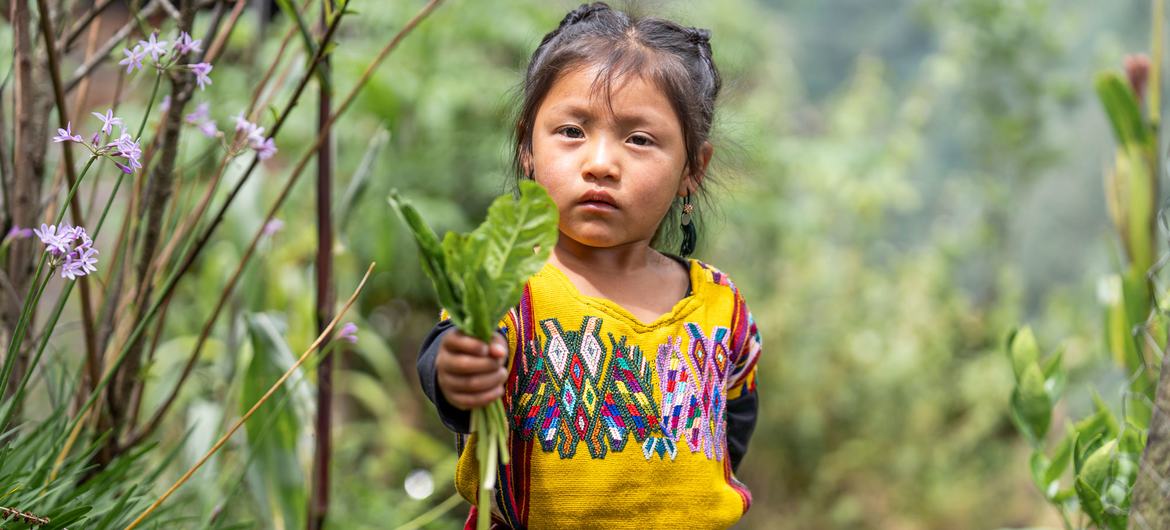
A young girl in Guatemala holds herbs from a kitchen garden.

Multilateralism is non-negotiable

The Secretary-General said that the SDGs cannot be achieved without significant reforms to the financial architecture, which must begin with an investment in multilateralism.

“This year’s HLPF is a crucial moment that gives us hope and encourages us to think collectively outside the box,” said Lok Bahadur Thapa, Vice President of the Economic and Social Council (ECOSOC) at the meeting which opened the HLPF.

This forum is an acknowledgement that the work is not yet done – the goals require more investment and more commitment in the next five years in order to ensure that the world does not leave more people behind.

“This is not a moment for despair, but for determined action. We have the knowledge, tools, and partnerships to drive transformation. What we need now is urgent multilateralism – a recommitment to shared responsibility and sustained investment,” Mr. Li said.

Source link