
Meet Aniket Bera: Indian-origin researcher builds an AI-powered drone that can track people through dense forests without GPS or internet; it could help rescue missing people |

A drone built by Purdue University researchers followed a runner through an unmapped forest without GPS, weaving between trees and using its onboard computer to predict where the person would reappear. The 44-second demonstration shows a skill that could help rescuers keep track of someone through dense vegetation. Finding a missing person in the first place remains a separate challenge.

Aniket Bera, an Indian-origin computer science professor who directs Purdue’s IDEAS Lab, shared the footage on LinkedIn on October 24. The team designed the aircraft’s carbon-fibre frame and developed the software that tracks the runner and plans the drone’s route. The system makes flight decisions onboard without relying on an internet connection or a map loaded before takeoff.

How the drone tracks a runner behind trees

The drone combines images from a depth-sensing camera with three-dimensional measurements from LiDAR, which uses laser pulses to measure distances. It builds a map of nearby obstacles as it flies. When a trunk blocks the camera’s view, the tracking software uses earlier observations to estimate where the runner is heading and where they may come back into sight. The aircraft can also brake to maintain separation, Bera told TechSpot.

In the LinkedIn post, Bera wrote that “we cannot afford offboard latency” when the aircraft banks to avoid a branch. He said the onboard processor must turn camera data into motor commands within milliseconds while working within the aircraft’s limits on weight, power and heat.

The video’s flight charts prompted questions about the software behind the demonstration. Bera told TechSpot that a label for SUPER, a University of Hong Kong navigation system, came from an earlier comparison script. Purdue uses its own flight planner, alongside the open-source FAST-LIO software to estimate the drone’s position and a modified version of ROG-Map to map obstacles. Bera said a paper describing the system was under peer review.

What a rescue trial would need to show

A search crew may have to locate someone who is stationary, injured or hidden by vegetation. Purdue’s video begins with the runner already in view. Public accounts of the demonstration give no figures for battery endurance, operating range or the share of attempts in which the drone regained sight of a person after losing them.

A separate prototype from Austria’s Johannes Kepler University Linz offers a benchmark for the initial search. In a 2021 study, researchers reported that an autonomous drone detected 38 of 42 hidden people across 17 forest field experiments. The system combined thermal images from multiple viewpoints to pick out people partly obscured by vegetation and adjusted its flight path to take another look at possible detections.

Purdue has also announced a five-year, $1.5 million agreement with the US Army Research Laboratory for Bera’s team to develop air and ground robots that can map and navigate difficult terrain without GPS. For civilian search teams, field trials would need to measure how much ground the drone can cover on one battery charge, how reliably it can recover a track under different canopy conditions and how accurately it can report a person’s location to crews on the ground.

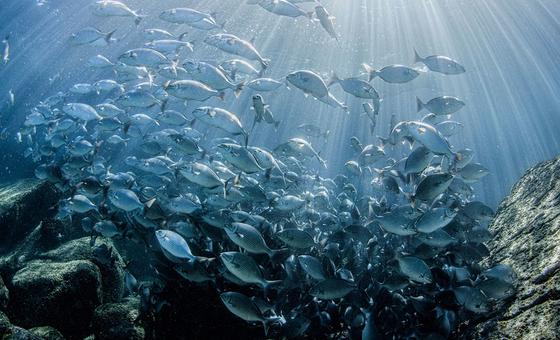
Momentum builds towards marine biodiversity treaty, as experts convene in New York

Formally titled the Agreement under the United Nations Convention on the Law of the Sea on the Conservation and Sustainable Use of Marine Biological Diversity of Areas beyond National Jurisdiction, it was adopted in June 2023 after years of negotiation, and is open for signature until 20 September.

With only eight ratifications left before it can enter into force, momentum is accelerating toward the treaty’s implementation phase, which could begin as early as 2026.

Urgent, ‘decisive and concerted action’

By covering marine genetic resources, environmental impact assessments, area-based management tools, and the transfer of marine technology, the treaty is central to protecting the ocean.

“The need for decisive and concerted action has never been more urgent,” UN Legal Counsel Elinor Hammarskjöld told delegates at the opening of the session.

From rules of participation and financing to digital access and institutional hosting, negotiators face complex trade-offs.

But the sense of urgency, and the crowded rooms at UN Headquarters, suggested that the international community is edging closer to turning text into reality.

Recalling the 2025 UN Ocean Conference held in Nice in June, co-hosted by France and Costa Rica, Ms. Hammarskjöld said that it reaffirmed the essential role of multilateralism in addressing the pressures putting marine ecosystems at risk.  

Further, the 39 treaty actions by States from all regions undertaken during the Ocean Conference demonstrated the international community’s strong commitment to conserve and sustainably use the ocean and its resources.

Now, “with the real probability of the first Conference of the Parties to the Agreement convening in 2026, we are at a critical juncture”, she stated.

That urgency was echoed by the Commission’s Co-Chair Janine Coye-Felson, who said that “if the momentum bolstered by the third United Nations Oceans Conference, held in Nice in June this year, sustains, it can be reasonably expected that the Agreement may enter into force in the latter part of 2025, or early 2026”.

Indigenous Peoples as rights-holders

During the session’s early debates, small island developing States (SIDS) pressed for flexibility, including virtual participation and guaranteed representation in the COP Bureau.

The representative of the Federated States of Micronesia, speaking for the Pacific small island developing States, also supported the allocation of one seat to small island developing States.  

Further, he called for recognition of “the distinct status of Indigenous Peoples under international law as rights-holders, rather than as mere stakeholders”. 

Financing and equity

Developing States, represented by groups including the G77 and China, the African Group, CARICOM and Pacific SIDS, stressed that participation funding shall not be optional but an obligation under the treaty, and called for a voluntary trust fund to cover the full expenses of delegates from least developed countries, landlocked states – and SIDS – while opposing restrictions on states in arrears.

‘Clearing house’

As entry into force approaches, delegates turned to operational issues. A proposed Clearing-House Mechanism will serve as the treaty’s central hub for information exchange.

“There is perhaps no more urgent piece of work that is in front of us than this one,” underscored Commission Co-Chair Adam McCarthy at one of the meetings.

Given the current rate of ratification, “we might need a form of Clearing-House Mechanism in operation sometime in early 2026”, he pointed out, encouraging delegates to work towards having the informal expert group “up and running” to start its work by September.

With 139 signatures and 52 ratifications already secured, the treaty is within reach of the 60 needed for entry into force.

The gathering will continue at UN Headquarters until 29 August.

Source link