
Ukraine: ‘Diplomatic momentum’ at risk amid large-scale Russian strikes

Miroslav Jenča, Assistant Secretary-General for Europe, Central Asia and the Americas, was speaking a day after the latest wave of Russian airstrikes across the country, with at least 23 people killed in the capital, Kyiv.

“The mounting death toll and devastation caused by the intensifying fighting over the summer, run counter to the significant efforts over the past few months to give diplomacy a chance,” he said.

Young lives lost

According to Ukrainian officials, Russia launched 598 drones and 31 missiles across Ukraine overnight between 27 and 28 August. 

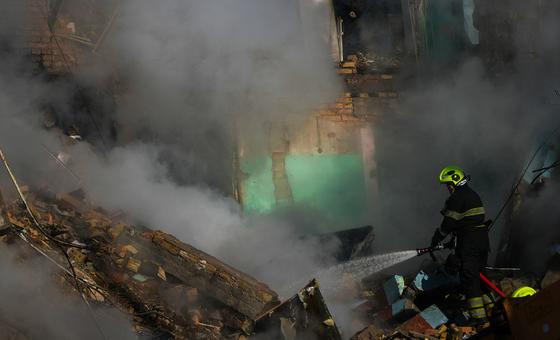
Four children aged between two and 17 were among those killed in Kyiv and 64 people were injured. Several buildings were damaged in 33 locations across all 10 districts of the city.

“Most of the fatalities occurred in the Darnytskyi district of Kyiv, where a missile reportedly struck a five-story residential building, demolishing it from the first to the fifth floor,” he said.

Civilian casualties also were reported in five other regions – Chernihiv, Kharkiv, Zaporizhzhia, Donetsk and Kherson – and a train depot in Vinnytsia region was reportedly hit.

Dangerous escalation

Mr. Jenča said these strikes “are only the latest in the brutal escalation of country-wide aerial attacks.”

The full-scale Russian invasion of Ukraine began in February 2022.  In July, the UN human rights office, OHCHR, recorded rising civilian casualties across 18 regions and the capital.

Last month “set a new, tragic record for monthly casualties”, with 286 killed and 1,388 injured – the highest number since May 2022, the top UN official said.

The impact of the conflict has also been felt by civilians in Russia. Local authorities have reported casualties there, including in the border regions of Belgorod, Kursk and Bryansk.

Russian officials also reported that a fire broke out after a Ukrainian drone was shot down near the Kursk Nuclear Power Plant.

Although the UN is unable to verify these reports, the growing impact of the conflict on civilians in Russia is of concern, he said, reiterating UN condemnation of attacks against civilians and civilian infrastructure.

Winter support

“We are also concerned about the impact of the expanding and escalating fighting on the humanitarian situation in Ukraine as we are entering the fourth winter of the full-scale war,” he continued.

He underlined the UN’s full commitment to supporting civilians, adding that targeted winter support preparations are underway for 1.7 million people, though more donor funding is urgently needed.

Diplomatic efforts welcomed

On the diplomatic front, he said the Secretary-General has welcomed recent efforts led by the United States President. This includes separate meetings this month between Donald Trump and Vladimir Putin, in Alaska, and another between the Presidents of the US and Ukraine and European leaders in Washington.

The UN has also welcomed earlier rounds of direct talks between senior Ukrainian and Russian officials held in Istanbul between May and July, and commended prisoner exchanges that have continued to take place as a result.

Appeal for de-escalation

“However, as large-scale attacks against civilians persist and civilian casualties rise, the current diplomatic momentum is at risk of rapidly fading if the focus on the need to end the violence and engage in genuine peace talks is not maintained,” he said.

“We therefore urge all concerned to urgently de-escalate the situation and to redouble efforts to create conditions for inclusive diplomatic efforts towards a cessation of hostilities and a just peace.” 

Mr. Jenča concluded his remarks by renewing the Secretary-General’s appeal for a full, immediate and unconditional ceasefire. 
Source link

Momentum builds towards marine biodiversity treaty, as experts convene in New York

Formally titled the Agreement under the United Nations Convention on the Law of the Sea on the Conservation and Sustainable Use of Marine Biological Diversity of Areas beyond National Jurisdiction, it was adopted in June 2023 after years of negotiation, and is open for signature until 20 September.

With only eight ratifications left before it can enter into force, momentum is accelerating toward the treaty’s implementation phase, which could begin as early as 2026.

Urgent, ‘decisive and concerted action’

By covering marine genetic resources, environmental impact assessments, area-based management tools, and the transfer of marine technology, the treaty is central to protecting the ocean.

The need for decisive and concerted action has never been more urgent,” UN Legal Counsel Elinor Hammarskjöld told delegates at the opening of the session.

From rules of participation and financing to digital access and institutional hosting, negotiators face complex trade-offs.

But the sense of urgency, and the crowded rooms at UN Headquarters, suggested that the international community is edging closer to turning text into reality.

Recalling the 2025 UN Ocean Conference held in Nice in June, co-hosted by France and Costa Rica, Ms. Hammarskjöld said that it reaffirmed the essential role of multilateralism in addressing the pressures putting marine ecosystems at risk.  

Further, the 39 treaty actions by States from all regions undertaken during the Ocean Conference demonstrated the international community’s strong commitment to conserve and sustainably use the ocean and its resources.

Now, “with the real probability of the first Conference of the Parties to the Agreement convening in 2026, we are at a critical juncture”, she stated.

That urgency was echoed by the Commission’s Co-Chair Janine Coye-Felson, who said that “if the momentum bolstered by the third United Nations Oceans Conference, held in Nice in June this year, sustains, it can be reasonably expected that the Agreement may enter into force in the latter part of 2025, or early 2026”.

Indigenous Peoples as rights-holders

During the session’s early debates, small island developing States (SIDS) pressed for flexibility, including virtual participation and guaranteed representation in the COP Bureau.

The representative of the Federated States of Micronesia, speaking for the Pacific small island developing States, also supported the allocation of one seat to small island developing States.  

Further, he called for recognition of “the distinct status of Indigenous Peoples under international law as rights-holders, rather than as mere stakeholders”. 

Financing and equity

Developing States, represented by groups including the G77 and China, the African Group, CARICOM and Pacific SIDS, stressed that participation funding shall not be optional but an obligation under the treaty, and called for a voluntary trust fund to cover the full expenses of delegates from least developed countries, landlocked states – and SIDS – while opposing restrictions on states in arrears.

‘Clearing house’

As entry into force approaches, delegates turned to operational issues. A proposed Clearing-House Mechanism will serve as the treaty’s central hub for information exchange.

“There is perhaps no more urgent piece of work that is in front of us than this one,” underscored Commission Co-Chair Adam McCarthy at one of the meetings.

Given the current rate of ratification, “we might need a form of Clearing-House Mechanism in operation sometime in early 2026”, he pointed out, encouraging delegates to work towards having the informal expert group “up and running” to start its work by September.

With 139 signatures and 52 ratifications already secured, the treaty is within reach of the 60 needed for entry into force.

The gathering will continue at UN Headquarters until 29 August.

Source link