UN warns of escalation risk after large-scale Russian drone incursion into Poland

She said it was not the first time drones had been spotted beyond Ukraine’s borders “but it is the first time that multiple drones have flown so deep into a neighbouring country’s airspace.

Ms. DiCarlo said the UN had no way of verifying any claims or counter-claims surrounding the incident and could only rely on publicly available information.

According to Poland, 19 Russian drones entered its airspace overnight on 9 and 10 September during a large-scale missile and drone assault on Ukraine. Polish authorities said some drones were pre-emptively shot down, and debris was later recovered across central and eastern parts of the country.

The episode marked the first time NATO allies used force to neutralize such drones.

Polish authorities reported temporary airport closures in Warsaw and Rzeszów and restrictions on air traffic in the east of the country. While no casualties were reported, residential areas in some villages sustained damage.

Russia’s Defence Ministry acknowledged carrying out strikes against Ukrainian targets during the same period but said it had no intention of engaging any targets in Poland. Belarus reportedly stated that some drones were deflected by Ukrainian countermeasures and veered off course, adding that it had alerted neighbouring countries as drones approached their airspace.

Poland invoked Article 4 of the North Atlantic Treaty (NATO treaty) following the incident, prompting emergency consultations among the 32 member states of the European security pact.

Civilian toll mounts in Ukraine

The briefing came against a backdrop of continued Russian strikes across Ukraine.

President Volodymyr Zelenskyy said more than 400 drones and 40 cruise and ballistic missiles were launched on 15 regions between 9 and 10 September, causing civilian deaths, including at least one in the capital Kyiv.

Impact in Russia and occupied regions

Ms. DiCarlo also highlighted the war’s toll in Russia and in Russian-occupied regions of Ukraine.

She reminded the Council that attacks against civilians and civilian infrastructure, wherever they occur, are prohibited under international humanitarian law and must stop.

“This week’s events underline the dangerous impact of this war on the security of the region and the risk of escalation,” she said.

“We, therefore, once again urgently call for a full, immediate and unconditional ceasefire in Ukraine. The end state must be a just, comprehensive and sustainable peace in line with the UN Charter, international law and relevant UN resolutions.


More to follow…

Source link

Ukraine: ‘Diplomatic momentum’ at risk amid large-scale Russian strikes

Miroslav Jenča, Assistant Secretary-General for Europe, Central Asia and the Americas, was speaking a day after the latest wave of Russian airstrikes across the country, with at least 23 people killed in the capital, Kyiv.

“The mounting death toll and devastation caused by the intensifying fighting over the summer, run counter to the significant efforts over the past few months to give diplomacy a chance,” he said.

Young lives lost

According to Ukrainian officials, Russia launched 598 drones and 31 missiles across Ukraine overnight between 27 and 28 August. 

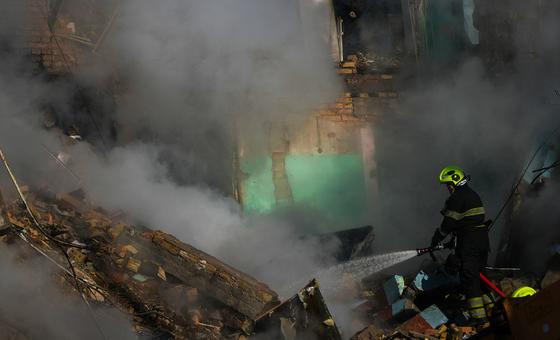
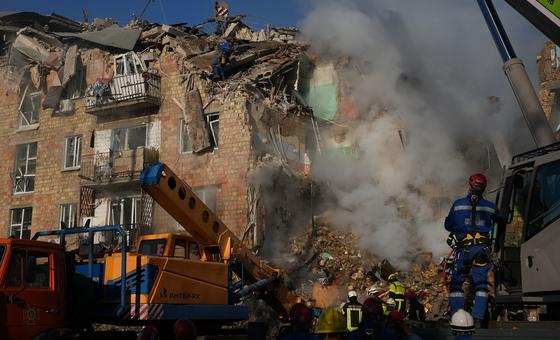
Four children aged between two and 17 were among those killed in Kyiv and 64 people were injured. Several buildings were damaged in 33 locations across all 10 districts of the city.

“Most of the fatalities occurred in the Darnytskyi district of Kyiv, where a missile reportedly struck a five-story residential building, demolishing it from the first to the fifth floor,” he said.

Civilian casualties also were reported in five other regions – Chernihiv, Kharkiv, Zaporizhzhia, Donetsk and Kherson – and a train depot in Vinnytsia region was reportedly hit.

Dangerous escalation

Mr. Jenča said these strikes “are only the latest in the brutal escalation of country-wide aerial attacks.”

The full-scale Russian invasion of Ukraine began in February 2022.  In July, the UN human rights office, OHCHR, recorded rising civilian casualties across 18 regions and the capital.

Last month “set a new, tragic record for monthly casualties”, with 286 killed and 1,388 injured – the highest number since May 2022, the top UN official said.

The impact of the conflict has also been felt by civilians in Russia. Local authorities have reported casualties there, including in the border regions of Belgorod, Kursk and Bryansk.

Russian officials also reported that a fire broke out after a Ukrainian drone was shot down near the Kursk Nuclear Power Plant.

Although the UN is unable to verify these reports, the growing impact of the conflict on civilians in Russia is of concern, he said, reiterating UN condemnation of attacks against civilians and civilian infrastructure.

Winter support

“We are also concerned about the impact of the expanding and escalating fighting on the humanitarian situation in Ukraine as we are entering the fourth winter of the full-scale war,” he continued.

He underlined the UN’s full commitment to supporting civilians, adding that targeted winter support preparations are underway for 1.7 million people, though more donor funding is urgently needed.

Diplomatic efforts welcomed

On the diplomatic front, he said the Secretary-General has welcomed recent efforts led by the United States President. This includes separate meetings this month between Donald Trump and Vladimir Putin, in Alaska, and another between the Presidents of the US and Ukraine and European leaders in Washington.

The UN has also welcomed earlier rounds of direct talks between senior Ukrainian and Russian officials held in Istanbul between May and July, and commended prisoner exchanges that have continued to take place as a result.

Appeal for de-escalation

“However, as large-scale attacks against civilians persist and civilian casualties rise, the current diplomatic momentum is at risk of rapidly fading if the focus on the need to end the violence and engage in genuine peace talks is not maintained,” he said.

“We therefore urge all concerned to urgently de-escalate the situation and to redouble efforts to create conditions for inclusive diplomatic efforts towards a cessation of hostilities and a just peace.” 

Mr. Jenča concluded his remarks by renewing the Secretary-General’s appeal for a full, immediate and unconditional ceasefire. 

Source link

SECURITY COUNCIL LIVE: Push for peace in Ukraine could rapidly fade if large-scale Russian attacks continue

The UN Security Council met in emergency session in New York on Friday afternoon following overnight strikes early on Thursday by Russia on Ukrainian cities including the capital, which left at least 23 dead, including four children. Assistant Secretary-General Miroslav Jenča told ambassadors that diplomatic momentum towards a possible peace deal was “at risk of rapidly fading” if large-scale attacks by Moscow continue. Follow our live meetings coverage below. 

Source link