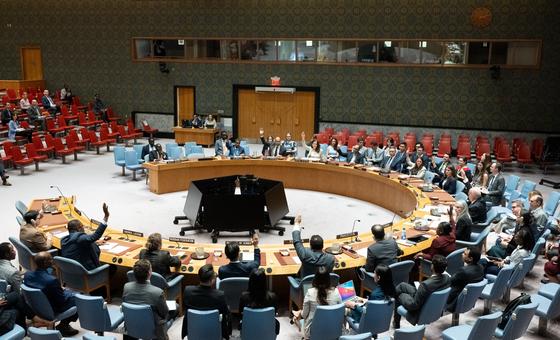

“Syria simply cannot withstand another wave of instability,” UN Deputy Special Envoy Najat Rochdi said on Tuesday in a briefing to the Security Council in New York.
“The risks of further escalation in the region are not hypothetical – they are immediate, severe, and risk unraveling the fragile progress toward peace and recovery in Syria.”
She echoed the Secretary-General’s condemnation of military escalation in Middle East and his call on Israel and Iran to show maximum restraint.
The UN Special Envoy for Syria, Geir Pedersen, has also expressed growing alarm over the potential consequences of any further escalation, which she also conveyed.
‘Constructive and cooperative’ engagement
Ms. Rochdi reported on the Special Envoy’s ongoing engagement in recent months, such as meetings with senior officials in Damascus, including interim foreign minister Asaad Hassan al-Shaibani.
Their discussions focused on recent positive developments in international relations as well as the importance of prioritizing domestic affairs towards a genuinely inclusive political transition in which all Syrians have a stake.
Overall, the meetings with Syrian officials “were marked by a constructive and cooperative tone, with a shared interest in strengthening engagement with the United Nations across multiple sectors,” she said.
Road to transition
“Particular attention was given to the next steps in the transition and to coordinating efforts with the newly established committees on transitional justice and missing persons,” she added.
Among the important next steps is the establishment of a new People’s Assembly as the transitional legislative authority. In this regard, she welcomed the recent presidential decree announcing the appointment of a supreme committee for elections to the Assembly.
The committee will be responsible for supervising the indirect election of 100 of the 150 members of the People’s Assembly via electoral colleges, she explained. It will also define the electoral timeframe and eligibility conditions for electors and candidates.
“We encourage the Supreme Committee to take measures that safeguard inclusivity, transparency and openness in all stages of this process,” she said.
Developments in the northeast
Turning to the northeast, Ms. Rochdi referred to the 10 March deal reached between the interim authorities and the Syrian Democratic Forces (SDF), which controls the region, to integrate the Kurdish-led group into the national army.
The agreement “continues to present a historical opportunity to solve one of the key outstanding issues in this conflict and restore Syria’s sovereignty and unity, a priority which the Special Envoy discussed with interim Foreign Minister Shaibani.”
She also welcomed recent detainee exchanges as well as cooperation that enabled several Syrian families at the Al-Hol camp to return to the northwest. Thousands of people from several countries have been held for years at the notorious complex for their alleged ties to ISIL extremists.
“We stress the importance of negotiations moving forward in earnest with bold steps and an active spirit of compromise from both sides to implement the 10 March agreement,” Ms. Rochdi told ambassadors.
“This is a priority for stability in Syria and the region, for the restoration of Syria’s sovereignty, unity, independence and territorial integrity, and for the success of the overall political transition.”
Women and civil society
Special Envoy Pedersen also engaged with a broad spectrum of Syrians including women, who continue to seek greater representation in leadership positions, including as candidates and delegates in the process for the People’s Assembly.
“Syrian civil society representatives also continue to be active on all fronts working for a new Syria founded on the principles of inclusivity, openness, and transparent participatory processes,” she added.
She stressed that the protection and safety of all components of society, along with prevention of incitement of communal tensions, “are absolute cornerstones for stability.”
Attacks against specific communities
She noted that sporadic violent incidents continued in Homs, Hama and other regions, including killings, kidnappings and infringements on individual liberties.
Furthermore, some of the people that the Special Envoy met in Damascus voiced concern over ongoing attacks targeting specific communities and groups, including Alawites, Druze, and women.
“While many interlocutors emphasized that these incidents did not appear to be systematic or part of official policy, they highlighted the persistent challenges faced by the interim authorities in controlling certain groups – whether affiliated with the interim authorities or operating independently,” she said.
Ms. Rochdi also pointed to encouraging signs the interim authorities have taken to ease tensions such as the recent issuance of a fatwa that prohibits revenge killings and extrajudicial retaliation. Additionally, recent decisions to reinstate judges who were removed by the former regime represent a welcome step towards rebuilding trust between the judiciary and the population.
Respect Syria’s sovereignty
Meanwhile, other security challenges persist, with sporadic and limited acts of violence this month, including at a border post with Iraq and on contact lines in Deir-ez-Zor, and in rural Homs.
“The southwest saw a serious incident of Israeli artillery fire and airstrikes on military sites and weapons depots across southern Syria, in response to a rare incident of small rocket fires out of Syria into the Israeli-occupied Syrian Golan,” she continued, noting that two groups unaffiliated with the interim authorities claimed responsibility.
Additionally, Israeli incursions, arrests, and drone strikes occurred last week in Beit Jinn in the Damascus countryside, which she said are unacceptable and must cease.
“Syria’s sovereignty, independence, and territorial integrity must be respected, along with the 1974 Disengagement of Forces Agreement. Diplomacy is possible and must be prioritised,” she said.
Ms. Rochdi further reported that “ongoing activity by ISIL remains notable, including attacks on SDF positions, and a US drone strike on an ISIL figure in northwest Syria.”
Returnees and economic measures
Before concluding, Ms. Rochdi reported that despite the fragile security and socioeconomic situation in their homeland, nearly 600,000 people are estimated to have returned to Syria in the past six months, mostly from neighbouring countries.
An estimated 1.34 million displaced people inside Syria have also gone back to their areas of origin during the same period.
She said the UN continues to welcome and encourage international actions which contribute to the reactivation of Syria’s economy. They include a six-month waiver of some US sanctions, the European Union’s (EU) lifting of economic sanctions, and a broad range of transactions authorized by the United Kingdom to facilitate commercial activity in some key sectors.
She also hailed a large contract for the construction of several gas and solar energy plants, signed between the interim authorities and a consortium of regional and international actors.
“These projects are expected to supply more than half of Syria’s national electricity needs, representing a big leap toward energy security, economic revival, and infrastructure resilience,” she said.