Power to the people; funding community-led development in Somalia

In the heart of Galmudug State, Somalia, the dream of two young women, Iftin and Aminaa, to attend university in Abudwaq was fraught with challenges.

Frequent power cuts and a long, dark and possibly dangerous road between the campus and town made it nearly impossible for them and other girls to attend evening classes.

Determined to find a solution, they approached the International Organization for Migration’s (IOM) Co-Funding System (CFS), which provides matching funding for community-led projects and which is designed to empower local communities in Somalia to take charge of their development and recovery.

© IOM/Spotlight Communications

Solar panels provide consistent power to the university in Abudwaq, Galmadug.

Rallying 19 other women students, Iftin and Aminaa submitted a simple yet transformative proposal….. to crowdfund for solar streetlights and a solar energy system for the school.

By July 2022, the girls had raised $10,000. IOM matched this amount and added $50,000 more.

The result was a well-lit and secure road from Abudwaq town to the university and a fully functional solar energy system.

The system now powers the university around the clock with clean energy.

The impact didn’t stop there.

The community later decided to connect a nearby borehole to the system, providing clean, free water to all of Abudwaq and nearby pastoralist communities, who now bring their livestock to drink and graze near the water source.

Animals water at a borehole powered by solar energy.

“Abudwaq was not one of our original target locations,” explained Mohamed Mohamud Hussein, an IOM officer working on community-based planning. “But we considered the proposal because it was well thought out, transformational for the community, and aligned with the CFS’s mandate and priorities around ownership and sustainability.”

Iftin and Aminaa’s determination set an example for other communities across Somalia.

Community power

Piloted by IOM in 2021, the CFS has become one of Somalia’s most innovative recovery tools. It puts power in the hands of local communities.

By the end of 2024, 42 projects had been completed, reaching over 580,000 people across 22 districts in central Somalia.

Nine more are ongoing. Close to 1,600 community and diaspora members contributed, raising over $500,000, which IOM matched with $2.3 million.

Even in fragile settings, collective action is making a difference. In Farjano, a settlement for internally displaced persons in Galmudug State, the construction of a new primary school did more than provide classrooms. It has restored hope.

A new primary school was built in Farjano financed by IOM’s Co-Funding System.

“For the very first time, all my children could go to school – and it was free,” said Shamso, a mother of three.

In Mataban, a newly built youth stadium fostered unity and a sense of shared identity. Groups that had once avoided each other began to spend time together. “The stadium brought us together in ways we never imagined,” said Mustaf, a resident of Mataban. “It’s not just for sports – it’s where our community feels united.”

By requiring communities to identify their needs and raise initial funds, the CFS takes a bottom-up rather than traditional top-down approach to development.

It ensures that projects are not only community-driven but also have a higher chance of long-term success and impact

The Fourth International Conference on Financing for Development (FFD4) which begins in Sevilla, Spain on 30 June, aims to reform financing at all levels, and will no doubt consider the local solutions and community-driven initiatives which have proven so successful in Somalia.

Source link

What is financing for development?

These are part of 17 goals agreed by nearly every country, called the Sustainable Development Goals (SDGs). The plan is to hit these targets by 2030.

But we’re falling behind. One big reason? There just isn’t enough consistent funding to make real progress.

That’s why world leaders, economists, and other decision-makers are meeting at the end of this month in Sevilla, Spain, for a major event called the Fourth International Conference on Financing for Development. It’s being called a “once-in-a-decade opportunity” to rethink how the world pays for sustainable development.

What is financing for development?

At its core, financing for development works to answer a simple question – how does the world pay for a fairer and more balanced system of aid, trade and development? 

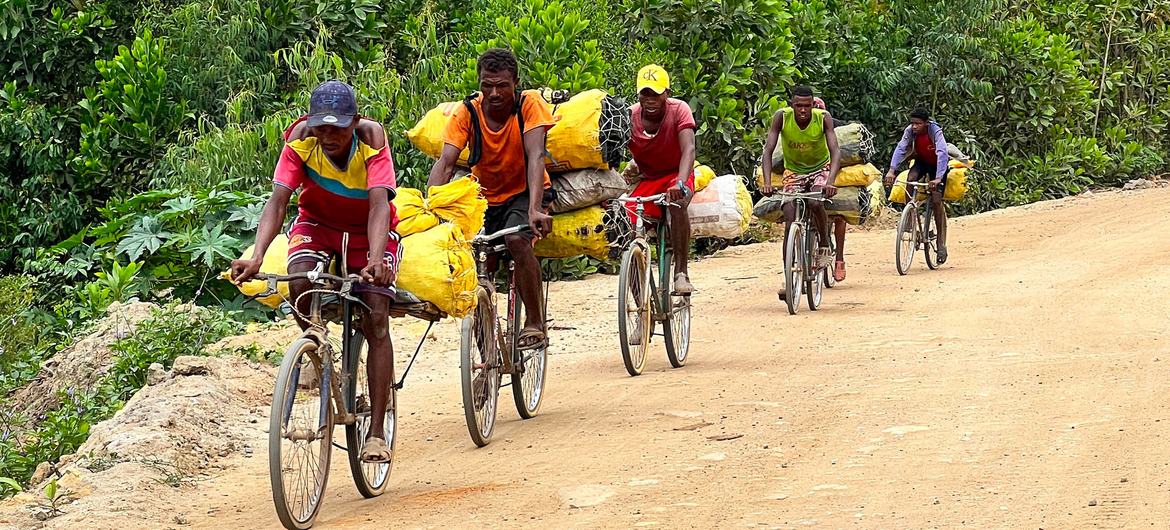
Traders in Madagascar. one of the most under-developed countries in Africa, transport charcoal to market.

The answer from the global community has been to create a system which mobilizes the entire international financial architecture – taxes, subsidies, trade, financial and monetary policies — towards the development agenda.

The architecture aspires to be as inclusive as possible, engaging a wide array of funding sources empowering countries to become more self-sufficient so their citizens can lead healthy, productive, prosperous and peaceful lives.

Financing for development is basically about “changing the way the system works to make it so that developing countries are able to…actually invest in their futures,” Shari Spiegel, Director of Financing for Sustainable Development at the UN’s Department of Economic and Social Affairs (DESA), told UN News

Among these sources of financing are multilateral development banks that provide financial and technical support to developing countries. Revised international and national trade and tax policies also work to jump-start developing economies.

And, official development assistance (ODA) creates a channel through which aid from developed countries can flow directly to developing countries.

Why is financing for development important? 

From rising debt and falling investment to shrinking aid and missed development goals, the current system is failing the people it is meant to serve. 

People everywhere are paying the price:

  • Debt is rising, investment is falling, and donor aid is shrinking.
  • 600 million people could still be living in extreme poverty by 2030 if we don’t change course and it will take many more decades to reach the SDGs.
  • Today, 3.3 billion people live in countries that spend more on paying off debt than on health or education.
  • Moreover, billions of people will continue to live in countries which must prioritize debt payments over development.
  • That means less money for schools, hospitals, clean water, and jobs – the  basics that people need to thrive.

And for the people who face the consequences of the world’s inaction, this is an unacceptable timeline.

What systemic changes need to be made?

With trade barriers growing and official development assistance decreasing annually, a business-as-usual approach to financing for development is unsustainable. 
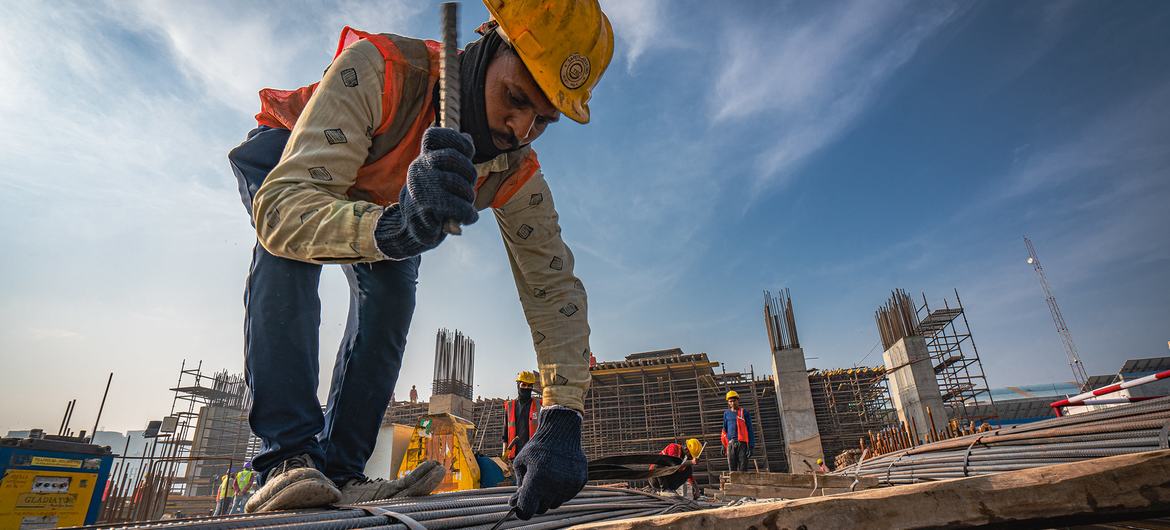
Work has begun on a rapid transit system connecting Delhi to Meerut in Uttar Pradesh, India.

The upcoming conference in Sevilla provides an opportunity to change course, to mobilize finance at scale and reform the rules of the system to put people’s needs at the centre.

The conference will bring together countries, civil society representatives and financial experts to discuss new approaches to financing for development.

Crucially, this conference will also give developing countries a seat at the table, so their needs are addressed in international financial decision-making. 

What role does debt play?

In the current financing system, developing countries continue to pay exorbitant amounts to service their debt while also facing borrowing costs which can be as much as two or four times higher than their developed counterparts.

These costs tend to rise especially during or directly after times of crisis, creating a feedback loop through which developing countries cannot afford to develop the very structures which would enable them to pay these costs.

“Faced with sky-high debt burdens and cost of capital, developing countries have limited prospects of financing the sustainable development goals,” the UN Secretary-General, António Guterres said. 
© UNICEF/Allessio Romenzi

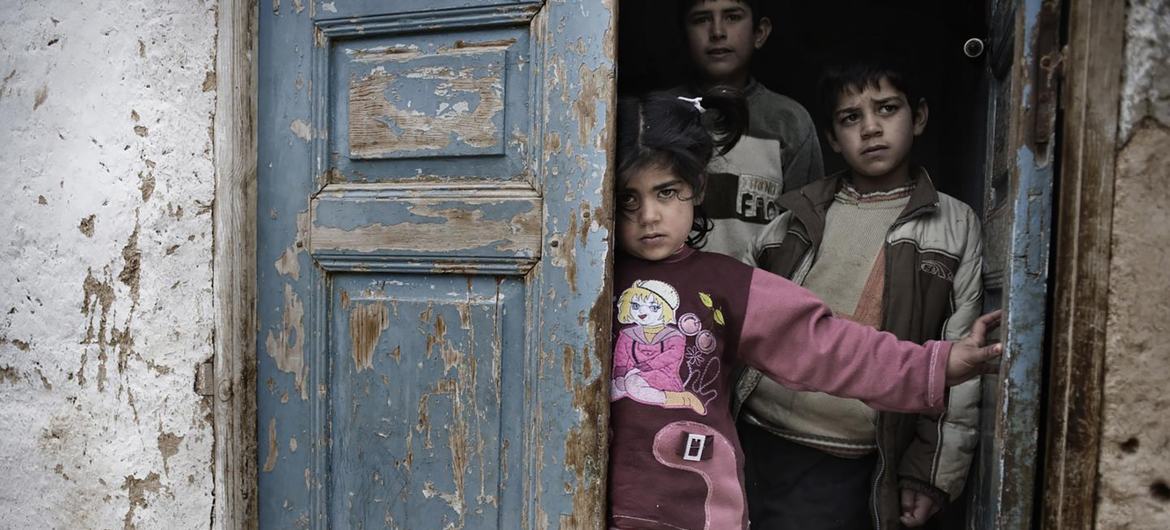
Children stand in the doorway of a home in a poverty stricken neighborhood in Lebanon. (file)

What can be expected from the conference?

The Secretary-General has said that it will take “big ideas” and “ambitious reforms” to get back on track to ending poverty, hunger and inequality.

“[The conference] presents a unique opportunity to reform an international financial system that is outdated, dysfunctional and unfair,” UN chief António Guterres has said.

Member States reached agreement on a draft which will launch an ambitious package of reforms and actions countries need to take to close the $4 trillion financing gap.

The United States pulled out of the conference process on Tuesday during final negotiations over the outcome document, saying that it couldn’t get on board with the draft. 

Reform will come in part from effectively mobilizing all stakeholders – private and public, formal and informal, developing and developed – and aligning their incentives and commitments towards a sustainable future.   

This includes emphasising multilateralism as the foundation of all development, increasing taxes which directs public funds towards international development goals, lowering the cost of capital for developing countries, restructuring existing debt and searching for even more innovative methods of finance.

“Sevilla is a moment in time. It’s really the beginning, not the end of the process. So now the question is, how do we implement the commitments?” said Ms. Spiegel.

Reforming a broken financing system is challenging but Ms. Spiegel is optimistic that multilateralism is up to the task. 

Source link

Development is ‘the first line of defense against conflict,’ Guterres tells Security Council

Ambassadors met to debate how poverty, inequality, and underdevelopment are fuelling conflict and instability, at a time when hostilities are increasing and demand for humanitarian aid is rising as resources dwindle.  

Every dollar spent on prevention could save up to $103 in conflict-related costs, according to the International Monetary Fund (IMF). 

Sustainable development critical

Conflicts are proliferating and lasting longer, said Mr. Guterres. At the same time the global economy is slowing and trade tensions are rising, as aid budgets are being slashed while military spending soars. 

He warned that if current trends continue, two thirds of the world’s poor will live in conflict-affected or fragile countries by the end of this decade. 

“The message is clear,” he said.  “The farther a country is from sustainable and inclusive development, the closer it is to instability, and even conflict.”

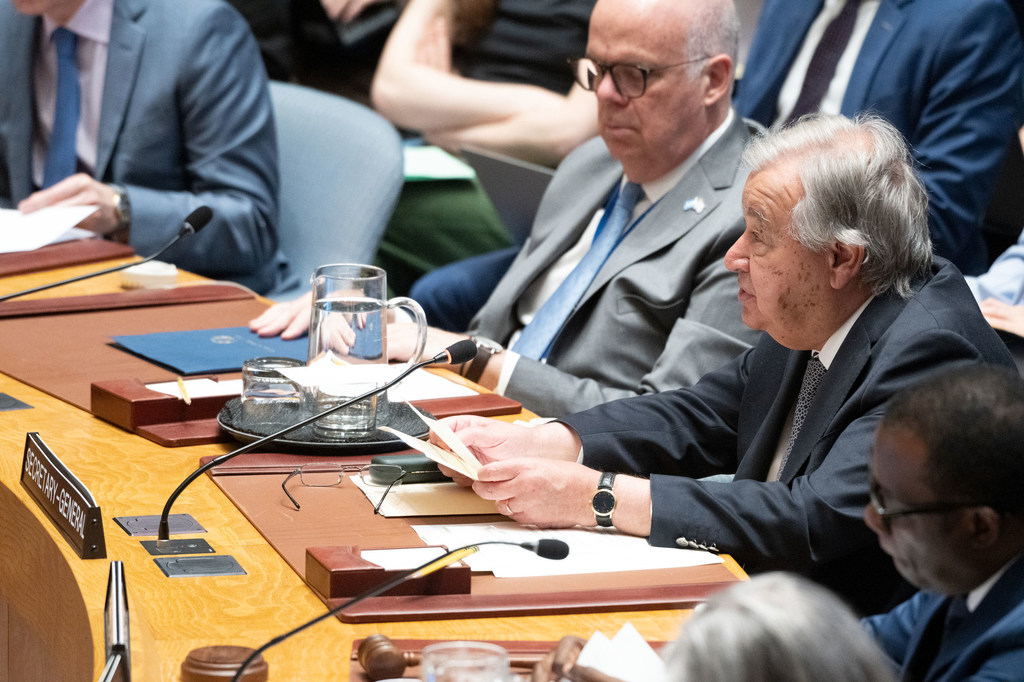
Secretary-General António Guterres briefs the Security Council meeting on Poverty, Underdevelopment, and Conflict.

Give peace a (fighting) chance

The Secretary-General highlighted how the UN has worked to advance the three pillars of peace, development and human rights.  

These efforts began with its establishment 80 years ago and continue today, “guided by the simple principle that prevention is the best cure for instability and conflict, and there is no better preventive measure than investing in development,” he said.

“Development gives peace a fighting chance. It’s the first line of defence against conflict. But right now, we’re losing ground,” he said, noting that “the engine of development is sputtering.”

World falling short

Currently, two-thirds of the targets under the Sustainable Development Goals (SDGs) are lagging 10 years after adoption. 

“The world is falling short by over $4 trillion annually in the resources developing countries need to deliver on these promises by 2030,” he added.

Furthermore, “developing countries are being battered and bruised by limited fiscal space, crushing debt burdens and skyrocketing prices.”

Fix the ‘engine’

The Secretary-General pointed to the fourth Conference on Financing for Development, which begins next week in Spain, as an important moment “to fix and strengthen this essential engine.”

He called for renewed commitments towards securing public and private finance for the areas of greatest need, providing urgent relief for debt-laden countries, and reforming the outdated global financial architecture.

The Council debate “could not be more prescient,” said Kanni Wignaraja, the UN Development Programme’s (UNDP) Assistant Secretary-General and Regional Director for Asia and the Pacific.

Break the cycle

Global human development has stalled just as violent conflicts have surged to levels not seen in eight decades, she said, before presenting three priorities for investment to help break the cycle, including protecting household economies.

“In fragile settings, where peace and security have been shattered, development that goes directly to the local level becomes the first line of peoples’ defence and survival. And their hope for recovery,” she said.

“From these local economies – where livelihoods are restored, water and electricity can flow again, women’s businesses in particular reopen, farmers can trade food, and there is basic finance to allow markets to stay afloat – from this, comes the resources to build back broken capabilities and resilience.”

Address systemic imbalances

The Chairperson of the African Union (AU) Commission, Mahmoud Youssouf Ali, recalled how the continent loses billions of dollars annually to conflict, which could be channelled into schools, hospitals, infrastructure and innovation.

He said the international community must also acknowledge that poverty and underdevelopment “are not confined within national borders” but are global challenges that require global response.

“If we are to uphold international peace and security, we must address the systemic imbalances – economic, political, and institutional – that continue to fuel deprivation, exclusion, and instability across regions,” he said.

In this regard, the AU called for enhanced support to African-led peace operations, particularly those deployed in regions where poverty and underdevelopment are deeply entrenched. 

Critical juncture requires collective action

The debate was convened by Guyana, which holds the rotating Council presidency this month.

The country’s Foreign Minister, Hugh Todd, remarked that with the world “at a critical juncture where the interlinkages between peace, security and development have never been more pronounced,” collective and decisive action is required.

He cautioned against “prioritizing only political solutions in conflicts where poverty and underdevelopment feature prominently,” as creating conditions for socio-economic stability and well-being are also critical for peace.

Mr. Todd urged countries to address issues such as lack of access to education, unemployment, exclusion, and greater participation of women and youth.

“Currently, the global youth population is the highest in history, with most young people concentrated in developing countries,” he said.

“For us to harness their full potential, they must be given adequate economic opportunities and be involved in decision making on peace and security.” 

Source link

Power of football inspires team effort towards development goals

As the football Club World Cup gets underway in the United States, on the other side of the globe, Japanese club Gamba Osaka has reaffirmed its commitment to sustainable development by becoming the first team in the country’s professional league to join the United Nations’ Football for the Goals initiative.

The initiative provides a platform for the global football community to engage with and promote the internationally agreed Sustainable Development Goals (SDGs).

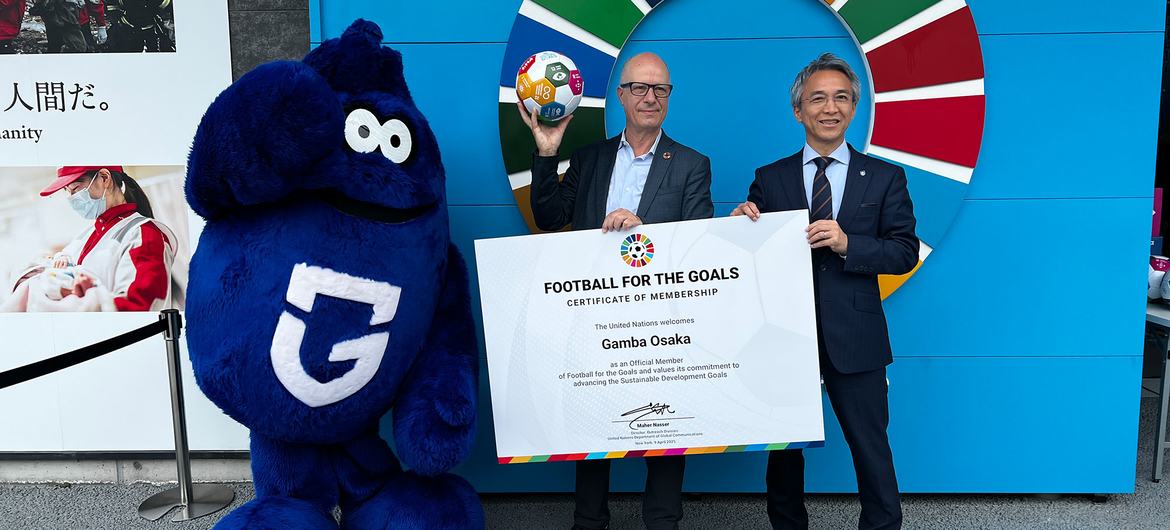
The UN’s Maher Nasser (left) and Shinji Ito of Gamba Osaka mark the Japanese club’s membership of the Football for the goals initiative.

Shinji Ito, an external affairs executive for the football team, Gamba Osaka, told UN News at the United Nations Pavilion at Expo 2025 in Osaka that supporting the Sustainable Development Goals (SDGs) is important to his club.

“As a football club we can work with supporters towards changing attitudes and behaviour on issues like the environment, climate, sustainability, health and disability, which are part of the SDGs.”

The multicoloured SDG logo is prominently displayed at the club’s stadium in Osaka, Japan’s second largest city, it has featured on the team kit and players have visited local schools to explain why the SDGs are important.

At the stadium, efforts are made to encourage fans to separate recycling trash, a behaviour which many in Japan believe needs to be highlighted and stepped up.  Paper cups have replaced plastic cups and the player’s team shirts are made from more sustainable and environmentally-friendly materials.

“We are seeing increased awareness about the importance of the SDGs,” said Mr Ito. “We recognize that this is a long-term commitment and that significant change takes place over 10 years or longer.”

Team effort

Gamba Osaka is now signed up to the UN’s Football for the Goals initiative, making it a first for Japan’s professional game. 

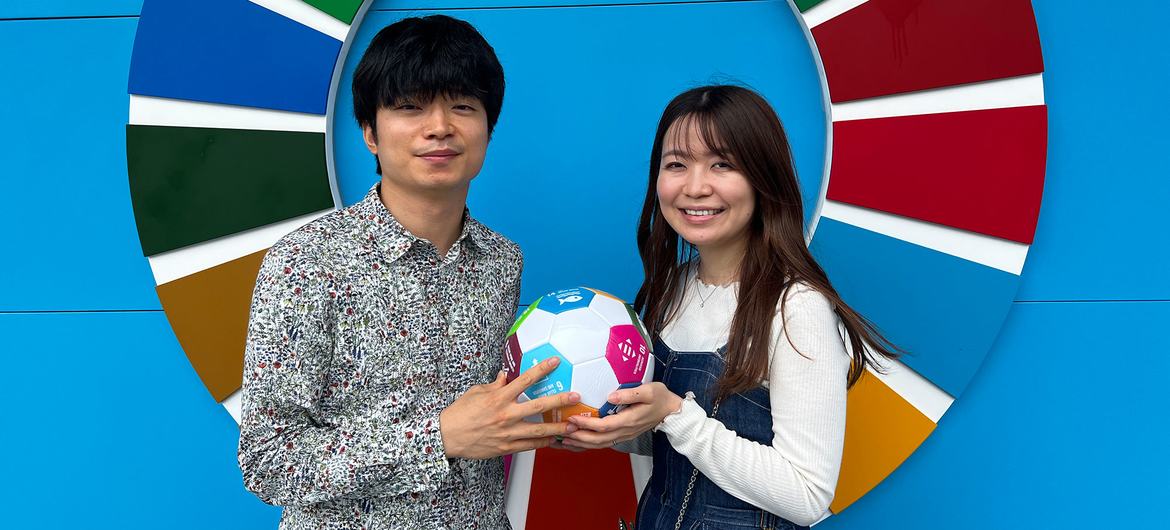
Taro Shinzato (left) visited the UN Pavilion with Satoka Shinzato.

The initiative aims to inspire and guide all those involved in the sport who see the value of sustainability, from confederations, national associations, leagues and clubs to players’ associations, organized fan groups, as well as media and commercial partners.

It’s encouraging them to build on existing sustainability approaches and to implement strategies that lead to behavioural change.

Launched in 2022, at a time when progress towards the SDGs was and continues to falter, there are now some 370 entities signed up.

“The global football industry is extremely influential and has the power to communicate with billions of people across the world,” said Maher Nasser, Commissioner-General of the United Nations at Expo 2025.

“Our members will inspire action by demonstrating how sustainable practices can be mainstreamed through any business model, including sport,” he added.

Keeping an eye on the ball

The SDGs are part of the Japanese school curriculum,  so many young people are aware of their importance.

Taro Shinzato, who supports rival team Nagoya Grampus 8, visited the UN Pavilion at Expo 2025, telling us: “When we think of the SDGs, we focus on the environment and sustainable living in Japan. We perhaps don’t think enough about the SDGs in other countries, which is very important as we all share the same Earth.” 

Football for the Goals

  • Football for the Goals was launched in July 2022.
  • The initiative has 370 members from over 120 countries.
  • All six of FIFA’s regional confederations are members.
  • Each member has committed to integrating sustainable practices into their operations and to promoting the SDGs.

Global action needed as progress stalls on disability-inclusive development goals

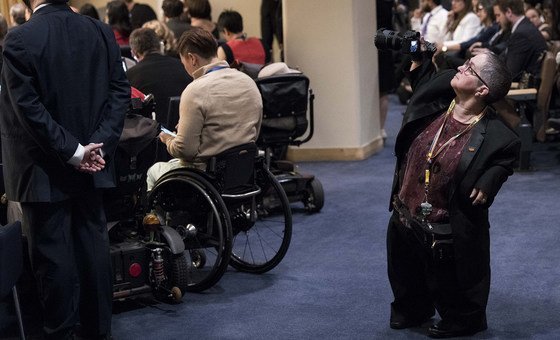
“The message is stark: persons with disabilities face higher poverty, greater unemployment, deeper food and health insecurity and more limited access to education, jobs, and digital technologies,” said Amina Mohammed.

But action is underway.

The 18th Session of the Conference of States Parties to the Convention on the Rights of Persons with Disabilities (COSP18) will focus on enhancing public awareness of the rights and contributions of persons with disabilities for social development.

Progressive roots

Chair of the Committee on the Rights of Persons with Disabilities, Kim Mi-Yeon, underscored the importance of the Convention on the Rights of Persons with Disabilities, now 20 years old, even amid growing global challenges.

The CRPD is the most progressive human rights treaty of the 21st century…It marked a decisive shift – from medical and charity models to a rights-based approach – and affirms the duty to dismantle structural and gender-based discrimination,” said Mr. Kim.  

Even with the ongoing UN liquidity crisis, he highlighted the momentum across the world for bolstering rights, including the International Forum on Disability Employment in Korea.  

Gaining momentum

The social development agenda aims to continue building momentum for disability rights and social development ahead of two major upcoming events: the Second World Summit for Social Development in November and the Fourth International Conference on Financing for Development later this month, FFD4, taking place in the Spanish city of Sevilla.

This week’s agenda

From Tuesday to Thursday, the conference will feature speeches by UN and civil society leaders, a public debate on the rights and contributions of persons with disabilities and three roundtables.

The roundtables will explore financing for disability-inclusive development, harnessing artificial intelligence for inclusion and advancing the rights of Indigenous persons with disabilities

Government officials, civil society representatives, UN agencies, and experts will share strategies and best practices throughout the event. 

Source link

Champions for Change: World football teams up with UN development goals

The Football for the Goals Forum brought UN leaders and some of the top voices in the world’s most popular sport to UN Headquarters in New York for the inaugural Champions for Change: Football and the UN Unite for the SDGs event.

The UN has long recognised the role of sport in advancing the SDGs – promoting peace, gender equality, health, and climate action – as affirmed in a General Assembly Resolution on Sport adopted in December 2022.

With unparalleled global reach, football holds a unique position to drive progress on these goals. Launched in July 2022, Football for the Goals is a UN initiative engaging the international football community to advocate for the SDGs.

Wednesday’s forum aimed to mobilise the football community for action across key SDG areas.

The kick off

After introductions from football executives, UN Spokesperson Stéphane Dujarric, UN communications chief Melissa Fleming, and the Qatari Representative to the UN, the opening panel – Bolstering Community Engagement with the SDGs – outlined the origins of Football for the Goals and explored how the football community can deepen its contribution to the SDGs.

This was followed by a brief discussion on the football sector’s commitment to climate sustainability.

The programme then shifted to some of the Forum’s most substantive panels, exploring how football both reflects global inequalities – between the Global South and North, and between men and women – and has the potential to help address them.

North-South divide

Júlia Pimenta of Street Child United highlighted that football organisations in the Global South, which serve the children who need support most, often lack adequate funding and must compete with well-resourced programmes in the Global North.

Sarah Van Vooren of Atoot in Nepal similarly noted that grassroots organisations connecting football and sustainable development, frequently lack the resources needed to reach their full potential.

When these organisations are properly supported, they can provide safe, educational environments for children – often with life-changing results.

Panellists emphasised that funding such initiatives is key to advancing SDGs related to education and reducing inequality.

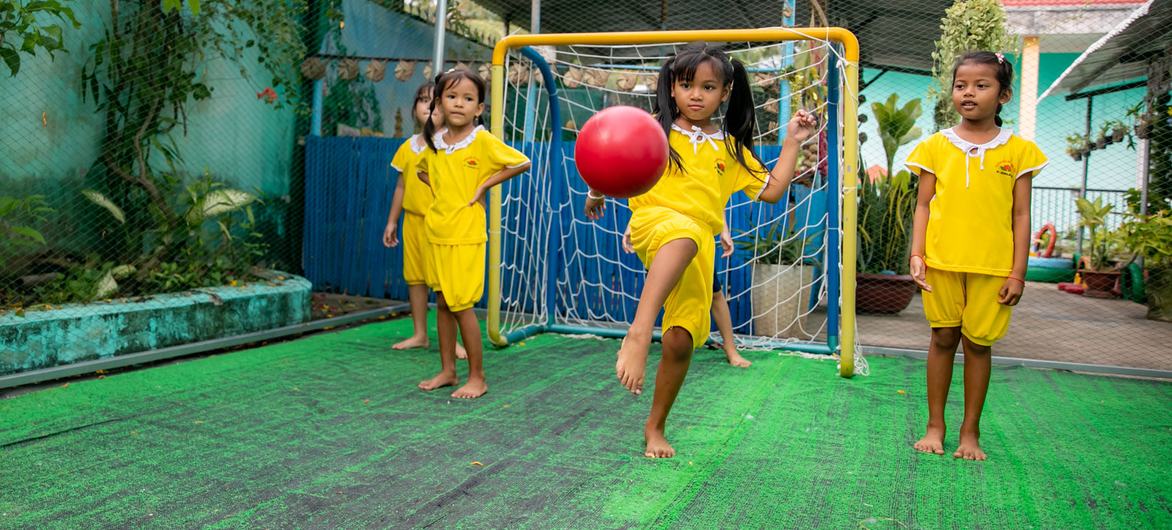
© UNICEF/Truong Viet Hung

Young girls play football at school in Soc Trang Province, Viet Nam.

Levelling the gender playing field

Jayathma Wickramanayake, a policy advisor on sports partnerships at UN Women, noted that the gender equality agency is responsible for most of the targets under SDG 5 related to closing the gender gap.

She emphasised that progress has been slow – and in some areas, it’s even regressing – largely due to the persistence of rigid social norms, attitudes, and behaviours.

These norms often manifest in the sports world through unequal pay and incidents of sexual harassment. However, Ms. Wickramanayake and other panellists highlighted how sport can be a powerful tool to challenge stereotypes and empower women and girls to succeed – both on and off the pitch.

Source link

‘Alarming’ slowdown in human development – could AI provide answers?

For several decades, human development indicators showed a steady, upward curve and UN researchers predicted that by 2030, a high level of development would be enjoyed by the global population.

Those hopes have been dashed in recent years following a period of exceptional crises such as the COVID-19 pandemic – and progress has stalled across all regions of the world.

‘Very real threat’ to progress

The Human Development Report, an annual publication from the UN Development Programme (UNDP), shows that inequalities between rich and poor countries have widened for the fourth year in a row.  

Global pressures, such as increasing trade tensions and a worsening debt crisis which limits the ability of governments to invest in public services, are narrowing traditional paths to development.

“This deceleration signals a very real threat to global progress,” said Achim Steiner, UNDP Administrator. “If 2024’s sluggish progress becomes ‘the new normal’, that 2030 milestone could slip by decades – making our world less secure, more divided, and more vulnerable to economic and ecological shocks.”

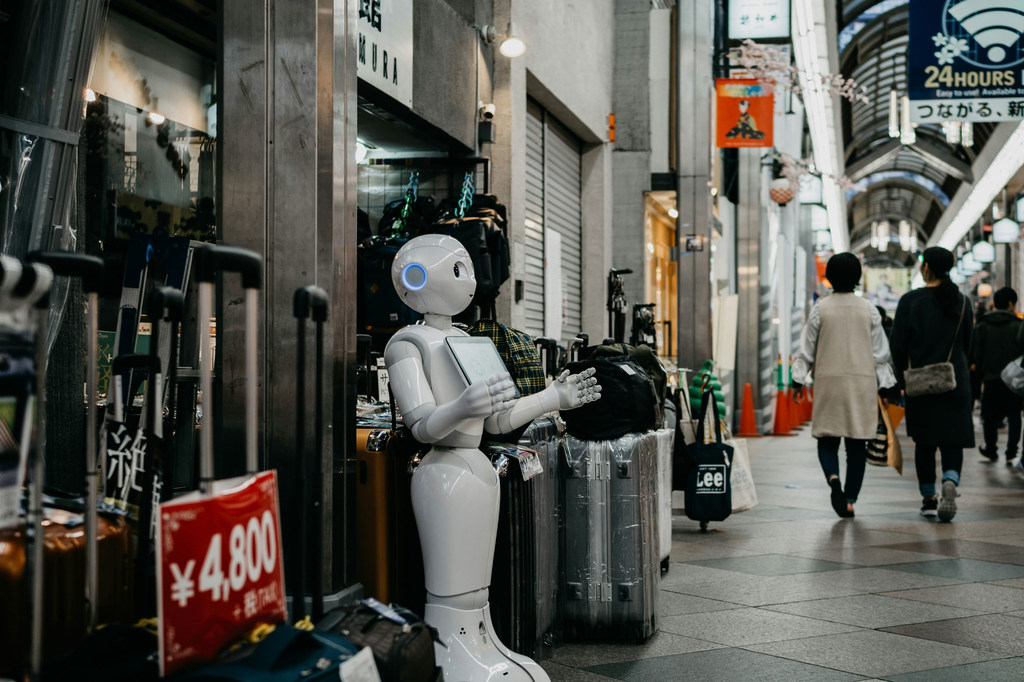
A robot which could carry out tasks assigned to humans stands in a shopping mall in Kyoto, Japan.

Maybe the robots aren’t coming for our jobs after all

Despite the gloomy indicators, the report is strikingly upbeat about the potential of artificial intelligence, noting the breakneck pace at which free or low-cost tools have been embraced by businesses and individuals alike.

UNDP researchers carried out a survey to gauge opinions on AI and discovered that around 60 per cent of respondents expect the technology to positively impact their work and create new opportunities.  

Those living in low and medium levels of development were particularly keen: 70 per cent expect AI to increase their productivity, and two thirds anticipate using AI in education, health, or work within the next year. 

Action stations

The report’s authors include recommendations for action to make sure that AI is as beneficial as possible, including the modernisation of education and health systems to adequately meet today’s needs – building an economy focused on human collaboration with AI (rather than competition) – putting humans at the heart of AI development, from design to deployment.

“The choices we make in the coming years will define the legacy of this technological transition for human development,” said Pedro Conceição, Director of UNDP’s Human Development Report Office.  

“With the right policies and focus on people, AI can be a crucial bridge to new knowledge, skills, and ideas that can empower everyone from farmers to small business owners.”

Ultimately, the report’s message is that the impact of AI is hard to predict. Rather than being an autonomous force, it is a reflection and amplifier of the values and inequalities of the societies that shape it.  

To avoid what it calls “development disappointment”, UNDP urges stronger global cooperation on AI governance, alignment between private innovation and public goals, and a renewed commitment to human dignity, equity, and sustainability.

“The 2025 HDR is not a report about technology,” writes Mr.  Steiner in the foreword. “It is a report about people – and our ability to reinvent ourselves in the face of profound change.”

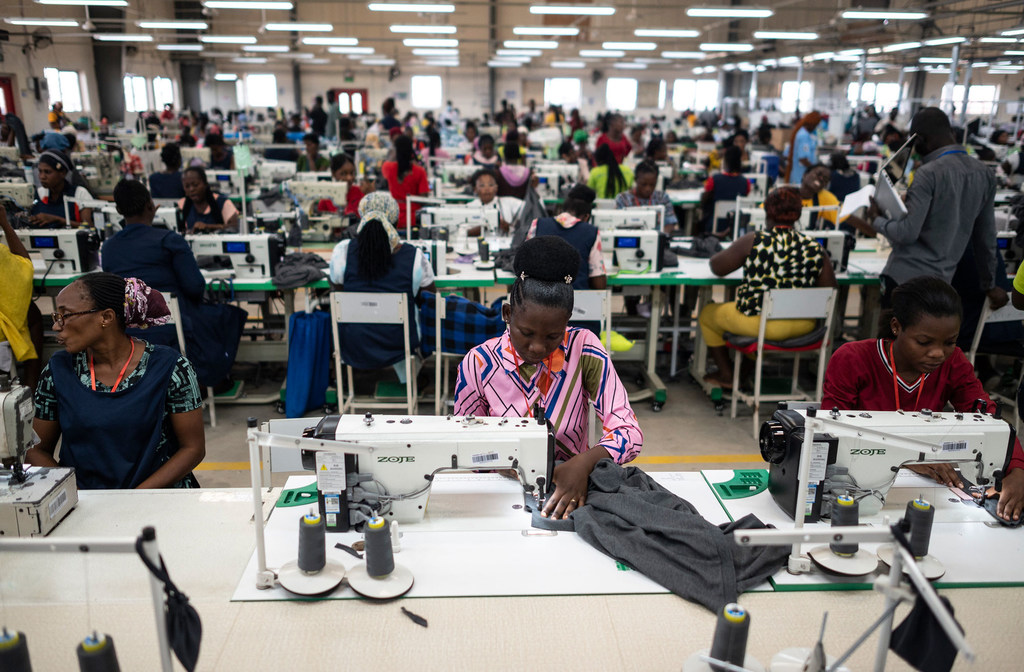
© IMF/Andrew Caballero-Reynolds

Workers sew fabric at an apparel factory in Ghana.

Source link

UN warns of $4 trillion shortfall threatening global development goals

Speaking at UN Headquarters in New York, Secretary-General António Guterres, General Assembly President Philémon Yang and Economic and Social Council President Bob Rae stressed the need for more resources and a global financial overhaul.

Without an effective response, they stressed, the world risks falling even further behind on ending poverty, fighting climate change, and building new sustainable economies.

They were addressing the ECOSOC annual forum on financing for development, which follows last week’s World Bank and International Monetary Fund (IMF) Spring Meetings where global growth, trade tensions and the rising debt burden in developing countries were front and centre.

Everyone loses in a trade war

This year’s ECOSOC Forum comes at a pivotal time,” Mr. Guterres told delegates, warning that global cooperation itself is under threat.

He pointed to rising trade tensions as a major risk, noting that while fair trade is a clear example of the benefits of international collaboration, the surge in trade barriers poses a “clear and present danger” to the global economy – as seen in recent downgrades to global growth forecasts by the IMF, the World Trade Organization (WTO), and UN economists.

In a trade war, everybody loses – especially the most vulnerable countries and people, who are hit the hardest,” he said.

We must shift into overdrive

Mr. Guterres highlighted how many donors are pulling back from aid commitments while soaring borrowing costs drain public investments, putting the SDGs “dramatically off track.”

With just five years to reach the SDGs, we need to shift into overdrive,” he stressed, urging countries to deliver bold outcomes at the upcoming Fourth International Conference on Financing for Development, in Seville.

“Against this turbulent background, we cannot let our financing for development ambitions get swept away.”

Secretary-General António Guterres (right) addresses the ECOSOC 2025 Forum on Financing for Development Follow-up. At his left is Philémon Yang, President of the General Assembly.

Crushing debt burdens

ECOSOC President Bob Rae echoed these concerns, emphasising that over three billion people live in countries where governments spend more on interest payments than on health or education.

“We desperately need a more affordable debt architecture – it’s that simple,” he said, calling for urgent reforms that would allow countries a fair chance to repay what they owe while investing in their futures.

He also sounded the alarm over rising trade barriers – citing recent moves by major economies, like the United States, to impose new tariffs.

Trade is not a four-letter word,” Mr. Rae said, “it is a positive way for countries to exchange goods and services and emerge from poverty.”

He urged countries not to see trade as a zero-sum game – where there are only winners and losers – and embrace fair, open trading systems as a path to shared prosperity.

Calls for reform

General Assembly President Philémon Yang underscored the consequences of rising debts and shrinking fiscal space.

In more than 50 developing countries, governments now spend over 10 percent of their revenues on debt servicing – and in 17 of them, over 20 percent – a clear warning sign of default, according to UN economists.

“Our inability to reform the international financial architecture is severely restricting capital access,” Mr. Yang warned, stressing that closing the financing gap – now estimated at over $4 trillion annually – is critical to achieving the SDGs.

Time is of the essence. Let us use this ECOSOC Forum to bridge divides, build trust, and lay the foundation for success.

The 17 Sustainable Development Goals are all interconnected, for instance progress on SDG 2 to end hunger is closely tied to advances in health and education.

Looking ahead to Seville

As negotiations continue towards an agreed outcome in Seville, Secretary-General Guterres highlighted three priority areas – tackling unsustainable debt, strengthening multilateral development banks and unlocking new streams of sustainable finance.

He called for mobilizing more domestic resources, innovative financing solutions, better controls on illicit financial flows and stronger partnerships with the private sector.

ECOSOC President Rae added that the conversation must move beyond declarations to concrete, measurable action.

We need innovation, creativity and partnerships that deliver lasting and transformative impact,” he said.

The Fourth International Conference on Financing for Development – to be held from 30 June to 3 July in Seville, Spain – represents a critical opportunity to rebuild the global financial system to unleash the investments urgently needed to achieve the SDGs.

Source link

14 Coastal Economic Zones to Come up Under Sagarmala Program

The Indian Ministry of Shipping has identified 14 Coastal Economic Zones (CEZ) along the coastline under National Perspective Plan (NPP) of Sagarmala Program, said Minister of State for Shipping Mansukh Lal Mandaviya in reply to a question in Lok Sabha on Thursday (08 Dec 2016).

The CEZ are  spatial economic regions spread over multiple coastal districts with strong port linkage. Within each CEZ, there could be multiple industrial clusters that could contain industrial units with requisite support infrastructure.  The details of  identified CEZs are as under:-


CEZ State Linkage Port Potential Industries
CEZ-1 Gujarat Kandla, Mundra Petrochemicals, Cement, Furniture
CEZ-2 Pipavav, Sikka Apparel, Automotive
CEZ-3 Dahej, Hazira Marine clusters
CEZ-4 Maharashtra

Goa

JNPT, Mumbai Power, Electronics, Apparel
CEZ-5 Dighi, Jaigarh, Mormugao Refining, Steel, Food processing
CEZ-6 Karnataka New Mangalore Petrochemicals
CEZ-7 Kerala Cochin Furniture
CEZ-8  

Tamil Nadu

VOCPT(Tuticorin) Apparel, Refining
CEZ-9 Karaikal Leather processing, Power
CEZ-10 Chennai, Kamarajar(Ennore) and Katupalli Steel, Petrochemicals, Electronics, Shipbuilding
CEZ-11 Andhra Pradesh Krishnapatnam Electronics
CEZ-12 Vizag, Kakinada Food processing, Petrochemicals, Cement, Apparel
CEZ-13 Odisha Paradip, Dhamara Petrochemicals, Marine processing
CEZ-14 West Bengal Kolkata, Haldia Leather processing


Based on the land parcels available in close proximity to a deep draught port and with strong potential for manufacturing, four CEZs have been identified to be taken up in the first phase of development.  These are in Gujarat, Andhra Pradesh, Maharashtra and Tamil Nadu. No special provision regarding tax holiday, employment and extent of investment has been made so far.