World News in Brief: South Sudan urged to avoid slide to war, Türk calls on EU not to weaken landmark law, Ukraine and Mali updates

The Quartet is calling on the country’s leaders to end hostilities and return to dialogue to fully implement the 2018 peace agreement known as the Revitalized Agreement on the Resolution of the Conflict in the Republic of South Sudan (R-ARCSS).

South Sudan, the world’s youngest nation, gained independence in 2011 but soon descended into a brutal civil war. A 2018 peace agreement has held together but now threatens to fully unwind between the president and his vice presidential rival.

Regional pressure

In recent weeks, the Quartet has observed air and ground attacks that have led to loss of life, the destruction of homes, and the displacement of civilians. Humanitarian facilities have also been targeted, while hate speech and ethnic tensions are on the rise.

The Quartet welcomed a recent joint visit by the African Union and IGAD to South Sudan as a sign of regional support for peace. It also called on all sides to cooperate with ceasefire monitors investigating recent violence.

South Sudan’s leaders must commit to inclusive dialogue, the release of political detainees, and renewed efforts to carry out the peace deal, the Quartet stressed.

A return to war would betray the people’s hope for peace and stability, they warned. Only a political solution can ensure free and fair elections at the end of the current transitional period.

UN rights chief urges EU not to weaken landmark corporate responsibility law

UN human rights chief Volker Türk has called on the European Union to protect a key law that holds large companies accountable for human rights and environmental harm.

The EU’s Corporate Sustainability Due Diligence Directive (CSDDD), adopted last year, requires businesses to identify and address any negative impact their activities may have on people or the planet.

But changes now being discussed in Brussels as part of a broader reform package could weaken the law, Mr. Türk warned on Wednesday.

“The CSDDD, by far the most ambitious business and human rights regulatory initiative anywhere in the world, has rightly been welcomed by companies, policy makers, civil society, and national human rights institutions alike,” he said.

“A large number of businesses have already taken steps to ensure they comply with it.”

Detailed review

UN human rights office, OHCHR, has published a detailed review of the EU proposal, pointing to ways it could undermine this groundbreaking directive.

Mr. Türk urged lawmakers to keep the law in line with global standards, such as the UN Guiding Principles on Business and Human Rights.

“While some streamlining… could be advantageous, it would be counterproductive to water down its alignment with international standards,” he said.

April deadliest month for civilians in Ukraine since September

April was the deadliest month for civilians in Ukraine since September 2024, with at least 209 people killed and 1,146 injured, the UN Human Rights Monitoring Mission in Ukraine (HRMMU) reported on Wednesday.

In its monthly update, the Mission said that 97 per cent of casualties occurred in areas controlled by Ukraine, with nearly half caused by missile and loitering munitions attacks by Russian forces.

“Kryvyi Rih, Sumy, Dnipro, Zaporizhzhia, Kyiv, and Kharkiv all endured devastating attacks,” said Danielle Bell, Head of HRMMU. “The sharp rise in casualties was mainly due to the intensified use of ballistic missiles in major cities.”

Among the deadliest incidents:

  • On 4 April, a missile strike on Kryvyi Rih killed 20 civilians and injured 63.
  • On Palm Sunday (13 April), two missiles hit Sumy, killing at least 31 and injuring 105.
  • A 24 April attack on Kyiv killed 11 and injured 81.

Children were especially affected. At least 19 were killed and 78 injured in April – the highest monthly total since June 2022.

The wave of attacks continued into May, with cities including Kharkiv, Odesa and Kyiv again coming under fire.

UN experts raise alarm over Mali’s suspension of political parties

Independent UN human rights experts have strongly criticised Mali’s military authorities for suspending all political parties and activities, calling the move a clear violation of basic rights.

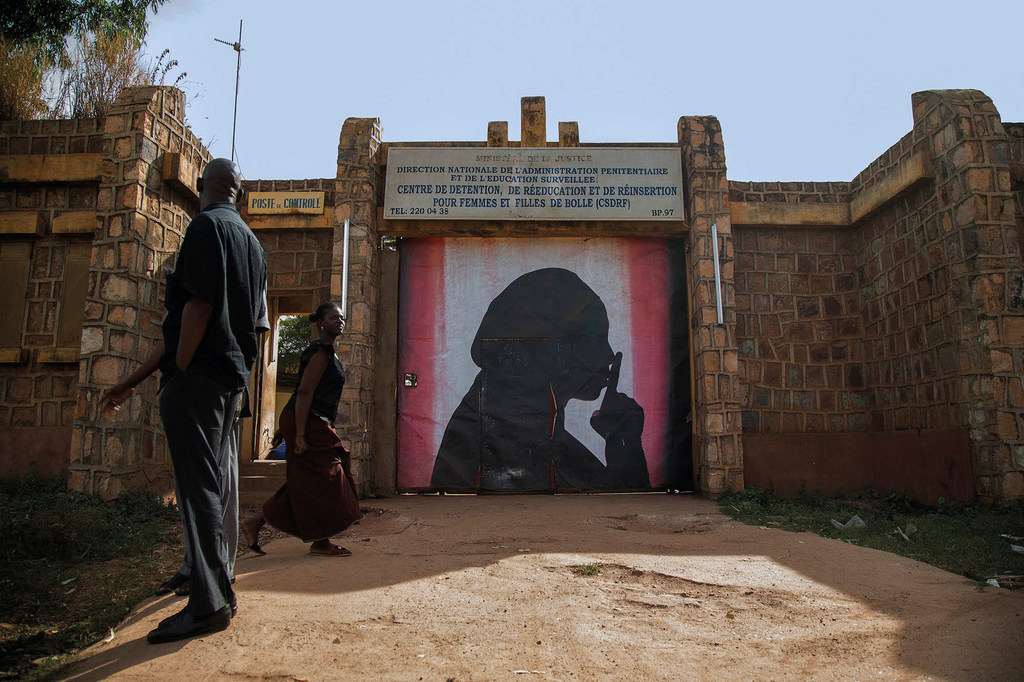
© MINUSMA/Harandane Dicko

A detention centre in Bamako, Mali. (file)

The decision, announced on 7 May via state television, halts political activity “until further notice.” The junta, which took power following coups in 2020 and 2021, said the suspension was necessary to maintain public order.

The three UN Human Rights Council-appointed experts described it as a direct violation of human rights and called for the order’s immediate repeal.

They also called on the National Transitional Council to strike down a bill introduced on 30 April, which repealed legislation governing how political parties operate.

“If passed into law, the 30 April bill will place Mali in contravention of its human rights obligations, notably on freedoms of association and expression,” the experts stressed.”

Protests

In response to the 30 April bill, opposition parties organised a pro-democracy rally in the capital Bamako on 3 May which drew hundreds of demonstrators. The parties reportedly demanded a timeline to end military rule and a return to constitutional order.

Another protest is planned for Friday to oppose the decree against political parties.

The experts said Malian authorities must work to counteract “the current climate of suppression of the civic space”.

“The right to peacefully assembly is essential to the health of a vibrant political community,” the experts said. “The Malian Transitional authorities must scrupulously respect it and abstain from acts of intimidation and repression that risk the physical integrity and the rights of demonstrators.”

Special Rapporteurs and Independent Experts are appointed by the Geneva-based Human Rights Council. They serve in their individual capacity, independent of the UN system and national governments. They are not UN staff and draw no salary

Source link

World News in Brief: Deadly attacks in South Sudan and Ukraine, World Court rejects Sudan case, lifesaving aid in Yemen

According to the UN relief coordination office (OCHA), the hospital in Old Fangak was struck early Saturday, killing seven civilians and injuring at least 20 more. The attack also destroyed vital supplies and forced the withdrawal of aid workers, leaving the town’s population without access to critical care.

“People in these areas are already battling flooding, food shortages and disease,” said Marie-Helene Verney, the UN’s acting Humanitarian Coordinator in South Sudan.

Too many lives at risk

“The destruction of critical health infrastructure and continued fighting puts innocent South Sudanese lives at risk.”

The bombing follows a wave of similar attacks in Upper Nile state, where health facilities in Ulang and Nasir have been targeted in recent months. The latest strike has heightened fears of renewed conflict as political and ethnic tensions rise nationwide.

The UN is now airlifting essential supplies to the area, but access remains limited. The violence has displaced over 130,000 people in the past two months, and aid agencies warn that South Sudan’s broader $1.7 billion humanitarian plan remains only 16 per cent funded.

Large scale attacks on densely populated cities across Ukraine

The UN’s top humanitarian official in Ukraine on Monday condemned a series of Russian strikes this weekend on densely populated towns and cities.

Between Friday and Monday, at least 12 people were killed and more than 100 others injured in attacks thar targeted Kharkiv, Kyiv and Cherkasy, and other regions in Ukraine.

These attacks also damaged homes, schools, a hospital and other civilian infrastructure, according to local authorities and partners, UN Deputy Spokesperson Farhan Haq told journalists in New York.

In the aftermath of the strikes, “humanitarian organizations provided first aid, psychosocial support, emergency shelter kits, repair materials, meals and drinks,” Mr. Haq said.

In the Kharkiv region, a fire triggered by a strike near the city of Izium on Sunday, burned 85 hectares of land and damaged over a dozen buildings. There were no casualties reported, Mr. Haq added.

Meanwhile, UN agencies alongside partners reached 600,000 people so far this year with first aid, medical transport, primary care and mental health support, including at transit centres for displaced people.

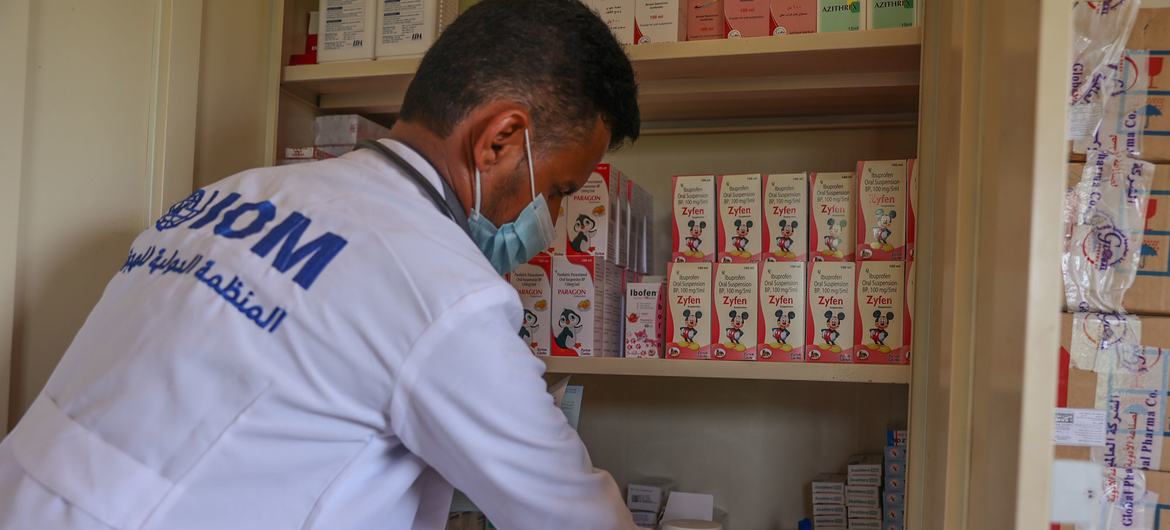
An IOM-supported health worker in Yemen accesses medical supplies.

Yemen: UN delivers lifesaving medical supplies

The UN International Organization for Migration (IOM) on Monday delivered critical medical supplies to seven health facilities in Yemen, where a collapsing health system and chronic shortages continue to endanger millions.

With support from the Government of the United Kingdom, IOM shipments are reaching hospitals and clinics in Aden, Lahj, Shabwah, Al Bayda and Sana’a – facilities serving both migrants and local communities.

“Every day, our teams see the impact of empty medicine shelves and overwhelmed clinics, on families and entire communities,” said Abdusattor Esoev, head of IOM in Yemen.

“By delivering essential supplies and supporting frontline staff, we are not just responding to urgent needs – we are keeping health services running for those who have nowhere else to turn.”

Crisis on crisis

The intervention comes amid an alarming health crisis.

Nearly 20 million people in Yemen require medical assistance in 2025, but over half of the country’s health facilities are only partially functioning or have shut down altogether. Funding gaps have left 382 facilities unsupported, forcing many to close or drastically cut services.

IOM’s assistance includes essential medicines, surgical equipment and infection prevention tools, as well as infrastructure repairs and support for health workers.

For many in the strife-torn country, IOM-supported clinics remain the only source of free medical care.

ICJ rejects Sudan’s genocide case against UAE

The International Court of Justice (ICJ) has rejected Sudan’s case accusing the United Arab Emirates (UAE) of complicity in genocide in Darfur, citing a lack of jurisdiction.

In the decision, the UN’s top judicial body ruled on Monday by a vote of 14 to two that it could not proceed with the case brought by Sudan under the Convention on the Prevention and Punishment of the Crime of Genocide (Genocide Convention) and declined to impose any provisional measures, as Sudan had requested.

The Court also removed the case from its general list by a vote of nine to seven.

“Having come to the conclusion that it manifestly lacks jurisdiction, the Court is precluded from taking any position on the merits of the claims made by Sudan,” the ruling stated.

Complicity charge

Sudan had accused the UAE of backing the paramilitary Rapid Support Forces (RSF), alleging its support amounted to complicity in genocidal acts against the non-Arab Masalit population in West Darfur.

The conflict between the RSF and the Sudanese army has claimed thousands of lives and displaced over 12.7 million people since April 2023.

The Court noted that while it could not hear the case, all States remain bound by their obligations under the Genocide Convention.

Source link

World News in Brief: Guterres on India-Pakistan tensions, eastern DR Congo update, weather boost for locusts in Africa

UN Secretary-General Guterres has spoken to leaders on both sides on India-Pakistan tensions.

“This morning, he spoke separately by telephone with Muhammad Shebaz Sharif, the Prime Minister of the Islamic Republic of Pakistan, and he also spoke earlier in the day with Subrahmanyam Jaishankar, the Minister for External Affairs of the Republic of India,” said UN Spokesperson Stéphane Dujarric, briefing journalists at UN Headquarters in New York.

During the calls the UN chief reiterated his strong condemnation of the 22 April terrorist attack, noting “the importance of pursuing justice and accountability for these attacks through lawful means.”

He expressed major concern over “rising tensions between India and Pakistan and he also underscored the need to avoid a confrontation that could result in tragic consequences,” added Mr. Dujarric.

The Secretary-General also offered to help mediate in support of any de-escalation efforts.

Escalating violence displaces thousands in eastern DR Congo

Ongoing violence in eastern Democratic Republic of the Congo (DRC) is uprooting families, crippling essential services, and placing civilians at growing risk, the UN humanitarian affairs office (OCHA) warned on Tuesday.

Fresh fighting in South Kivu province has forced communities to flee and left at least 10 civilians dead in Walungu territory alone, according to local authorities. “The violence is disrupting both economic life and the delivery of urgently needed humanitarian aid,” said OCHA.

Multiple rape cases

In nearby Kalehe, Minova hospital has reported multiple cases of rape and physical assault in recent days amid worsening insecurity. Meanwhile, clashes in Fizi territory last week led to health centres being looted and schools burned, threatening already fragile public services.

OCHA urged all combatants to respect international humanitarian law and ensure the protection of civilians. “Humanitarian access must be safe and unhindered,” the agency stressed.

The surge in displacement comes as eastern DRC remains gripped by fighting between the M23 rebel group and government forces, particularly in North Kivu. Since January, the violence has displaced hundreds of thousands.

In Walikale territory, civilians are trapped in a dangerous cycle of displacement and return, OCHA said, calling for strengthened protection and support for affected communities.

Locust swarms can devastate crops and pastures in many parts of Africa and elsewhere.

Favourable weather fuels desert locust surge in North Africa

Unusually high levels of desert locust infestations have been reported during the current breeding season, raising alarms across affected regions, the UN Food and Agriculture Organization (FAO) warned on Tuesday.

“Desert locusts remain among the most devastating migratory pests on the planet,” said UN Spokesperson Stéphane Dujarric, emphasising the threat they pose to food security and livelihoods.

A single swarm of locusts can cover anywhere from one to several hundred square kilometres and may contain up to 80 million adult locusts. In just 1 km², they can eat as much food in a day as 35,000 people.

Feeding on crops and pastureland, they pose a threat to crops grown for both people and livestock, risking starvation in communities that depend on agriculture for survival.

Clement weather for pests

According to the FAO, favourable weather conditions have created suitable breeding grounds for the flying pests. Winds and rainfall patterns have facilitated the movement of desert locusts from the Sahel to North Africa.

The FAO recommends conducting intensive ground surveys across key areas where locust breeding is likely to occur.

The area spanning from south of the Atlas Mountains in Morocco, through the Sahara in Algeria, and extending to southern Tunisia and western Libya is particularly at risk.

“Surveys and control operations are particularly urgent in locations where winter and early spring rains have created suitable breeding conditions,” said Cyril Piou, the FAO’s Locust Monitoring and Forecasting Officer.

Early detection and rapid response are critical to preventing a wider crisis, the UN food agency underscores.

Source link

Israel’s restrictions on UN agencies in Gaza in spotlight at world court

The ICJ, which sits in The Hague and is the UN’s top court, is expected to hear from 40 States and four international organizations in proceedings slated to last all week.

Representing Secretary-General António Guterres, UN Legal Counsel Elinor Hammarskjöld reiterated his many calls for a ceasefire, for humanitarian aid to reach all people in need and for all hostages to be freed.

A total of 13 UN entities are present in Gaza, Ms. Hammarskjöld noted, adding that 295 UN personnel have died in Gaza since the war began on 7 October 2023, following Hamas-led terror attacks in Israel.

Legal opinion

The UN legal counsel insisted on the special protections and immunities of UN agencies and personnel which it needs to implement its mandated activities all over the world, including in the OPT.

These protections also apply during armed conflict, Ms. Hammarskjöld said, before highlighting Israel’s obligations as the occupying power under international law.

“The overarching obligation [is] to administer the territory for the benefit of the local population and “to agree to and facilitate relief schemes”, she said “In the specific context of the current situation in the OPT, these obligations entail allowing and facilitating all relevant UN entities to carry out those activities for the benefit of the local population.”

The purpose of the hearings at the ICJ all this week is to establish what’s known as an “advisory opinion” on Israel’s obligations as the occupying power in Gaza and the wider OPT, in accordance with the UN Charter.

It follows a vote at the UN General Assembly in December where Member States voted 137 to 12 to seek the view of the ICJ’s 15 judges, amid ongoing Israeli bombardment and dramatic aid shortages across Gaza.

Although the ICJ judges’ advisory opinion is not binding – as opposed to the legal disputes between countries on which it rules (so-called “contentious cases”) – it provides clarity on legal questions.

Once the court has issued its opinion, the General Assembly would be open to pick up the matter again and decide on further action.

UNRWA shut out

Welcoming the hearings, the head of the UN agency for Palestine refugees, (UNRWA) Philippe Lazzarini, insisted that aid agencies were working “to address overwhelming needs”.

The UNRWA Commissioner-General explained that the Israeli Parliament’s widely condemned “no-contact” policy banning any coordination with UNRWA official have obstructed the delivery of essential relief services and aid.

The move is particularly significant because UNRWA is the largest aid agency in Gaza, where it has provided health, education and other vital public services for decades.

But since these restrictions came into effect at the end of January, UNRWA international staff have not received visas to enter Israel, Mr. Lazzarini said.

Inside Gaza, meanwhile, ordinary Gazans continue to face desperate food shortages linked to the 2 March decision by Israel to seal the enclave’s borders.

“Today people are not surviving in Gaza, those that aren’t being killed with bombs and bullets are slowly dying,” said Jonathan Whittall, local Head of Office for the UN aid coordination wing, OCHA. He insisted that humanitarian agencies are unable to meet soaring needs following Israel’s decision to cut all commercial and relief supplies.

“People here are being suffocated,” he maintained. “What we see around us is endless suffering under a total and complete blockade. A total closure that’s now lasted for almost two months while airstrikes, ground operations are intensifying and displacement orders that are pushing people out of their homes are increasing.”

Witness statements

The following Gaza testimonies have been provided by UNRWA:

Mona, a grandmother living in an UNRWA shelter in Gaza City:

“We only eat one meal a day, I go to sleep thinking about what we will eat tomorrow and how we will provide…I have enough flour for several days. I try to preserve it by making small loaves so that it lasts for a few more days. When children get hungry, I give them my loaf. I no longer take medicine, even if it is available, because treatment requires good food, and that is not available now.”

Wafaa, whose oldest child is seven and whose youngest is three, speaking from an UNRWA school in Gaza City:

“I have two cans of beans, some cans of peas, two cans of chickpeas, some duqqa (a spice mix), and a few kilos of flour that will only last for four days…The flour is mouldy and smells bad, but I can’t complain. When will this nightmare end?”

Source link