UN social policy commission closes with calls to turn pledges into action

Meeting at UN Headquarters, in New York, from 2 to 10 February, the Commission for Social Development marked its first session since the Second World Summit for Social Development, held in Doha last year.

The gathering brought together ministers, senior UN officials, civil society groups and youth representatives to examine how global pledges can be translated into coordinated, inclusive and equitable policies at the national level.

Opening the session, Economic and Social Council (ECOSOC) President Lok Bahadur Thapa stressed that social development policies are where “resilience, social cohesion, and trust are ultimately tested.”

He warned that widening inequalities, demographic change, and rapid digital and green transitions are placing growing strain on societies worldwide. Responding in an integrated, people-centred way, he said, is “not merely a policy choice; it is a moral imperative.”

Delegates at the 64th session of the Commission for Social Development.

What is the Commission for Social Development?

The Commission for Social Development is an ECOSOC functional commission and the United Nations’ primary intergovernmental body for social development.

Established in 1946, it has helped shape global policy frameworks on poverty eradication, employment, social protection and inclusion, including by steering follow-up to landmark agreements such as the 1995 Copenhagen Declaration and, more recently, the 2025 Doha Political Declaration.

Click here for UN News special coverage of the Doha Summit

Over the years, the Commission has driven progress on universal social protection, decent work for all, and international focus on groups at risk of exclusion, including persons with disabilities, older persons, youth and families.  

Its conclusions have informed national policies, helped develop social protection floors, and reinforced links between social development and the Sustainable Development Goals.

The Commission meets annually at UN Headquarters, in New York, generally in February.

Click here for more information on the Commission

A post-Doha moment for social policy

This year’s priority themeadvancing social development and social justice through coordinated, equitable and inclusive policies – framed discussions throughout the session, reflecting concerns that fragmented policymaking is slowing progress on poverty eradication, decent work and social inclusion.

Addressing delegates, General Assembly President Annalena Baerbock underscored that social development is not a secondary concern reserved for calmer times, but “the foundation that peace is built upon” and a critical investment in stability.

Ending hunger and poverty, she said, is both a moral obligation and a matter of security, noting how deprivation fuels conflict, migration and instability.

From commitments to delivery

In a message to the Commission, Deputy Secretary-General Amina Mohammed highlighted the shift signalled by the Doha Political Declaration away from incremental progress towards more ambitious, coordinated action.

She pointed to strong civil society engagement – with more than 700 non-governmental organizations (NGOs) registered for the session – and urged governments to match that readiness with concrete delivery.

“If Copenhagen, Doha and the 2030 Agenda are where we drew the map, then the Commission for Social Development sets us on the road,” she said.

Click here to watch the Deputy Secretary-General’s message

Coordinating policies in a changing world

Throughout the session, speakers repeatedly stressed the need for greater policy coherence – aligning employment strategies with universal social protection floors, inclusive education and health systems, and just-transition measures.

The Commission also examined emerging social challenges, including demographic change, labour-market disruption, and the social impacts of digital transformation and artificial intelligence.

Delegates heard that while new technologies carry risks, they can also accelerate progress towards the Sustainable Development Goals (SDGs) if governed inclusively and equitably.

A young boy relaxes in a wicker basket as his family threshes harvested wheat.

Youth mental health in focus

Youth voices featured prominently, reflecting the Commission’s emphasis on inclusion. The launch of the World Youth Report on Youth Mental Health and Well-being highlighted the growing pressures facing young people – from poverty and inequality to climate stress, conflict and digital harms.

Youth delegates and advocates shared lived experiences, describing how uncertainty about the future is eroding trust and well-being among younger generations, while calling for preventive, community-based and youth-responsive approaches.

Resolutions endorsed

At the close of the session, Member States endorsed two draft resolutions – one on advancing social development and social justice through coordinated, equitable and inclusive social policies, and another on the social dimensions of the New Partnership for Africa’s Development.

The resolutions reaffirm commitments made at the 1995 Copenhagen Summit and the 2025 Doha Summit, while emphasizing the need to translate global pledges into concrete national action.

Outcomes from the session will feed into upcoming UN processes, including the High-Level Political Forum on Sustainable Development in July, ECOSOC’s broader work, and the General Assembly’s five-year follow-up towards a high-level review of social development commitments in 2031.

Source link

Syria: UN commission hails recent action to address past violations

Paulo Sérgio Pinheiro highlighted the establishment of the National Transitional Authority and the National Authority for Missing Persons which are expected to help reveal the fate of the more than 100,000 Syrians estimated to have been forcibly disappeared or gone missing.

They are also expected to expose the truth about systematic violations like arbitrary detention, torture and ill-treatment, and about widespread attacks which killed hundreds of thousands of civilians and maimed millions during hostilities.

Syria continues along the path to transition following the overthrow of the Assad regime last December.

Wave of retaliatory attacks

Mr. Pinheiro said the security vacuum left after the dismissal of the armed forces and security services, together with a lack of clarity on the new framework for justice, contributed to an atmosphere where victims of past crimes and violations attempted to take the law into their own hands and settle scores.

Retaliatory attacks that took place in coastal areas in March, and on a smaller scale in other parts of the country, were “in part a response to five decades of systematic crimes perpetrated by security forces with impunity which affected all Syrians,” he said.

“More recently, sectarian fault lines have also been fuelled by widespread hate speech and incitement against Alawis, off and online, including posts with false information reportedly often originating from abroad.”

Eyewitness accounts

The Commission conducted its latest visit to Syria last week and travelled to several locations on the coast where killings and looting had occurred.  The team met with several civil and security authorities, as well as eyewitnesses and victims’ families.

“First-hand accounts by survivors of these events…revealed in detail how residential areas were raided by large groups of armed men, many of them members of factions now affiliated with the State. They told us how the assailants detained, ill-treated and executed Alawis,” he said.

He acknowledged the interim authorities’ establishment of a National Inquiry to investigate the violations as well as an additional High-Level Committee to Maintain Civil Peace.  Furthermore, dozens of alleged perpetrators have been arrested.

“Protection of civilians is essential to prevent further violations and crimes,” he said. 

“We welcome the commitment of President (Ahmed) al-Sharaa to hold those responsible accountable to restore confidence for State institutions amongst the affected communities.”

He also pointed to a deadly attack on a Greek Orthodox church in Damascus last Sunday, saying the authorities must ensure the protection of places of worship and threatened communities, and perpetrators and enablers must be held accountable.

Foreign intervention

Mr. Pinheiro told the Council that “the Syrian conflict has had no shortage of internal challenges and grievances, many of which were made worse by foreign interventions.”

In recent weeks, Israel has carried out a wave of airstrikes in and around Damascus, including near the presidential palace. Military bases and weapons depots in Daraa, Hama, Tartous and Latakia have also been targeted as part of its sustained military campaign in Syria. Several civilians were killed.

Civilian casualties were also reported in the context of Israeli operations in the buffer zone in Quneitra and southwestern Daraa monitored by the UN Disengagement Observer Force (UNDOF)

“These actions raise serious concerns of violations of international human rights and humanitarian law as UN Secretary-General (António) Guterres further stated recently,” he said.

Millions in need 

Mr. Pinheiro reported that more than two million Syrians have returned home since December, including nearly 600,000 from neighbouring countries and just under 1.5 million internally displaced persons (IDPs).

“For many of the over seven million Syrians who remain displaced, massive property-related challenges will need to be tackled in the wake of industrial-scale destruction, pillage and confiscation of homes and lands,” he said.

Moreover, he noted that “despite the recent encouraging steps towards lifting of sectoral sanctions and opening the country to new investments, nearly 16.5 million Syrians remain in need of humanitarian assistance.” Among them are nearly three million people facing severe food insecurity.

Mr. Pinheiro concluded his remarks, saying “the interim authorities’ repeated commitments to protect the rights of everyone and all communities in Syria without discrimination of any kind are encouraging” and “should be met with the necessary support from the international community.”

About the Commission

The Independent International Commission of Inquiry on the Syrian Arab Republic was by the Human Rights Council in August 2011 with a mandate to investigate all alleged violations of international human rights law since March 2011.

The members are Mr. Pinheiro and Commissioners Hanny Megally and Lynn Welchman.

They are not UN staff and do not receive any payment for their work.

UN Peacebuilding Commission ‘more needed than ever’ amid rising conflict

They shared their experiences at an event this week at UN Headquarters to mark 20 years of the Peacebuilding Commission (PBC).

The intergovernmental advisory body supports countries emerging from conflict in areas such as governance, justice, reconciliation, institution-building and sustainable development.

Pain and promise

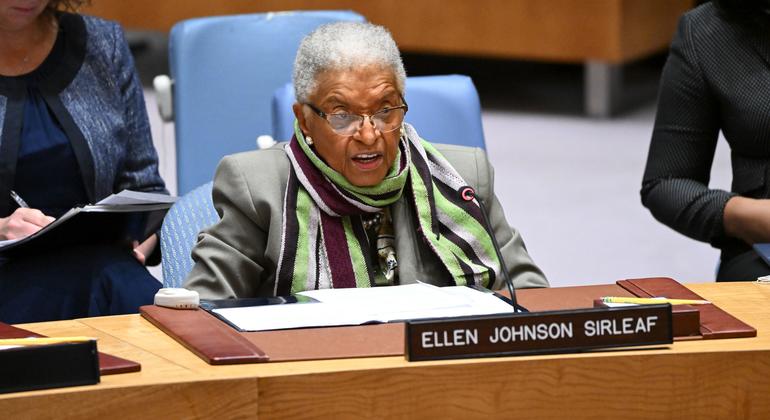
Liberia’s story is one of pain, but also of promise,” Ms. Johnson-Sirleaf said in a video message.

“A nation once brought to its knees by protracted conflict now stands as a testimony to what is possible when national will is matched by international solidarity.”

In August 2003, the Liberian Government, two rebel groups and several political parties signed a peace accord in Accra, Ghana, after 14 years of civil war.

Building a new Liberia

“Knowing that Liberia could not return to what it was, we had to construct a new nation based on new governance structures of inclusion, transparency, justice and hope,” said the former President and Nobel Peace Prize laureate.

Critical institutions such as the Central Bank, the judiciary, the anti-corruption commission, and even civil society organizations, had to be restructured or built from the ground up. And women played a central role in peace efforts by leading advocacy, mediation and community rebuilding.

“Importantly, also, Liberia’s path to peace could not be walked alone,” she said.

Ms. Johnson-Sirleaf pointed to the essential role played by the international community through the UN and its peacekeeping Mission UNMIL, regional bloc ECOWAS, the African Union, the European Union, and other entities.

‘A work in progress’

She also expressed gratitude to multilateral and bilateral partners – including the PBC – whose technical, financial and moral support laid the foundations for the peace enjoyed today.

“Liberia’s peace remains a work in progress,” she said. “We still face challenges -economic fragility, governance bottlenecks and the aspirations of a youthful population seeking opportunity. But we have also come a long way.”

The PBC has backed peacebuilding efforts in more than 30 countries and regions, for example supporting democratic transition in The Gambia and collaborating with Timor Leste to advance stability.

Its “intervention and decisiveness at a critical juncture is not only manifestly historic but serves as a cardinal reference point for preventive diplomacy and international solidarity,” said Gambia’s Foreign Minister Mamadou Tangara.

Conflicts on the rise

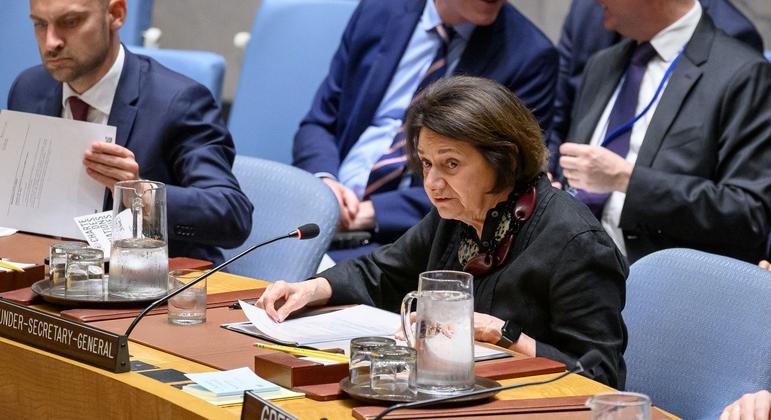
Rosemary DiCarlo, UN Under-Secretary-General for Political and Peacebuilding Affairs, remarked that the event was being held at a time when conflicts are becoming more numerous, more protracted and more complex, and as negotiated settlements are becoming even harder to achieve.

Against this backdrop, the role of the Peacebuilding Commission remains critical and more needed than ever,” she said.

She highlighted the Pact for the Future, adopted by UN Member States last September, which recognizes the central role of civil society, women and youth, and the value of UN partnerships with regional organizations and international financial institutions.

“Crucially, the Pact decided on the strengthening of the Peacebuilding Commission,” she said.  “Our task is to translate this ambition into practical progress.”

Still relevant today

Ms. DiCarlo said the PBC “should be equipped, strengthened and empowered to assist interested Member States to develop and implement national strategies for prevention and peace building.”

It should also have more systematic and robust links to other UN bodies and processes, such as the Security Council, and engage more deeply with regional organizations, international financial institutions and other key partners.

“The Commission is no longer a new institution, but its relevance and potential are undiminished at a time of increasing need. We must equip it to invest to deliver fully on its mandate.” 

Source link