
In hard-hitting human rights address, Guterres calls for urgent action on Gaza, authoritarianism and climate justice

Recalling his own experience living under dictatorship in Portugal, Mr. Guterres told participants at the Global Assembly of the international rights charity Amnesty International on Friday that the fight for human rights is “more important than ever”.

He called on States to uphold international law and defend human rights “consistently and universally, even or especially when inconvenient”, urging collective action to restore global trust, dignity and justice.

‘A moral crisis’

Mr. Guterres painted a stark picture of a world in turmoil, citing multiple ongoing crises, foremost among them, the war in Gaza.

While reiterating his condemnation of the 7 October 2023 terror attacks by Hamas and other Palestinian armed groups in Israel, the Secretary-General said that “nothing can justify the explosion of death and destruction since”.

The scale and scope is beyond anything we have seen in recent times,” he said.

I cannot explain the level of indifference and inaction we see by too many in the international community. The lack of compassion. The lack of truth. The lack of humanity.

Key takeaways from the address

  • Gaza – “A moral crisis that challenges the global conscience”
  • Ukraine – Call for a “just and lasting peace” based on the UN Charter, international law and resolutions
  • Authoritarianism – A “global contagion”, with political repression, attacks on minorities and shrinking civic space
  • Climate justice – Bold action needed to cut emissions; clean energy transition must uphold human rights
  • Digital threats – Concern over algorithmic spread of hate and falsehoods; manipulation via social media
  • Call to action – “Human rights are the solution, foundation of peace and engine of progress”

UN staff ‘neither dead nor alive’

He described UN staff in Gaza as working in “unimaginable conditions”, many of them so depleted they “say they feel neither dead nor alive”.

Since late May, he noted, more than 1,000 Palestinians have been killed trying to access food – not in combat, but “in desperation – while the entire population starves”.

This is not just a humanitarian crisis. It is a moral crisis that challenges the global conscience.

Ready to scale up aid

Mr. Guterres said the UN stands ready to dramatically scale up humanitarian operations “as we successfully did during the previous pause in fighting”, but called for an “immediate and permanent ceasefire”, the unconditional release of all hostages and full humanitarian access.

“At the same time, we need urgent, concrete and irreversible steps towards a two-State solution,” he stressed.

He also spoke about other conflicts, including Sudan as well as Russia’s invasion of Ukraine, where he called for a “just and lasting peace” based on the UN Charter, international law and relevant UN resolutions.

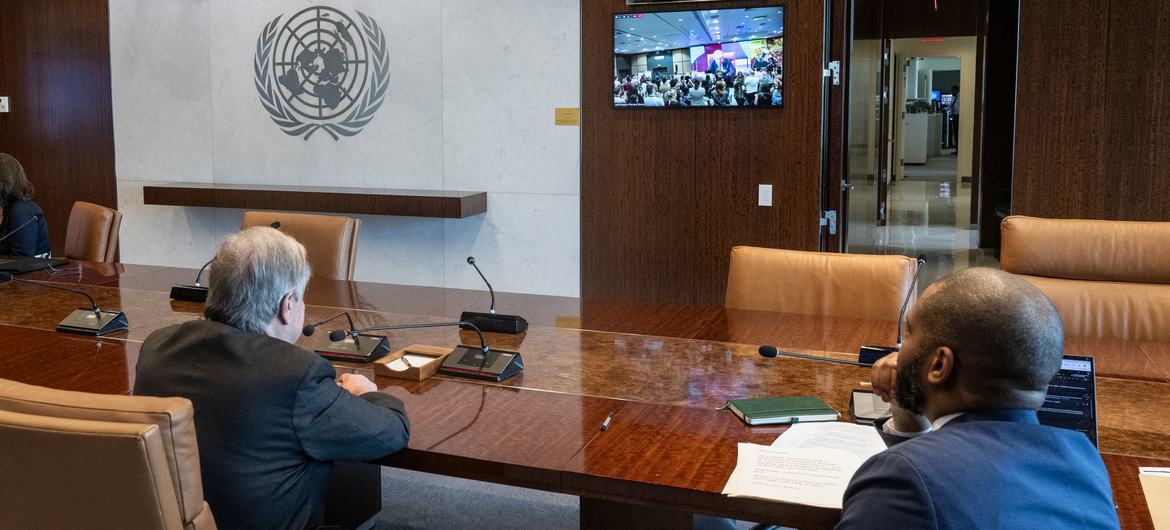
Secretary-General Guterres (left) addresses Amnesty International’s Global Assembly via video link.

Rising authoritarianism

The Secretary-General warned that authoritarian tactics are on the rise globally.

We are witnessing a surge in repressive tactics aiming at corroding respect for human rights,” he said. “And these are contaminating some democracies.

Political opposition movements are being crushed, accountability mechanisms dismantled, journalists and activists silenced, civic space strangled and minorities scapegoated.

Rights of women and girls in particular are being rolled back, most starkly, he said, in Afghanistan.

“This is not a series of isolated events. It is a global contagion.”

Weaponization of technology

He decried the growing weaponization of digital platforms, saying algorithms are “boosting the worst of humanity, rewarding falsehoods, fuelling racism and misogyny and deepening division”.

He called on governments to uphold the Global Digital Compact adopted by countries at the UN General Assembly last September and to take stronger action to combat online hate and disinformation.
© ICJ-CIJ/Frank van Beek

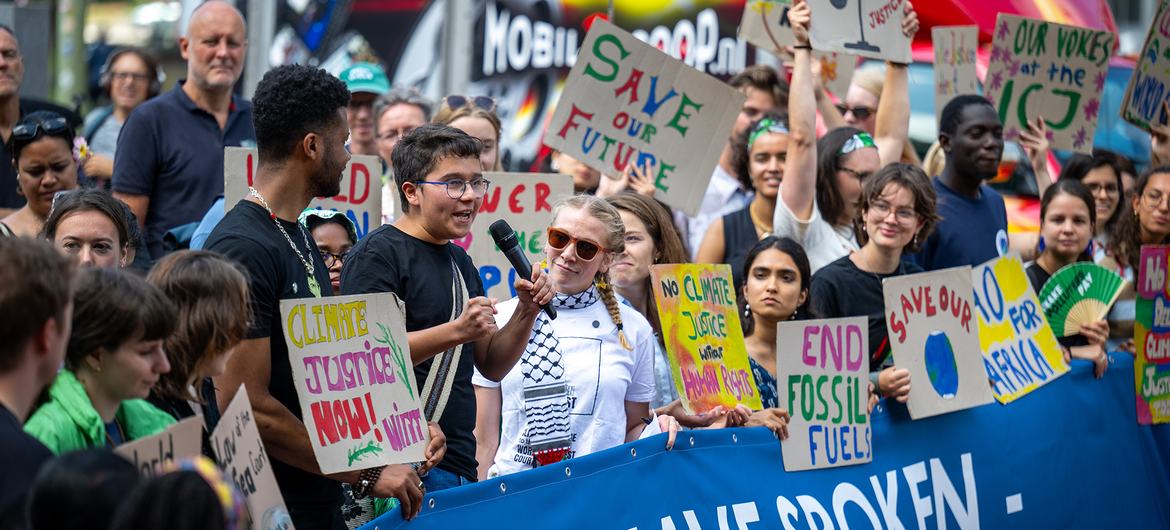
Activists outside the International Court of Justice (ICJ) in The Hague as the Court delivers its advisory opinion on the obligations of States in respect of climate change.

Climate justice is human rights

Turning to climate, Mr. Guterres described the environmental emergency as a “human rights catastrophe”, with the poorest and most vulnerable communities suffering most.

He welcomed the International Court of Justice (ICJ)’s advisory opinion this week, affirming that climate change is a human rights issue and that States have obligations under international law to protect the global climate system.

But, he cautioned against a transition to clean energy that sacrifices human rights.

“We cannot accept a clean energy future built on dirty practices…We cannot accept enormous violations of human rights, many of them against children, in the name of climate progress.”

He called for urgent emissions cuts, a just transition away from fossil fuels and real financing for developing countries to adapt, build resilience and recover from loss and damage.

A legacy of activism

The Secretary-General concluded by praising Amnesty International’s decades of activism, calling its work “indispensable” to the global human rights movement.

When you stand for human rights, you stand with what is right,” he told delegates.

“Your courage continues to change lives. Your persistence is shifting the course of history. Let’s keep going. Let’s meet this moment with the urgency it demands. And let’s never, ever give up.

Founded in 1961, Amnesty International is a global human rights movement that campaigns to end abuses and promote justice. The organization has long worked in collaboration with the United Nations, participating actively in the development of international human rights law and mechanisms.

Today’s speech by Mr. Guterres is first-ever address by a UN Secretary-General to Amnesty International’s Global Assembly, the charity’s highest decision-making body. The UN chief spoke via a video link to the event in Prague.
Source link

Global collaboration grows to address crises in Gaza, Sudan, Afghanistan

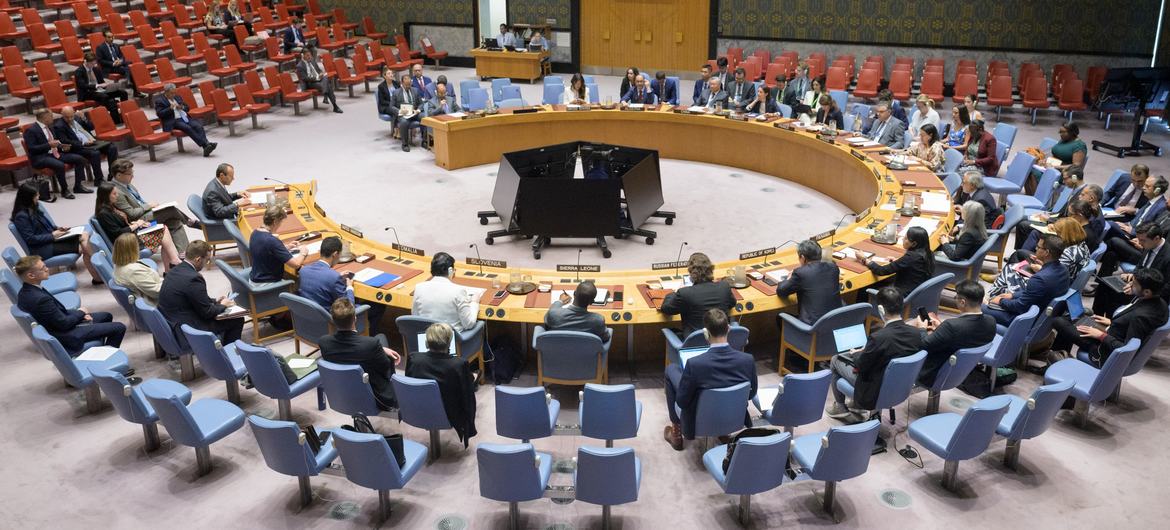
Briefing the Security Council on Thursday, Khaled Khiari, Assistant Secretary-General for the Middle East, said the OIC remains an “indispensable” partner in efforts to promote peace, uphold international law and deliver durable political solutions in a range of crisis contexts.

Headquartered in Jeddah, Saudi Arabia, the OIC has 57 member states and five observers, representing significant political, economic cultural and religious constituency.

Its voice carries considerable weight in some of the world’s conflict-affected situations,” Mr. Khiari said.

The UN values this partnership, not only as a matter of institutional cooperation, but as an essential component of our efforts to promote durable peace, inclusive governance and respect for international and human rights law.

He emphasized that the cooperation aligns with Chapter VIII of the UN Charter, which encourages partnerships with regional organizations in maintaining peace and security, and with the Pact for the Future – adopted by Member States last September to revitalize multilateralism and tackle global challenges through collective action.

Helping resolve crises

Mr. Khiari outlined joint UN-OIC work in Gaza, including the recent endorsement by the bloc and the League of Arab States of a recovery and reconstruction plan, as well as collaboration on the question of Jerusalem through an annual conference held in Dakar, Senegal.

In Sudan, where over two years of war have brought devastating humanitarian consequences, he welcomed the OIC’s backing for international mediation, including support for the UN Secretary-General’s Personal Envoy, Ramtane Lamamra.

Turning to Afghanistan, Mr. Khiari praised the OIC’s role in the UN-led “Doha Process,” noting its continued engagement with the Taliban de facto authorities and advocacy for the rights of Afghan women and girls – an area where the OIC’s moral and religious standing carries particular influence.

On Myanmar, the OIC remains an essential voice in global efforts to ensure a safe, dignified and voluntary return of the Rohingya to Rakhine state. He noted sustained coordination between the UN Secretary-General’s Special Envoy and the OIC in pushing for accountability and citizenship rights.

A wideview of the Security Council as ASG Khaled Khiari briefs members about cooperation between the UN and the Organisation of Islamic Cooperation.

Cooperation on global issues

Assistant Secretary-General Khiari also highlighted the growing collaboration between the two organizations on elections, including training on observation and women’s political participation. A new staff exchange programme is also helping to strengthen institutional ties.

He acknowledged the OIC’s leadership in countering Islamophobia and all forms of religious intolerance, an area where the UN has stepped up efforts, including through the appointment of a Special Envoy.

Counter-terrorism cooperation has also advanced, following a March 2024 memorandum of understanding. Joint initiatives include technical support, parliamentary engagement, and rights-based prevention strategies.

“As we move forward with the implementation of the Pact for the Future,” Mr. Khiari concluded, “the UN-OIC partnership will remain critical to defusing tensions, advancing sustainable peace, and reinforcing multilateral norms and principles.

Source link

Syria: UN commission hails recent action to address past violations

Paulo Sérgio Pinheiro highlighted the establishment of the National Transitional Authority and the National Authority for Missing Persons which are expected to help reveal the fate of the more than 100,000 Syrians estimated to have been forcibly disappeared or gone missing.

They are also expected to expose the truth about systematic violations like arbitrary detention, torture and ill-treatment, and about widespread attacks which killed hundreds of thousands of civilians and maimed millions during hostilities.

Syria continues along the path to transition following the overthrow of the Assad regime last December.

Wave of retaliatory attacks

Mr. Pinheiro said the security vacuum left after the dismissal of the armed forces and security services, together with a lack of clarity on the new framework for justice, contributed to an atmosphere where victims of past crimes and violations attempted to take the law into their own hands and settle scores.

Retaliatory attacks that took place in coastal areas in March, and on a smaller scale in other parts of the country, were “in part a response to five decades of systematic crimes perpetrated by security forces with impunity which affected all Syrians,” he said.

“More recently, sectarian fault lines have also been fuelled by widespread hate speech and incitement against Alawis, off and online, including posts with false information reportedly often originating from abroad.”

Eyewitness accounts

The Commission conducted its latest visit to Syria last week and travelled to several locations on the coast where killings and looting had occurred.  The team met with several civil and security authorities, as well as eyewitnesses and victims’ families.

“First-hand accounts by survivors of these events…revealed in detail how residential areas were raided by large groups of armed men, many of them members of factions now affiliated with the State. They told us how the assailants detained, ill-treated and executed Alawis,” he said.

He acknowledged the interim authorities’ establishment of a National Inquiry to investigate the violations as well as an additional High-Level Committee to Maintain Civil Peace.  Furthermore, dozens of alleged perpetrators have been arrested.

“Protection of civilians is essential to prevent further violations and crimes,” he said. 

“We welcome the commitment of President (Ahmed) al-Sharaa to hold those responsible accountable to restore confidence for State institutions amongst the affected communities.”

He also pointed to a deadly attack on a Greek Orthodox church in Damascus last Sunday, saying the authorities must ensure the protection of places of worship and threatened communities, and perpetrators and enablers must be held accountable.

Foreign intervention

Mr. Pinheiro told the Council that “the Syrian conflict has had no shortage of internal challenges and grievances, many of which were made worse by foreign interventions.”

In recent weeks, Israel has carried out a wave of airstrikes in and around Damascus, including near the presidential palace. Military bases and weapons depots in Daraa, Hama, Tartous and Latakia have also been targeted as part of its sustained military campaign in Syria. Several civilians were killed.

Civilian casualties were also reported in the context of Israeli operations in the buffer zone in Quneitra and southwestern Daraa monitored by the UN Disengagement Observer Force (UNDOF)

“These actions raise serious concerns of violations of international human rights and humanitarian law as UN Secretary-General (António) Guterres further stated recently,” he said.

Millions in need 

Mr. Pinheiro reported that more than two million Syrians have returned home since December, including nearly 600,000 from neighbouring countries and just under 1.5 million internally displaced persons (IDPs).

“For many of the over seven million Syrians who remain displaced, massive property-related challenges will need to be tackled in the wake of industrial-scale destruction, pillage and confiscation of homes and lands,” he said.

Moreover, he noted that “despite the recent encouraging steps towards lifting of sectoral sanctions and opening the country to new investments, nearly 16.5 million Syrians remain in need of humanitarian assistance.” Among them are nearly three million people facing severe food insecurity.

Mr. Pinheiro concluded his remarks, saying “the interim authorities’ repeated commitments to protect the rights of everyone and all communities in Syria without discrimination of any kind are encouraging” and “should be met with the necessary support from the international community.”

About the Commission

The Independent International Commission of Inquiry on the Syrian Arab Republic was by the Human Rights Council in August 2011 with a mandate to investigate all alleged violations of international human rights law since March 2011.

The members are Mr. Pinheiro and Commissioners Hanny Megally and Lynn Welchman.

They are not UN staff and do not receive any payment for their work.

Energy access has improved, but more funding is needed to address disparities: WHO

While the rate of basic access to energy has increased since 2022, the current pace is insufficient to reach universal access by 2030, one of the UN’s Sustainable Development Goals (SDGs), according to a report published by the WHO and partners this Wednesday.

The report highlights the role of cost-effective distributed renewable energy — a combination of mini-grid and off-grid solar systems — in accelerating energy access, particularly as the populations who remain unconnected mostly live in remote, lower-income, and fragile areas.

Regional disparities

“Despite progress in some parts of the world, the expansion of electricity and clean cooking access remains disappointingly slow, especially in Africa,” said Fatih Birol, Executive Director of the International Energy Agency (IEA), as 85 per cent of the global population without electricity access reside in sub-Saharan Africa.

In the region, renewables deployment has rapidly expanded; however, on average, it remains limited to 40 watts of installed capacity per capita — only one eighth of the average in other developing countries.

Clean cooking

As regional disparities persist, an estimated 1.5 billion people residing in rural areas still lack access to clean cooking, while over two billion people remain dependent on polluting and hazardous fuels such as firewood and charcoal for their cooking needs.

Yet, the use of off-grid clean technologies, such as household biogas plants and mini-grids that enable electric cooking, can offer solutions that reduce the health impacts caused by household air pollution.

“The same pollutants that are poisoning our planet are also poisoning people, contributing to millions of deaths each year from cardiovascular and respiratory diseases, particularly among the most vulnerable, including women and children,” said Tedros Ghebreyesus, WHO Director-General.

Lack of financing

The report identified the lack of sufficient and affordable financing as a key reason for regional inequalities and slow progress.

While international public financial flows to developing countries in support of clean energy have increased since 2022, the developing world received significantly fewer flows in 2023 than in 2016.

“This year’s report shows that now is the time to come together to build on existing achievements and scale up our efforts,” said Stefan Schweinfest, Director of the UN Statistics Division, as the report called for strengthened international cooperation between the public and private sectors to scale up financial support for developing countries, especially in sub-Saharan Africa.