
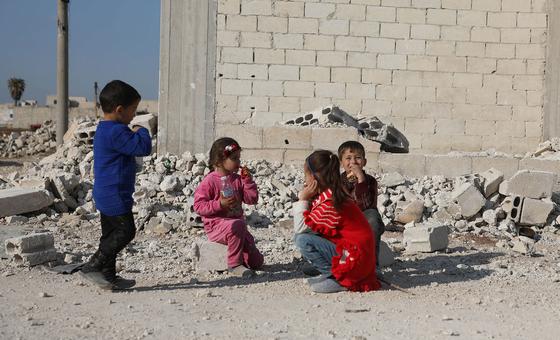
Port Sudan: No let-up in drone attacks as UN chief urges peace

The UN chief warned that any further escalation of the conflict could result in massive civilian casualties and worsen the already catastrophic humanitarian situation across the country.

The expansion of the conflict into an area that has served as a place of refuge for a large number of displaced people is alarming,” he said in a statement issued by his Spokesperson’s office.

Mr. Guterres’s appeal follows days of drone strikes on key infrastructure in Port Sudan that have opened a new front in the fighting between forces of the military government and heavily armed paramilitaries.

The city is a main entry point for relief supplies, hosting airports and direct access to the Red Sea. It is also a shelter for hundreds of thousands of displaced people and the seat of government after generals lost control of the capital Khartoum to the Rapid Support Forces (RSF).

Aid flights suspended

In response to the drone attacks, flights of the UN Humanitarian Air Service (UNHAS) to and from Port Sudan have been suspended since 4 May.

The UN World Food Programme (WFP) which manages the airline said that operations will resume as soon as conditions allow. For the moment, amid reported gun and weapons fire overnight, the insecurity has impacted the movement of aid workers into Sudan and across the country.

A country in flux

Drone strikes have also been reported elsewhere in Sudan, including the states of Kassala and River Nile. In Kassala, strikes near the airport displaced about 2,900 people and led to the temporary suspension or relocation of some aid activities, according to the UN aid coordination office, OCHA.

As of Wednesday evening, River Nile State was still without power following a drone strike on the transformer station in Atbara on 25 April. The outage has contributed to growing fuel and bread shortages and long queues at petrol stations and bakeries.

The situation remains dire across Sudan, the UN chief continued, citing intense attacks on critical infrastructure since January that have hampered people’s access to essential services and left them without food, clean water, healthcare and electricity.

“All parties to the conflict must comply with their obligations under international humanitarian law,” Mr. Guterres insisted. “They must not direct attacks against civilians and civilian objects; must take all feasible precautions to avoid, and in any event to minimize, incidental civilian casualties; and must allow and facilitate rapid and unimpeded passage of humanitarian relief for civilians in need.”

Sudan’s war stems from the breakdown in the transition to civilian rule following the overthrow in April 2019 of Omar al-Bashir, who had been president for 30 years.

Mr. Guterres decried a “lack of political will” by the warring parties to engage in constructive dialogue as they pursued their military goals.

“Dialogue is the only way to achieve the peace that the people of Sudan demand,” the Secretary-General insisted.

A hunger catastrophe

The turmoil caused by relentless heavy fighting across Sudan has reportedly killed more than 18,800 civilians and injured tens of thousands more. UN aid agencies say that the country’s people are in the grip of the largest hunger catastrophe on the planet.

Today, more than half of Sudan’s population – 30.4 million people – need humanitarian assistance, including more than 15 million children. They lack access to food, water, shelter, electricity, education and healthcare, aid veterans have warned repeatedly.

“Across Sudan, 25 million people face acute hunger,” WFP spokesperson Leni Kinzli told UN News. “And people are displaced across the country, nearly 13 million people forced from their homes. We are seeing waves of displacement in North Darfur, where around 450,000 people have fled horrific levels of violence.

Reaching those in need

Despite the dangers, UN agencies and partners are doing everything they can to reach the most vulnerable uprooted by intensifying attacks on government-controlled El Fasher town and Zamzam displacement camp.

“We’ve distributed assistance food assistance and emergency food packages to 335,000 people who recently fled that violence in and around El Fasher,” Ms. Kinzli explained. “We are also ramping up assistance in Khartoum, aiming to support one million people across the coming month.”

Distributions are ongoing in Jabalia, in the South of Khartoum, which is one of the risk of famine areas, as well as the central Khartoum neighbourhood of Burri, “where we finally reached the centre of the city…just last week”, the WFP officer noted.

To reach 21 million people in desperate need this year the UN needs $4.2 billion which is only seven per cent funded.

And over the next six months, WFP requires around $700 million to ramp up assistance and expand assistance to seven million people per month. 

Source link

UN Secretary-General urges military restraint from India, Pakistan

In a note to correspondents issued by his spokesperson on Tuesday, Secretary-General António Guterres called for military restraint from both countries.

The world cannot afford a military confrontation between India and Pakistan,” the note said.

On Monday, the Secretary-General had warned that the tensions between the two South Asian neighbours had reached “their highest in years.”

He offered his good offices to both governments to help defuse tensions and promote diplomacy, stressing that “a military solution is no solution.”

Source link

‘Step back from the brink’, Guterres urges India and Pakistan

Addressing journalists outside the Security Council at UN Headquarters in New York, Mr. Guterres expressed deep concern over deteriorating relations between the two South Asian neighbours, saying they had reached “their highest in years.”

He reiterated his condemnation of the 22 April terror attack in the Pahalgam area of Jammu and Kashmir, which killed at least 26 civilians and injured many more.

Targeting civilians is unacceptable – and those responsible must be brought to justice through credible and lawful means,” Mr. Guterres said.

It is also essential – especially at this critical hour – to avoid a military confrontation that could easily spin out of control.

The Security Council is due to meet behind closed doors later on Monday to discuss the rising tensions between the two nations.

UN ready to help de-escalate

He offered his good offices to both governments to help defuse tensions and promote diplomacy, stressing that “a military solution is no solution.

“Now is the time for maximum restraint and stepping back from the brink,” he said.

Mr. Guterres also praised both countries for their long-standing contributions to UN peacekeeping operations and expressed hope that their shared history of cooperation could form the basis for renewed dialogue.

“The United Nations stands ready to support any initiative that promotes de-escalation, diplomacy, and a renewed commitment to peace,” he said.

Source link

Guterres condemns violence against civilians in Syria, urges Israel to stop attacks

UN Spokesperson Stéphane Dujarric said on Friday that the Secretary-General “has been monitoring with alarm the reports of violence in the suburbs of Damascus and in the south of Syria, including reports of civilian casualties and assassination of local administration figures.”

More than 100 people have reportedly been killed in recent days during clashes with sectarian overtones, including in Suweyda governorate.

Call for restraint

Mr. Dujarric said the Secretary-General condemns all violence against civilians, including acts which could risk inflaming sectarian tensions.

In this context, the UN chief also condemned Israel’s violation of Syria’s sovereignty, including the latest airstrike near the presidential palace in Damascus.

“It is essential that these attacks stop and that Israel respect Syria’s sovereignty, unity, territorial integrity, and independence,” the Spokesperson added.

The Secretary-General unequivocally called on all concerned to cease all hostilities, exercise utmost restraint and avoid further escalation. 

He was encouraged by intra-Syrian efforts to de-escalate the violence and maintain security and stability. 

Mr. Guterres took note of the statement by Syria’s interim President Ahmed al-Sharaa, which prioritizes “dialogue and cooperation within the framework of national unity.” He also appealed to the interim authorities to transparently and openly investigate all violations. 

Rights experts’ warning

Experts appointed by the UN Human Rights Council also warned that the recent surge in violence “is deeply troubling” for peace efforts in Syria

The Commission of Inquiry on Syria said the fighting, combined with ongoing Israeli airstrikes, raises the risk of further fragmentation and harm to civilians.

Members noted that hate speech and incitement on social media are fuelling tensions, urging all sides to stop hostilities and commit to dialogue.

While a local agreement has reportedly been reached between Damascus authorities and community leaders, the interim government remains responsible for protecting civilians.

The Commission also called for credible investigations into alleged abuses.

“Impunity for grave violations has in the past been a consistent driver of Syria’s conflict and must not be allowed to persist,” it said. 

“Only by upholding the rule of law and ensuring justice, accountability and reparations for victims and their families can Syria begin to rebuild trust across its fractured communities.”

Independent voices

The Commission of Inquiry was initially established in August 2011 and its mandate has been consistently renewed, most recently in April.

The three Commissioners serve in their individual capacity and are independent from any government or organization, including the UN.

They are not UN staff and do not receive payment for their work.  

Source link

Israel must end ‘cruel collective punishment’ in Gaza, urges UN relief chief

In a powerful statement on Thursday, Tom Fletcher, the UN Emergency Relief Coordinator, condemned Israel’s decision to halt humanitarian assistance as a “cruel collective punishment” of the Palestinian population.

“Two months ago, the Israeli authorities took a deliberate decision to block all aid to Gaza and halt our efforts to save survivors of their military offensive,” said Mr Fletcher. “They have been bracingly honest that this policy is to pressurise Hamas.”

‘Blocking aid kills’

While reaffirming the urgent need for the release of hostages taken by Hamas on 7 October 2023 – who “should never have been taken from their families,” – the UN relief chief stressed that “international law is unequivocal: As the occupying power, Israel must allow humanitarian support in.”

Aid, and the civilian lives it saves, should never be a bargaining chip,” he added. “Blocking aid kills.”

Mr Fletcher warned that the aid blockade “starves civilians”, denies them basic medical services, and “strips them of dignity and hope.”

He underscored the neutrality and impartiality of humanitarian efforts, adding: “We believe that all civilians are equally worthy of protection. We remain ready to save as many lives as we can, despite the risks.”

Let us save lives

However, the latest delivery mechanism proposed by Israel, he said, “does not meet the minimum bar for principled humanitarian support.”

“To the Israeli authorities, and those who can still reason with them, we say again: lift this brutal blockade. Let humanitarians save lives,” he pleaded.

Addressing civilians in Gaza, Mr Fletcher said: “No apology can suffice… But I am truly sorry that we are unable to move the international community to prevent this injustice. We won’t give up.”

More to follow…