
From war zones to outer space, radio remains essential

Every 13 February marks World Radio Day, a celebration timed to the moment UN Radio first crackled to life 80 years ago.

UN News teams have gathered stories from every corner of the world that reveal a simple truth: in places fractured by conflict, disasters or deep digital divides, radio remains a steady, reliable pulse – carrying information, reassurance and connection where other signals cannot reach.

From UN Radio to UN News

This enduring role is deeply woven into the history of the United Nations itself. Eighty years ago, as the world emerged from the devastation of the Second World War, UN Radio began broadcasting from modest studios at UN Headquarters in New York, reaching audiences with news bulletins and feature programmes in five languages, often transmitting entire Security Council proceedings.

L to R: UN Radio staff José Quijano-Santos, Luis Marron, Hernando Solano, Jorge A. Carvallo, Luis Carlos Sanchez, Osvaldo Lopez Noguerol, Beatrix Alcapra Cuellar and Guillermo Caram, record a special broadcast for Latin American radio networks.

Over the decades, iconic voices such as Edward R. Murrow, Marlon Brando, Audrey Hepburn and Frank Sinatra helped narrate global stories, while listeners heard historic speeches from leaders including John F. Kennedy, Mikhail Gorbachev, Nelson Mandela, Fidel Castro and Pope John Paul II.

That legacy evolved into what is now UN News, a multimedia platform publishing in 10 languages and connecting with audiences in more than 170 countries. It brings breaking news, interviews, live coverage and richer storytelling on the world’s most urgent challenges – and the efforts under way to solve them.

For all the transformations brought by new technology, one guiding principle endures: providing dependable information to the people who need it most, through audio formats that bridge both heritage and innovation.

Rebuilding radio broadcasting in Gaza

Nowhere is this mission more urgent than in conflict zones. In Gaza, before October 7, 2023, a total of 23 local radio stations operated across the territory. Following the war triggered by Hamas attacks on Israel, every station was destroyed.

Yet Rami Al‑Sharafi, director of Zaman FM, is working to piece broadcasting back together – a fragile but determined effort in the midst of profound damage.

Journalist Rami Al-Sharfi, is the director of radio at Gaza’s ZMN 90.60 FM radio station.

When UN News Arabic visited the station, he put it plainly: “Zaman FM has resumed broadcasting, and we are currently the only radio station transmitting FM frequencies from inside the Gaza Strip after this massive destruction.”

The need for reliable broadcasting is profound, particularly as Gaza faces the spread of diseases, the collapse of educational structures, and disrupted public services.

A crucial tool for peacekeeping

Across other conflict zones, radio serves as a steadying presence. In the Democratic Republic of the Congo, Radio Okapi, has become a trusted voice since its creation in 2002 as part of the UN peacekeeping mission there, known as MONUSCO.

Broadcasting in French and four national languages, the station offers reliable information in regions of the country affected by violence and displacement, according to testimonies gathered by UN News French.

In Bukavu, deep in the country’s restive eastern region, one listener described how Radio Okapi “plays a key role in promoting peace by broadcasting information that is reliable and impartial,” noting that “when people want to be sure that information is true, they often turn to Radio Okapi.”

Radio Okapi and Radio nationale congolaise have made a commitment to broadcast didactic sequences on the main subjects of the primary and secondary cycle in the DRC during the Covid-19 pandemic

For many communities, the station is also a vital channel for civic participation and accountability. “It ensures that victims of war can express their suffering so that it can reach the authorities,” said another Bukavu resident.

The station’s influence extends beyond information, actively countering hate speech and strengthening social cohesion. In Lubumbashi, a listener credited Radio Okapi with helping “stop or reduce messages inciting hatred,” while praising programmes like Inter-Congolese Dialogue, which he said, “allow national cohesion to produce outcomes of peace.”

Lifesaving information in conflict zones

For refugees such as Bahati Yohane, now living in Kyangwali Refugee camp in Uganda, Okapi became a literal lifeline during escalating violence in DRC. In an interview to UN News Kiswahili, he said: “To be honest, if there had been no radio to tell us anything about security, we would not be alive in this world today”.

In the Central African Republic, radio continues to bridge isolation in remote and insecure areas. The UN Mission, MINUSCA, supports both its own station, Guira FM, and local broadcasters to strengthen access to trusted information.

Radio GUIRA-FM – 4 years anniversary

Through recent campaigns that put more than 500 radios into local hands, communities have not only improved the flow of reliable information but also curbed the kinds of rumors that can disrupt travel, trade and relations between neighbours.

These efforts revive a tradition that began decades ago, when UN News Kiswahili partnered with Radio Tanzania – now the Tanzania Broadcasting Corporation – to air the weekly programme Mwangaza wa Umoja wa Mataifa from the 1970s through the 1990s.Former programme controller Edda Sanga remembers that “the program helped build hope and aspirations for many people,” offering stories of progress and practical solutions.

It became, she said, a programme “eagerly awaited” by listeners looking for reliable updates on peace, human rights, environmental issues and conflicts unfolding in neighbouring countries.

The UN Educational, Scientific and Cultural Organization, UNESCO, is also a key partner for radio stations across fragile environments, helping them remain operational during crises and continue delivering life‑saving information. In Afghanistan, the agency backs 10 stations that broadcast guidance on basic services, reaching as many as 20 million listeners, about 40 per cent of whom are women and girls.

Radio amateurs as national heroes

Outside conflict areas, radio’s quiet strength becomes even clearer during climate‑driven emergencies. As storms or floods knock out phone lines and internet connections, radio signals frequently remain the last dependable link to the outside world.

Eloísa Farrera/CINU México

Jesús Miguel Sarmiento, with the call sign XE1EW as a radio operator, presides over the Mexican Federation of Radio Experimenters

In Mexico, amateur radio operators were recognized as national heroes following the 1985 earthquake, when traditional communication systems failed entirely.

Today, the Mexican Federation of Radio Amateurs coordinates the National Emergency Network, due to its ability of transmitting vital information during hurricanes, floods, and earthquakes.

During Hurricane Otis in 2023, operators quickly improvised communication systems under extreme conditions. As Federation President Jesús Miguel Sarmiento Montesinos told UN News Spanish, “They turned copper wires into antennas, used their equipment and batteries, and immediately began transmitting, reporting on the situation in the affected areas, the extent of the flooding, and whether the areas were accessible or inaccessible”.

An inclusive platform

Radio also serves as a powerful force for accessibility and inclusion. In India, Radio Udaan was launched in 2014 as the country’s first online station operated entirely by visually impaired presenters and staff. Today, it reaches 125,000 listeners across 120 countries, addressing disability rights, education, technology and social inclusion, and challenging stereotypes through fashion shows, singing competitions, matchmaking, talent hunts and other community‑driven programmes.

UN News Hindi spoke with Founder Danish Mahajan, who explained that his lived experience as a visually impaired person helps shape programming tailored to audience needs.

An Online Radio Station Giving Voice to India’s Visually Impaired.

He highlighted the importance of UN News content, noting, “Whenever there is a programme, discussion, or special UN commemoration related to disability, the themes, dialogues, and inspirational talks produced by the United Nations greatly benefit the community”.

Mr. Mahajan also sees new opportunities through artificial intelligence, AI, describing it as a “game-changing technology” capable of expanding accessibility through tools such as smart glasses that help visually impaired individuals make sense of their surroundings.

Empathy that algorithms can’t replicate

Artificial intelligence is transforming the global audio landscape. In China, these shifts are unfolding at remarkable speed, with the podcast audience already exceeding 150 million and expected to grow further.

UN News Chinese heard from Professor Sun Shaojing of Fudan University that audio content is becoming deeply woven into daily life – from electric vehicles navigating crowded cities to smart devices accompanying moments of solitude.

The UN Global Digital Compact aims to bring together governments and industry to ensure that technology, like AI, works for all humanity.

He notes that AI‑generated news presenters and synthetic voices are becoming increasingly common, offering accuracy, efficiency and multilingual reach on a scale once unimaginable. Yet within this technological precision, Professor Sun identifies a paradox: the very imperfections of human speech – the pauses, hesitations and emotional textures – are what give voice its soul.

“When reporting on disaster scenes, affected individuals, their suffering, and their needs, AI would lose many of the emotional and empathetic dimensions that require human compassion and connection. It would not achieve the same depth of emotional impact or resonance”, he said.

Demand increases for radio communications in outer space

Even beyond Earth, radio continues to underpin communication and discovery. From the moment the first satellite broke through the atmosphere in 1957, radio waves have carried the quiet work of exploration, becoming the unseen bridge behind space communications, Earth monitoring and navigation.

As space exploration accelerates, these frequencies are becoming even more critical. Alexandre Vallet, Chief of Space Services at the International Telecommunication Union, ITU, told UN News Portuguese that satellites equipped with highly sensitive sensors rely on ITU’s protected spectrum bands to accurately track the accelerating impacts of climate change.

A satellite, as seen from space, tracks over South America.

He explained that expanding lunar plans by major space powers – including proposals from the United States and China to build permanent bases – are likely to drive a steep increase in radio‑communication needs. That surge, he warned, could threaten the Moon’s Shielded Zone, protected under a 1970s ITU treaty to preserve the lunar silence essential for studying the universe’s earliest moments.

“For the next conference on the radio regulations, at the end of 2027, we will discuss establishing for the first time a regulatory framework for radio spectrum management on the moon. So, this will include finding a good balance between the need for communication links and also the need to protect the spectrum for scientific purposes,” he said.

Looking ahead, the rapid transformation of the space economy will only deepen humanity’s reliance on radio spectrum. Mr. Vallet added that emerging industries such as space tourism, orbital manufacturing, space mining, and even data centers beyond Earth will depend on reliable radio-based communication channels.

A signal that endures

Across conflict zones, disaster response, accessibility efforts, digital innovation and even the far reaches of space, radio continues to demonstrate its quiet but remarkable strength.

Amid a world overwhelmed by images and accelerating technology, these invisible waves endure as a reminder that the simplest forms of communication often hold the greatest power to inform, protect and unite.

Listen to daily news bulletins and podcasts on SoundCloud or here.

Source link

‘Our work is largely invisible’: Journey from outer space to frontline aid worker

Ahead of donning a beige WFP vest and boots to face hurricanes, wars and refugee camps, the Portuguese scientist worked with satellite imagery and cartography, creating maps to support humanitarian missions, until he realised he didn’t want to stay behind a computer screen.

On the occasion of World Humanitarian Day, marked annually on 19 August, Mr. Matos shared his story with UN News.

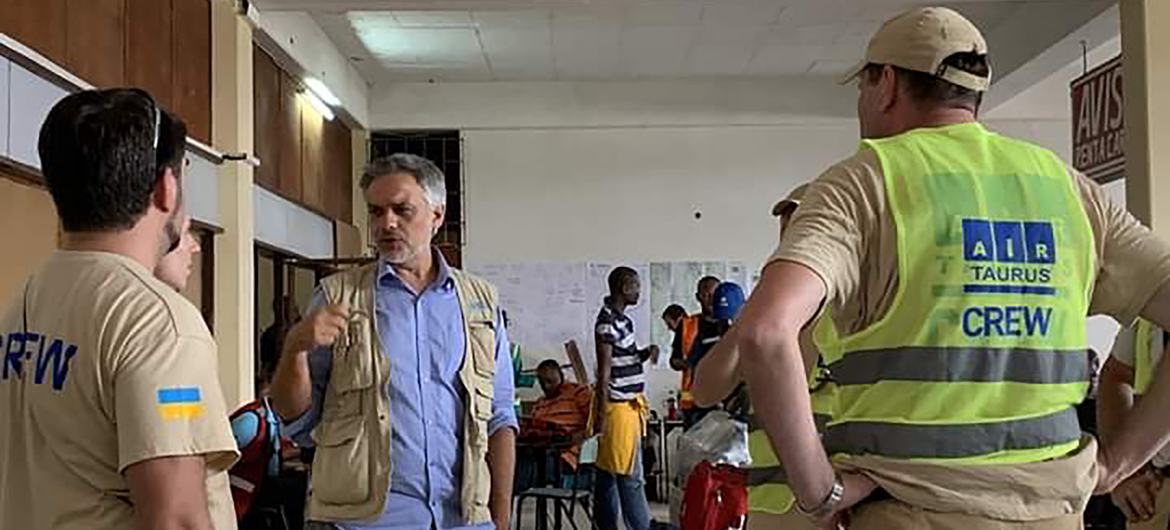
Pedro Matos joined the WFP response team following the deadly Cyclone Idai in Mozambique in 2019. (file)

From hurricanes to war

“At a certain point, it just wasn’t enough,” he recalled about his space engineering job. “I didn’t want to be making maps for other people to go and do humanitarian responses. I want to take those maps and be the one to do the responding.”

That’s exactly what he did. At WFP, he first developed maps on the ground and then went on to coordinate the agency’s emergency operations.

Since then, he has visited dozens of countries often at the epicentre of crises, from Hurricane Idai in Mozambique to the outbreak of war in Ukraine.
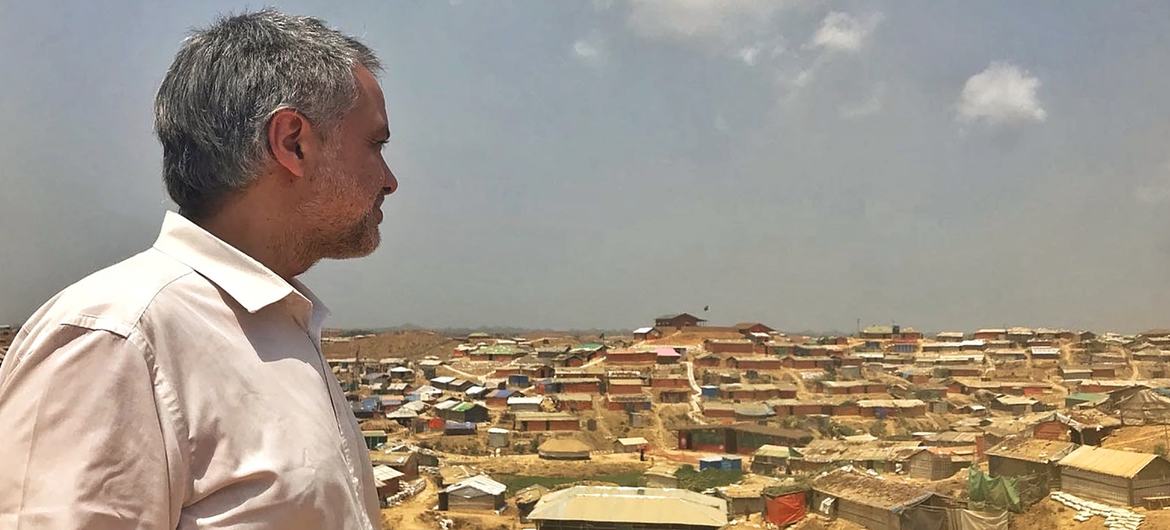
In 2018, Pedro Matos looks at the Kutupalong refugee camp where Rohingya refugees live. (file)

‘Like moving an entire government’

Coordinating in an emergency response is like “moving an entire government”, where each UN agency represents a “ministry” and the response only works when everyone comes together over the four essential areas in a crisis response: food, shelter, water and health.

Having just returned from a mission in Bangladesh, he described efforts to respond at Cox’s Bazar, the world’s largest refugee camp and home to 700,000 people who fled violence in Myanmar.

“We’ve been able to provide better conditions for people to live in this limbo with a little more comfort,” he said, also remembering his visit there in 2018 at the height of the crisis.

At the time, “a million people crossed the border in a month.” Today, although they remain in “limbo”, he pointed to improvements such as more monsoon-resistant homes and roads, gas stoves and reforestation.
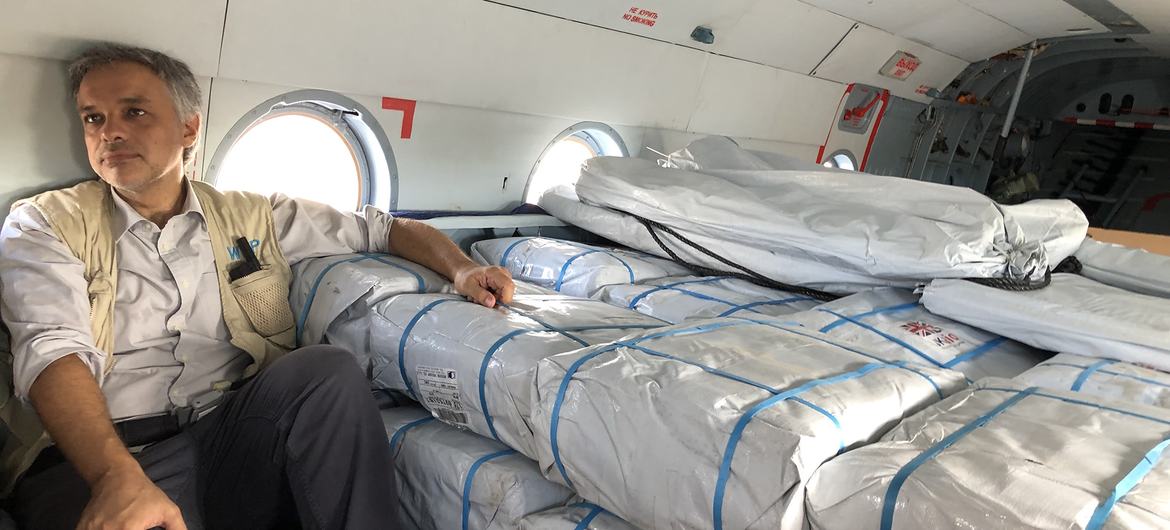
Pedro Matos on board a humanitarian aid flight after Cyclone Idai in Mozambique. (file)

Heart-shredding challenges and profound rewards

The job has meant both challenges and rewards.

“We’ve also had a few instances where we’ve been kidnapped, or come under fire, but it’s not the things that happen to us that impact us the most,” he said. “It’s the things that happen to others that have the most impact.”

Hurricane Idai in Mozambique was a Category 5 hurricane that hit Beira in 2019 was one of the biggest and most intense crisis, but also most rewarding, he said.

“There’s this mix of something that was very intense and hard because we couldn’t reach everyone, but at the same time, the fact was that there were many people – tens or hundreds of thousands of people – who would have died if we hadn’t been there,” he said. “That was the most impactful response in my 17 years at the United Nations.”

When he was in Yemen, “we were bombed 20 times a day” in the capital, Sana’a, he said, adding that “there’s a strange normalcy” that develops.

“We find ourselves saying things like, ‘no, that wasn’t very far; it was only 500 metres from here,’” he said. “It’s something I never thought I’d think or say before doing this work.”

When reaching central Ukraine several weeks after Russia’s full-scale invasion in early 2022, he called the situation “very intense”. Within a week, he and his colleagues began distributing money to people coming from the frontlines.

We couldn’t reach everyone, but there were tens or hundreds of thousands of people who would have died if we hadn’t been there.

“When we interviewed people and asked them what they were doing with the money we gave them, it was very gratifying,” he said. “It was beautiful.”

Those who had been wounded in the war were using the money to buy painkillers. Others used it to pay for gas to escape the frontlines. One mother had been able to buy her daughter a scoop of ice cream for the first time since the war began.

“Her daughter was delighted,” he said. “There are very rewarding moments.”

Feeding millions every day

“We all think we know what the humanitarian or aid sector is,” Mr. Matos explained, adding that the scale during a crisis is much, much larger.

“I thought we’d be rehabilitating schools, feeding 100 people,” he continued. “I never imagined I’d be feeding 13 million people a day in Yemen. The scale is absolutely incredible.”

However, humanitarian work is often seen as a separate job, he said. Almost every profession that exists in private and government sectors also exists in an aid landscape, from lawyers, those who work in procurement, like in supermarkets, and human resources.

“I basically do the same work as social workers or firefighters,” he said. “They do it here every day, and I do it elsewhere. But, our work is in the same field and very similar.”
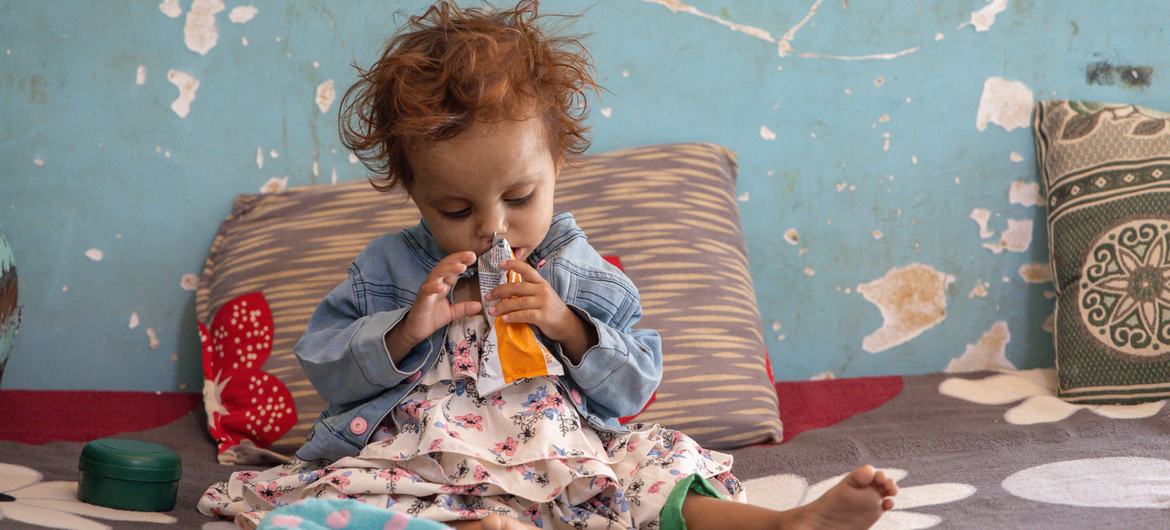
A toddler eats a food supplement, as part of WFP’s nutrition programme, in Mokha, Taiz, in Yemen.

The value of a Nobel Prize

WFP was awarded the Nobel Peace Prize in 2020, a recognition that Mr. Matos received with humility.

“Our work is largely invisible, despite feeding 120 million people every day,” he said. “It gave us a platform to raise awareness about crises like Congo, Myanmar, Sudan and Gaza, which often go unnoticed.”

Our work is largely invisible, despite feeding 120 million people every day.

He said his job is to give voice to the voiceless when crises fade from news headlines. Despite the difficulties and risks across his career, Mr. Matos has no doubt about the most important lesson he learned.

“People are essentially good,” he said. “When faced with the imminence of tragedy, people are fundamentally good and want to help others, even if that other person is very different. It was good to realise this because it’s not always obvious when we’re far from these crises.”

Source link