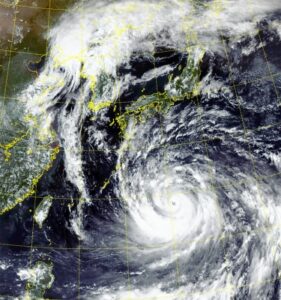
Sep 19 (IANS) At least two people were killed in Japan and some nine million others asked to evacuate from their homes after super typhoon Nanmadol, deemed to be one of the worst, made landfall in the region of Kyushu, bringing heavy rain and gales, local media reported on Monday.
In Fukuoka prefecture, a man who was believed to be on his way to find shelter from the typhoon was found collapsed and later confirmed dead, reports Xinhua news agency.
Another man was declared dead after being pulled out of a car submerged in a flooded farmland in Miyazaki prefecture, according to local authorities.
According to a Miyazaki prefectural official, a man in his 40s was reported missing after his cabin was destroyed by a landslide.
Typhoon/Ians
The 14th typhoon of the year was moving near Hagi, Yamaguchi prefecture on Monday afternoon, at a speed of some 20 km per hour.
It had an atmospheric pressure of 975 hectopascals at its centre, packing winds up to 108 kph with maximum gusts of 162 kph.
More than 70 people were injured amid the extreme weather, with bullet trains suspended in Kyushu on Monday and around 600 flights cancelled by the country’s two main airlines ANA and Japan Airlines, the local media reports said.
The typhoon is expected to travel across Japan’s largest island, Honshu through Tuesday, with the Japan Meteorological Agency continuing to issue warnings for strong winds, high tides and mudslides.
Typhoon/Ians
Tens of thousands of people spent Sunday night in emergency shelters, and almost 350,000 homes are without power.
Prime Minister Fumio Kishida has delayed a visit to New York, where he is due to give speech at the UN General Assembly, until Tuesday, to monitor the impact of the storm.
On April 24, NASA’s Aqua satellite captured a visible image of Tropical Cyclone Fakir, southeast of La Reunion Island. The image showed vertical wind shear was pushing the bulk of clouds southeast of the center of circulation.Credits: NASA/NRL
Tropical Cyclone Fakir tracked by NASA’s Aqua satellite, Heavy rains, tsunami-like waves likely on Indian coast of Andhra Pradesh and Odisha on Wednesday.
NASA’s Aqua satellite captured a visible image of Tropical Cyclone Fakir, southeast of La Reunion Island, that showed vertical wind shear affecting it in the Southern Indian Ocean.
The Joint Typhoon Warning Center or JTWC noted on Tuesday, April 24 at 11 a.m. EDT that Fakir’s center was located near 23.3 degrees south latitude and 57.5 degrees east longitude.
From the image taken at the location is approximately 162 nautical miles south of Port Louis, Mauritius, cyclone Fakir was seen moving to the south-southeast at 18 knots (20.7 mph/33.3 kph). Maximum sustained surface winds were estimated at 60 knots (69 mph /111 kph).
The Moderate Resolution Imaging Spectroradiometer or MODIS instrument aboard NASA’s Aqua satellite has captured a visible image of Fakir that showed a rapidly disintegrated system.
The image showed the cyclone elongated as the bulk of clouds and thunderstorms were being pushed to the southeast of the center, in an area of high vertical wind shear between 40 and 50 knots (46 to 57 mph/74 to 92 kph).
JTWC warned that “[Fakir] is forecast to continue deteriorating due to the severe vertical wind shear associated with the trough (elongated area of low pressure) approaching from the west and cooling sea surface temperatures along its forecast track to the southeast. The unfavorable environment will lead to dissipation by Thursday, April 26.”
The southwest Indian Ocean cyclone season that started on November 15, 2017 will last until April 30, 2018 and the major cyclone Fakir formed on Monday, April 23 near northeastern Madagascar as captured by the Global Precipitation Measurement mission or GPM core satellite looked at the storm’s rainfall rates.
On April 22, GPM showed that bands of extremely heavy rainfall were spiraling into the tropical low’s southeastern side. GPM’s radar (DPR Ku Band) showed that precipitation was falling at a rate of over 219 mm (8.6 inches) per hour in some of the strong convective storms that were moving toward Madagascar. GPM’s radar indicated that a few of the tallest intense convective storms were reaching heights of almost 16 km (9.9 miles).
Credits: NASA/JAXA, Hal Pierce
Fakir is expected to intensify as it moves toward the southeast and could be a significant tropical cyclone on Wednesday. Fakir will add woes to an already battered Madagascar by tropical cyclones Ava, Dumazile, and Eliakim.
The GPM core observatory satellite flew above the forming cyclone near northeastern Madagascar on April 22, 2018 and its Microwave Imager (GMI) and Dual Frequency Precipitation Radar (DPR) instruments revealed the locations of heavy rainfall linked with the forming Fakir cyclone.
GPM showed that bands of extremely heavy rainfall were spiraling into the southeastern side, precipitation was falling at a rate of over 219 mm (8.6 inches) per hour in some of the strong convective storms, seen moving toward Madagascar.
A 3-D view of precipitation in forming tropical cyclone Fakirwas simulated 3-D cross section generated at NASA’s Goddard Space Flight Center in Greenbelt, Maryland to show the heights of cloud tops and radar reflectivity values within the forming tropical cyclone.
GPM’s radar indicated some convective storms were reaching heights of almost 16 km (9.9 miles). On April 23, 2018 at 11 a.m. EDT, Fakir had maximum sustained winds near 40 knots (46 mph/74 kph). Fakir was centered near 6.5 degrees south latitude and 53.2 east longitude, about 313 nautical miles north-northwest of St Denis, la Reunion and seen moving southeastward to hit the Indian coast. The system is expected to peak in strength in one day, April 24.