
World News in Brief: Typhoon generation, disability rights in Myanmar, new refugee-led climate fund

After slamming into the island nation on 9 November with winds of around 185 kilometres per hour (or 115 miles per hour) leaving at least six dead, Super Typhoon Fung-wong hit homes, schools and access to health services across 16 regions, UNICEF reported on Thursday.

The archipelago has already been exhausted by multiple climate-related and geophysical shocks this year. Just days ago, more than 200 people died in the Typhoon Kalmaegi disaster.

From one crisis to another

“Children and their families are barely climbing out of one crisis before another strikes, pushing them back to zero,” said UNICEF Philippines Representative Kyungsun Kim.

The agency is carrying out joint assessments with the authorities and partners to determine the highest needs.

In addition to providing life-saving support, UNICEF prioritises child-centred climate policies, climate-resilient social services and mobilising climate financing to safeguard communities from natural shocks.

UN launches first refugee-led green fund to restore land and cut carbon

The UN refugee agency, UNHCR, has launched the Refugee Environmental Protection Fund, the first major refugee-led initiative using carbon finance to tackle deforestation, promote clean energy and create green jobs.

The new fund will start projects in Uganda and Rwanda, aiming over the next decade to restore more than 100,000 hectares of land and bring clean energy access to 1 million people.

Seeded in Uganda and Rwanda

In Uganda’s Bidibidi and Kyangwali settlements, activities will include reforestation, seedling production and the rollout of cleaner cooking technologies, expected to cut over 200,000 tonnes of CO₂ each year and create thousands of jobs for refugees and host communities.

In Rwanda’s Kigeme camp, the project will rehabilitate degraded hillsides, promote safer cooking for 15,000 people and support sustainable livelihoods through nursery management and soil conservation.

Revenues from verified carbon credits will be reinvested in local environmental projects, ensuring communities share the benefits.

“Refugees often live on the front lines of extreme weather,” said Siddhartha Sinha, UNHCR’s Head of Innovative Financing. “This fund helps them protect the land they depend on.”

Expansion is already being explored in Brazil and Bangladesh, linking environmental recovery with long-term community resilience.

Daily fight for survival for people with disabilities in Myanmar

Soldiers loyal to Myanmar’s military junta have reportedly executed, tortured and sexually assaulted persons with disabilities, trapping many in a daily fight for survival, according to a new report issued by the independent UN human rights expert for Myanmar.

Since seizing power in 2021, Myanmar’s military has ruled by force, violently targeting opposition, protests, ethnic minorities, and especially persons with disabilities, said Special Rapporteur Tom Andrews on Thursday.

Burned alive

“Dozens of persons with disabilities have been burned alive in their own homes as junta forces carried out campaigns of mass arson throughout the country,” he added.

Deep-rooted religious and cultural beliefs continue to perpetuate the isolation and disenfranchisement of people with disabilities in Myanmar, leaving them trapped in a vicious cycle of repression and discrimination, underscored the report.

“The widespread belief that impairments result from misdeeds in a past life not only fuels discrimination but is also internalised by persons with disabilities, leading many to withdraw from community life out of shame and an erosion of personal dignity”, said Mr. Andrews. 

Nevertheless, a remarkable network of organisations, many led by persons with disabilities, continue to work against all odds to provide essential services and defend the rights of persons with disabilities.

“As a distracted world fixes its attention on other crises and conflicts, the situation of persons with disabilities in Myanmar has truly become a hidden crisis within a forgotten humanitarian catastrophe,” said the independent expert.

“It is critical that the world pay attention.”

Independent experts and Special Rapporteurs are appointed by the UN Human Rights Council to report on specific human rights issues. They serve in a personal capacity and are not UN staff. 

2 dead, 9 mn people to evacuate after super typhoon hits Japan; Typhoon expected to travel across Honshu

Sep 19 (IANS) At least two people were killed in Japan and some nine million others asked to evacuate from their homes after super typhoon Nanmadol, deemed to be one of the worst, made landfall in the region of Kyushu, bringing heavy rain and gales, local media reported on Monday.

In Fukuoka prefecture, a man who was believed to be on his way to find shelter from the typhoon was found collapsed and later confirmed dead, reports Xinhua news agency.

Another man was declared dead after being pulled out of a car submerged in a flooded farmland in Miyazaki prefecture, according to local authorities.

According to a Miyazaki prefectural official, a man in his 40s was reported missing after his cabin was destroyed by a landslide.

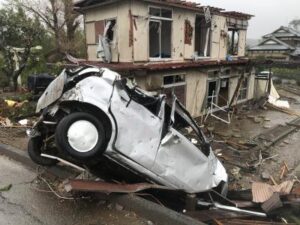
Typhoon/Ians

The 14th typhoon of the year was moving near Hagi, Yamaguchi prefecture on Monday afternoon, at a speed of some 20 km per hour.

It had an atmospheric pressure of 975 hectopascals at its centre, packing winds up to 108 kph with maximum gusts of 162 kph.

More than 70 people were injured amid the extreme weather, with bullet trains suspended in Kyushu on Monday and around 600 flights cancelled by the country’s two main airlines ANA and Japan Airlines, the local media reports said.

The typhoon is expected to travel across Japan’s largest island, Honshu through Tuesday, with the Japan Meteorological Agency continuing to issue warnings for strong winds, high tides and mudslides.

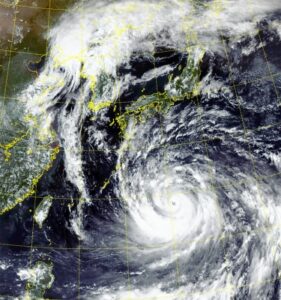
Typhoon/Ians

Tens of thousands of people spent Sunday night in emergency shelters, and almost 350,000 homes are without power.

Prime Minister Fumio Kishida has delayed a visit to New York, where he is due to give speech at the UN General Assembly, until Tuesday, to monitor the impact of the storm.

NASA sees wide-eyed Typhoon Noru headed for landfall in Kyushu, Japan

Typhoon Noru was churning just south of the southwestern-most island of Japan when NASA’s Terra satellite captured an image of the storm with an eye over 35 miles wide. The Joint Typhoon Warning Center expects Noru to make landfall in Kyushu by August 6.

On August 4, 2017 at 0220 UTC (Aug. 3 at 10:20 p.m. EDT), NASA’s Terra satellite passed over the Northwestern Pacific Ocean and the Moderate Resolution Imaging Spectroradiometer or MODIS instrument captured a visible-light image of the storm. The image revealed that Noru’s eye had become more apparent since the previous day. The western quadrant of the storm was affecting Japan’s Tokara Islands, which lie to the south of Japan’s large island of Kyushu. The Tokara Islands is an archipelago in the Nansei Islands, part of the Ryukyu Archipelago. The chain of islands consists of twelve small islands between Yakushima and Amami-Oshima.

Animated enhanced infrared satellite imagery and radar imagery indicate that Noru was re-intensifying with improved deep convective thunderstorm banding and a 37-nautical-mile-wide eye.

On August 4, 2017 at 11 a.m. EDT (1500 UTC), Noru’s maximum sustained winds were near 86 mph (75 knots/139 kph). Noru’s eye was centered near 29.3 degrees north latitude and 130.3 degrees east longitude, about 218 nautical miles northeast of Kadena Air Base, Okinawa, Japan. Noru has tracked to the west-northwestward at 5.7 mph (5 knots/9.2 kph).

Warnings are already in effect for the sub-prefecture regions of Kyushu including: Satsuma Chiho, Osumi Chiho, Tanegashima-Yakushima Chiho, Amami Chiho, Nambu Heiyabu, Hokubu Heiyabu, Nambu Yamazoi and Hokubu Yamazoi.

For watches and warnings from the Japan Meteorological Agency on Noru, visit: http://www.jma.go.jp/jma/indexe.html

Noru is forecast to turn north-northeast and make landfall in Kyushu on August 6. The Joint Typhoon Warning Center forecasts the storm will then move in a northeasterly direction and move west of Kyoto on the big island of Japan before moving into the Sea of Japan.