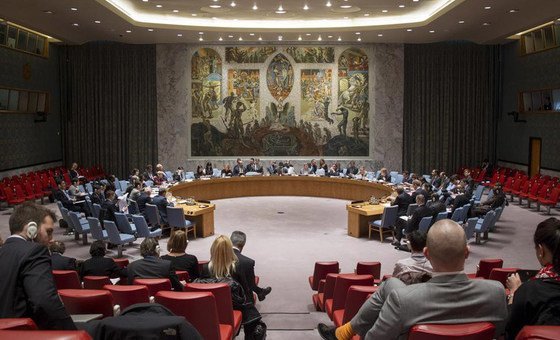
High Representative Christian Schmidt briefed on latest developments surrounding implementation of the 1995 General Framework Agreement for Peace in Bosnia and Herzegovina, which ended more than three years of bloodshed and genocide following the breakup of the former Yugoslavia.
The accord, also known as the Dayton Peace Agreement, established a new constitution and created two entities within the country: the mainly Bosniak and Croat Federation of Bosnia and Herzegovina and the ethnically Serb Republika Srpska.
Constitutional order under attack
Mr. Schmidt – who’s key role is overseeing implementation of the 1995 agreement – said conditions for the full implementation of the civilian aspects of the deal have vastly deteriorated.
“The first quarter of this year was marked by a significant rise of tensions, which without question amounts to an extraordinary crisis in the country since the signing of the Dayton Agreement,” he said.
“I may underline that I see a political crisis. I do not yet have indications for a security crisis.”
The sudden deterioration stems from reactions following the 26 February conviction of Republika Srpska President Milorad Dodik for failing to enforce the decisions of the High Representative.
He was sentenced to one year in prison and banned from political office for six years but has appealed the decision.
“After the verdict, Mr. Dodik intensified his attacks on the constitutional order of the country by directing the authorities of the Republika Srpska to adopt legislation that effectively bans State-level judiciary and State-level law enforcement in the Republika Srpska and by even putting on the table a draft Entity constitution, hinting at de facto secession,” said Mr. Schmidt.
He told the Council that given the speed with which the draft laws and constitution were made public strongly suggests that they had been prepared well in advance.

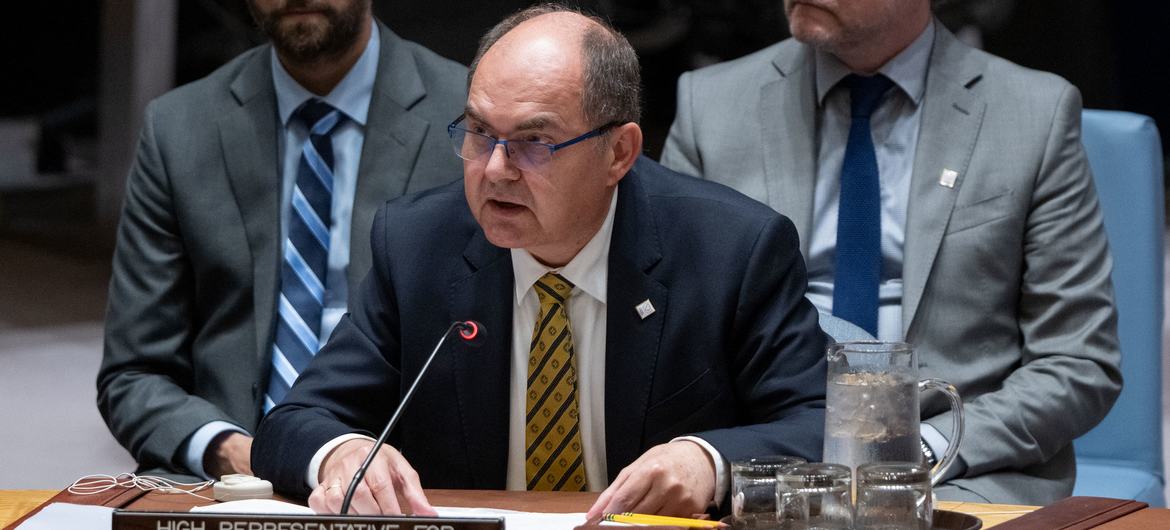
Christian Schmidt, High Representative for Bosnia and Herzegovina, briefs members of UN the Security Council on the situation in the country.
Fears of disintegration
He said these acts and legislation fundamentally contradict the implementation of the Dayton Accords and “endanger the territorial and societal integrity of the country and of its peoples by performing secessionist acts.”
Furthermore, “they also create legal and executive insecurity by establishing Entity laws and institutions that contradict and compete with State law and competence.”
He stressed that “it will require institutions created in Dayton, such as the Constitutional Court, to prevent this country from falling apart, and when it comes to safeguarding the functionality of the State, my legal competencies as High Representative as well.”
As a result, the State-level coalition has been seriously affected, momentum towards European Union (EU) accession has stalled and the functionality of the State is being undermined, while reforms have been sidelined.
“This development is not irreversible, but it is severe,” he warned. “It needs to be addressed without delay, it requires active engagement by the international community.”
Communities shun extremism
The High Representative noted that the Serb community “did not pay heed to Mr. Dodik’s unlawful directives.” For example, although ethnic Serbs working in State-level institutions have been pressured to abandon their posts, “these calls and threats have been left overwhelmingly unanswered.”
Meanwhile, the Bosniak community “has been able to remain calm despite the tensions and to continue on the path of patient dialogue also in order to keep the country’s European integration on the table.”
He also noticed “a continuing pro-European commitment” on the part of the Croat community, “as well as an increased willingness to engage in inter-ethnic dialogue, including in local disputes.”
Mr. Schmidt was adamant that the people of Bosnia and Herzegovina can and do live together.
“For the most part, the communities in the country do not support extremism or secessionism,” he said. “There is ample evidence for that in daily life, but ethnocentric politics spends too much time on dividing the communities rather than uniting them.”
Peace accord remains crucial
While the country is facing complex and varied challenges, he said the current extraordinary crisis is the result of severe attacks against the Dayton Agreement “encompassing the constitutional and legal order” and has nothing to do with the peace deal itself.
“Bosnia and Herzegovina is facing difficult times. Nobody would have expected 30 years ago that the international community is needed as much today as it is,” he said.
“But the Peace Agreement that this UN Security Council endorsed 30 years ago remains the very foundation on which the future of Bosnia and Herzegovina with its sovereignty, territorial integrity, and political independence can be built.”
Although reopening or redefining Dayton challenges the basis for peace and prosperity in the country, “this does not mean we should not talk about necessary amendments and adoptions of this constitution,” he said.
Attacks threaten ‘very foundation’
“The way forward includes countering threats and attacks to its very foundation, but also implementing meaningful reforms, including in the context of the country’s European integration,” he continued.
“It is about strengthening institutional stability and functionality of the State and continuing to reinforce election integrity in view of the country’s general elections in 2026.”
Mr. Schmidt concluded his remarks by urging the international community to continue to support and assist the country and the people of Bosnia and Herzegovina to shape their future and to reassure the population that they have not been forgotten.