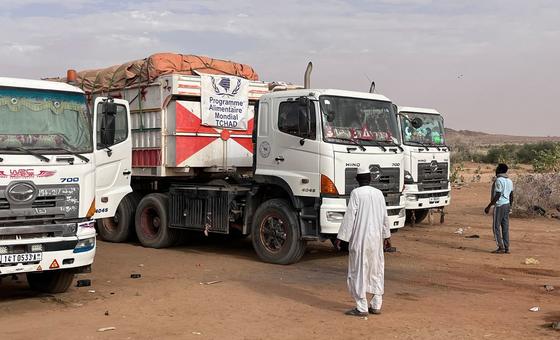
Ukraine: UN aid convoy reaches frontlines in Dnipro

UN Spokesperson Stéphane Dujarric told reporters that access to the town had been “extremely difficult due to the continued fighting.” Of the 10,000 people who lived there before the full-scale invasion in February 2022, only about 500 remain, “most of them older people and people with disabilities.”

According to Ukrainian authorities, hostilities between Tuesday and Wednesday morning caused several civilian deaths and injuries, including children. The regions of Donetsk, Dnipro, Sumy and Kherson were reported to be the hardest hit.

In Zaporizhzhia region, a hospital and a pre-school were damaged, and thousands of people were left without heating following an attack, underscoring the strain on essential services as winter conditions persist.

Drone strike devastates family

Meanwhile, a Russian drone strike killed a father and three young children and left a pregnant woman critically injured in the town of Bohodukhiv in the Kharkiv region, humanitarian workers said on Wednesday.

The attack occurred around midnight Tuesday into Wednesday, completely destroying the family home, according to Olena Labzeva of the Humanitarian Mission Proliska.

The father, who had a disability, and the couple’s three children – including toddlers aged one and two – were killed.

A neighbour who heard the explosion pulled the injured woman from the burning rubble. She remains in an extremely serious physical and psychological condition in hospital.

Damage costs exceed $176 billion

Amid the ongoing violence, UN agencies are also supporting longer-term recovery efforts.

The UN Development Programme (UNDP) said it has now helped clear one million tonnes of debris since the start of the full-scale invasion, restoring safe access to more than 200 public locations and enabling reconstruction at over 1,600 heavily damaged sites – including homes, schools and hospitals.

Direct damage to Ukraine’s buildings and infrastructure was estimated at $176 billion by the end of 2024, with debris posing a major obstacle to rebuilding and the return of residents.

Health system under severe strain

At the same time, the war’s devastation is placing additional pressure on the health system.

Repeated strikes on energy facilities have disrupted electricity, heating and water supplies, complicating care for pregnant women and newborns, particularly during freezing winter temperatures.

According to the UN reproductive health agency, UNFPA, doctors and nurses have reported power outages during complex surgical procedures.

They are also seeing more potentially life-threatening obstetric emergencies, including hypertension and uterine rupture, signalling a maternal health system under severe strain.

Just under 12 per cent of babies are born preterm in frontline areas – nearly double the national rate.

UNFPA is supplying maternity hospitals with back-up energy systems and life-saving reproductive health supplies, while calling for sustained international support.

Source link

South Sudan: UN forced to suspend food aid after ‘unacceptable’ attacks on convoy

As fighting intensifies there between opposition forces and national troops, there are reports of airstrikes and daily civilian casualties.

UN agencies warn that worsening insecurity is blocking lifesaving aid, while hunger projections deteriorate and cholera treatment centres struggle to cope with an influx of newly displaced people.

The renewed violence comes as South Sudan’s 2018 Revitalised Peace Agreement continue to fall apart amid stalled reforms, rising political tensions ahead of planned elections in 2026, and mounting pressure from more than one million refugees fleeing the brutal war in neighbouring Sudan.

Click here to read a summary of threats to South Sudan’s peace process and the converging political, security and humanitarian crises, and their impact on civilians.

Humanitarian statistics for South Sudan as of December 2025.

WFP convoy attacked, activities suspended

The UN World Food Programme (WFP) on Wednesday suspended all activities in Baliet County, Upper Nile state, following repeated attacks on a convoy carrying humanitarian assistance down river.

Between last Friday and Sunday, a 12-boat convoy transporting more than 1,500 metric tonnes of food and other relief items was attacked several times by armed youth.

The cargo was later looted in multiple locations, despite receiving prior security assurances for the safe passage of aid.

WFP said the suspension would remain in place until the safety of its staff, partners and contractors is assured and authorities take immediate steps to recover the stolen supplies.

Attacks on humanitarians are never acceptable,” WFP said, urging all parties to respect humanitarian workers and safeguard the facilities and resources essential for delivering aid.

Aid access under threat

The convoy attack reflects a broader collapse in humanitarian access, particularly in Jonglei state, where renewed fighting since late December has intensified clashes between the South Sudan People’s Defense Forces and the South Sudan People’s Liberation Army-in-Opposition across multiple counties.

According to the UN relief coordination office, OCHA, fighting and airstrikes have displaced around 280,000 people since late December, including more than 235,000 across Jonglei alone. Many have fled to areas with minimal water, sanitation and health services, sharply increasing the risk of disease outbreaks.

Humanitarian partners report that at least seven aid facilities have been looted or damaged in Jonglei, with assets confiscated and aid workers intimidated, forcing the suspension of operations in several locations.

South Sudan: Humanitarian snapshot (December 2025).

Hospitals hit, services halted

The medical charity Médecins Sans Frontières (MSF) reported that Government forces bombarded its hospital in Lankien, Jonglei State, overnight on 3 February, destroying the main warehouse and most critical medical supplies. One MSF staff member suffered minor injuries.

In a separate incident the same day, MSF’s health facility in Pieri was looted by unknown assailants, forcing staff to flee. The NGO said the violence had left around 250,000 people without healthcare, as the organization had been the only provider in the area.

Hunger and disease risks rising

UN agencies warn that escalating conflict is expected to significantly worsen food insecurity, particularly in northern Jonglei and Upper Nile states.

Projections indicate that the number of counties facing emergency-level hunger (IPC Phase 4) between February and May will more than double, with some households at risk of slipping into catastrophic conditions (IPC Phase 5).

Insecurity has already forced WFP to pause plans to pre-position 12,000 metric tons of food ahead of the rainy season in Jonglei, raising concerns that access will further deteriorate once roads become impassable.

Since September 2024, South Sudan has recorded nearly 98,000 cholera cases and more than 1,600 deaths, with Jonglei among the worst affected, overwhelming treatment centres.

Source link

Syria: Second convoy brings critical aid to Sweida

Deadly sectarian violence has displaced more than 145,000 people in the southern city, some of whom have fled to neighbouring Dar’a and Rural Damascus governorates. 

The convoy carried a range of critical support, including food, wheat flour, fuel, medicines and health supplies. 

OCHA coordinated with the SARC to prepare the convoy, which included supplies from UN agencies.  

Engagement and support

The Office continues to engage with authorities and partners to facilitate an inter-agency UN mission to Sweida as conditions allow.

The UN is also working with partners to deliver a range of assistance to people displaced to Dar’a and Rural Damascus, including food, water, and health and protection services.   

Mobile medical teams have so far provided more than 3,500 consultations, including trauma care, maternal health and psychosocial support while nearly 38,000 people have received food aid. 

Additionally, over 1,000 kits containing non-food items were distributed in Dar’a and Rural Damascus, helping more than 5,000 people. 

OCHA said UN inter-agency missions to assess needs and provide assistance to both governorates are planned for the coming days. 

The first convoy to Sweida arrived on Sunday. The 32 trucks brought food, water, medical supplies and fuel provided by the UN World Food Programme (WFP), the UN Children’s Fund (UNICEF) and other partners. 

Five humanitarians killed in ‘horrendous’ attack on aid convoy in Sudan

The World Food Programme (WFP) and the United Nations Children’s Fund (UNICEF) condemned the attack on the joint humanitarian convoy and reminded the international community that under humanitarian law, aid must be able to move securely.  

“Aid convoys must be protected and parties have the obligation to allow and facilitate rapid and unimpeded passage of humanitarian relief for civilians in need,” the two agencies said in a joint press release.

UN Spokesperson Stéphane Dujarric reiterated this sentiment, saying that the United Nations condemns this “horrendous attack in the strongest possible terms.”  

‘Devastating’ attack  

According to WFP and UNICEF, the aid convoy had travelled over 1,800 kilometres from Port Sudan, which has itself endured ongoing drone strikes.  

The 15 trucks were carrying vital nutritional supplies to North Darfur, a region in which hundreds of thousands of internally displaced people are at high risk of malnutrition and starvation. 

The agencies noted that all parties on the ground had been notified about the convoy and its movements. 

“They were 80 kilometres from El Fasher, parked on the side of the road, waiting for clearance, and they were attacked,” said Mr. Dujarric. 

This would have been the first convoy to reach El Fasher in over a year. In April, the city and the nearby Zamzam displacement camp were attacked, displacing hundreds of thousands, many of whom had already been displaced.  

The attack on the convoy comes amidst a two-year conflict which has ravaged Sudan, displacing over nine million people. Famine has been declared in multiple places, including in El Fasher, and many more regions remain at risk.   

Broader attacks on aid 

The attack on the convoy comes amidst other attacks on humanitarian operations and civilians and civilian infrastructure in Sudan.  

Last week, the WFP premises in El Fasher were bombed and damaged and an international hospital in Al Obeid also experienced a deadly drone strike. 

Civilian infrastructure around the country continues to be targeted, including electricity infrastructure in Khartoum. The damage of this infrastructure in the capital has worsened an already spreading cholera outbreak in the city.   

WFP and UNICEF reiterated that attacks on humanitarian activities and personnel are unacceptable and must stop immediately.  

“Attacks on humanitarian staff, aid, operations as well as civilians and civilian infrastructure in Sudan have continued for far too long with impunity,” they said.  

Source link