
Health, education, opportunity at stake, amid stubborn digital gender divide

Closing this gap is not optional. There were189 million fewer women than men online in 2024.  

The disparity is about more than access, it reflects deeper systemic barriers, according to ​Doreen Bogdan-Martin who heads the UN telecommunications agency, ITU.

“That’s too many missed opportunities to learn, to earn and to shape our shared digital future,” she said in a message for Thursday’s International Girls in ICT Day.

She underscored that connectivity alone is not enough to ensure true digital transformation.

“It must be meaningful – being able to afford digital devices and services, having the skills to use technology and feeling safe in online spaces. Everyone deserves the chance to thrive in an increasingly digital world.”

ITU Secretary-General Doreen Bogdan-Martin’s video message.

2025 Theme

Celebrated annually on the fourth Thursday of April, Girls in ICT Day encourages girls to pursue careers in science, technology, engineering and mathematics (STEM).

Since its launch in 2011, more than 417,000 girls and young women have participated in over 11,500 celebrations across 175 countries.

This year’s theme is Girls in ICT for inclusive digital transformation. The ITU is calling for more investment in girls’ digital education and expansion of access to technology.  

More young women need to become creators – not just consumers in the digital world, the agency argues.

“Whether you are an entrepreneur, launching an AI startup, a teacher incorporating digital skills into your classroom or a policymaker shaping our shared digital future, you can help ensure every woman and girl has the chance to connect, create and lead in digital spaces,” Ms. Bogdan-Martin emphasised.

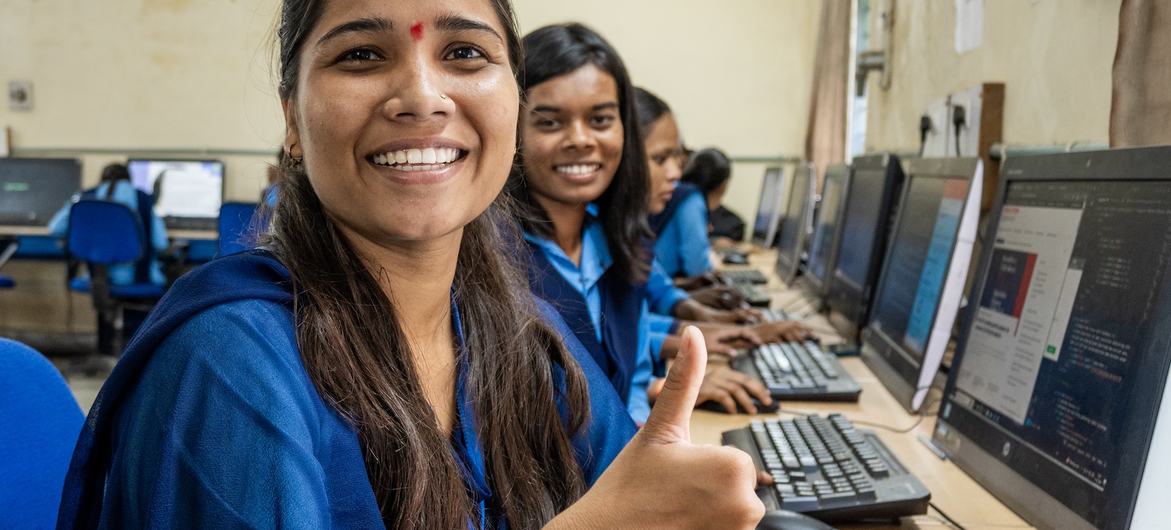
A participant at a UN-supported training on STEM for girls and young women.

Global observance

The 2025 global observance will be co-hosted this year by the Commonwealth of Independent States (CIS) in Eurasia together with States from the Arab region, featuring a live-streamed hybrid event linking Bishkek, Kyrgyzstan and Nouakchott, Mauritania.

The programme includes an intergenerational dialogue bringing together girls, women leaders, and ICT experts to discuss practical strategies for closing the gender gap.

Events are also being organized worldwide, including Girls in ICT in Solomon Islands in the Pacific, the Melon Girls Club in North Macedonia and STEM Supergirls in Croatia.

Source link

5 Takeaways from New Education policy 2017

Indian Minister of State for Human Resource Development Satya Pal Singh has said that the new education policy is in final stages and it would be announced in December.

Inaugurating a ‘National Academic meet’ in Thiruvananthapuram on Monday, Satyapal Singh said the policy envisages to ‘correct’ the course of education system in the country, that has followed a colonial mindset. The Minister said it will be the first education policy that was discussed layer by layer and threadbare.

He pointed out that unfortunately after independence, most of the academicians followed the footsteps of British and Western scholars and deliberately denigrating Indian culture. Stating that the biggest challenge being faced by the education system and the government is ‘how to de-colonise the Indian mind’ and the government is working on the policy in this regard.

Dr. Singh said improving the quality of education from the primary level, making higher education affordable to people and accessing higher education to more are some of the major issues faced by the education system. He said skill development is one of the major areas the government has given thrust upon.

To prevent the exodus of students to foreign countries seeking education, Dr. Singh said the higher education institutions should be developed to the standard of Centres of International Excellence. He said accessibility to higher education in the country is only 25.6 per cent while in USA 86 per cent Germany 80 and in China 60 per cent.

The Minister pointed out that the aim of the government is to improve the higher education system in the country to make available to more students. Stating that higher education is very expensive, Dr. Singh said it has to be made more affordable to all sections in the society.

Indicating that changes are necessary in the Right to Education Act, Dr. Singh said the Act lacks teeth. The Act provides right to compulsory primary education. But what is the remedy if parents do not send their children to school. So many things have to be done in improving the primary education in the country’, he added.

The meet was organised by Bharatheeya Vichara Kendram as part of the navathi celebration of P Parameswarn, Director of Vichara Kendram.

Early puberty may mean less time in education for girls

The age at which girls have their first period may influence how long they stay in education.

The findings come from a study in which researchers have tried to untangle the effect of the age at first period from other complex factors that might affect time spent in education, revealing that young women who start their periods earlier may spend less time in the education system.

Previous research has indicated girls who reach sexual maturity earlier may be more prone to developing depression and, in low and middle income countries, more vulnerable to early pregnancy and negative sexual health outcomes, but whether it affects how long they spend in education was unclear.

Studies trying to pick apart the link between the age at which a girl has her first period — called menarche — and how long they spend in education can be muddied by numerous factors, including obesity, socio-economic status, and parental education level.

Now, a team led by researchers at Imperial College London has tried to untangle this complex relationship by turning to genetic markers as a proxy for the age of first period. Using a statistical method called Mendelian randomization, they attempted to remove the influence of external factors such as diet and lifestyle — which are known to be associated with both early menarche and less time in education.

By using genetic markers known to be associated with menarche, the researchers have revealed an impact of the age of first menstruation on the amount of time spent in education.

“It’s well established that the length of time that someone spends in education can have repercussions later on in life,” said Dr Dipender Gill, a Wellcome Trust Clinical Research Fellow at Imperial and lead author of the study. “It is associated with socio-economic status, rates of depression, risk-taking behaviour and a range of health outcomes, so clearly time spent in education is important. This study identifies that the age of puberty may have an effect on the length of time that women spend in education.”

In the study, published in the journal Behaviour Genetics, researchers looked at data from more than 180,000 European women, where 122 points in the genome where a single ‘letter’ difference in the DNA — called a single nucleotide polymorphism (SNP) — were associated with the onset of menstruation in girls.

The effects of these markers on time spent in education were then estimated using a separate dataset including more than 118,000 women over the age of 30 and of European descent, where participants had provided the number of years spent in education.

Analysis revealed a small but statistically significant causal link between markers for age at menarche and the length of time women spent in education. The findings showed that on average, starting menstruation one year later was associated with approximately an additional 53 days spent in education.

According to the researchers, one possible explanation for the observed effect could be due to young women being treated as more mature due to physical changes, while their emotional development takes time to catch up. Such a delay between physical and mental maturation may give rise to factors which lead to less time spent in education, such as increased risk-taking behaviour, or a failure to adapt psychologically to changes in how they are treated.

The group reports that the data could be skewed by women self-reporting the age they had their first period. In addition, the extended age ranges of women in the study group — born over nine decades (1901 to 1989) — overlaps with societal changes and the establishment of educational programmes. They add that the findings cannot be used to predict how long a young woman might stay in education, based on her age at her first period.

According to the researchers, now that a link has been established, the next step is to work out why age of menarche is having such an effect.

“Once we understand the mechanism, it might give us the opportunity address the discrepancies that we’re seeing,” explained Dr Gill.

“Going through puberty is associated with various physiological and psychological changes,” he adds. “It might be that girls who go through puberty earlier are less well-equipped to deal with the pressures. They may be suffering as a result and this might be manifest in the length of time that they spend in school.”

‘Age at menarche and time spent in education: a Mendelian Randomization study’ by Gill, D. et al, is published in the journal Behavior Genetics.

Schemes to make education loan as easy loans

All Scheduled Commercial Banks provide Education Loan to students. Simple interest is charged during the study period and up to commencement of repayment. Accrued interest is added to the principal amount borrowed while fixing EMI (Equated Monthly Instalment) for repayment.

The Schemes launched by the Government to provide interest subsidy to the students include:

(i) Central Scheme to provide Interest Subsidy (CSIS) wherein full interest subsidy is available for the students belonging to economically weaker sections, for studies in India, for educational loans disbursed on or after 1st April, 2009 during the period of moratorium.
(ii) Padho Pardesh Scheme to award interest subsidy to meritorious students belonging to economically weaker sections of notified minority communities for overseas studies.
(iii) Dr Ambedkar Central Sector Scheme of Interest Subsidy on Educational Loan for Overseas Studies for Other Backward Classes whereby interest payable by the students for the period of moratorium is borne by the Government of India.

In order to facilitate easy processing and disbursal of loans, Government has launched a web-based portal namely Vidya Lakshmi Portal where students can apply online and track education loans. Credit Guarantee Fund Scheme for Education Loans (CGFSEL) is also there wherein collateral free loan is given upto Rs.7.5 lakh.

This was stated by Shri Arjun Ram Meghwal, Minister of State for Finance in written reply to a question in Rajya Sabha today.

Quota of OBCs in higher education

The University Grants Commission(UGC) has circulated the Central Educational Institutions (Reservation in Admission) Act, 2006 and Amendment Act, 2012 to all Central Educational Institutions directing them to implement reservation provisions for Other Backward Classes (OBCs) including admission of OBC students to these Institutions. UGC has issued instruction to all the grant-in-aid institutions funded by the Central Government, except minority Institutions under Article 30(1) of the Constitution of India to implement 27% reservation for OBCs.

As per the information available with the Ministry, during 2015-16, 22 out of 40 Central Universities have successfully achieved the prescribed percentage of student intake from OBC Community. Some of the universities like Aligarh Muslim University, Jamia Milia University and some like Mizoram University, Nagaland University, North Eastern Hill University could not achieve the prescribed percentage as these were either minority institutions or were situated in Tribal dominated areas where less OBC students apply for admissions. All Indian Institutes of Technology/National Institutes of Technology/Indian Institutes of Information Technology achieved the stipulated 27 % intake of OBC students. Further, 13 Indian Institutes of Management out of 19 and 22 out of 31 National Institutes of Technology recorded more than the stipulated 27% student intake.

The Government of India and UGC has been continuously monitoring the progress of implementation of Reservation policy for OBCs in admission to courses at all level in Universities/Institutions.

The Ministry of Human Resource Development through UGC instructs Universities/Institutions to furnish periodic reports on the implementation of reservation guidelines for OBCs for admissions to courses at all level and Hostel accommodation for students.

UGC has a dedicated SC/ST/OBC section which monitors effective implementation of the Reservation Policy for all communities including OBCs in admission and recruitment to various posts in universities and colleges.

This information was given by the Minister of State (HRD), Dr. Mahendra Nath Pandey today in a written reply to a Rajya Sabha question.

India Signs Agreement on $201 Mln Loan From World Bank for Quality Tech Education

India has signed an Agreement for IDA credit of US$201.50 million for the “Third Technical Education Quality Improvement Programme” (TEQIP III) on February 1, 2017 in New Delhi.

The loan agreement envisages an active funding participation in Indian Engineering Education Institutes and improve the efficiency of the Engineering Education System in Uttarakhand, Himachal Pradesh, Bihar, Uttar Pradesh, Madhya Pradesh, Chhattisgarh, Rajasthan, 8 North Eastern States and Andaman & Nicobar Islands.

The Project seeks to improve quality and equity in engineering institutes in these states and to undertake system-level initiatives to strengthen sector governance and performance.

The World Bank loan, to be implemented till March 2022, will be disbursed based on achievement of specific outcomes and goals by these institutions, said a World Bank statement.

Mr. Raj Kumar, Joint Secretary, Department of Economic Affairs signed the agreement on behalf of the Government of India and Mr. Junaid Kamal Ahmad, Country Director for World Bank, on behalf of the World Bank.

“The focus on strengthening engineering education and research under TEQIP III will help prospective labor market entrants acquire the skills needed to produce a world-class technical workforce,” said Junaid Ahmad, World Bank Country Director in India.

TEQIP III will intensify its efforts in the focus states with the support from the IITs, IIMs and other high-performing institutes across the country. “As with previous phases of TEQIP, the country’s top institutes will mentor TEQIP colleges and help them develop their curriculum, faculty and students”, said R. Subrahmanyam, Additional Secretary, Department of Technical Education, Ministry of Human Resources Development, the implementing agency for the project.