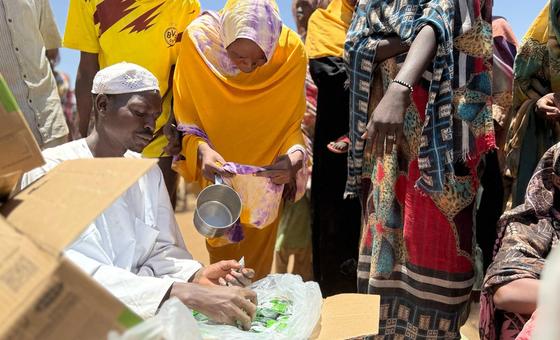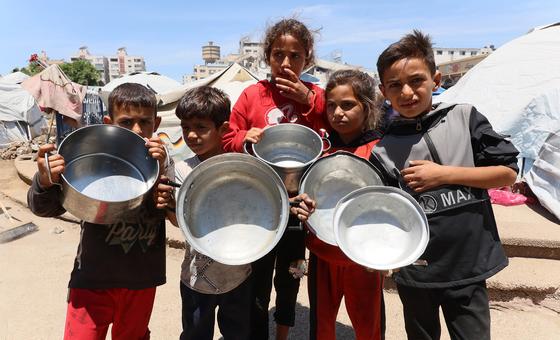

“Goods indispensable for people’s survival are either depleted or expected to run out in the coming weeks…The entire population is facing high levels of acute food insecurity,” said the Integrated Food Security Phase Classification (IPC) platform.
In its latest update, the IPC estimated that one in five people in Gaza – 500,000 – faces starvation.
Prices have soared for basics such as a 25 kilogramme sack of wheat flour, which now costs between $235 and $520, representing a 3,000 per cent price spike since February.
“In a scenario of a protracted and large-scale military operation and continuation of the humanitarian and commercial blockade, there would be a critical lack of access to supplies and services that are essential to survival,” the IPC said.
New strikes on UN shelters
The development comes amid continuing reports of Israeli bombardment across Gaza on Monday.
On Saturday, another school run by the UN agency for Palestine refugees, UNRWA was hit, this time in Gaza City at around 6.30pm, reportedly killing two people and injuring an unknown number.
A day earlier, four more people were reportedly killed when another UNRWA facility was bombed in Jabalia camp, north Gaza. The agency’s office was “completely destroyed” and three surrounding buildings sustained severe damage, including a distribution centre. There were no supplies in the distribution centre when it was hit, owing to the continuing Israeli blockade, UNRWA said, noting that it ran out of food for Gaza “more than two weeks ago”.
Echoing the wider aid community’s rejection of the Israeli plan to manage deliveries of food and non-food items across Gaza’s governorates, the IPC deemed it “highly insufficient to meet the population’s essential needs for food, water, shelter and medicine”.
IPC’s assessments help aid agencies decide where needs are greatest around the world. Food insecurity is measured on a scale of one to five, with IPC1 indicating no hunger and IPC5 denoting famine conditions.
According to the latest data, 15 per cent of people in the governorates of Rafah, North Gaza and Gaza are classified as IPC5. Most of the remainder are little better off.
Israel plan scepticism
Amid this disastrous and deteriorating situation, Israel’s proposed distribution plan will likely create “significant access barriers [to aid] for large segments of the population”, the IPC said.
And pointing to Israel’s recently announced large-scale military operation across the Gaza Strip and persistent obstacles impeding the work of aid agencies, it warned that there was “a high risk that ‘Famine (IPC Phase 5)’ will occur” between now and 30 September.
With hunger everywhere, a high number of households have reported having to resort to “extreme coping strategies” such as collecting rubbish to sell for food. But one in four of this number say that “no valuable garbage remains”, while social order “is breaking down” the IPC reported.