The tournament is more than a sporting event. It’s a lifeline. In Ma’rib Governorate, where over 2.3 million internally displaced people have settled, families live in makeshift shelters, often after being forced to flee multiple times. Water is scarce, the heat is unforgiving, and access to education and health care is limited at best. In these conditions, there is little space for childhood, let alone for play.
Yet when the whistle blows, something shifts. On the field, children and young adults are no longer defined by conflict. For a moment, they become teammates, competitors and determined athletes, focused on the game and nothing else.
This year’s tournament, which is organised by the International Organisation for Migration (IOM) brought together youth from more than a dozen displacement sites, including Salwa, Al-Ramsa and Al-Sowayda. In areas where daily life can feel heavy and isolated, the matches created a sense of connection and community.
Among the players is Basheer, a 26-year-old displaced from his home and now living in the heart of Salwa displacement site. Basheer shoulders far more than just his own future. He is the sixth of seven brothers and the only one with a steady income. Every day, he works on a minibus, shuttling people back and forth across town from early morning to late afternoon. On a good day, he brings home 20,000 Yemeni rials – barely enough to cover food.
The rest of the family depends on him. His brothers are out of work. The eldest managed to reach the Kingdom of Saudi Arabia and sends money when he can, but the support is irregular. Most days, they survive on whatever Basheer is able to bring home.
Football, for Basheer, is more than a distraction. It’s a refuge. A rare moment of focus and joy in a life shaped by duty and survival. “Football takes me to another world,” says Basheer. “When I’m playing, I forget everything else.”
Player in football tournament for displaced people in Ma’rib, Yemen
‘Some came barefoot and played all day under the burning sun’
Despite its popularity, this year’s tournament faced a serious challenge: a lack of funding. In previous years, IOM had managed to fully equip the teams. Players received football boots, socks, kits and even proper goalposts. This year, IOM’s Camp Coordination and Camp Management team could only provide basic jerseys.
Jamal Alshami, an IOM field assistant and one of the long-time organisers, feared the turnout would suffer and that players might lose interest or feel discouraged. But the opposite happened.
“Even more players joined than last year,” he recounts. “Some came barefoot and played all day under the burning sun. They were happy just to be there.”
Displacement takes a toll on mental health. Life in the camps is stressful and isolating. But sport, and football in particular, gives young people a way to reconnect with themselves and with each other. “When people are displaced, they leave behind everything. That includes the things they used to enjoy,” says Mr. Alshami. “That’s why these activities matter. They help people relax and reconnect with something they once loved.”
That sense of joy was felt far beyond the players themselves. Spectators gathered along the sidelines, cheering with every goal. Commentators brought the matches to life with their lively calls. Even camp managers paused their work to watch. For a few hours each day, the camps felt different. They felt louder, lighter and full of life.
With Ma’rib continuing to receive new waves of displacement, IOM is working to bring mental health and psychosocial support closer to the ground. This includes sports, youth clubs and cultural events. Football, in this context, is more than a game. It is a reminder of identity. A way to heal. A moment of normal life in a place where very little feels normal.

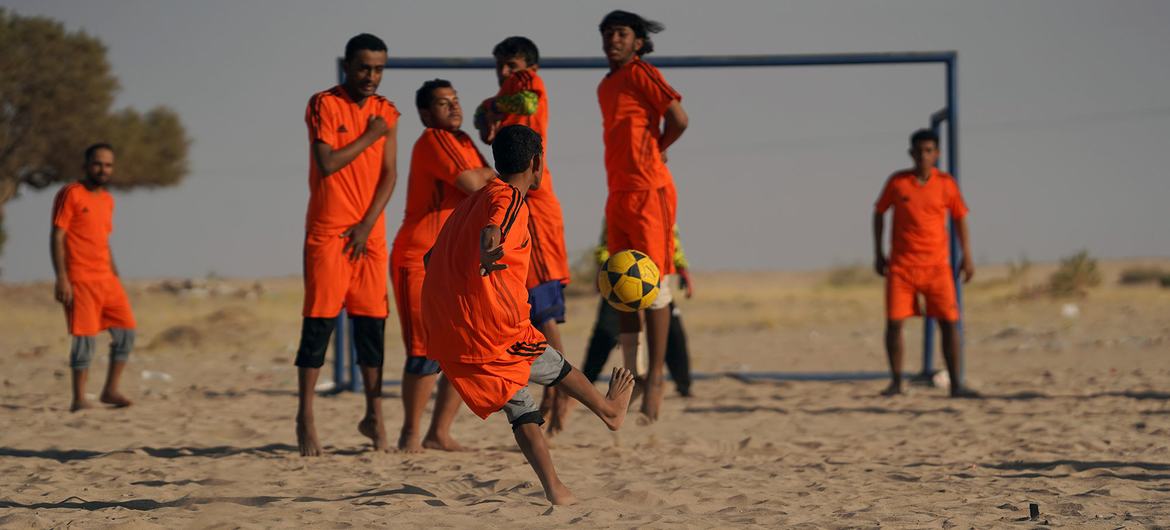
Players in football tournament for displaced people in Ma’rib, Yemen