Ukraine: Civilians under fire in record numbers as attacks surge

According to the UN human rights office, OHCHR, at least 139 civilians have been killed and 791 injured so far in July alone.

“The devastating physical and psychological impact on civilians of repeated attacks in this and other conflicts cannot be captured by numbers alone,” said OHCHR spokesperson Liz Throssell on Tuesday.

Escalating attacks

On the night of 12 July, Russian forces reportedly launched nearly 600 Shahed-type unmanned attack and decoy drones, along with 26 missiles, killing two civilians and injuring 41.

Damage was reported across multiple regions, including Chernivtsi, Lviv, Cherkasy, Volyn and Kirovohrad – all far from active combat zones. Earlier that same week, Russian forces reportedly launched a record-breaking 728 long-range drones in a single 24-hour period.

June marked the deadliest month for civilians in over three years.

“People are having to spend hours sheltering (…) in basements, corridors and available refuges such as metro stations,” said Ms. Throssell. “In some cases, they’re unable to get to shelter at all.”

Health under pressure

The UN World Health Organization (WHO) meanwhile has verified 2,504 attacks on health facilities and personnel in Ukraine since the start of the full-scale invasion by the Russian Federation on 24 February 2022.

These strikes have hit hospitals, ambulances and first responders, including in so-called “double tap” attacks where secondary strikes follow the initial impact.

“This means more than two attacks every day…Healthcare is not a safe place for patients and healthcare workers,” said Dr. Jarno Habicht, WHO Representative in Ukraine.

Access to healthcare remains especially limited in frontline areas, where personnel and supplies are scarce.

Only 69 per cent of residents in those areas have seen a primary care doctor, compared to 74 per cent nationally. WHO mobile teams operating in 82 locations have conducted more than 7,500 consultations in 2025 so far.

The psychological toll is also wearing people down. A recent assessment found that seven out of 10 people reported anxiety, depression or severe stress over the last 12 months, while one in two said they had experienced significant stress in just the past two months.

To address this, WHO and national partners have trained more than 125,000 health workers and expanded mental health services through more than 220 community resilience centres.

Despite continued deliveries of trauma kits and medical supplies by UN and humanitarian partners, the response remains critically underfunded. As of mid-July, only 35.5 per cent of the required $129 million for 2025 has been secured, leaving more than two million people without adequate medical support.

Call for accountability

In Geneva, Ms. Throssell highlighted the UN human rights chief’s calls for an immediate end to hostilities and for efforts toward a just and lasting peace.

“The Russian Federation’s full-scale armed attack on Ukraine must urgently be halted and work on a lasting peace in line with international law must intensify,” Volker Türk said in a statement.

The High Commissioner emphasized that any sustainable solution must include accountability for serious human rights violations, the return of deported children, protection for civilians in occupied areas, humane treatment of prisoners of war, and restoration of humanitarian corridors.


Source link

Now go for painless tattoos that can be self-administered, say Researchers

Instead of sitting in a tattoo chair for hours enduring painful punctures, imagine getting tattooed by a skin patch containing microscopic needles. Researchers at the Georgia Institute of Technology have developed low-cost, painless, and bloodless tattoos that can be self-administered and have many applications, from medical alerts to tracking neutered animals to cosmetics.

“We’ve miniaturized the needle so that it’s painless, but still effectively deposits tattoo ink in the skin,” said Mark Prausnitz, principal investigator on the paper. “This could be a way not only to make medical tattoos more accessible, but also to create new opportunities for cosmetic tattoos because of the ease of administration.”

Tattoos are used in medicine to cover up scars, guide repeated cancer radiation treatments, or restore nipples after breast surgery. Tattoos also can be used instead of bracelets as medical alerts to communicate serious medical conditions such as diabetes, epilepsy, or allergies.

Various cosmetic products using microneedles are already on the market — mostly for anti-aging — but developing microneedle technology for tattoos is new. Prausnitz, a veteran in this area, has studied microneedle patches for years to painlessly administer drugs and vaccines to the skin without the need for hypodermic needles.

tattoo/en.wikipedia.org

“We saw this as an opportunity to leverage our work on microneedle technology to make tattoos more accessible,” Prausnitz said. “While some people are willing to accept the pain and time required for a tattoo, we thought others might prefer a tattoo that is simply pressed onto the skin and does not hurt.”

Transforming Tattooing

Tattoos typically use large needles to puncture repeatedly into the skin to get a good image, a time-consuming and painful process. The Georgia Tech team has developed microneedles that are smaller than a grain of sand and are made of tattoo ink encased in a dissolvable matrix.

“Because the microneedles are made of tattoo ink, they deposit the ink in the skin very efficiently,” said Li, the lead author of the study.

In this way, the microneedles can be pressed into the skin just once and then dissolve, leaving the ink in the skin after a few minutes without bleeding.

Tattooing Technique

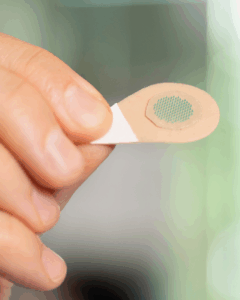
Although most microneedle patches for pharmaceuticals or cosmetics have dozens or hundreds of microneedles arranged in a square or circle, microneedle patch tattoos imprint a design that can include letters, numbers, symbols, and images. By arranging the microneedles in a specific pattern, each microneedle acts like a pixel to create a tattoo image in any shape or pattern.

The researchers start with a mold containing microneedles in a pattern that forms an image. They fill the microneedles in the mold with tattoo ink and add a patch backing for convenient handling. The resulting patch is then applied to the skin for a few minutes, during which time the microneedles dissolve and release the tattoo ink. Tattoo inks of various colors can be incorporated into the microneedles, including black-light ink that can only be seen when illuminated with ultraviolet light.

Prausnitz’s lab has been researching microneedles for vaccine delivery for years and realized they could be equally applicable to tattoos. With support from the Alliance for Contraception in Cats and Dogs, Prausnitz’s team started working on tattoos to identify spayed and neutered pets, but then realized the technology could be effective for people, too.

The tattoos were also designed with privacy in mind. The researchers even created patches sensitive to environmental factors such as light or temperature changes, where the tattoo will only appear with ultraviolet light or higher temperatures. This provides patients with privacy, revealing the tattoo only when desired.

A magnified view of a microneedle patch with green tattoo ink/photo:Georgia Tech

The study showed that the tattoos could last for at least a year and are likely to be permanent, which also makes them viable cosmetic options for people who want an aesthetic tattoo without risk of infection or the pain associated with traditional tattoos. Microneedle tattoos could alternatively be loaded with temporary tattoo ink to address short-term needs in medicine and cosmetics.

Microneedle patch tattoos can also be used to encode information in the skin of animals. Rather than clipping the ear or applying an ear tag to animals to indicate sterilization status, a painless and discreet tattoo can be applied instead.

“The goal isn’t to replace all tattoos, which are often works of beauty created by tattoo artists,” Prausnitz said. “Our goal is to create new opportunities for patients, pets, and people who want a painless tattoo that can be easily administered.”