
World News in Brief: Iran in the Human Rights Council, Myanmar election ‘fraud’, migration chief in Cyprus, Mozambique flood update

Addressing the Human Rights Council in Geneva, Mr. Türk said that although the “killing on the streets of Iran may have subsided…the brutality continues”.

He said that violent repression did not solve any of Iran’s problems but instead created conditions for further violations, instability and bloodshed.

“We have indications that the security forces made mass arrests in several cities, even pursuing injured people into hospitals, and detaining lawyers, human rights defenders, activists, and ordinary civilians,” he told diplomats.

Prosecutions ongoing

“The Tehran Prosecutor’s Office has reportedly opened criminal cases against athletes, actors, people involved in the movie industry, and the owners of cafes, on charges of supporting the protests,” Mr. Türk continued. 

Protests erupted across Iran on 28 December in response to the collapse of the national currency, soaring inflation and worsening living conditions.

Also speaking at the Council, former international prosecutor Payam Akhavan described how one protester pretended to be dead in a body-bag for three days until his parents found him. 

The civil society representative said that parents looking for their relatives usually started at hospitals, where “many of the wounded (protesters) have been abducted and killed”. 

Others have been forced to sign confessions which blame imaginary “terrorists” for the murder of their children, Mr. Akhavan maintained.

He cited a medical report circulating among Iranian doctors that 16,500 people had been killed during the demonstrations. “The number increases by the day, because the killings haven’t stopped,” he said.

Rejection of Myanmar military’s ‘fraudulent’ election must be unequivocal: UN independent expert

The international community must unequivocally reject as illegitimate the election results in Myanmar and any power arrangement that follows, said Tom Andrews, the Special Rapporteur on human rights in Myanmar on Friday.

The UN-appointed independent expert described the elections, which began in late December and are expected to be concluded this weekend, as ‘fraudulent’, urging countries not to accept the results. 

“The junta is banking on the world’s fatigue, hoping that the international community will accept military rule dressed up in civilian clothing,” he said. “Governments must not allow that to happen.”

‘Fear and coercion’

The junta’s election scheme was marked by violence, low turnout and widespread coercion, said Mr. Andrews.

Voters reported being monitored and pressured by local authorities, with threats explicit or implied. Junta officials were pushing citizens to polling stations even as military jets bombed villages throughout the country.

Mr. Andrews added that the junta banned credible opposition parties, jailed popular political figures and muzzled the press, “crushing fundamental freedoms, and using fear and coercion to drive a reluctant electorate to the polls.”

UN migration chief backs EU presidency efforts on migration

This week, the UN migration agency (IOM) Chief Amy Pope concluded a visit to Cyprus after a round of high-level talks, which focused on advancing a comprehensive migration and asylum agenda. 

“Cyprus knows what it means to be on the frontline – and that experience really matters right now,” said Ms Pope. “As the European Union (EU) moves from agreement to action, this is the moment to make sure policies really work – for migrants, for communities, and countries.

This trip marks the IOM Chief’s first visit to Cyprus in her current role, as Cyprus assumes the EU Council Presidency and the EU begins implementing the landmark Migration and Asylum Pact.

Humane returns 

With persistent instability Afghanistan, Syria, Sudan and the Sahel, Ms Pope reaffirmed IOM’s support and engagement with the EU to ensure refugee returns are humane and dignified. 

During her visit, she underscored the urgent need to address conditions along key migration routes, with IOM emphasising efforts to curb irregular migration, disrupt smuggling networks, meet humanitarian needs, and save lives.

Ms Pope also called for stronger migration data systems and evidence-based policymaking.

Nearly 600,000 people upended by Mozambique floods

Nearly 600,000 people have been affected by severe flooding across southern and central Mozambique. Weeks of heavy and sustained rainfall have caused homes to collapse and roads to wash away, displacing more than 73,000 people, according to figures from the IOM

Flooding has been reported in 10 of Mozambique’s 11 provinces, with Gaza Province “hosting significant concentrations of displaced people”. Humanitarian response partners expect reported figures to rise as access to affected communities improves.

IOM teams there have described acute shortages of shelter, constraints on food and basic services, overcrowded centres, and limited access to safe water, sanitation and hygiene – increasing the risk of waterborne diseases spreading.

Preliminary reports from the International Red Cross (IFRC) indicated between 50 and 60 deaths, a figure likely to rise as waters levels recede. 

Response ahead of cyclone season 

Following a Government request for international support on 16 January including air assets for search and rescue efforts, the IOM plans to appeal for up to $20 million to reinforce life-saving assistance and strengthen water, sanitation and hygiene. 

With this being only the start of the cyclone season and dams at near capacity, representatives from the IFRC have underscored the need for investment in early warning systems, climate‑resilient infrastructure, and locally led preparedness. 

Source link

UN chief reports progress in Cyprus talks, urges swift implementation of trust measures

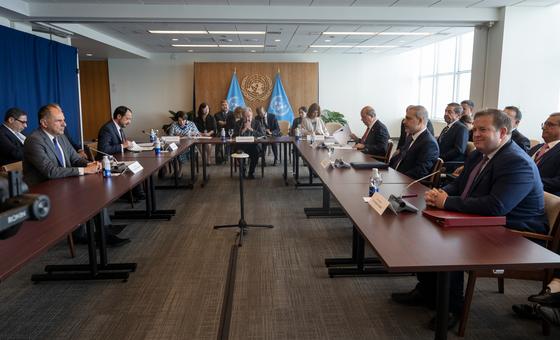
Mr. Guterres was speaking to reporters after hosting Greek Cypriot leader Nikos Christodoulides and Turkish Cypriot leader Ersin Tatar at the UN Headquarters in New York.

Today’s discussions were constructive. Both leaders reviewed the progress on the six initiatives they agreed to in March to build trust,” he said.

Out of these six initiatives, four have been achieved: the creation of a technical committee on youth, initiatives on the environment and climate change, restoration of cemeteries, and an agreement on demining that will be closed once the final technical details are established.

“And discussions will continue on the remaining two,” the UN chief added, referring to the opening of four crossing points on the divided island and solar energy in the buffer zone.

New initiatives

In addition, the leaders reached a common understanding on new initiatives, including a consultative body for civil society engagement, exchanging cultural artifacts, improving air quality monitoring, and addressing microplastic pollution.

It is critical to implement these initiatives – all of them – as soon as possible for the benefit of all Cypriots,” Mr. Guterres said.

The Secretary-General also confirmed that he will meet both leaders again during the UN General Assembly’s high‑level week in September. Another informal meeting in the same format is planned later this year.

A long road ahead

There’s a long road ahead. And it is important to think about what the future can mean – for all Cypriots,” he said.

But these steps clearly demonstrate a commitment to continuing a dialogue on the way forward and working on initiatives that benefit all Cypriots,” he added.

Secretary-General Guterres speaks to the media at the UN Headquarters, in New York.

Supporting dialogue

The United Nations has been playing a central role in efforts towards a comprehensive and mutually acceptable settlement to the Cyprus issue, supporting dialogue between Greek Cypriot and Turkish Cypriot leaders.

While sufficient common ground has not been found to allow for the resumption of formal negotiations, engagement towards that end continues – including informal meetings convened by the Secretary-General and other top UN officials.

Meanwhile, the UN Peacekeeping Force in Cyprus (UNFICYP), deployed since 1964, remains on the ground, helping to maintain stability across the island.

Source link

India, Cyprus Enter Pact to Avoid Double taxation

A revised Agreement between India and Cyprus for the Avoidance of Double Taxation and the Prevention of Fiscal evasion (DTAA) with respect to taxes on income, along with its Protocol, was signed last month on 18th November, 2016 in Nicosia, which will replace the existing DTAA that was signed by two countries on 13th June 1994.

The Protocol was signed by Mr. Ravi Bangar, High Commissioner of India to Cyprus on behalf of India and Mr. Harris Georgiades, the Minister of Finance on behalf of Cyprus.

Both sides have now exchanged notifications intimating the completion of their respective internal procedures for the entry into force of the DTAA, with which the revised DTAA shall come into effect in India in the fiscal year beginning on or after 1st April, 2017.

The revised DTAA will enable source based taxation of capital gains on shares, except in respect of investments made prior to 1st April, 2017. In addition, the DTAA will also bring into effect updated provisions as per international standards and in accordance with the consistent position of India.

In a separate development, the notification of Cyprus under Section 94A of the Income Tax Act, 1961, as a notified jurisdictional area for lack of effective exchange of information, has been rescinded with effect from 1.11.2013, said a statement. The bilateral economic ties between the two countries are expected to be further strengthened by these measures, added the statement.