

As war rages on in Ukraine, organised crime is taking new forms

Since February 2022, both legal and illegal economies in Ukraine have been severely disrupted by the war. 

The report examines the evolution of organised crime structures in the country and focuses on six distinct areas: drug trafficking and production, online scams and fraud, arms trafficking, economic crime, trafficking in persons, and the facilitation of illegal exit and draft evasion.

“The war has not only inflicted untold suffering on the Ukrainian people, but has also triggered a marked evolution in organised crime – which can have profound implications for the country’s journey towards recovery and reconstruction,” said Angela Me, Chief of Research and Analysis at UNODC.

Drug trafficking

While the trafficking of cocaine and heroin through Ukraine has decreased drastically since 2022, the production and trafficking of synthetic drugs such as cathinones and methadone have increased.

The expansion of cathinone trafficking in recent years has been facilitated by the darknet, notably through market platforms such as Hydra, which was dismantled in April 2022.

Regarding methadone, the report noted that most of the Ukrainian production is trafficked within the country and not abroad, as domestic demand for the drug is on the rise.

Arms trafficking

The war has also increased the availability of weapons in the country, notably due to a massive influx of arms from the battlefield.

This surplus is resulting in a rise in arms seizures and violence among civilians, marked notably by an increase in domestic and intimate partner violence.

Although there is no evidence to suggest large-scale arms trafficking outside Ukraine, UNODC highlighted the importance of monitoring the situation in light of the sheer number of weapons available and the historic regional presence of criminal actors specialising in arms trafficking.

While there is, as of now, no evidence of drones being used in a non-military context, civilian drones and 3D-printed components for frontline attacks could fuel new illicit markets, the report found.

Trafficking in persons

As roughly 14 million people have been displaced by the war, some criminal groups have exploited these populations by luring them into shelters or accommodations disguised as humanitarian assistance providers, where they are subjected to forced labour.

While intensified patrolling of the borders, paired with the near-complete closure of the eastern and north-eastern borders, has limited the smuggling of migrants through Ukraine, traffickers have instead turned to facilitating draft evasion by Ukrainian men.

“Curtailing organised crime is a key requirement for achieving sustainable peace, justice, national security and the protection of human rights,” said Matthias Schmale, UN Resident and Humanitarian Coordinator in Ukraine, as the global body stands ready to support the country in this critical work. 
Source link

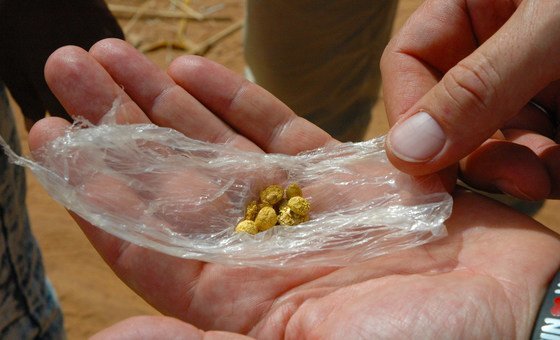
Organized crime groups increasingly embedded in gold supply chain

Criminal networks are increasingly seeking to gain control over extraction sites, trade routes, and refining infrastructure.

According to a new report from the UN Office on Drugs and Crime (UNODC), these groups have become deeply embedded in gold supply chains, drawn by the sector’s high profitability and rising gold prices.

‘Serious global threat’

Organized crime has become so involved in the gold supply that it now constitutes a “serious global threat”, with illegal networks constantly adapting in order to enable and hide their operations.

Exploiting advances in transportation, finance, and communications, many of these groups have a foothold in regular businesses, enabling them to both launder proceeds and move illegal gold with relative ease.

Apart from heightened violence, corruption and environmental degradation, crime gangs also expose vulnerable populations to exploitation, the UN highlights, increasing the risk of sexual exploitation, forced labour, and displacement.

Bypassing regulations

While legal mining operations are regulated to minimise environmental harm, illegal mining bypasses these safeguards entirely.

By clearing forests to access mineral deposits, illicit operations directly contribute to environmental destruction, degrading fragile ecosystems and accelerating biodiversity loss – particularly when such activities occur within protected areas.

One of the most severe environmental impacts of illegal gold mining is the use of hazardous or banned chemicals by criminal organisations.

Opportunities

Although the majority of gold mining sites are located in sub-Saharan Africa, Latin America, the Caribbean, and Southeast Asia, most gold refineries are concentrated in Europe, Asia, and North America. As a result, the precious metal often crosses multiple borders before it even reaches a refining centre.

This transnational movement creates opportunities for both criminal exploitation and law enforcement intervention.

Criminal groups frequently introduce illegally sourced gold into the supply chain by exploiting weak oversight, inconsistent documentation, and regulatory loopholes along trade routes.

However, the geographical concentration of refineries offers a strategic point for disruption, the UNODC report noted.

Focusing regulatory efforts on these key hubs could significantly reduce the flow of illicit gold into the global market, the report concluded.

Source link

Salman Khan convicted in 1998 Chinkara poaching case, faces 6 yrs in jail

Salman Khan, who was freed in Mumbai drunken drive case, was convicted in another case of blackbuck poaching in Jodhpur, on Thursday, April 5.

Two local Bishnoi people regard the animal as their deity and the man who chased poachers on motorcycle, identified and fought the case relentless for 20 years since 1998 against Bollywood celebrities. Under section 9/51 of Wildlife Act, Salman Khan faces up to 6 years jail term now.

Other actors Saif Ali Khan, Tabu, Sonali Bendre, Neelam, and a local resident Dushyant Singh were tried for abatement but are aquitted. Salman Khan appeared before the court on Thursday in the two-decade-old blackbuck (chinkara) poaching case, and was told by the court that he was convicted. The sentence will be pronounced tomorrow, Friday, April 6, 2018.

Salman Khan is currently busy with the shooting for his upcoming film Race 3 in Dubai and he took a day off to attend the court hearing. Salman’s sisters Arpita and Alvira arrived at the Jodhpur court and soon Saif, Bendre and Tabu joined them.

Before the verdict, Remo D’Souza, the director of Race 3, told New18, "Salman never talks about the case while shooting for his films. Same was the case during Abu Dhabi schedule of Race 3 after which the actor left for the verdict. The unit and everyone associated with his big Eid release is hoping for a closure to this long stretched case with a favorable verdict."

Smartphone tracking shows fear affects where youth spend time

Youth spend less time in their neighborhoods if area residents have a high fear of crime, according to a new study that used smartphones to track kids’ whereabouts.

Researchers found that adolescents aged 11 to 17 spent over an hour less each day on average in their neighborhoods if residents there were very fearful, compared to kids from areas perceived as being safer. Higher fear of crime was linked to high-poverty neighborhoods.

This is the first study to use smartphone data to track a large, diverse sample of young people to determine where they spend their time, said Christopher Browning, lead author of the study and professor of sociology at The Ohio State University.

“It is clear that kids who live in high-poverty areas are spending less time in their neighborhoods and that is linked to a collective fear of crime,” Browning said.

“This has never been tested before with GPS data that tracks movements on a minute-by-minute basis.”

Browning presented the research Aug. 14 in Montreal at the annual meeting of the American Sociological Association.

This preliminary data is from the Adolescent Health and Development in Context study, which Browning leads. The study is examining the lives of 1,402 representative youths living in 184 neighborhoods in Franklin County, Ohio. This includes the city of Columbus and its suburbs.

In this study, which was conducted April 2014 to July 2016, participating adolescents were given a smartphone that they kept with them for one week. The GPS function on the phone reported their location every 30 seconds.

Overall, results showed youth spent an average of 52 percent of their waking time each day at home, 13 percent in their neighborhoods, and 35 percent outside of their neighborhoods. About 27 percent of the time when they were not at home while awake, they were in their neighborhoods.

All caregivers of youth in the study were asked to rate how afraid they were to walk in their neighborhood.

Results showed that caregivers’ ratings were only weakly connected to how much time their own children spent in the neighborhood. But the collective fear ratings of all the caregivers who lived in or regularly visited a neighborhood was strongly linked to the amount of time kids spent close to home.

“Once enough people stop spending time in a neighborhood because they are afraid, others will withdraw, whether they are afraid or not,” Browning said.

“If teens go to the local playground and there’s no one to play pickup basketball with, they will go outside the neighborhood to find their friends, or spend more time at home.”

The study looked at whether the presence or absence of amenities like schools, community centers and stores could explain why youth in high-poverty neighborhoods spent less time there. But this factor explained little when compared to the collective fear of crime.

“Many cities have social services like recreation centers that are targeted for disadvantaged neighborhoods,” Browning said.

“But our results suggest these amenities may be underutilized because young people are withdrawing from the neighborhood. Whether they are afraid to go there or just following their friends elsewhere, young people spend less time in disadvantaged neighborhoods.”

Upcoming studies using this same data set will examine whether kids in disadvantaged neighborhoods spend their extra time at home, or outside of their area.

Study explains link between academic performance and violence

Numerous studies have shown a relationship between high-crime communities and the academic performance of children who live within them.

Now, new Northwestern University research suggests sleep disruption following violent incidents and increased amounts of the stress hormone cortisol offer a biological explanation for why children who live in neighborhoods with higher rates of violent crime struggle more in school.

“Both sleep and cortisol are connected to the ability to learn and perform academic tasks,” said study lead author Jenni Heissel, who recently received her Ph.D. in human development and social policy from the School of Education and Social Policy. “Our study identifies a pathway by which violent crime may get under the skin to affect academic performance.”

The study, conducted by researchers at Northwestern, New York University and DePaul University, found violent crime changes the sleep patterns of children living nearby, which increases the amount of cortisol, the stress hormone, in the children’s bodies the day immediately following the violent incident. Both sleep disruption and increased cortisol have demonstrated a negative impact on academic performance.

“Past research has found a link between violent crimes and performance on tests, but researchers haven’t been able to say why crime affects academic performance,” Heissel said.

Researchers tracked the sleep and stress hormones of 82 young people, ages 11 to 18, in a large Midwestern city who attended racially, ethnically and socioeconomically diverse public schools.

The students filled out daily diaries over four days, wore activity-tracking watches that measured sleep and had their saliva tested three times a day to check for cortisol. Researchers also collected information on violent crimes reported to police in the city during the study, including which students had violent crimes occur in their neighborhoods.

Researchers compared the students’ sleep on nights following a violent crime to their sleep on nights when there were no violent crimes committed nearby. They also compared students’ cortisol on days following a violent crime to their stress hormones on days when there were no violent crimes committed nearby.

Among the findings: Students went to sleep later on nights when a violent crime occurred near their home, often resulting in fewer total hours of sleep. In addition, the increase in youth’s cortisol levels the morning after a nearby crime occurred the day before was larger than on mornings following no crime the previous day, a pattern that previous research suggests might reflect the body’s anticipation of more stress the day following a crime. The changes in sleep and cortisol were largest when the crime committed the previous day was homicide, they were moderate for assault and sexual assault and nonexistent for robbery.

“The results of our research have several implications for policy,” suggested study co-author Emma Adam, professor of human development and social policy at SESP.

“They provide a link between violent crime and several mechanisms known to affect cognitive performance. They also may help explain why some low-income youth living in high-risk neighborhoods sleep less than higher-income youth. And they suggest that although programs to reduce violent crime may be the best policy solution, schools could also provide students with programs or methods to cope with their response to stressful events like nearby violent crimes.”