

“We close this historic week not just with hope, but with concrete commitment, clear direction, and undeniable momentum,” Li Junhua, the UN’s Under-Secretary-General for Economic and Social Affairs and Secretary-General of the summit, told reporters.
Co-hosted by France and Costa Rica, the five-day event brought 15,000 participants, including more than 60 Heads of State and Government, to France’s Mediterranean coast.
With over 450 side events and nearly 100,000 visitors, the gathering, dubbed UNOC3, built on the momentum of previous ocean summits in New York (2017) and Lisbon (2022). It culminated in a shared call to expand marine protection, curb pollution, regulate the high seas, and unlock financing for vulnerable coastal and island nations.

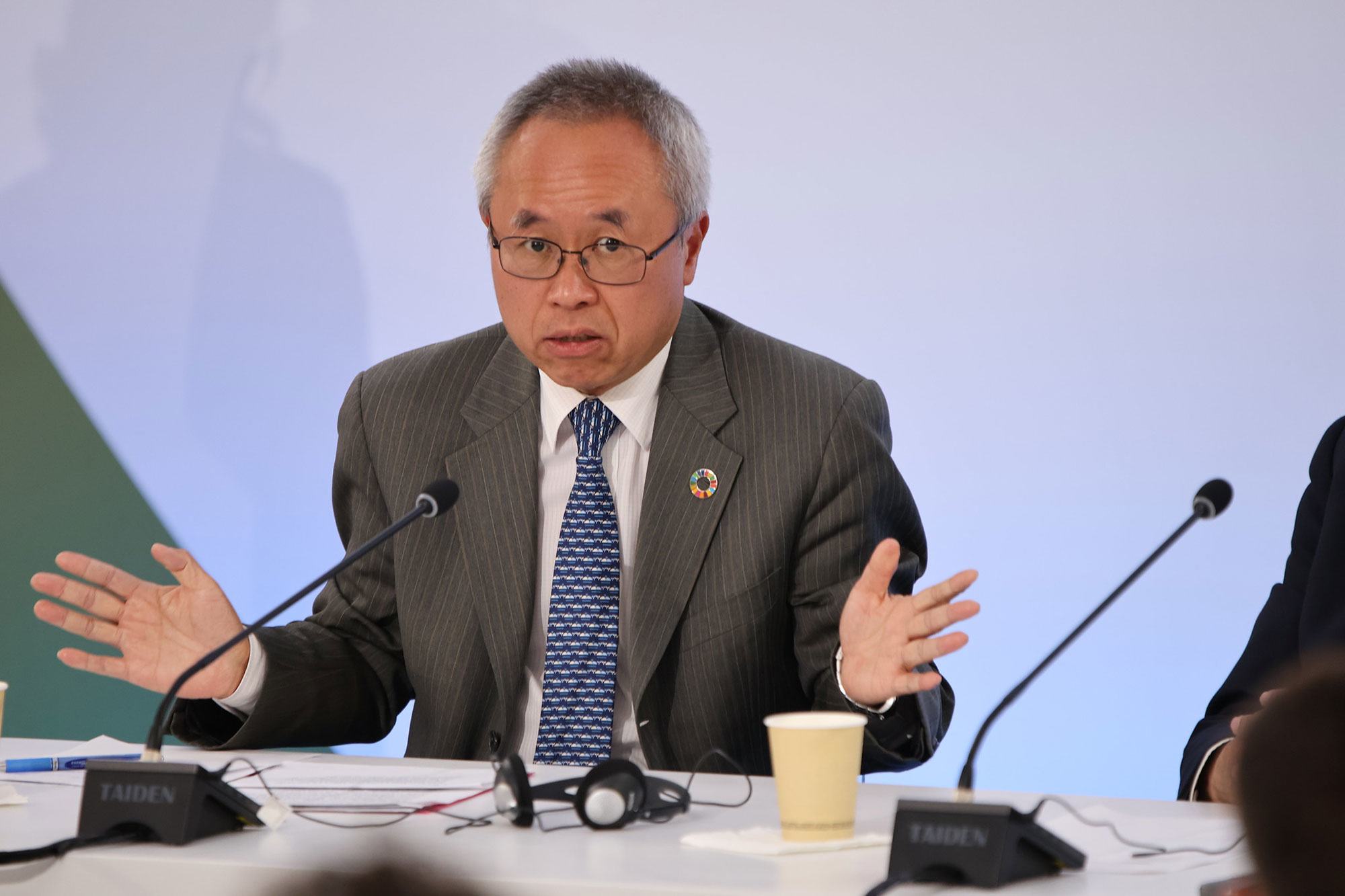
Li Junhua, the UN’s Under-Secretary-General for Economic and Social Affairs and Secretary-General of UNOC3, at the closing press conference, in Nice.
Ambitious pledges
The conference’s outcome, known as the Nice Ocean Action Plan, is a two-part framework that comprises a political declaration and over 800 voluntary commitments by governments, scientists, UN agencies, and civil society since the previous conference.
“These range from advocacy by youth to deep-sea ecosystem literacy, capacity building in science and innovation, and pledges to ratify intergovernmental treaties,” Mr. Li said.
The pledges unveiled this week reflected the breadth of the ocean crisis. The European Commission announced an investment of €1 billion to support ocean conservation, science, and sustainable fishing, while French Polynesia pledged to create the world’s largest marine protected area, encompassing its entire exclusive economic zone – about five million square kilometers.
Germany launched a €100-million programme to remove underwater munitions from the Baltic and North Seas. In addition, New Zealand committed $52 million to strengthen ocean governance in the Pacific, and Spain announced five new marine protected areas.
A 37-country coalition led by Panama and Canada launched the High Ambition Coalition for a Quiet Ocean to tackle underwater noise pollution. Meanwhile, Indonesia and the World Bank introduced a ‘Coral Bond’ to help finance reef conservation in the country.
“The waves of change have formed,” Mr. Li said. “It is now our collective responsibility to propel them forward – for our people, our planet, and future generations.”
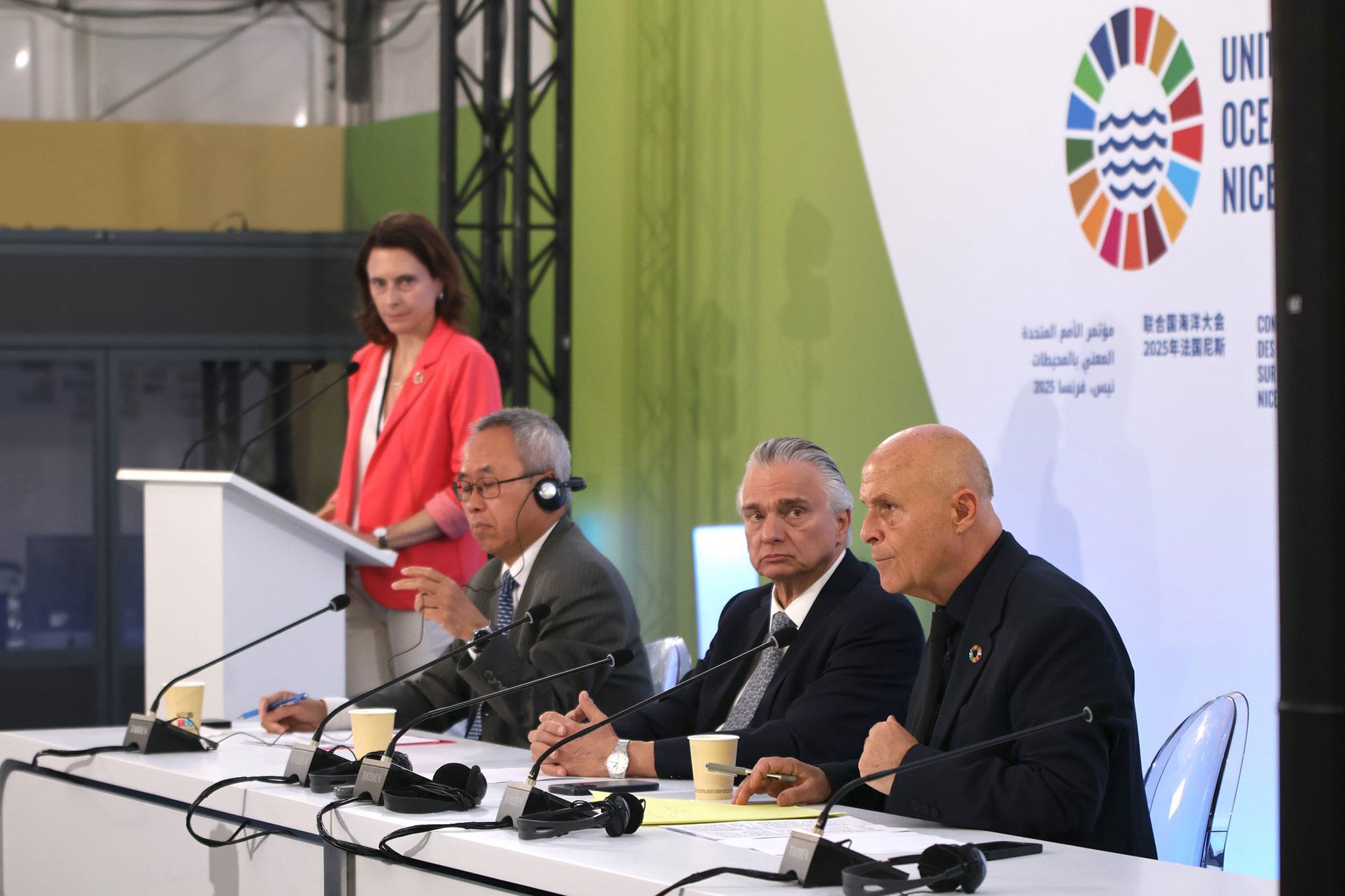
Olivier Poivre d’Arvor (right), France’s special envoy for the conference, at UNOC3;s closing press conference, in Nice.
A diplomatic stage
The summit opened Monday with stark warnings. “We are not treating the ocean as what it is – the ultimate global commons,” said UN Secretary-General António Guterres, alongside the presidents of France and Costa Rica, Emmanuel Macron and Rodrigo Chaves Robles, who called for a renewed multilateralism anchored in science.
On Friday, France’s special envoy for the conference, Olivier Poivre d’Arvor, recalled the stakes: “We wanted in Nice… to take a chance on transformative change. I believe we have moved forward, but we can no longer go backwards.”
One of the conference’s main objectives was to accelerate progress on the High Seas Treaty – known as the BBNJ agreement – adopted in 2023 to safeguard marine life in international waters. Sixty ratifications are needed for it to enter into force. Over the past week, 19 countries ratified the accord, bringing the total number as for Friday, to 50.
“This is a significant victory,” said Mr. Poivre d’Arvor. “It’s very difficult to work on the ocean right now when the United States is so little involved.”
The French envoy was alluding to the absence of a senior US delegation, as well as President Donald Trump’s recent executive order advancing deep-sea mining. “The abyss is not for sale,” he said, echoing remarks made earlier in the week by President Macron.
Still, Mr. Poivre d’Arvor emphasized the broad agreement achieved at the summit. “One country may be missing,” he said. “But 92 per cent of the ‘co-owners’ were present today in Nice.”
His counterpart, Arnoldo André-Tinoco, the Foreign Minister of Costa Rica, urged other nations to accelerate financing for ocean protection. “Each commitment must be held accountable,” he said at the conference’s closing meeting.

Momentum – and a test
For Peter Thomson, the UN’s Special Envoy for the Ocean, Nice marked a turning point. “It’s not so much what happens at the conference, it is what happens afterwards,” he told UN News, recalling the early days of ocean advocacy when Sustainable Development Goal 14 (SDG14), on life below water, was first established.
“From the desert we were in back in 2015… to where we are now, where you see this incredible engagement.”
Looking ahead, attention is already turning to the Fourth UN Ocean Conference, slated to be co-hosted by Chile and South Korea in 2028.
“We’re going to again see a big surge upwards from here,” Mr. Thomson predicted. He expressed hope that major global agreements — including the BBNJ treaty, the WTO Fisheries Subsidies Agreement, and the future Global Plastics Treaty – will all be ratified and implemented by then.
The 2028 summit will also mark a moment of reckoning, as SDG 14 approaches its 2030 target.
“What do we do when SDG 14 matures in 2030?” Mr. Thomson asked. “Obviously, it’s got to be raised ambition. It’s got to be stronger.” He emphasized that while SDG14 had aimed to protect 10 per cent of the ocean by 2020 – a target the world failed to meet – the new benchmark is 30 per cent by 2030.
Wearing a shell necklace gifted by the Marshall Islands, the Fiji native praised small island nations and atoll collectives for setting ambitious marine protections.
“If small countries can make big measures like that, why can’t the big countries follow suit?” he said.
He also saluted the 2,000 scientists who gathered for the One Ocean Science Congress ahead of the summit. “What a great way to run things,” he said.
A show of unity
Despite the celebratory tone, tensions lingered. Small Island Developing States pushed for stronger language on loss and damage – harms inflicted by climate change that go beyond what people can adapt to. “You cannot have an ocean declaration without SIDS,” one delegate warned earlier this week.
Others, including President Chaves, of Costa Rica, called for a moratorium on deep-sea mining in international waters until science can assess the risks – a step not included in the final declaration.
Still, the political declaration adopted in Nice, titled Our ocean, our future: united for urgent action, reaffirms the goal of protecting 30 percent of the ocean and land by 2030, while supporting global frameworks like the Kunming-Montreal Biodiversity Agreement and the International Maritime Organization’s climate goals.
“The real test,” Mr. Li said, “is not what we said here in Nice – but what we do next.”
As the sun dipped behind the Promenade des Anglais and the conference’s final plenary adjourned, the sea – ancient, vital, and imperiled – bore silent witness to a fragile but shared promise.