
Six labourers killed as lift collapses in under-construction highrise building

Ahmedabad, Sep 14 (IANS) At least six labourers were killed and one seriously injured after the lift of an under-construction building collapsed here on Wednesday.

The lift crashed from the seventh floor. The under-construction highrise building, named Aspire-II was located near the Gujarat University campus.

“At the time of the accident seven labourers were inside the lift, which was used to carry various materials. The lift crashed from the seventh floor on Wednesday morning. The labourers were working in the lift chamber,” said Mahendra, an eyewitness and labourer at the site.

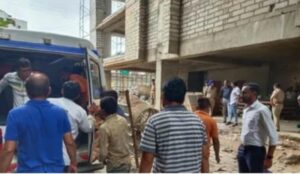
Building collapsed

He told the media that all the labourers hailed from the Panchmahal district.

The Ahmedabad Municipal Corporation said the incident will be probed and action against responsible builders will be taken.


Lift crashed

Hitesh Barot, Ahmedabad Municipal Corporation Standing Committee Chairman told the media that all aspects of safety measures will be investigated, and if the builder was found responsible, suitable action will be taken against him or the company. The police were also carrying out the investigation parallely.

Arvind Kejriwal dines at auto driver’s home in Ahmedabad

Aam Aadmi Party (AAP) supremo and Delhi Chief Minister Arvind Kejriwal, who was in Gujarat on Monday to campaign for the upcoming Assembly elections, kept his promise made to an auto rickshaw driver of having dinner at his home in Ahmedabad.

During a meeting with auto drivers earlier in the day, Vikram Dantani had requested Kejriwal to have dinner at his place. Accordingly, Kejriwal, accompanied by Gujarat AAP leaders Isudan Ghadvi, Gopal Italia and Indranil Rajyaguru, went to Dantani’s house to have dinner on Monday evening.

“In Ahmedabad, auto driver Vikrambhai Dantani lovingly took me home for dinner, introduced me to the whole family, and treated me with delicious food with great respect. Heartfelt thanks to Vikrambhai and all the auto driver brothers of Gujarat for this immense affection,” Kejriwal tweeted.

Ahmadabad Joins 36 UNESCO’s World Heritage Properties in India


The “Historic City of Ahmadabad” has figured on UNESCO’s World Heritage list on 8th July, 2017 during the 41st Session of World Heritage Committee, which makes the walled city of Ahmedabad the first city in India and the third in Asia to be inscribed to the World Heritage List.

In the past 3 years alone, India has managed to put five built heritage sites on the world heritage list of UNESCO. India now has overall 36 World Heritage Inscriptions with 28 Cultural, 07 Natural and 01 Mixed site. While India stands second largest in number after China in terms of number of world heritage properties in ASPAC (Asia and Pacific) region, it is overall seventh in the world.

Founded in 15th century, the walled city of Ahmadabad, on the eastern bank of the Sabarmati river, has a rich architectural heritage with 28 ASI Centrally Protected Monuments. The urban structures of the historic city of Ahmedabad are distinctive due to their puras (neighbourhoods), pols (residential streets), and khadki (inner entrances to pols) largely made of timber.

The historic architecture reflects symbols and myths connected with its inhabitants. The urban fabric is made up of densely-packed traditional houses (pols) in gated traditional streets (puras) with characteristic features such as bird feeders, public wells and religious institutions. It is a unique example of multi-religious and multicultural coexistence.

The inscription has been done under Criteria (ii) and (v) as defined in the UNESCO’s Operational Guidelines, 2016. Criterion (ii) refers to the important interchange of human values, over a span of time on development of architecture, monumental arts, town planning and landscape while Criterion (v) refers to being an outstanding example of human settlement and land use.

The international recognition to the city is expected to boost the local economy, giving it a tremendous fillip to domestic and international tourism leading to increased employment generation, creation of world-class infrastructure and augmentation of sale of local handicrafts, handlooms and heritage memorabilia.