Bollywood actor Farhan Akhtar has donated 1,000 PPE or protective equipment for the Coronavirus frontline warriors in Mumbai, on the lines of many other donors such as Uday Shankar, Chairman of Star and Disney India. PPEs will be extremely helpful during the lockdown that has been caused by the coronavirus pandemic.
Since there was a shortage of supply of personal protection equipment (PPE) for people working in the frontline, many celebrities have come to their aid and donated lakhs of PPE kits to the frontline heroes who are fighting Covid-19 and also encouraged the people to donate as much as they can.
Farhan inspired people to donate and the actor recently expressed his gratitude towards people who helped make the donation possible. He posted a picture of PPE kits on social media with the caption:
“Thanks for your support you amazing people. Our first batch of PPE kits are on its way to Vakola Police Station from the factory. Please do contribute at http://tring.co.in/Farhan-Akhtar
Let’s protect our frontline warriors Smiling face with smiling eyes🙏🏽 Jai Hind. @MumbaiPolice @DevenBhartiIPS @TringIndia”
Thanks for your support you amazing people. Our first batch of PPE kits are on its way to Vakola Police Station from the factory.
Last week, Uday Shankar, who is President of the Walt Disney Company Asia Pacific and chairman, Star and Disney India, was among those to contribute 2 lakh PPEs in partnership with Project India. The company has donated over 200,000 PPE kits to the health workers at BMC and an additional 10,000 khakhi coloured kits for the Mumbai Police. The BMC tweeted, thanking it for the initiative.
One million years old early stone tool used by hominins (early humans) has been unearthed by archaeologists in the Nihewan Basin, China which has thrown light on how the early civilizations were able to adapt to climate change and lead a sustainable living.
These stone tools show the skills of ancient humans who modified their tool manufacturing behaviour in Eastern Asia, said Shixia Yang, who led a team that examined three well-known archaeological sites from the Nihewan Basin in North China. The study has been published in the journal National Science Review.
Ecological, biological and stone tool information from 2.2 million years ago to the present (the light red horizontal bar shows increased climate variability) (a) Global climate change. (b) Vegetation history of the North China Plain based on pollen analysis. (c) Hominin brain size estimates for Africa and Eurasia. (d1) Stone tool changes through time in the Nihewan Basin, China, showing the frequency of artefacts across different time periods (dark green bars). (¬d2) Key stone tool changes across China / Science China Press
Comparing the stone tools from the archaeological sites of Xiaochangliang, Cenjiawan and Donggutuo, the archaeologists realized that these tools indicate that technological skills increase at ca. 1.1-1.0 million years ago. The stone tools at Cenjiawan and Donggutuo show increasing levels of manufacturing procedures and some degree of planning in the tool-making process to produce desired end-products, said the team.
Stone tools adapting climate change
The ancient technological innovations at ca. 1.1-1.0 million years ago in the Nihewan Basin coincided with a major climate transition which occurred between 1.2 million years ago to 700,000 years ago (called the Mid-Pleistocene Climate Transition), effecting a series of global and regional palaeoclimatic and palaeoenvironmental changes during the period such as increase in aridity and monsoon intensity and decrease in sea surface temperature in the North Atlantic.
Hence, at 1.1 million years ago the early human inhabitants of the Nihewan Basin lived under a changing and unstable environment, experiencing aridification. The climatic change also produced ecological changes, including landscape alterations and mammalian extinctions, but adapting novel technologies may have provided benefits to those who lived in the Nihewan Basin, said the study.
The unstable environmental conditions during the onset of this period provide a good example of the adaptive skills of early hominins in China, contrasting with the notion of long-lasting conservative behaviours recorded by other archaeologists, said the research paper.
Making stone tools
Earlier studies showed that refined stone tools emerged half a million years ago. Research carried out at the University of Kent demonstrates that a technique used to produce stone tools is likely to have needed a modern human-like hand, such as the ability to perform highly forceful precision grips.
Image of stone tools half-a–million years ago — Comparison between a Handaxe and a Clovis Point CREDIT: Alastair Key and Metin Eren
The technique involves preparing a striking area on a tool to remove specific stone flakes and shape the tool into a pre-conceived design. Platform preparation is key for making many different types of advanced prehistoric stone tool, with the earliest known occurrence observed at the 500,000-year-old site of Boxgrove in West Sussex (UK).
A study, led by Dr Alastair Key, of the University’s School of Anthropology and Conservation, and funded by the British Academy, investigated how hands are used to produce such early stones.
Using sensors attached to the hand of skilled flint knappers (stone tool producers), the researchers identified platform preparation using the hand to exert significantly more pressure through the fingers when compared to all other stone tool activities studied.
Since human hand bones rarely survive in the fossil record, Dr Key said: “Hand bones from before 300,000 years ago are rare, particularly when compared to other human fossils such as teeth, so the fact we can study the manipulative capabilities of our early ancestors from the stone tools they produced is incredibly exciting.”
The research demonstrates that the Boxgrove hominins would have needed significantly stronger grips compared to earlier populations who did not perform this behaviour. It further suggests that highly modified handaxes discovered at Boxgrove and stone spear points found in later prehistory, may not have been possible to produce until humans evolved the ability to perform particularly forceful grips.
After building a high buzz around the story line and characters in their their upcoming series, the makers of Amazon Prime’s Paatal Lok recently released the trailer bringing the intensity to the series.
From the looks, the series had created a buzz with the social media raving about the characters, actors, story line and the graph of captivating content the series brings along, ever since the trailer hit the Youtube. The makers started off by releasing the teaser followed by character posters of Jaideep Ahlawat, Abhishek Banerjee and Neeraj Kabi, back to back.
The trailer gives an insight into the story line of Paatal Lok and certainly gives you shivers and walk you through the gateway of hell. The highly anticipated Amazon Original Series by Creator Sudip Sharma (writer of NH10 and Udta Punjab) is set to make viewers have a whole different experience of hell on Friday, May 15, 2020, amid the coronavirus lockdown when many people are watching Amazon Prime on their tiny phones at home.
Produced by Clean Slate Films, Bollywood actress Anushka Sharma‘s banner, the story revolves around a down and out cop who lands in the case of a lifetime when four suspects are nabbed in the assassination attempt of a prime time journalist. The case turns out to be a devious maze where nothing is what it appears and a hot pursuit of it leads them to the dark netherworld – the ‘Paatal Lok’, and many more shocking discoveries in the past of the four suspects.
Written by Sudip Sharma, the police and crime thriller series is inspired by the traditional concepts of Svarga, Dharti and Paatal (heaven, earth and the underworld) and the four estates of present government structure. Inspector Hathi Ram Chaudhary is a cynical, washed out Delhi cop who has nothing to look forward to in his ordinary career finds the case too high profile to earn him a promotion. The case turns into a dark mystery thriller that leads inspector to the dark realm of underworld or Paatal Lok.
When Hathi Ram follows his instincts to investigate into the lives of the suspects, he discovers startling truths and insights that eventually unravel his place in the larger scheme of things and the larger meaning of life itself.
Cast
Neeraj Kabi as Sanjeev Mehra
Gul Panag as Renu Chaudhary
Jaideep Ahlawat as Hathiram Chaudhary
Abhishek Banerjee as Hathoda Tyagi
Swastika Mukherjee as Dolly Mehra
Ishwak Singh as Imran Ansari
Jagjeet Sandhu
Asif Khan
Mairembam Ronaldo Singh
Niharika Lyra Dutt as Sara Matthews
Bodhisattva Sharma as Siddharth Chaudhary.
Since going to Mars, one of our closest terrestrial neighbors, is still very far away, Japanese scientists have tried something on our own planet with simulations and found that the iron-sulfur alloys thought to comprise the core of Mars to reveal details about the planet’s seismic properties for the first time.
This information will be compared to observations made by Martian space probes in the near future when Mars missions yield results. Mars is usually 55 million and 400 million kilometers away from the Earth depending on where both the planets are relative to the sun.
Keisuke Nishida, an Assistant Professor from the University of Tokyo’s (Todai) Department of Earth and Planetary Science and his team studied the seismic data and composition which revealed the present state of the red planet, including its past and the possible origin.
“The exploration of the deep interiors of Earth, Mars and other planets is one of the great frontiers of science,” said Nishida. “It’s fascinating partly because of the daunting scales involved, but also because of how we investigate them safely from the surface of the Earth.”
For a long time it has been theorized that the core of Mars probably consists of an iron-sulfur alloy but it will take decades to confirm scientifically. Hence, the Todai team focused on seismic waves, which are akin to enormously powerful sound waves, and can travel through a planet and offer a glimpse inside, albeit with some caveats.
The Missing Middle
“NASA’s Insight probe is already on Mars collecting seismic readings,” said Nishida. “However, even with the seismic data there was an important missing piece of information without which the data could not be interpreted. We needed to know the seismic properties of the iron-sulfur alloy thought to make up the core of Mars.”
Kawai-type multianvil presses installed at the SPring-8 facility (left) and KEK-PF (right)
Nishida and the team have measured the velocity for P-waves (one of two types of seismic wave, the other being S-waves) in molten iron-sulfur alloys. The study that last for more than three years to collect the ultrasonic data, however, helped to throw some light on the red planet. “A molten iron-sulfur alloy just above its melting point of 1,500 degrees Celsius and subjected to 13 gigapascals of pressure has a P-Wave velocity of 4,680 meters per second; this is over 13 times faster than the speed of sound in air, which is 343 meters per second,” explained researchers.
They used a device called a Kawai-type multianvil press to compress the sample to such pressures, besides X-ray beams from two synchrotron facilities, KEK-PF and SPring-8, to get images of the samples and then calculate the P-wave values.
“Taking our results, researchers reading Martian seismic data will now be able to tell whether the core is primarily iron-sulfur alloy or not,” said Nishida. “If it isn’t, that will tell us something of Mars’ origins. For example, if Mars’ core includes silicon and oxygen, it suggests that, like the Earth, Mars suffered a huge impact event as it formed. So, what is Mars made of and how was it formed? I think we are about to find out.”
A helium atom in which one of the two electrons has been replaced by a negative pion gives out a composite particle made of one quark and one antiquark. Exotic atoms can help physicists to make exquisitely precise measurements of the fundamental constants of nature, such as the size of the proton.
Pionic helium is the latest addition to a zoo of exotic atoms, including positronium, muonium, muonic hydrogen, muonic deuterium and antihydrogen. No dilithium crystals yet, though. Pionic helium could provide a direct measurement of the mass of a related fundamental particle, the neutrino. That has been estimated indirectly, says physicist Masaki Hori, but “it is always nice to have a direct laboratory determination”.
Exotic atoms are those in which one or more of the constituents of normal atoms have been replaced by an exotic particle, such as an antimatter particle. These atoms can then be probed to search for any tiny discrepancies in their properties from those predicted by models using techniques that underpin the world’s most accurate timekeepers, atomic clocks — and thereby opening a window on the foundations of physics.
Transition in ‘pionic’ helium atom
Reporting for the the first time about laser excitation of helium atoms in which one electron has been replaced by a subatomic particle called a pion, the scientists said they recorded a transition in a ‘pionic’ helium atom, in which one of the two electrons of a helium atom has been replaced by a subatomic particle called a pion.
Pions were discovered7 by Cecil Powell and co-workers in 1947, but their existence was first predicted in 1935 by Hideki Yukawa. They belong to the family of subatomic particles known as mesons, which are made up of a quark and an antiquark. Quarks are the particles that make up protons and neutrons.
Pions are short-lived particles that come in positively charged, negatively charged and neutral varieties and the team amanged to produce negatively charged pions with a lifetime of only 26 nanoseconds when isolated. It is thus no small feat that the experiment not only succeeded in replacing an electron in helium atoms with a pion, but also observed the resulting exotic atom undergo a quantum transition.
Hori and colleagues’ work now opens up a whole new experimental system for further exploration. If some challenges can be overcome, such exploration might enable the accuracy of the mass of the negative pion to be improved by a factor of 10–100, for instance; currently, this mass is known to only six decimal places.
By Dr. S. Naresh Kumar / Dr. Om Prakash / Jitender Kumar Gupta
The Covid-19 epidemic is spreading rapidly across the country and the number of patients infected with corona virus is increasing. India has done a great job so far in keeping these numbers low, relative to other countries. However, the indirect impact of this infection is on the farmers and crops. During March and April, crops usually get ready to be harvested in most parts of the country.
However, due to the fear of virus infection and lockdown, farmers have been facing many problems in harvesting and marketing the crop produce. A quick view of the issues faced by the farmers of Bundelkhand region (Jhansi and Niwari districts) along with their response to situation as well as Government interventions by a team of Indian Agricultural Research Institute (ICAR) led by Dr. S. Naresh Kumar and his team Dr. Om Prakash and Jitender Kumar Gupta could see the ground level impact in some villages of Bundelkhand region.
Covid-19 impact in villages
The crop harvest is delayed due to non-availability of labour as a consequence of nation-wide lockdown.
Threshing machines come to Bundelkhand region mostly from areas like Punjab, Haryana and Rajasthan during the wheat harvesting season to work on rent but, due to lockdown the threshing machine could not reach in time.
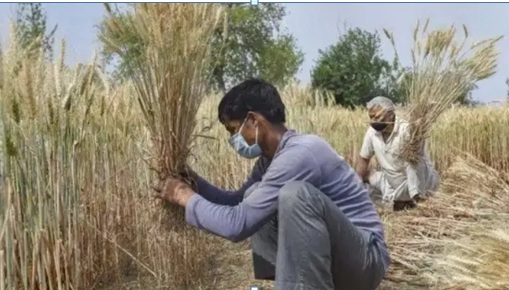
To save crop from wastage, farmers are trying to harvest and transport themselves.
After harvesting, they are also facing issues in storing the produce, transporting it to markets and selling it. During the first phase of lockdown farmers could not even get the means of transportation to take them to markets.
In such a situation, farmers are looking for options to sell the crop directly from the farm field, so that they can get some money for their produce.
Pradhan Kaushal Nayak and wheat farmers of village Pathari in block Babina of Jhansi district say that this is the season for harvesting of crops like wheat and gram, while the harvesting of mustard crop was over before lockdown. In fact, the absence of laborers forced many farmers to harvest the crop by involving entire family members and by taking help from neighbours. But due to lack of transportation, they could not sell the crop.
In case of vegetable crops, major varieties such as cauliflower, cabbage, brinjal, okra, pumpkin are drying in the fields. Due to the closure of routes leading to vegetable markets, farmers have left the vegetables in the fields unharvested. In normal course, vegetables from Jhansi used to go to distant places such as Agra, Banda, Mahoba, Gwalior and Jabalpur. But the lockdown made it virtually impossible to transport the vegetables to distant places, while buyers too could not reach the villages. Farmers are left to face economic strides in their villages.
Decrease in sales and prices
In another village, NayaGaon, of the same block, the farmers shared their issues related to animal husbandry. Rajesh Rai and other livestock owners say that the price of animal feed such as khali (oil cake) has gone up by Rs 200 to Rs 300 per bag. For instance, a bag of oil cake which was available earlier at Rs 1,400 has now become Rs 1,600. In the same vein, the Chokar (wheat bran) which was Rs 850 is now available for Rs 1,100. On the other hand, prices of milk have decreased, causing further economic loss to farmers. Closure of sweet shops and hotels has also led to a huge reduction in the demand for milk. The milk which was earlier sold at Rs. 45 to Rs. 50 per liter, is now sold barely at Rs. 25 to Rs. 30 a litre.
Despite all these hardships, farmers have shown exemplary resilience following the coronavirus directions to keep social distance, wear masks and sanitize hands frequently. They started harvesting crops themselves. Soon, the government has exempted the agricultural related activities from lockdown restrictions.
This has greatly helped them to access the harvesting machines, labour, local transport and markets. Machines related to harvesting, such as Combined Harvester, Reaper is able to move from one state to another for meeting the harvesting demand in a short duration. Harvesting was done even during nights to maximize the machine availability.
Opening of government markets, agricultural production market committees and those mandated with agricultural products as listed by the authorities enabled farmers to access fertilizers, seed and chemical pesticide shops for maintaining their standing vegetable crops in tact and to plan for ensuing kharif season. The Government has allowed movement of people engaged in crop harvesting and those in procurement of crops at minimum support price. In addition, opening of Custom Hearing Centers helped them to prepare value added products.
Govt relief efforts
In addition to all these, under the PM Kisan Samman Yojana, registered farmers got an installment of Rs. 2,000 in the first week of April. This amount provided instant financial relief in the midst of Corona crisis. Under the Pradhan Mantri Ujjwala Yojana, the Centre has decided to provide free gas cylinders to the beneficiary women for three months. Farmers in these villages already started getting these benefits. Due to the above facilities and financial relief that is being provided by the government to farmers, despite the lockdown, they are able to carry on agricultural work with relatively less hardship.
Among other facets of village activities, education of school and college going children is largely affected as many of them do not have smartphones, the internet connectivity is limited and know-how on use of online or e-learning platforms is also limited.
The Indian Council of Agricultural Research and Indian Agricultural Research have issued advisories to farmers to use machines for harvesting and threshing. A precautionary advisory is made for the use of farm equipment, so that more people will not gather for farm operations; and if possible, engage people only familiar to the farm work to prevent any Covid-19 infection from outsiders. These guidelines along with the Covid-19 prevention measures helped farmers to carry on farm operations without much hindrance.
Guidelines to farmers
The ICAR-Indian Agricultural Research is implementing the climate resilient technologies in six villages of Jhansi (in UP) and Niwari (in MP) districts under the project entitled ‘Agricultural Productivity in Climate Change Scenarios: Impacts and Adaptation Pathways’. On-station project personnel have been providing the information to farmers of Bundelkhand region on precautions to be followed for prevention of Corona virus. The precautions advised to farmers in these villages while performing the agricultural operations such as harvesting or threshing include:
Maintain social distance (i.e. at least 2-meter distance between each other),
Do not employ more workers in the field simultaneously,
Do not drink water from the same bottle used by others,
Use your own farm implement or wash it before and after use, if borrowed from others,
All working persons / workers have to ensure that they work only by wearing home-made masks,
All must wash their hands frequently with soap for at least 22 seconds,
If crop is harvested, then store the produce in dry place,
Do not indulge in panic selling, as there may be a possibility of getting lower price,
Keep emergency numbers of your district officials (agriculture, health, etc) with you,
The most important thing is to take care of health of yourself and your family, and
Do not litter and do not defecate in the open.
Future challenges and opportunities
The recent developments also lead to the return of villagers who migrated to cities for jobs and livelihood. Currently, these are under quarantine at centers located in district headquarters. This ‘Reverse Migration’ will pose new challenges and also provide opportunities in rural areas. Over 2 million people are likely to return to their villages across the country, though it may not be a huge number in a country that has about 1.3 billion people. Many may return to their earlier jobs in cities but surely some will stay back due to the family and social pressures.
It is important to provide opportunities to start their own small business or ventures of their expertise in the village or cluster of villages. Agricultural activities such as farm mechanization, value addition, processing, grading, packing, transportation and marketing can attract these relatively skilled force. Some can also form the groups to start agricultural services such as supplying inputs (both material and knowledge) to farmers, provide market information and act as output managers. Thus a few in the village can act as the‘input-output service provider’.
In addition, the rural infrastructure needs to be given emphasis. This includes providing threshing platforms, village level storage facility, facilities for development of value added products, etc. The internet facility and some ICT facilities are needed for developing online learning facility within the village. This facility can be used by all villagers (including students) for learning and communication. For all these, the government, industries (under corporate social responsibility), NGOs and individuals can join hands to make rural India vibrant.
Time to build future vibrant rural economy
The current crisis has made us all realize that too much human perturbation has taken place in ecosystems leading to their degradation. Globally, we have been experiencing cleaner air, cleaner water and more activities of other living beings (birds, animals) due to the restrained activities of humans under Covid-19 threat. Hence, these ‘forced learnings’ must not be wasted. It’s time to rethink about designing the future development pathways that are in harmony with ecosystem sustainability so that plant earth becomes more sustainable.
All the initiatives must take ecosystems sustainability more seriously. In agriculture, for example, ecosystem based approach and solutions must be given priority. In energy sector, the renewable energy sources and developing energy use efficient technologies become important. While doing so the waste generated (eg. batteries) must not pollute the ecosystems. Similarly, in real estate sector, designing and constriction of energy efficient buildings must be given the priority. So let us think and act for a green and clean bright future of the planet earth.
(The writers are scientists from the Indian Agricultural Research Institute (ICAR), New Delhi.)
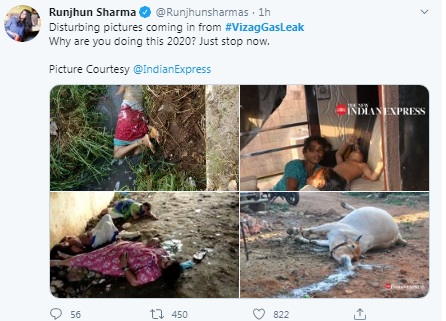
Eleven people were killed in Visakhapatnam (Vizag) styrene gas leak tragedy that shook the coastal city in Andhra Pradesh in India during the wee hours on Thursday between 02:30 to 03:00 AM. More than 1,000 people who live in villages surrounding the factory have been shifted to hospitals in the city of Vizag and a massive hunt is on for those still inside homes or died during sleep.
The deadly gas leaked from a closed LG polymers factory in Vepagunta village in Gopalapatnam near Vizag was identified as styrene gas, which is one of the most poisonous gases that affects lungs and nervous system initially and many vital organs over a period of two to three years. The gas leakage started at 3 pm in the night and many panic-stricken local villagers reportedly ran out of their homes towards Meghadrigedda nearby but further exposed to more gas and suffered on the roads and streets. The visuals of people falling down on roads and pavements filled the local TV screens.
While three people died after falling into a canal, five have been declared brought dead by the King George Hospital, where more than 180 people are currently being treated, said local reports. Many animals were seen already dead by morning or struggling to breathe in the open.
The leak reportedly occurred in Styrene gas chamber, that was shutdown for over a month due to the coronavirus lockdown. The doctors have warned that inhalation of this poisonous gas is dangerous with long-standing effect on lungs, liver and other vital organs of the body, besides affecting the nervous system of the human body.
Evacuation
Vizag District collector V Vinay Chand said the tragedy occurred while the plant was being recommissioned after the COVID lockdown without giving more details on how the mishap took place in the night. People from all villages around the plant have been shifted to safer places nearby and people are advised to put wet cloth on their faces covering eyes, he said.
Ambulances and RTC buses are arranged to evacuate local villages from the affected area. “Initial attempts to control the gas by spraying did not yield any result. It will take another two hours to bring the gas leak under control,” said the collector soon after the accident.
The chief minister of Andhra Pradesh, Mr Jagan Mohan Reddy announced Rs. 1 crore ($145,000) in compensation to each affected family with a death. Local leaders blamed the LG polymers, of the Korean conglomerate, which was built in 1997 at RR Venkatapuram near Gopalapatnam village in an area of 200 acres. It has a capacity of producing 400 tonnes of polystyrene daily using styrene, a highly inflammable liquid. As the area was a green zone under Covid-19 measures, the lock-down was eased earlier this week prompting the factory to resume production.
Medical doctors have advised those who are likely to have inhaled the gas up to five kilometers in radius to follow some quick precautions such as:
— Drinking more water
— Using a wet cloth mask
–Use eye-drops if there is any irritation in eyes
–Stay at home instead of going out and getting exposed to the gas, and
— Consult doctor immediately for treatment.
What is Styrene Gas?
Styrene gas was first isolated in 1839 by a German apothecary, Eduard Simon, from the resin called storax or styrax of the American sweetgum tree and named the liquid “styrol”, which eventually came to be known as styrene and in 1866 the French chemist Marcelin Berthelot stated that “metastyrol” was a polymer of styrene or polystyrene. It is used in making rubber, plastic, insulation tapes, fiberglass, pipes, automobile and boat parts, food containers and carpet backing.
Styrene is a “known carcinogen”, especially in case of eye contact, skin contact and of inhalation, as styrene oxide is considered toxic and mutagenic. Exposure to styrene causes cancer, according to some studies. The US National Toxicology Program of the U.S. Department of Health and Human Services has determined that styrene is “reasonably anticipated to be a human carcinogen.”
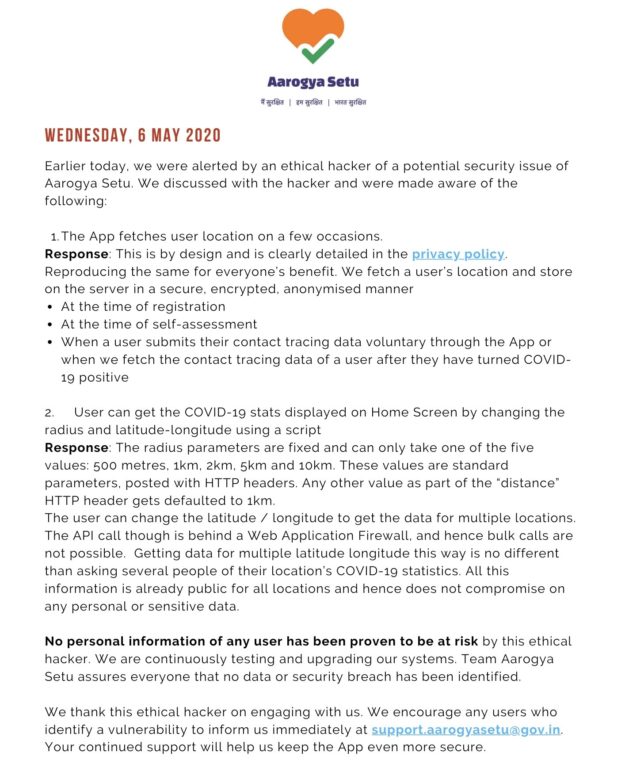
Following a tweet by ethical hacker and French cybersecurity expert under the alias “Elliot Alderson” claiming that there is a “security issue” within the Aarogya Setu app developed by the National Informatics Centre, a part of the Ministry of Electronics and Information Technology, the developers refuted the allegations over security or privacy concerns of 9 crore people who are using it amid the coronavirus pandemic in the country.
In its response posted on Wednesday, the Aarogya Setu team said, “no personal information of any users has been proven to be at risk,” though acknowledged ‘some issues’ with the app. The hacker alleged that this issue puts the data of 90 million users at risk.
The hacker, who had earlier exposed flaws in Aadhar, claimed this time that the Aarogya Setu app fetches location data and on a few occasions. The Aarogya Setu team clarified that the app stores the location data on secure servers which are encrypted. The team also denied the hacker’s claim that the “users can get the COVID-19 stats displayed on Home Screen by changing the radius and latitude-longitude using a script.”
The team said:“The radius parameters are fixed and can only take one of the few values: 500 meters, 1km, 2km, 5km, and 10km. These values are standard parameters posted with HTTP headers.”
Earlier Elliot had tweeted saying, “A security issue has been found in your app. The privacy of 90 million Indians is at stake. Can you contact me in private?” He tagged official handle of Arogya Setu and Congress leader Rahul Gandhi, who had last week raised data security concerns on the app.
Rahul Gandhi alleged that the app is a sophisticated surveillance system and it was “outsourced to a pvt operator, with no institutional oversight – raising serious data security & privacy concerns.”
Later, Elliot said that he was contacted by the Computer Emergency Response Team (CERT) and the National Informatics Centre (NIC) and he urged them to fix the flaws within a “reasonable deadline”. After the reply from Arogya Setu team, he said he would respond soon with his findings. Here’s his tweet:
My prediction was correct 😅
Thank you all for your messages, emails and sms. I’m doing my best to answer to everyone. Welcome to the new 20K people who follow since yesterday 😯
The Aarogya Setu app has come under severe scrutiny over privacy and surveillance concerns as well as the lack of audit and transparency, as it is not an open source code.
Here’s the full statement by the Aarogya Setu team on issues raised by the ethical hacker:
India is preparing the ground for what is billed as the biggest evacuation of its citizens, millions of them, stranded in several countries abroad due to the coronavirus pandemic beginning with the registration forms being opened online onTuesday, May 5, on their respective Indian embassy website.
Once the information is collected, India’s flag carrier Air India is ready to screen and repatriate all those willing to return home, including the United States, Europe and Asia. Quoting a senior official, ANI reported that the Indian missions will be asked to compile a list through this registration and repatriation will be coordinated with respective states. This registration exercise would help the Government of India to assess and plan for the return of Indian nationals wishing to return home for “compelling” reasons.
ANI further reported that the government has listed some categories, who would be given priority and who will get accommodated in special repatriation flights, followed by the students stranded in foreign countries. “The Middle East will first be the focus. We are still formulating if the citizens stranded will be airlifted by the Air India or commercial flights,” the source told ANI.
It is learnt from Kerala that more than 25 lakh Keralites are stranded in several Gulf countries and seeking to return home immediately. “On landing in India, every citizen will be screened to figure out if the person should be sent to quarantine centres or straight to the hospital,” the official added.
On those who are stranded in the US, the official told ANI, “The exact number of Indians stranded in the United States is still to be gathered, but the New York jurisdiction of the Indian mission alone has more than a million Indians, who have shown a willingness to return to their homes.”
However, there is no official confirmation of any evacuation flight from the US to India so far though many NRI organisations are coordinating with the authorities on evacuation plans, mainly for stranded students and visitors. ANI reported that the main purpose of this information sheet is to collect actionable data on Indian nationals willing to travel to India urgently. The registration is likely to be finished by Thursday and further plans will be announced by the government.
So far, a total of 42,533 confirmed coronavirus cases have been reported in India, an increase of 2,553 has been noted in the last 24 hours, while the number of recovery stood at 11,706. The current rate of recovery rate is 27.52%, said the Union Ministry of Health and Family Welfare.
Dr. Harsh Vardhan, Union Minister of Health and Family Welfare held a meeting today with Narottam Mishra, Health Minister of Madhya Pradesh in presence of Ashwini Kumar Choubey, Minister of State of Health and Family Welfare along with the senior officials from both Centre and State to review containment and management on COVID-19 in the State.
Various issues regarding contact tracing, surveillance, strengthening house-to-house active case finding, awareness generation among the people regarding seeking treatment for non-COVID disease management etc., were deliberated and discussed, said the ministry.
Outcome ratio of Recovered vs. Death for all closed cases “indicates the clinical management status in the hospitals was analysed since 17th April, and it is observed that there is an improvement in the country compared to that prior to 17th April, 2020 (Outcome ratio was 80:20) while as of today it is 90:10,” said the ministry in a statement.
So far, a total of 11,706 people have been cured. This takes our total recovery to 27.52%. The total number of confirmed cases is now 42,533. Since yesterday, an increase of 2,553 has been noted in the number of COVID-19 confirmed cases in India.
“It is again reiterated that States / UTs must ensure that rigorous containment measures are taken, so that the caseload remains low. They must also ensure effective case clinical management while parallely focusing on infection prevention & control.
It is important that as lockdown eases, we should follow protocol and guidelines related to physical distancing, follow preventive measures like hand hygiene and environmental hygiene and deal with COVID-19 by being careful, aware and alert. Always wear face covers / masks in public spaces. Even outside containment zones, follow all guidelines issued by the government on preventive measures. Avoid overcrowding while buying essential items or meeting in common areas,” said the ministry.
India’s Defence Research and Development Organisation (DRDO) has developed an Ultra Violet (UV) Disinfection Tower for rapid and chemical free disinfection of high infection prone areas as coronavirus is continuing its spread in the country with more than 42,000 affected already.
The equipment named UV blaster is a UV based area sanitiser designed and developed by Laser Science & Technology Centre (LASTEC) in Delhi, a premier laboratory of DRDO, with the help of New Age Instruments and Materials Private Limited, Gurugram.
The UV Blaster is useful for high tech surfaces like electronic equipment, computers and other gadgets in laboratories and offices that are not suitable for disinfection with chemical methods. The product is also effective for areas with large flow of people such as airports, shopping malls, metros, hotels, factories, and offices.
UVDisinfectionTower / DRDO
The UV based area sanitiser may be used by remote operation through laptop or mobile phone using any wi-fi link. The equipment has six lamps, each with 43 watts of UV-C power at 254 nm wavelength for 360 degree illumination. “For a room of about 12 x 12-ft dimension, the disinfection time is about 10 minutes and 30 minutes for 400 square feet area by positioning the equipment at different places within the room,” said the DRDO in a statement.
This sanitiser switches off on accidental opening of room or human intervention and another salient safety feature of the product is the key to arm operation, said DRDO in a statement.
The online concert ‘I for India’, organized to raise funds for those affected by the coronavirus pandemic in India, has brought together both Hollywood and Bollywood stars to perform from their homes and engage their viewers across the continents. The benefit reportedly raised Rs. 3.75 crore ($496,025).
Lakhs of people on Sunday watched more than 70 of the country’s biggest celebrities – including Bollywood superstar Shah Rukh Khan, Aishwarya Rai Bachchan and cricket team captain Virat Kohli – in the “I for India” show, broadcast on Facebook Live.
Indian celebrities were joined by international stars such as actor Will Smith and rock legend Mick Jagger for the five-hour online concert to raise funds for people affected by the novel coronavirus, which has affected almost 3.5 million people globally. India has reported over 42,000 COVID-19 cases so far and is looking to ease lockdown measures.
During the concert, Will Smith and Mick Jagger spoke about the problems faced by rural migrant workers, who have been stranded without work in cities following the sudden nationwide lockdown imposed since March 24 to contain COVID-19.
“They and their families may be going hungry. Please give what you can,” said Jagger. Shah Rukh Khan, who was in the forefront, sang for the fundraiser, while Priyanka Chopra urged fans to donate to the fund,which has been the initiative undertaken by some of the biggest names in Indian entertainment and Facebook to put together a home-to-home fundraiser GiveIndia.
GiveIndia is India’s largest giving platform with reach across 23 states. It is associated with over 100 NGOs, working on-ground to support the required interventions with prevention, healthcare infrastructure, livelihood support and essentials for people in need.
The four-hour long concert will be live globally on Facebook (www.facebook.com/Facebookindiapp) on Sunday, 3rd May 2020 at 7:30pm IST featured performances and personal messages from more than 85 Indian and global stars. I for India’s Fundraiser is active on Facebook and people can donate via https://fb me/IforIndiaFundraiser.
In the long and eminent list of personalities from the Indian film industry such as Aamir Khan, A R Rahman, Farhan Akhtar, Zoya Akhtar, Aishwairya Rai Bachchan, Alia Bhatt, Ustad Amjad Ali Bangash, Russell Peters and others.
Bollywood actors Aamir Khan, A R Rahman, Aishwairya Rai Bachchan, Alia Bhatt, filmmaker Zoya Akhtar are all set to be a part of a fundraiser concert, I For India, of which, the entire proceeds would go to the India COVID Response Fund managed by GiveIndia, to support on-ground relief efforts.
The vision for the concert by leaders from the entertainment industry is three-pronged: to entertain those locked down in their homes, to pay tribute to those who are working on the frontlines and to raise funds for those who have no work and no home and do not know where their next meal is coming from.
The initiative comes to life as Facebook has collaborated with some of the biggest names in Indian entertainment, including Zoya Akhtar and others to put together a home-to-home fundraiser.
GiveIndia is India’s largest giving platform with reach across 23 states. It is associated with over 100 NGOs, working on-ground to support the required interventions with prevention, healthcare infrastructure, livelihood support and essentials for people in need.
The four-hour long concert will be live globally on Facebook (www.facebook.com/Facebookindiapp) on Sunday, 3rd May 2020 at 7:30pm IST and will feature performances and personal messages from 85+ Indian and global stars.
In the long and eminent list of personalities from the Indian film industry and other walks of life along with Zoya Akhar are Aamir Khan, A R Rahman, Farhan Akhtar and band, Aishwairya Rai Bachchan, Alia Bhatt, Ustad Amjad Ali Bangash, Russell Peters and the list continues as it promises to be a starry philanthropic effort.
AstraZeneca Plc agreed to make an experimental coronavirus vaccine developed by Oxford University researchers as the race for vaccine heats up. In India, the Serum Institute, the world’s largest maker of vaccines by volume, has already started producing millions of doses of the Oxford University shot and it remains to be seen whether market share will be entered at a later stage depending on the availability of the vaccine.
Astra has a capacity to produce 100 million doses by the end of the year, said the company, which is gearing up for a tough competition with a dozen other competitors across the world. UK-based AstraZeneca announced partnership with the University of Oxford on Thursday to help develop, produce and distribute a potential COVID-19 vaccine as a solution to the deadly disease.
UK Business Secretary Alok Sharma welcomed the tie-up as a vital step while a team of British scientists last week administered first vaccine doses to volunteers. “Our hope is that, by joining forces, we can accelerate the globalisation of a vaccine to combat the virus and protect people from the deadliest pandemic in a generation,” AstraZeneca Chief Executive Pascal Soriot said.
The vaccine “ChAdOx1 nCoV-19” is being developed by the Jenner Institute and Oxford Vaccine Group. The AstraZeneca-Oxford partnership is looking to provide vaccine inside the UK by the end of the year. Cambridge-based AstraZeneca is also testing two other treatments for coronavirus that has so far infected over 3 million people and killed more than 215,000 worldwide.
The shares of the company rose 2% on London’s FTSE by 9:30 am Friday, outpacing rival GSK. Apart from AstraZeneca. GSK and Sanofi are the other major players working on their own vaccine. Other major drugmakers testing possible COVID-19 vaccines include Pfizer, Moderna, Johnson & Johnson and Novavax. Nearly, 100 vaccines are in the pipeline at various stages of initial trials around the world and scientists say it may take another year for the right vaccine to emerge successfully.
The Indian vaccine being developed by the Serum Institute is a recombinant viral vector vaccine using a weakened version of the common-cold virus spiked with proteins from the novel coronavirus to trigger a response from the body’s immune system.
India has ramped up its exports of hydroxychloroquine (HCQ) amidst demand from the US and Europe as it is being touted one of the treatment drugs for coronavirus, though severalside-effects have been noticed over its usage among patients. After allowing 60 drug makers in Uttarakhand to produce HCQ, an Indian source with direct knowledge of the exports said 50 million tablets have been exported to the US.
India’s export of the drug follows a request by US President Donald Trump for New Delhi to release supplies of hydroxychloroquine in March, despite restrictions and even sparking off a diplomatic embarrassment for New Delhi. Trump in his briefings warned that halting shipments would result in diplomatic retaliation. India eased restrictions and clarified that shipments would be sent as per the agreement.
Nearly 60 pharma companies in Uttarakhand and 68 companies in Gujarat have gone into HCQ production, easing the requirements all over the globe. Majority of these licences are for exports, said H.G. Koshia, commissioner, Food and Drug Control Administration (FDCA), Gujarat.
“It amounts to 50 million tablets… Commercial companies are pursuing. It’s ongoing,” reports Reuters quoting a source, who declined to be identified due to the sensitivity of discussions with the United States. Teva Pharmaceutical Industries, IPCA Laboratories and Cadila Healthcare are among India’s leading suppliers of hydroxychloroquine. Cadila alone has ramped up production tenfold to 30 metric tonnes per month to meet the demand.
However, the US Food and Drug Administration, the European Union’s drug regulator and the Canadian health department have cited side effects of the drug including abnormal heart rhythms and a dangerously rapid heart rate, which have done little to the US, which is using the drug for the treatment of COVID-19 as no other drug is available. Already, the US coronavirus death toll has reached 63,746 as of Thursday – the highest in the world.
“There is high demand for hydroxychloroquine in the international market including US,” Viranchi Shah, senior vice-president, Indian Drug Manufacturers Association (IDMA). Ever since Trump touted the drug as a “game changer” and urged Prime Minister Narendra Modi to send supplies, sales of the decades-old treatment had soared overnight despite medical reasoning not to use the drug for every case of coronavirus.
The foreign ministry said India was continuing to supply hydroxychloroquine and other essential medicines both on humanitarian grounds and for commercial ties.
Reports are going viral speculating not merely the post-surgery complications of North Korea’s Supreme Leader Kim Jong-un but hints from medical quarters that he passed away are going viral with no reaction from the official quarters of Pyongyang. The news of his successor are equally attracting the world attention. Associated Press has brought them to a halt showcasing a train purportedly belonging to him in news.
kim train
However, state-run North Korean media outlets have remained silent spectators without giving away any clue even on Kim Jong-un’s whereabouts, if not his health condition or the news of his purported demise after a heart surgery failure. A U.S. official told CNN that Washington is looking into intelligence reports that Kim is in “grave danger”, while US President Donald Trump brushed aside the bad news as another fake news.
North Korea media reports
On its part, North Korean media has put out usual reports that Kim is sending diplomatic letters. One report on Wednesday said Kim had sent another message to Syrian President Bashar al-Assad, expressing gratitude for congratulating him on the anniversary of his late grandfather and national founder Kim Il-sung’s birthday.
Kim was last seen on April 11 presiding over a political bureau meeting of the ruling Workers’ Party reviewing measures against the coronavirus but what’s missing is his usual “field guidance” trips or public appearances for over two weeks in row, giving fuel to speculations that his health could be the reason behind. Whether it was coronavirus-related self-quarantine measure or his heart surgery has not been confirmed so far.
Another key appearance on the 108th birth anniversary of Kim Il-sung on April 15 has sparked row over his health as never in the past did he miss the trip to the mausoleum since taking office in late 2011. Even its arch rival South Korea has officially maintained that there is no truth in reports on Kim’s health.
Kim Jong Un
Kim could be staying in a “local region” outside of Pyongyang due to coronavirus and running the government as usual, according to Cheong Wa Dae officials. Some media reports hinted that he might be in the eastern coastal town of Wonsan to avoid the coronavirus. Of course, taking it far, some news outlets have extrapolated it to claim that one of the doctors from China who performed on him was infected with the coronavirus and so did the North Korean leader too contracted the disease and is in self-quarantine as well as on hospital bed.
Coronavirus quarantine?
However, this is not the first time that Kim’s public health raised world glare, owing to his health. In the last nine years, his health remained the top agenda on world media circles but owing to the secretive state of affairs in the country, they failed to die. If China had sent health teams, it could be another “solid” reason for another to speculate his death.
For Kim, disappearance from the public is not new. Earlier this year, he re-emerged after 21 days of absence and in 2014, he disappeared from the public eye for about a month but reappeared limping and using cane. It was confirmed later that he had a cyst removed from his ankle.
Kim knows how to keep the world media covering constantly. It may not be long if he reappears in public, this time after the coronavirus calms down in his country.
US space agency is as active as before and joining the fight against coronavirus pandemic, which has claimed maximum number of lives in the country. they have come out with a new viable and affordable ventilator, positive pressure helmet for oxygen intake and producing a portable surface decontamination system called AMBUStat.
“We’re all in this together. Here at NASA, we’re channeling our expertise and ingenuity to join the fight against COVID-19 with efforts across the country. NASA’s strength has always been our ability and passion – collective and individual – for solving problems,” said NASA Administrator Jim Bridenstine.
VITAL Ventilator
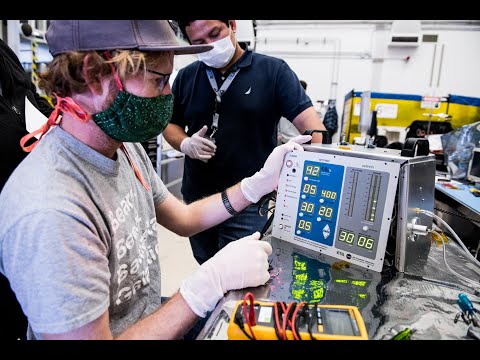
Engineers at Jet Propulsion Laboratory in California have designed a new high-pressure ventilator, called VITAL, to treat patients with milder symptoms, thereby keeping the nation’s limited supply of traditional ventilators available for patients with more severe COVID-19 symptoms.
“We specialize in spacecraft, not medical-device manufacturing,” said JPL Director Michael Watkins. “But excellent engineering, rigorous testing and rapid prototyping are some of our specialties. When people at JPL realized they might have what it takes to support the medical community and the broader community, they felt it was their duty to share their ingenuity, expertise and drive.”
NASA next is seeking expedited FDA approval for the device via an emergency use authorization, a fast-track approval process developed for crisis situations that takes just days rather than years. To get input from a gold-standard medical facility, JPL delivered a prototype of the device to the Human Simulation Lab in the Department of Anesthesiology, Perioperative and Pain Medicine at Mount Sinai for additional testing.
Like all ventilators, VITAL requires patients to be sedated and an oxygen tube inserted into their airway to breathe. The new device wouldn’t replace current hospital ventilators, which can last years and are built to address a broader range of medical issues. Instead, VITAL is intended to last three to four months and is specifically tailored for COVID-19 patients.
Positive Pressure Helmet
NASA’s Armstrong Flight Research Center teamed up with a task force in Antelope Valley, California to solve possible shortages of medical equipment in the local community. The first of these efforts, a positive pressure oxygen helmet, has been successfully tested. This task force is working closely with medical professionals at the hospital to provide alternative solutions to needed equipment that is not available for a large-scale emergency. One of their first efforts was to build a prototype oxygen hood that has now proven to work for the doctors at the hospital. The production of 500 will begin next week at TSC’s Faith Facility in Mojave.
The device, developed by NASA engineer Mike Buttigieg, is an oxygen hood for COVID-19 patients exhibiting minor symptoms and will minimize the need for these patients to use ventilators. The device functions like a continuous positive airway pressure (CPAP) machine to force oxygen into a patient’s low-functioning lungs.
Surface Decontamination System
NASA’s Glenn Research Center in Ohio guided the development and production of a small, portable and economical device called AMBUStat that decontaminates spaces, such as ambulances, at a fraction of the cost of systems currently in use.
The small, portable, and economical device that decontaminates spaces such as ambulances in under an hour and at a fraction of the cost of systems currently in use. AMBUStat is being used in police cars and other areas killing airborne and surface particles of viruses. Now NASA is conducting additional research to continue to maximize the effectiveness of this device on COVID-19.
NASA’s legacy of human space exploration, research and technology development has yielded countless innovations that prove the direct and profound impact of taxpayer investment in America’s space program on our quality of life on Earth, including improved technologies for water purification, air filtration, kidney dialysis and tele-medicine, as well as research that has led to improved vaccines, drug therapies, and mitigations for bone loss.
“We can only speculate as to the breadth of transformative benefits that will come from America’s return to the Moon through NASA’s Artemis program and our efforts to put the first humans on Mars,” said NASA in a statement.
Following a meeting with Union Home minister, the members of Indian Medical Association has withdrawn its earlier call for symbolic protest on Wednesday night with candles.
Union Minister for Home Affairs Amit Shah and Union Minister for Health and Family Welfare Harsh Vardhan interacted with doctors and senior representatives of the Indian Medical Association (IMA), through a video conference, in New Delhi on Wednesday, where the Home Minister appreciated the role of doctors in the fight against Coronavirus.
He allayed all concerns of the medical fraternity regarding their security in the fight against Coronavirus, he assured them that the government would leave no stone unturned in ensuring their well-being and security.
Shah strongly condemned the recent attacks on health professionals and said that all necessary arrangements would be put in place to prevent such incidents in future. He appealed to doctors not to do even a symbolic protest as proposed by them, as it is not in national or global interest.
Considering the immediate high level response from the Union government and assurance given by the Union Home and Health Ministers, the IMA has withdrawn the proposed protest to maintain the fight against COVID-19 in an uninterrupted manner.
The IMA call for protest came in the wake of a mob attack on doctors in Chennai where a deceased doctor’s body in an ambulance was blocked and stoned preventing burial. The post by Dr. Pradeep Kumar has gone viral forcing the IMA to call for a symbolic candle light arrest on Wednesday, April 22.
India witnessed 1,383 fresh coronavirus cases on Tuesday, April 21 pushing the cases almost touching the 20,000-mark at 19,984, according to the latest data released by the Union Ministry of Health. The deaths have risen to 640 after 50 casualties were reported on Tuesday, while 3,869 people who had been infected with conoravirus have recovered.
Maharashtra remains on top as the the worst affected state with 5,218 cases and 251 casualties. The other states which follow include: Gujarat (2,178), Delhi (2,156), Tamil Nadu (1,596), Rajasthan (1,659), Madhya Pradesh (1,552), Uttar Pradesh (1294) and Telangana (928). India’s medical research body Indian Council of Medical Research on Tuesday asked states to stop using the rapid antibody test kits for at least two days till the tests on their quality is examined amid reports that they are not fully effective.
However, India’s coronavirus situation is still under control as the world figure is mounting beyond 25 lakhs while the death toll has gone above 1.77 lakh, according to latest figures from Johns Hopkins University. US alone reported coronavirus deaths of 45,000 while the total number of confirmed cases crossed 8.2 lakh, almost four times as many as Spain, the second-highest nation in the list.
Twitter Handle on Covid-19 queries
Meanwhile, the Ministry of Health and Family Welfare (MoHFW) has introduced Covid India Seva, a Twitter handle to offer real time responses to user queries on Covid-19.Launching the handle, Union Health Minister Dr. Harsh Vardhan stated that on the @CovidIndiaSeva handle, “experts will share authoritative public health information regarding Covid-19 swiftly at scale, helping to build a direct channel for communication with citizens.”
The Twitter handle for Covid India Seva can be accessed in all supported Indian languages by simply tweeting to @CovidIndiaSeva.
Karnataka Ordinance
As attacks on medical staff are mounting in several states, Karnataka has brought out an ordinance, based on the Uttar Pradesh and Kerala model, making it punishable with jail term. The ordinance issued on Wednesday, stated that the ordinance will provide protection to the frontline health workers, in the wake of a mob turned violent in Padarayanapura area of Bengaluru on Tuesday when health workers were trying to shift suspected COVID-19 persons to the quarantine facility.
Prabhas is hoping for the grand release and success of his 20th film, still unnamed but referred as ‘Prabhas 20’, which is likely tobe released this year once the coronavirus quarantine ends. Prabhas-20 is a romantic entertainer movie directed by KK Radha Krishna and produced by Gopi Krishna in association with UV creations banner.
The movie cast includes Prabhas and Pooja Hegde are in the main lead roles. The story line revolves around a beautiful love story in the 1960s and early 70s in Europe.
His next film will be with Mahanati director Nag Ashwin, to be produced by Vyjayanthi Movies, who has completed 50 years in the industry. Vyjayanthi Movies celebrated the milestone with a new film announcement that they will be bankrolling Nag Ashwin’s film with actor Prabhas. Reportedly, this film will be a pan-Indian venture in multiple languages. Details regarding the film’s genre, the cast and crew will be announced soon.
In his Instagrampost, Prabhas earlier stated, “Elated to share that I’m resuming shooting for my upcoming film. Looking forward to a fun schedule.” The film was originally scheduled for release on October 16, 2020 but the coronavirus lockdown may pushthe schedule of the film.
Prabhas, who gained immeasurable fandom after his glorious performance in the epic two part film of Baahubali, gained huge popularity in the nation and the whole wide world. He has lit the cinemas aflame with his substantial presence whenever he has made an appearance on-screen.
The actor absolutely nails all his roles with his fiery passion and always makes a lasting impact at the box office. The actor’s film Baahubali had the honor to be one of the first non-English films to be premiered at Royal Albert Hall where the biggest and the best of the musicians have performed.
‘Sahoo’ is the next hit film by Prabhas alongside Shraddha Kapoor which did reasonably good in terms of box office collections. Prabhas’ magnificent entry scenes are always greeted with applause and whistles as the audience is always thrilled to see the actor on-screen. The actor is highly in demand among film-makers due to his expansive fandom and sensational performances.