Hacked Wuhan lab details point out lab-origin of Coronavirus, WHO denies

The World Health Organization (WHO) on Tuesday reiterated its earlier stand that the novel coronavirus originated in bats in China late last year and was not manipulated or constructed in a laboratory. This follows last week statement by US President Donald Trump that his government was trying to determine whether the virus emanated from a lab in Wuhan.

Refuting the reports which are pointing out that the virus was of lab origin and manipulated with HIV virus to make it deadly, WHO spokeswoman Fadela Chaib told a Geneva news briefing, “All available evidence suggests the virus has an animal origin and is not manipulated or constructed virus in a lab or somewhere else. It is probable, likely that the virus is of animal origin.”

Though it was not clear how the virus had jumped the species barrier to humans, there had “certainly” been an intermediate animal host, she stressed.

Wuhan lab origin?

Increasingly, reports have been going viral online stating that the virus has Wuhan lab origin and manipulated to mix it with HIV virus, making deadlier than any other virus known so far. The latest such report from the Washington Post on Tuesday revealed that hackers were able able to steal nearly 25,000 emails, passwords and classified documents allegedly belonging to the WHO, the Gates Foundation, as well as the Wuhan Institute of Virology, among other organizations. The details were posted on image board website 4chan, later shared on Pastebin, a text storage site, social media platforms Twitter and Telegram.
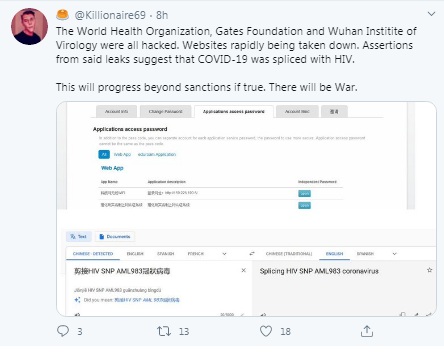
“Using the data, far-right extremists were calling for a harassment campaign while sharing conspiracy theories about the coronavirus pandemic,” said Rita Katz, Intelligence Group SITE’s executive director. “The distribution of these alleged email credentials were just another part of a months-long initiative across the far right to weaponize the covid-19 pandemic.”

Earlier, Luc Montagnier, a Nobel winning French scientist who co-discovered HIV (Human Immunodeficiency Virus) came out with a theory that the novel coronavirus came from a lab, denying WHO and Chinese government clims to the contrary. Montagnier claimed that the new ‘SARS-CoV-2’ virus came as a resultant in attempting to manufacture a vaccine for the AIDS virus, which may have got accidentally released. He claimed it in a podcast by Pourquoi Docteur and also in a TV interview on April 17.

Meet Dr Pradeep, who narrates the ugly side of a mob in Chennai over burial of his friend

Ever since Coronavirus whistleblower in Wuhan, a doctor, succumbed to it after facing humiliation by authorities, the medical fraternity has been moved all over the world and no wonder India paid rich tribute to them on March 22 as a part of the Janata curfew. But the ovation did not last long when a Chennai doctor who was in the frontline of the Coronavirus fight fell victim and lost his life on Sunday night. His friend and co-doctor Dr K Pradeep Kumar faced the cruel face of a pandemic and ignorance among people.

When neurosurgeon Dr. Simon died of coronavirus, the body of the 55-year-old colleague was brought to the crematorium on Sunday night by Dr. Pradeep and other hospital staff in PPE suits. But a mob gathered on the road leading to the crematorium in front of a theatre and the ambulance was smashed.

Sordid Ordeal

The occupants of the ambulance were assaulted with bricks, stones, bottles and sticks and chased away. The body was left in the middle of the road opposite to the theatre. Later, police arrested 20 men but the story tells a different tale altogether.

Undaunted, Dr. Pradeep begged ambulance staff to take the body elsewhere but they were already shaken and in a bad shape to drive. Hence the doctor, along with two ward boys, drove the ambulance himself to another cemetery where there was no crowd. Using only one spade available there, the doctor personally dug the grove along with the help of a policeman and buried the body.

Traumatised about burying his own colleague and friend, Dr. Pradeep says,”such a death should not occur to even our enemies.”  This is the narrative of the event that happened from the doctor who was in the frontline. What about other ordinary mortals?

IMA White Alert

Now, the Indian Medical Association (IMA) has called for protests on Wednesday, April 21, demanding that a Special Central Law Against Violence on Doctors be brought in. “IMA has maintained utmost restraint and patience in spite of extreme provocations. Doctors have been abused, beaten up, denied entry and residence. Obstruction to cremation is the last straw that IMA can bear. If dignity is denied even in death, our patience and restraint lose their value. We demand a special Central Law against violence on doctors, nurses, healthcare workers and hospitals by an ordinance,” said a letter issued by the IMA’s National president Dr Rajan Sharma and general secretary Dr R V Asokan.

“This brings out the narrow minded nature of the public and I wonder where these patients will go if all hospitals do not want to treat the COVID patients? We are not God and we also are vulnerable to get the disease but we work inspite of all adverse situations to deserve only this treatment from the public. I don’t think medical profession is considered noble anymore,” says another doctor who is also an official of IMA in Tamil Nadu.

The IMA has issued a white alert for Wednesday 9 pm, april 21, exactly a month after the nation paid tribute to the frontliners. All doctors and hospitals across the country will be lighting candles as a sign of protest.

IMF optimistic about India’s growth at 7.4% in 2021, if coronavirus is contained now

The International Monetary Fund (IMF) mission chief has a good news for India stating that if India is able to contain the coronavirus outbreak in the country, it can look forward to bounce back to 7% growth rate in 2021.

In virtual spring meeting, the IMF official said India would grow 1.9% for the current fiscal year that ends on March 31, 2021, which it says is on the positive side alongwith China in the world as all major economies are experiencing worst fears of negative growth with manufacturing halted and running into debt-ridden future. For the next financial year, IMF projected the Indian economy could grow at 7.4%.

That forecast by IMF mission chief Ranil Salgado in a CNBC’s “Squawk Box” on Monday was based on the global financial agency’s observations that India is capable of resilient economy with very large external buffers and reserves to boost spending, meeting the country’s health-care needs, extending support for the more vulnerable businesses and households.

Food and Foreign Reserves

On the food front, when the U.N. Food and Agriculture Organization sounded the alarm over a looming food crisis, Salgado said India has substantial food buffer. “I think one concern is the rabi crop harvest, which is coming up,” he said. Rabi crops are sown in winter and harvested in spring.

“That’s based on a control of the pandemic, ending the lockdowns, and then stimulus that is already (given), in terms of monetary policy, and some initial steps on fiscal policy as well,” he said. “Finally, India gets a tailwind from the lower oil prices.”

So far, India has reported 17,265 confirmed cases of infection and 543 deaths as of April 20, while 2,546 patients have recovered. The nationwide lockdown is unlikely to open nonessential businesses and services until May 3. India has already announced a $22.5 billion fiscal package to help millions of daily wage earners. On Wednesday, agriculture and some essential industries in rural areas have been given approval to resume.

“In rural India, the possibility of social distancing is more–you’re more able to do that in, compared to, say, in urban India. I think the government is concerned about ensuring adequate food supplies and is making effort to do that,” Salgado said.

Once the economic shock passes, it’s important that India returns to its path of undertaking long-term reforms, he advised.

Coronavirus Impact: Trump cracks another whip, suspending all immigration into US

Battered by criticism at home over delayed response to Coronavirus pandemic, President Donald Trump announced on Monday evening to sign an executive order temporarily suspending all immigration into the United States temporarily, without specifying how long it would be in effect and whom it would affect.

“In light of the attack from the Invisible Enemy, as well as the need to protect the jobs of our GREAT American Citizens,” Trump wrote in the tweet, “I will be signing an Executive Order to temporarily suspend immigration into the United States!”


However, it is not clear whether the suspension would impact those with work and other visas. This follows March 19 order to close the Mexican and Canadian borders and banning entry of foreign nationals who had visited China, Iran, Austria, Belgium, Czech Republic, Denmark, Estonia, Finland, France, Germany, Greece, Hungary, Iceland, Italy, Latvia, Liechtenstein, Lithuania, Luxembourg, Malta, Netherlands, Norway, Poland, Portugal, Slovakia, Slovenia, Spain, Sweden, Switzerland, United Kingdom and Ireland. It was followed up by another order on March 19, in the form of a Level 4 advisory against any global travel by US citizens.

Democratic Representative Don Beyer of Virginia criticized the move as another failure by Trump. He tweeted, “From the beginning Trump has flailed about seeking someone to blame for his own failure. Obama. Governors. China. Speaker Pelosi. People of Asian descent. Immigration has nearly stopped and the US has far more cases than any other country. This is just xenophobic scapegoating.”

The United States has reported by far the world’s largest number of confirmed coronavirus cases at more than 760,000 and over 41,100 deaths, nearly half of them in the state of New York.

Farting another potential cause for rapid spread of Coronavirus? Australian doctors ponder

Two Australian doctors are studying the possibility of the spread of the coronavirus due to farting. In an episode on the infection on Friday on Australian Broadcasting Corporation’s “Coronacast,” podcast, host Dr. Norman Swan made a suggestion to the effect as particles of feces set adrift and the spread COVID-19.

Though he made the suggestion in a mild amused tone saying, “No bare-bottom farting,” it soon caught the attention of a physician Dr. Andy Tagg who posed the question on Twitter asking, “So, can the bottom-based emissions of someone with coronavirus be silent and deadly?” He went further stating that flatulence is an “aerosol-generating procedure.”

Indirectly he said yes to the possibility. According to him humans produce about a 1 litre of gas a day (plus or minus 500mls) and release it in 15-20 discrete episodes.

Andy Tagg

However, there is no study conducted on it so far but one recent study suggested that flushing toilet could spread the coronavirus via “aerosolized feces.” In fact, health officials in Oregon and New York have have recently cautioned against oral contact with feces during sex.

However, there is no research findings available as of now about the possibility of passing COVID-19 while passing gas. But another Australian doctor Aaron E. Glatt, a Mount Sinai South Nassau epidemiologist at the Icahn School of Medicine told the Post in an email: “Studies have clearly shown that a significant percentage of COVID-19 patients do have GI symptoms  at the time of illness presentation. However, there are no published data on whether flatulence alone presents any risk of transmission, although in a clothed person, it would be unlikely to be a significant route of transmission.”

Tagg, who also runs a medical education site ‘Don’t Forget the Bubbles’, suggests that one should keep pants as personal protection equipment (PPE). He tweeted: “Perhaps SARS-CoV-2 can be spread the power of parping — we need more evidence… So remember to wear appropriate PPE at all times and stay safe!”


North Korean leader Kim Jong Un in ‘critical condition’ after heart surgery in a remote villa?

North Korean leader Kim Jong Un is reportedly in serious condition following a cardiovascular surgery, said one anonymous US intelligence official but not confirmed by CIA or the South Korean government officials so far.

As coronavirus is around, rumours are ripe that one of the doctors who performed the heart surgery was flown in from China but he had developed coronavirus leading to worsening the condition of Kim too after the heart surgery.

The initial suspicion mounted following an anonymous US official who said Kim was in “grave danger” after a surgery. The fact that coronavirus is spreading through North Korea slowly as per official narrative, the impact of it cannot be ruled out on anybody due to weaker immunity levels following the heart surgery.

Daily NK, an online newspaper based in South Korea, said Kim had undergone a cardio procedure on April 12 due to his “excessive smoking, obesity, and overwork,” and is now undergoing treatment in a villa in Hyangsan County. Only a few in the medical team returned to Pyongyang on April 19, while the rest are still attending on him, said the report which could not be confirmed independently.

Rarely, the North Korean officials confirm such reports on their leader. Neither the US National Security Council nor the office of the Director of National Intelligence or the South Korean officials could immediately confirm the report.

In fact, the noticeable absence of Kim during the celebration of his late grandfather and state founder Kim Il Sung on April 15 had raised many suspicions among the North Korean watchers. He was last seen on April 11 presiding over a political bureau meeting of the ruling Workers’ Party, calling for “strict national countermeasures to check the coronavirus.”

“There have been a number of recent rumors about Kim’s health. If Kim is hospitalized, it would explain why he wasn’t present on the important April 15th celebrations,” said Bruce Klingner, a senior research fellow at the Heritage Foundation and former CIA official who worked on North Korea. “But, over the years, there have been a number of false health rumors about Kim Jong-un or his father. We’ll have to wait and see,” he told CNN.

Born on Jan. 8, 1983 as the second child of Kim Jong-il (1941–2011), who was North Korea’s second leader from 1994 to 2011, Kim Jong Un is the grandson of Kim Il-sung, who was the founder of North Korea in 1948 until his death in 1994. Kim has apparently ordered the assassination of his half-brother Kim Jong-nam in Malaysia in February 2017.

He is sometimes accompanied by his younger sister Kim Yo-jong, who is said to be behind his official engagements. Speculation is high that she may emerge as his successor. Earlier, rumors about Kim Jong Un’s health surfaced in 2014 when he disappeared from the public for over a month. But he returned with a walking cane, after apparently undergoing a minor surgery for the removal of a cyst in his ankle.

Salman Khan’s song ‘Pyaar Karona’ is out, coinciding with Coronavirus

Earlier this week, superstar Salman Khan took everyone by surprise as he dropped the teaser for Pyaar Karona, the song that is sung by the actor himself and released on his YouTube channel.

The song will give you chills. The song talks about how we as a nation should stand with each other and fight the pandemic by staying home. How we should respect the people fighting on the frontlines and how we need to step up and do our bit to fight coronavirus.

Sharing the song on social media, the actor wrote: “As India fights COVID-19, let’s join our forces of love and compassion to come out stronger in these times. Here’s presenting Pyaar Karona, an anthem sung by yours truly for the fight against the deadly Coronavirus pandemic. The song has been made using minimal resources available at my disposal. Listen to the inspiring number and spread the message of love.”

Earlier, the actor shared the release of the song on his Social Media with the caption, “So, I’m posting from my handle to let you know that tomorrow on my YouTube channel, mine kya? It’s ours! Song out tomorrow on it, hope you can handle it.”

https://twitter.com/beingsalmankhan/status/1252168158720360448?s=21

The track ‘Pyaar Karona’ aims to spread love and awareness amid the coronavirus pandemic and was written by Salman and Hussain Dalal.Composed by Sajid-Wajid and sung by Salman Khan himself, the teaser was uploaded on Twitter on April 20 on his YouTube channel.

The video begins with several hashtags, including “Being Human, India Fights Corona, Stay Home Stay Safe” as Salman sings in the background ‘Pyaar Karona, Ehtiyaat Karona.’

Salman Khan had earlier pledged to support 25,000 daily wage workers from the film industry stranded due to the nationwide lockdown. He had recently released a video criticising those flouting the rules and attacking the healthcare workers in parts of the country. India is under the lockdown in the wake of the coronavirus outbreak, which has infected over 15,000 people and claimed over 500 lives.

Confirmed! Mahesh Babu’s next film is with ‘Bahubali’ director Rajamouli

After his superb performance in Sarileru Neekevvaru and owning 2020, Telugu actor Mahesh Babu’s next project has been confirmed with none other than Baahubali director S.S Rajamouli. Over the last couple of months, a lot of news has been surfacing about a possible collaboration between Mahesh Babu and Rajamouli, which has been confirmed now.

Putting the rumours to rest, in a recent interview Rajamouli confirmed the news and shared, “There are no rumors. The fact is that I will direct Mahesh Babu and it will be produced by KL Narayana. This will be my next after ‘RRR’.”

The untitled movie will officially be announced next year and hit the floors in 2022. Needless to say, it will certainly be a treat for everyone to see the biggest Telugu actor and the biggest Telugu director come together for this project.

Mahesh Babu has a fandom like no other not just in the south circuit but Pan India and the box office collections for all his movies are proof of the same. The actors last release Sarileru Neekevvaru was a super hit box office and collected over 200 crores during its theatrical run. The movie also marked the third consecutive movie for the actor to enter the 100 crore club.

Rajamouli has made a name for himself all over the country with his rendezvous “Bahubali” in two series making the entire country await his second one eagerly for over two years. The decade of 2010 in Indian film industry owes to him for the film “Bahubali, the Beginning” and the sequel “Bahubali, the Conclusion”, which went on to earn Rs.500 crore and Rs.1000 crore respectively.

His next film “RRR” starring Jr NTR and Ramcharan was scheduled to hit this year but for the Coronavirus pandemic, it may be delayed but surely make it soon to the theatres.

Mahesh Babu starrer ‘Bharat Ane Nenu’ celebrates two year anniversary

Celebrating Mahesh Babu’s film, Bharat Ane Nenu’s two year anniversary and fans have done something really special!
from the Telugu actor, whose films never fade away without a special social message for his fans and viewers. The film had made it to the highest grossers of the year. Taking that note, Bharat Ane Nenu marks its two year anniversary today!

The film revolves around Bharat, an NRI, who returns to India and learns about the deteriorating political condition. He then decides to contest elections to transform the system, unaware of what awaits him. Bharat’s one step ahead in the right direction leading to many positive changes.

To mark the occasion on the anniversary today, the fans also started trending #2YearsForBharatAneNenu on twitter giving out the revenue the film grossed over the period:


The film took charge in summer and became one of the highest grossing films of the year, 2018 and created a lasting impression on the audiences and invoked a sense of patriotism. This is a film for all the people who love their country. The fans have been on a high, celebrating its successful two years and can’t contain their excitement

The film also has a raw part which evidently highlights how so much injustice is done and shows a real part of the government working. The audiences loved it a lot and the hulking fan base yet again proved their love for the superstar.

Bharat Ane Nenu starrs Mahesh Babu in lead roles. The film was directed by Koratala Siva and produced by DVV Danayya. The film hit the screens on 20th April 2018.

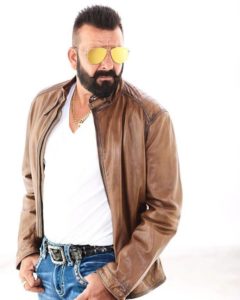
Sanjay Dutt spends the lock-down alone as wife, kids stuck in Dubai

Bollywood actor Sanjay Dutt is spending time alone in Mumbai as his wife Maanayata and children were stuck in Dubai when the lockdown was announced in March. But the actor has not lost his usual self of happiness and warmth. Unlike other stars who greet audience daily with safety guidelines on TV channels, Dutt has confined himself to spending more time online chatting his family in Dubai.

Sanjay Dutt

“In the past, I have spent periods of my life in a lock-down. Back then and even now, the one thought that stays with me is the way I miss my family. For me, they are everything. Thanks to technology, I can see and talk to the multiple times in a day, and yet, I miss them terribly,” he said.

In an interview with a newspaper, the Bollywood star shared his experience during the lock-down caused due to the epidemic. However, the actor ignited warmth in the audience’s hearts and said, “These times teach you about the fragility of life, and the value of moments spent with your loved ones. We should count our blessings, and never take them for granted.”

Speaking about work in another recent interview, Sanjay Dutt said:”Acting is a physically and mentally demanding job. This isolation has given me time to recharge my batteries, rest out mentally and prepare for my next set of roles. It takes a lot of time and energy to prepare for a role, especially given the complex characters that I enjoy playing.”

On the work front, Sanjay Dutt is going to be busy once the lockdown is lifted. He is providing his audience with an array of explosively entertaining films as he has a busy year set for him with five big-banner films — KGF: Chapter 2, Shamshera, Bhuj: The Pride of India, Torbaaz and Sadak 2 down his pipeline.

India’s new FDI rules violate WTO norms, says China

China, which has invested more than $8 billion in India, has taken recent India’s revision of its foreign direct investment (FDI) norms to prevent the takeover of Indian firms amid the coronavirus pandemic as discriminatory and in violation of World Trade Organization’s principles.

The Department of Promotion of Industry and Internal Trade (DPIIT) revised the FDI regulations stating, “An entity of a country, which shares land border with India or where the beneficial owner of an investment into India is situated in or is a citizen of any such country, can invest only under the government route.” India’s move comes after similar changes undertaken by countries such as Australia, Germany and the Czech Republic in recent months.

Recent reports said China, recovering from Coronavirus is aggressive in global markets and fears gripped economies that it may result in hostile takeovers by Chinese companies of Indian firms whose market values have dipped drastically due to the coronavirus pandemic.

In its reaction since India tweaked the rules on Saturday, April 18, a spokesperson for the Chinese embassy in New Delhi said the move is against the commitments made by India to World Trade Organisation (WTO)and other multilateral commitments.

“The barriers set by Indian side for investors from specific countries violate WTO’s principle of non-discrimination, and go against the general trend of liberalization and facilitation of trade and investment,” spokesperson Ji Rong said. “More importantly, they do not conform to the consensus of G20 leaders and trade ministers to realize a free, fair, non-discriminatory, transparent, predictable and stable trade and investment environment, and to keep our markets open,” she said.

“Companies make choices based on market principles. We hope India would revise relevant discriminatory practices, treat investments from different countries equally, and foster an open, fair and equitable business environment,” Ji noted.

The Indian foreign ministry has not reacted to the Chinese comments so far. Experts believe that India’s action is allowed under the WTO when a country’s national security is at stake and many countries have either tweaked the FDI norms or issued a moratorium of some sort to prevent hostile takeovers.

Ji pointed out that Chinese investments in India had crossed $8 billion as of December 2019. “Chinese investment has driven the development of India’s industries, such as mobile phone, household electrical appliances, infrastructure and automobile, creating a large number of jobs in India and promoting mutual beneficial and win-win cooperation.”

“Facing the economic downturn caused by covid-19, countries should work together to create a favorable investment environment to speed up the resumption of companies’ production and operation,” she added.

Ever since India pulled out of the Regional Comprehensive Economic Partnership in November last year, trade ties have taken a dip between the two countries.

India Coronavirus cases reach 17,265, death toll stands at 543 as of 20th April

A total of 17,265 confirmed cases are reported for COVID-19 in the country and a total of 543 deaths have been reported so far. Among those infected, 2,547 persons or 14.75 % of total cases have been cured or discharged after recovery, said the Union Ministry of Health and Family Welfare in its daily bulletin.

The doubling rate of COVID-19 cases calculated using growth over the past seven days indicates that India’s doubling rate for the week before lockdown was 3.4 and has improved to 7.5 as on 19th April, 2020 (for the last seven days). The 18 States that have shown improvement in doubling rate as compared to the national average, as on 19th April are:

Doubling rate: Less than 20 days 
Delhi (UT)- 8.5 days
Karnataka- 9.2 days
Telangana- 9.4 days
Andhra Pradesh- 10.6 days
J&K (UT)- 11.5 days
Punjab- 13.1 days
Chhattisgarh – 13.3 days
Tamil Nadu- 14 days
Bihar- 16.4 days
Doubling rate: Between 20 days to 30 days:
A&N (UT) – 20.1 days
Haryana – 21 days
Himachal Pradesh – 24.5 days
Chandigarh (UT)- 25.4 days
Assam – 25.8 days
Uttarakhand – 26.6 days
Ladakh (UT) – 26.6 days
Doubling rate: More than 30 days:
Odisha – 39.8 days
Kerala – 72.2 days.
————————————-

All COVID-19 patients in Goa were discharged from hospital after recovery, and now Goa has no active case. Three districts – Mahe (Puducherry), Kodaggu (Karnataka) & Pauri Garhwal (Uttrakhand) have also not reported any fresh cases during the last 28 days. There are now 59 additional districts from 23 States/UTs that have not reported any fresh cases during the last 14 days. The six new districts in this list include — Dungarpur & Pali in Rajasthan, Jamnagar and Morbi in Gujarat, North Goa in Goa and Gomati in Tripura.

Meanwhile, the ministry has advised its officers and officials to take strict precautionary measures in containing the spread of the virus. They must:

  • Use reusable/ cloth face cover;
  • Strictly follow disinfection protocols;
  • Frequently wash hands with soap and water or use alcohol-based hand rub/ sanitizers;
  • Maintain adequate distance between each other; and
  • Avoid the gathering of 5 or more people;

Facebook and Google may have to reveal algorithm changes to Australian media firms soon

In a new move, Facebook and Google will be forced to share advertising revenue with Australian media companies and inform them in advance about algorithm changes that would affect content rankings, favour original source news content in search page results, and share data with them.

The move come in the wake of an inquiry in December by the Australian Competition and Consumer Commission to develop a code between media companies and digital platforms including Google and Facebook. Following the findings, the treasurer, Josh Frydenberg has asked the competition watchdog to develop a mandatory code of conduct for the digital platforms in view of a steep decline in advertising revenue due to the coronavirus pandemic.

To be finalised in November this year, the ACCC will implement the code mandatorily in the country. It will propose a voluntary adherence to the code but spell out penalties and binding dispute resolution mechanisms for negotiations between the digital platforms and news businesses. Besides news content, the code will also cover other social media platforms such as Instagram and Twitter.

The government informed the Australian media that the draft code will be finalised by the end of July and the final text will be made soon after that. Defending the government move, Frydenberg said that it was a fair play for both media companies that created the content and the aggregators who deliver it on their platforms. “This will help to create a level playing field,” he said.

The communications minister, Paul Fletcher, said the code will enable to create a fair news media ecosystem. “Digital platforms have fundamentally changed the way that media content is produced, distributed and consumed… Digital platforms need to do more to improve the transparency of their operations for news media providers as they have a significant impact on the capacity of news media organisations to build and maintain an audience and derive resources from the media content they produce.”

The sudden disappearance of advertisement revenue for the print media has forced many newspapers to shut down during the pandemic already, while the online editions are struggling to make revenue out of aggregators or online advertisement. Several media companies in Australia have asked staff to take a pay cut or stand down in view of the onslaught on the print media.

How to take care of children during coronavirus? WHO issues guidelines

The World Health Organization (WHO) has issued new guidelines to take care of children at home and in schools from transmission of the COVID-19 virus with critical considerations and practical checklists and also advised national and local authorities on how to adapt and implement emergency plans for educational facilities.

Issued jointly with the International Federation of the Red Cross (IFRC) and UNICEF, the guidelines stated that in case of school closures efforts be taken to mitigate against the possible negative impacts on children’s learning and health, including plans in place to ensure the continuity of learning, including remote learning options such as online education strategies and radio broadcasts of academic content, and access to essential services for all children.

If schools remain open, the guidance calls for:

  • Providing children with information about how to protect themselves;
  • Promoting best handwashing and hygiene practices and providing hygiene supplies;
  • Cleaning and disinfecting school buildings, especially water and sanitation facilities; and
  • Increasing airflow and ventilation.

The guidance, while specific to countries that have already confirmed the transmission of COVID-19, is still relevant in all other contexts. Education can encourage students to become advocates for disease prevention and control at home, in school, and in their community by talking to others about how to prevent the spread of viruses. Maintaining safe school operations or reopening schools after a closure, requires many considerations, but if done well, can promote public health.

For example, safe school guidelines implemented in Guinea, Liberia and Sierra Leone during the outbreak of Ebola virus disease from 2014 to 2016 helped prevent school-based transmissions of the virus.

UNICEF is urging schools – whether open or helping students through remote learning – to provide students with holistic support. Schools should provide children with vital information on handwashing and other measures to protect themselves and their families; facilitate mental health support; and help to prevent stigma and discrimination by encouraging students to be kind to each other and avoid stereotypes when talking about the virus.

The new guidance also offers helpful tips and checklists for parents and caregivers, as well as children and students themselves. These actions include:

  • Monitoring children’s health and keeping them home from school if they are ill;
  • Encouraging children to ask questions and express their concerns; and
  • Coughing or sneezing into a tissue and avoid touching face, eyes, mouth and nose.

UN, WHO create new fund for Coronavirus

A new coronavirus disease (COVID-19) Solidarity Response Fund to raise money from donors to support the World Health Organization (WHO) respond to the COVID-19 pandemic, the first-of-its-kind, has been created by the United Nations Foundation and the Swiss Philanthropy Foundation, together with WHO.

The fund has already lined up support from Facebook and Google who have instituted a matching scheme for funds raised through their platforms, while individual donors are also supporting the fund through www.COVID19ResponseFund.org.

“We need everyone to get involved in this massive effort to keep the world safe,” said Dr. Tedros Adhanom Ghebreyesus, WHO Director-General. “A lot of people and institutions have been saying they want to contribute to the fight against the novel coronavirus. Now they can.”


Elizabeth Cousens, UN Foundation President and CEO said, “The case for global cooperation could not be clearer – communities everywhere are affected, and people want to contribute. This new fund will create space for people everywhere, together, to fight this virus.”

Funds will go towards enabling the COVID-19 Strategic Preparedness and Response Plan to enable all countries – particularly those most vulnerable and at-risk, and with the weakest health systems – to prepare for and respond to the COVID-19 crisis such as rapidly detecting cases, stopping transmission of the virus, and caring for those affected.

WHO is seeking financing for protective equipment for frontline health workers; to equip diagnostic laboratories; improve surveillance and data collection; establish and maintain intensive care units; strengthen supply chains; accelerate research and development of vaccines and therapeutics;  and take other critical steps to scale up the public health response to the pandemic.

All donations made to the COVID-19 Solidarity Response Fund are tax-deductible to the extent allowable by local laws. Swiss Philanthropy Foundation has also partnered with Transnational Giving Europe to extend tax benefit to European countries where applicable.

Finally, Trump tested for coronavirus, result negative

US President Donald Trump has undergone the test for coronavirus and tested negative, said the president’s personal physician Saturday night after Trump revealed that he too had undergone the test and his temperature was “totally normal.”

The coronavirus has already infected more than 2,200 people in the US and caused 50 deaths. Trump, 73, has come under radar ever since he met with at least three visitors from Brazil who have since tested positive for COVID-19. Due to the exposure by Trump to many visitors and aides, the White House has begun conducting temperature checks on all visitors, including reporters who attend White House briefing. On Saturday, one reporter with high temperature was not allowed.

Ignoring the advice to shun handshake, Trump said, “It almost becomes a habit. People come up to me, they shake hands, they put their hand out, it’s sort of a natural reflex. We’re all getting out of it. All of us have that problem.” However, he quickly said, “Shaking hands is not a great thing to be doing right now, I agree.”

The Brazilian Embassy in Washington DC said late Friday that the country’s chargé d’affaires, Nestor Forster, tested positive after sitting at Trump’s dinner table last week while a top aide to Brazilian President Jair Bolsonaro, who took a photo with Trump and another person who attended a campaign fundraiser with the president too found to be affected with the novel coronavirus

White House said its occupants don’t need to be tested or isolate themselves unless the symptoms appear while experts insist that the virus can be spread even by people who are asymptomatic. US Centers for Disease Control and Prevention guidelines include washing hands regularly and keeping a distance of at least 1.5-meter distance from people.

Meanwhile, Trump has extended the new travel ban to Britain, bringing the total number of US travel-restricted countries in Europe to 28.

Taranjit Singh Sandhu, new ambassador to US, has to do balancing act with strategic ally

India’s new ambassador to the US Taranjit Singh Sandhu

Taranjit Singh Sandhu (IFS:1988), presently High Commissioner of India, Colombo has been appointed as the next Ambassador of India to the United States of America. He has served as the Indian High Commissioner in Sri Lanka from 2017 and his new appointment comes at a time when New Delhi is trying to balance its strategic and tensed trade ties with the US.

Sandhu will succeed Harsh Vardhan Shringla, who will take charge as the country’s new foreign secretary on Feb 4, Wednesday. His immediate task will be overseeing a visit by US President Donald Trump next month to India, where New Delhi wants to pursue its push for a bilateral trade pact.

Taranjit Singh Sandhu’s appointment also comes at a time when New Delhi is facing criticism from the US Congress where Democrat leader Pramila Jaypal has introduced a resolution in the US House of Representatives over Kashmir and taken jibes at the current government over Citizenship Amendment Act (CAA) and Kashmir policy following abrogation of Article 370. The Indian embassy Saturday faced the wrath of protesters over these two issues.

Sandhi, a 1988 IFS batch member, had two stints at the Indian Embassy in Washington DC in the past.  He was Deputy Chief of Mission at Embassy of India in Washington D.C. from July 2013 to January 2017. He was First Secretary (Political) at Embassy of India, Washington, D.C. responsible for liaison with the United States Congress from 1997-2000.

He also served as Consul General of India in Frankfurt from September 2011 to July 2013. He served in the Ministry of External Affairs from March 2009 to August 2011, as Joint Secretary (United Nations) and later as Joint Secretary (Administration) heading the Human Resource Division. High Commissioner Sandhu was at the Permanent Mission of India to United Nations, New York from July 2005 to February 2009. Prior to it, he served as the Head of the Political Wing in the High Commission of India, Colombo from December 2000 to September 2004.

In a distinguished career spanning nearly thirty years in the Indian Foreign Service, he worked on various assignments including a three year stint at the Indian embassy in erstwhile Soviet Union (Russia) from 1990 to 1992 as Third Secretary (Political) / Second Secretary (Commercial). Following the breakup of Soviet Union, he was sent to open a new Embassy in Ukraine.

He served as Head of Political and Administration Wings in Indian Embassy in Kiev from 1992 to 1994. On his return to India, he served as Officer on Special Duty (Press Relations), Ministry of External Affairs from 1994 to March 1997. He was responsible for liaison with foreign media in India.

Born on 23 January 1963 in a family of educationists, High Commissioner Sandhu studied at the Lawrence School, Sanawar and graduated with History Honors from St. Stephens’ College, Delhi. He pursued a Masters Degree in International Relations at the Jawaharlal Nehru University (JNU) in New Delhi in 1982-84.

Sandhu is married to Mrs. Reenat Sandhu, who is also an IFS officer and is currently India’s Ambassador to Italy. They have two children.