Arun has been associated with India International Times since 2018 and he has been a key reporter in covering science and space related stories. He can be reached at arunKnn@indiainternationaltimes.com.
Within two weeks after Barack Obama stepped down after completing his two terms as US President, the unpopular Muslim visa ban of new US President Donald Trump has shaken Americans to wish for Obama’s return. However, the Twenty Second Amendment to the US Constitution doesn’t allow it.
In an opinion poll conducted by the Public Policy Polling after surveying 725 registered voters on January 30 and 31, majority or 52% of the voters said they would rather have Obama as President and 43% said they prefer Trump.
The 52% voters said they would prefer to see the real estate businessman who became President be impeached and, whereas 35% said so just a week ago. Only 43% are glad that Trump is the US President. The findings of the survey wer not only shocking but appalling, said Dean Debnam, President of Public Policy Polling.
“Donald Trump’s making history once again with a sizeable share of voters already wanting to impeach him, and a majority of voters wishing they could have Barack Obama back,” he noted. The Muslim visa ban is the root-cause of apprehension, he said.
“Overall voters are pretty evenly split on Trump’s executive order on immigration from last week, with 47 per cent supporting it to 49 per cent who are opposed. But when you get beyond the overall package, the pieces of the executive order become more clearly unpopular. 52 per cent of voters think that the order was intended to be a Muslim ban, to only 41 per cent who don’t think that was the intent. And the idea of a Muslim ban is extremely unpopular with the American people — only 26 per cent are in favour of it, to 65 per cent who are against it,” said the survey in its findings.
Even if Trump is impeached, which is highly unlikely, Vice President will succeed him as per the Constitution. And there is no return of Barack Obama since the 22nd Amendment prohibits any person from contesting for the third time ever since 1951.
In American history, only Franklin D. Roosevelt served as President during the World War period for an unprecedented four terms, forcing the Twenty Second Amendment to the US Constitution.
A Festival of India is being organized in Senegal from 26 January to 28 February, 2017 to showcase diverse Indian culture, including classical and folk dance, music and an exhibition on Mahatma Gandhi.
The following events will be held in the Senegal capital City of Dakar:
· Kathak Dance by Richa Jain and Group from 27-29 January, 2017.
· Bharatnatyam Dance by Priya Venkataraman and Group from 1-3 February, 2017.
· Music (Bollywood) by Melody Magic – Deepak Mehta & group from 6-8 February, 2017
· Rajasthani Folk Music and Dance by Anita Ordia and Group from 11-13 February, 2017
· Music (Vocal) by Dhananjay Kaul and Group from 16-18 February, 2017
· Exhibition on Mahatma Gandhi from 30 January – 28 February, 2017.
Indian culture, especially the dance and music are popular among the people of Senegal, which is home to about 40 India-friendship associations whose members are the local people who conduct cultural programmes involving Classical and even Bollywood music on important occasions, with active support from the Indian Mission.
Diplomatic ties between India and Senegal were established in 1962 and both countries enjoy friendly bilateral relations sharing common values such as democracy and secularism. They are both members of the Non-Aligned Movement and G-15.
India has been a key partner of Senegal in the field of urban transport, agriculture, rural electrification, human resource development and information technology with more than 300 Indians working in several companies set up here.
In view of deepening Indo-US defence scientific cooperation, a Joint Workshop on “Medical and Chem Bio-defence” is being organised by the Institute of Nuclear Medicine and Allied Sciences (INMAS), Delhi (of DRDO), is being held from 31st January to 2nd February 2017 at the Indian Chancery in Washington DC.
The workshop has focused on medical, chemical and biological defense strategies to seek future cooperation in areas of combat casualty care, neurocognitive assessment, military operational environment, detection and diagnostics for chemical and biological defence, medical countermeasures, radiation countermeasures as well as individual and collective protection/ decontamination.
A delegation of 27 members from the US Department of Defense, headed by Dr Patrick Mason (SES), Office of the Assistant Secretary of Defense for Research and Engineering is participating.
The Indian delegation, constituting about 25 members from the DRDO Life Sciences Cluster laboratories, is headed by Dr A K Singh, Director INMAS, and is being inaugurated by Dr Shashi Bala Singh, Director General (Life Sciences), DRDO.
“This workshop will prove a significant milestone in furthering the bilateral relationship of USA with India, and will give impetus to future scientific collaboration in the field of medical, chemical and biological defence,” said the Chancery in a statement.
With the rising threat perception at global level, both countries will find avenues of extending the desired protection to their armed forces and civilian populations.
In an official response to the preventive detention of Hafiz Saeed and others by Pakistan on Tuesday, India’s spokesperson for the Ministry of External Affairs, Mr Vikas Swarup said credible steps by Pakistan required to show its commitment to end terrorism.
Pakistan’s Ministry of Interior placed on Tuesday the Jamaat-ud-Dawa and the Falah–e-Insaniyet Foundation under the watchlist. Also the Falah-e-Insaniyet Foundation has been included in the second schedule of their anti-terror legislation under United Nations Security Council Resolution No. 1267.
“We have also noted that Hafiz Saeed and four others have been placed under preventive detention,” said Mr. Swarup.
The United Nations Security Council 1267 provisions maintain that the countries should list and prosecute known terrorist entities and individuals effectively. India said it has consistently called for bringing known terrorists under the ambit of the 1267 sanctions.
“Exercises such as yesterday’s orders against Hafiz Saeed and others have been carried out by Pakistan in the past also. Only a credible crack down on the mastermind of the Mumbai terrorist attack and terrorist organizations involved in cross border terrorism would be proof of Pakistan’s sincerity,” said Mr. Swarup in a cautious response to the development.
Hafiz Muhammad Saeed is a co-founder of Lashkar-e-Taiba, which operates from Pakistan soil and has had sanctions placed against it by the United Nations as a terrorist organisation. India has long been demanding his arrest and prosecution.
Finally, the Bill on High-Skilled Integrity and Fairness Act of 2017 has been introduced in the US House of Representatives seeking to double the minimum salary of H-1B visa holders to US$130,000, making it a mockery if American firms deny recruiting locals at a lower cost. Currently, the minimum wage cap on H1B Visa seekers is US$60,000 that was set in 1989.
The anti-H1B Visa Act, as is known among the Indian IT workers and firms in the US, was introduced by California Congressman Zoe Lofgren based on market requirements for visas to those companies willing to pay 200 percent of a wage given to local employees.
“My legislation refocuses the H-1B programme to its original intent to seek out and find the best and brightest from around the world, and to supplement the US workforce with talented, highly-paid, and highly-skilled workers who help create jobs here in America, not replace them,” said Lofgren. He said the Bill seeks to remove the ‘per country’ cap on immigrant visas so that employers hire the most skilled workers without regard to nation of origin.
It raises the salary level at which H-1B dependent employer are exempt from attestation requirements to a new required wage level of 35 percentile points above the median national annual wage for Computer and Mathematical Occupations published by the Department of Labour Occupational Employment Statistics, which eliminates the Master’s Degree exemption for dependent employers.
The legislation also seeks 20 percent of the annually allocated H-1B visas for small and start-ups. It also removes visa hurdles for students by building a bridge from F-1 student status to Lawful Permanent Residence without any paperwork and reducing administrative costs.
The Bill, if approved, would affect the entire gamut of IT companies in India which are solely dependent on H1B visa to depute its skilled techies to the US and save millions of dollars in projects running into months or few years.
Infosys alone has 14,659 employees working in the US on H-1B visas and 1,364 employees on L-1 visas as of FY ending March 2016. TCS has reduced its dependence on visa in the past three years and stepped up local hiring, while Wipro has 40% locals in its overseas offices. HCL has 65 percent locals in its US offices.
According to a study by the Bank of America Merrill Lynch, every 10% hike in H1B visa holder abroad would amount to 5% negtive impact on an average on a company’s earnings. Since the new Bill seeks almost 100% over the existing salary, it may virtually undercut the earnings by 50 percent, which may force several IT companies either to hire local workforce or stop seeking H1B visas altogether.
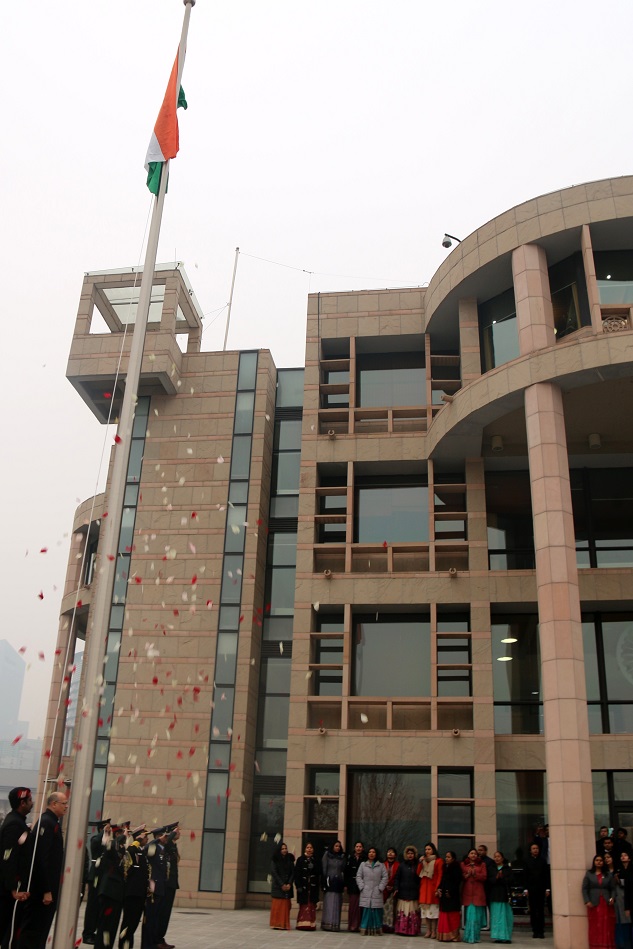
India’s 68th Republic Day was celebrated at the Embassy of India, Beijing on 26 January 2017 with Indian Ambassador Vijay Gokhale unfurling the Tricolor at Embassy premises. Later, he read out passages from the President of India’s Address to the Nation.
The Culture Wing of the Embassy then screened a short movie on “A Day in the Life of India”, which was followed by a reception for the Indian community, about 200 of them present.
Prior to the Republic Day, on 24 January 2017, the Embassy of India held a Republic Day reception for Chinese guests and the diplomatic community in Beijing, ahead of the Chinese New Year holidays. Assistant Foreign Minister of China, Mr. Kong Xuanyou was the Chief Guest at the event.
Ambassador Gokhale recalled that 2016 was an important year in India-China bilateral relations which witnessed the State Visit of the President of India Pranab Mukherjee to China in May 2016 and three meetings between Prime Minister Narendra Modi and Chinese President Xi Jinping.
Other high level engagements included the visits of India’s Defence Minister, Finance Minister and National Security Advisor to China and those of the Secretary of the Central Political and Legal Affairs Commission, State Councillor, Foreign Minister and Chairman of the National Development and Reform Commission from China to India.
Ambassador Gokhale quoted Prime Minister Narendra Modi’s remarks on the occasion:”I see the development of India and China as an unprecedented opportunity, for our two countries and for the whole world. At the same time, it is not unnatural for two large neighboring powers to have some differences. In the management of our relationship, and for peace and progress in the region, both our countries need to show sensitivity and respect for each other’s core concerns and interests.”
Ambassador Gokhale said 2017 would also mark further progress in bilateral ties.
More than 200 Indian community attended the 68th Republic day celebrations at the embassy. (Photo: Beijing India Mission)
Indian embassy in Washington DC on Monday observed the Martyr’s Day to mark the death anniversary of Mahatma Gandhi on Jan. 30, 1948. Indian Ambassador Navtej Sarna and other officers paid floral tributes to the statue of Mahatma Gandhi located in front of the Indian Embassy on Massachusetts Avenue in the US capital.
All the staff and visitors who participated in the event observed 2 minutes’ silence as a mark of respect to the Father of the Nation. Also Mahatma Gandhi’s favourite Bhajans were sung by on the occasion.
The Chancery of the Embassy of India in Washington DC, located at 2107 Massachusetts Avenue, has a history of more than a century. It consists of two adjacent buildings, one constructed in 1885, and the other (Depew House) in 1901, making them probably the oldest properties owned by the government of India abroad. Four floors were added to the first building in 1907.
Dephew Building which is now Indian chancery in Washington DC. (Photo: Indian Chancery)
Morris Murray, a prominent Washington physician, had built the second adjacent building based on 18th century French architecture style in 1901 in granite and limestone. This building over the years was occupied by some of the illustrious families including that of U.S. Senator Peter Gerry (1914-1915), Undersecretary of the Treasury Ogden L. Mills (1928) and the widow of U.S. Senator Chauncey Depew, May Palmer Depew. It was during her stay, the building came to be known as Depew House.
After her death in 1940, her cousin leased the Depew House to various tenants, including the British Purchase Agency. The Indian government had acquired the building in 1946 and connected it with the adjacent building to create the present Chancery. Gandhi’s statue was added later.
Vice Admiral RC Wijegunaratne, Commander of the Sri Lanka Navy, who is on an official visit to India from 29 January to 02 February 2017, held bilateral discussions with Admiral Sunil Lanba, Chief of the Naval Staff and other senior officials of the Indian Navy on 30 January 2017.
The Admiral is also scheduled to meet the Chief of the Air Staff, Chief of the Army Staff as well as the Director General, Indian Coast Guard, the Minister of State for Defence and Defence Secretary have also been scheduled as part of his official meetings in New Delhi.
Naval cooperation between India and Sri Lanka has been traditionally strong, encompassing a wide span which includes operational interactions through bilateral exercises, Training, Port Calls, Hydrographic co-operation, Special Forces interactions, Capability Building and Capacity Augmentation initiatives. Two Advanced Offshore Patrol Vessels (AOPVs) are also being constructed for the Sri Lankan Navy at Goa Shipyard Limited.
In addition to New Delhi, the Admiral is also scheduled to proceed to Goa where he will be visiting Naval War College and Goa Shipyard Limited besides interacting with Flag Officer Commanding Goa Area.
The Admiral would later visit the Training Command of the Indian Navy based at Kochi, where he would be briefed on training aspects and would also visit various training facilities/ professional schools. During his visit to Kochi, the Admiral would also interact with Sri Lankan Naval personnel undergoing training in India.
The Commander, Sri Lankan Navy’s visit follows closely on the visit of the Chief of Naval Staff, Admiral Sunil Lanba’s visit to Sri Lanka wherein he also participated in the 7th International Maritime Conference, Galle Dialogue 2016.
The nations of South Asian Association for Regional Cooperation (SAARC) will meet in Kathmandu on February 1-2 to attend the Programming Committee meeting over the next SAARC summit schedule.
This is the first meeting of the SAARC members after the controversial postponement of the 19th SAARC summit scheduled in Islamabad last year in November due to India’s objections over the escalation of border tensions.
The meeting in Nepal will witness all the SAARC member states to discuss the budget of the SAARC Secretariat and five regional centers of SAARC, besides the rescheduling of the next SAARC summit. The meeting will be attended by joint secretaries of the SAARC countries.
The decisions at the programming committee will be sent to the Standing Committee. SAARC, set up in 1985, consists of Afghanistan, Bangladesh, Bhutan, India, the Maldives, Nepal, Pakistan and Sri Lanka.
Last November, the SAARC Summit was postponed after four nations — Afghanistan, Bhutan, Bangladesh and India — requested the summit in Islamabad to be postponed over the border tensions between India and Pakistan. The four countries had blamed Pakistan for not creating a conducive environment and not cooperating on combating cross-border terrorism in the region for holding the SAARC Summit. Pakistan rejected the charges.
The 68th Republic Day of India was celebrated in Caracas at the Indian Embassy Residence on Thursday.
India’s Ambassador Rahul Shrivastava unfurled the national flag and read out President of India’s address to the nation on the eve of the Republic Day. More than 60 members of the Indian community and friends of India in Venezuela participated in the event.
Prior to the Republic Day, a three-member Violin cultural group led by Santosh Kumar Nahar, sponsored by the Indian Council for Cultural Relations (ICCR) visited Venezuela from 21 to 24 January 2017.
The Violin group performed on January 22, 2017 at Casa del ALBA Hall in Barinas province and Governor of Barinas, Ms. Zenaida Gallardo had witnessed the performance, which opened with a dance by two children. President of Casa De ALBA later addressed the audience.
a three-member Violin cultural group led by Santosh Kumar Nahar, sponsored by the Indian Council for Cultural Relations (ICCR) visited Venezuela from 21 to 24 January 2017. (Photo: MEA)
Foreign Secretary S.Jaishankar has been given an extension of tenure by one more year by the Appointments Committee of the Cabinet on Monday. He was scheduled to retire on January 28, after serving already on a two-year extension of service.
In a statement, the government said Jaishankar’s term has been extended from 29th January 2017 to 28th January 2018. A blued-eyed boy of both Manmohan Singh and Narendra Modi governments, Jaishankar, a 1977-batch IFS officer, is known more for his workholic nature and serving throughout the night when in demand.
He was appointed Foreign Secretary on 29 January 2015, a couple of days before his retirement, replacing incumbent Sujatha Singh, who resigned in protest. Jaishankar worked in Japan, China, the US and his understanding of the work ins within the corridors of power are well-known.
President of India Pranab Mukherjee on the eve of the 68th Republic Day received Chief Guest Sheikh Mohammed bin Zayed Al Nahyan, Crown Prince of Abu Dhabi and Deputy Supreme Commander of UAE Armed Forces at Rashtrapati Bhavan and hosted a banquet in his honour on Wednesday evening.
Welcoming the Crown Prince of Abu Dhabi, the President said the State visit is a reflection of the warm relations and intensifying co-operation between India and the UAE. “With our shared vision, we are committed to take our partnership to the highest strategic level as we realise its true potential. This State visit provides an opportunity to further enhance co-operation between India and UAE,” he said.
The President said the well-balanced bilateral trade turnover between India and UAE has been impressive. The bilateral trade during 2015-16 was US $ 49.729 billion. UAE is amongst India’s largest trade partners. To realise the potential for further growth, both countries have agreed to increase the bilateral trade by 60 % in next three years.
In his banquet speech, President Pranab Mukherjee said with India’s plans for rapid growth in the infrastructure sector, the liberalisation of foreign direct investment and as one of the fast growing economies in the world, India holds immense possibilities for investments.
The President reiterated India’s invitation to business houses of the United Arab Emirates to participate in our flagship projects like “Make in India”, “Digital India” and “Smart Cities” programmes. India looks forward to a robust partnership with UAE in our National Infrastructure Investment Fund.
The President reiterated the urgent need for responsible nations to continue collective efforts against the forces of extremism, terrorism and intolerance which attempt to weaken the very fabric of our societies. He said it is in the shared interest of both countries to work for peace and stability in both West Asia as well as South Asia.
When the much-awaited telephone call came from the new US President, Donald Trump, Indian Prime Minister Narendra Modi was upbeat because the call has accredited India with a prime status of being the fifth country made by Washington’s new leader.
Trump, in his typical style called India a “true friend and partner,” and invited Prime Minister Narendra Modi to the US, before the ritual October visit to the UN. Modi, in turn, invited the President too to visit India and he would be the next Republic Day chief guest. In 2015, US President Barack Obama graced the occasion as the chief guest.
The conversation mostly surrounded the need for both nations to stand “shoulder-to-shoulder” in the fight against terror. The defence and economic ties too came under discussion.
India is happy that US President trump called Modi ahead of other major powers and their leaders, ahead of China or Russia, for instance. Later Modi tweeted that they “agreed to work closely in the coming days to further strengthen our bilateral ties”.
“Had a warm conversation with President @realDonaldTrump late last evening,” he said in his tweet and revealed: “Have also invited President Trump to visit India.”
The White House said, “During a call with Prime Minister Narendra Modi of India, President Trump emphasised that the US considers India a true friend and partner in addressing challenges around the world. President Trump looked forward to hosting Prime Minister Modi in the US later this year.”
The defence ties take centre stage as Beijing is turning aggressive on the Soputh China Sea with other Asian nations warily looking at its bullish stance. “They also discussed security in the region of South and Central Asia. President Trump and Prime Minister Modi resolved that the US and India stand shoulder-to-shoulder in the global fight against terrorism,” the White House statement said.
However, on the domestic front, the H1B visa issue is still primary as Trump is keen to scrap it and retain jobs in the US for its own people under his “America First” policy.
India’s military prowess and achievements depicted in a variety of tableux were on a grand show before the public at the historic Rajpath when the country celebrated its 68th Republic Day today.
The highlights of this year’s Parade were a 149-member UAE Presidential Guard, the Air Force, the Navy and Army contingent led by a UAE band marching on Rajpath and presenting a ceremonial salute to the President of India. The UAE military contingent is led by Lt Col Abood Musabeh Abood Musabeh Alghfeli.
This year’s parade also showed some of the firsts to its credit. For the first time a contingent of the National Security Guard (NSG) popularly known as the Black Cat Commandoes marched past the Rajpath. The parade also saw the fly-past of three LCA Tejas Aircraft flying at a height of 300 m from ground in ‘Vic’ formation and the Airborne Early Warning & Control System (AEW&C) developed by DRDO.
Continuing the 67-year-old tradition of the Republic Day Celebration, the colourful BSF Camel Regiment led this time by Deputy Commandant Kuldeep Seervi took part.
The Indian Army’s missiles, T-90 ‘Bhishma’ tank, Infantry Combat Vehicle BMP-2K, Mobile Autonomous Launcher of the BrahMos Missile System, Weapon Locating Raddar ‘Swathi’, Akash Weapon System, CBRN Recconnnaisance Vehicle and Dhanush Gun System were the main draw in the mechanised columns.
An Indian Air Force Tableau marched past with the theme “Air Dominance Through Network Centric Operations”, displaying models of Su-30 MKI, Mirage-2000, AWACS, UAV, Apache and Communication Sattelite.
This year the Indian Navy’s Tableau had the theme ‘Indian Navy – Professional Force-Anchoring Stability, Security and National Prosperity’. The tableau showcased the lethal Marine Commandoes proceeding for action, the indigenously built Kolkata Class Destroyer and the Kalvari Class next generation attack submarines. The tableaux also displayed a model of the P-8I Long Range Maritime Patrol Aircraft.
The parade ceremony commenced at the Amar Jawan Jyoti at India Gate where Prime Minister Narendra Modi led the nation in paying homage to the martyrs by laying a wreath. An eternal flame burns at the Amar Jawan Jyoti to commemorate the indomitable courage of Indian Armed Forces personnel who have made the supreme sacrifice in the service of the motherland. The Amar Jawan, the immortal soldier, is symbolised by a reversed rifle standing on its barrel and crested by a soldier’s helmet.
As per tradition, after unfurling the National Flag, the national anthem was played with a 21 gun salute. The parade commenced then and President Mukherjee took the salute. This year’s Chief Guest in the parade Sheikh Mohammed bin Zayed Al Nahyan, the Crown Prince of Abu Dhabi and Deputy Supreme Commander of the United Arab Emirates (UAE) Armed Forces too joined PM Modi and other dignitaries in the glass box.
The parade was commanded by Lt. General Manoj Mukund Naravane, General Officer Commanding, Delhi Area. Major General Rajesh Sahai, Chief of Staff, Headquarter Delhi Area was the parade Second-in-Command.
Param Vir Chakra winners Subedar Major & Honorary Captain Bana Singh (Retd), Subedar Yogendra Singh Yadav, 18 Grenadiers and Naib/Subedar Sanjay Kumar, 13 JAK Rifles and Ashok Chakra winners Major General Cyrus A Pithawalla (Retd), Lt Col Jas Ram Singh (Retd), Mr. Hukum Singh and Mr. Govind Singh of district Chhatarpur, Madhya Pradesh and Mr. Bhure Lal of district Guna also from Madhya Pradesh followed the Deputy Parade Commander on Jeeps.
The tableau of the Veterans Always in Service of the Nation passes through the Rajpath, on the occasion of the 68th Republic Day Parade 2017, in New Delhi on January 26, 2017.(PIB)
The marching contingents of Army included horse-mounted columns of the 61st Cavalry, the Machanised Infantry Regiment, the Bihar Regiment, the 39 Gorkha Training Centre, 58 Gorkha Training Centre, the Madras Engineering Group and Centre and 103 Infantry Battalion (Territoral Army) Sikh LI.
The marching contingent of Navy comprising 144 young sailors was led by Lieutenant Aparna Nair, while the Indian Air Force contingent comprising 144 men will be led by Squadran Leader Attal Singh Shekhon. The Paramilitary and other auxiliary civil forces included the Border Security Force Camel Contingent, Indian Coast Guard, Central Reserve Police Force, Central Industrial Security Force, Delhi Police, National Cadet Corps and National Service Scheme.
Tableaux from 17 States and UT, six Central Ministries and Departments presented the varied historical, art and cultural heritage of the country. The country’s progress was displayed in different fields, particularly floats from Goa, Gujarat, Odisha, West Bengal, Assam and Jammu & Kashmir with their varied themes, which were of special attraction.
The floats of Central Board of Excise and Customs, Ministry of Micro, Small & Medium Enterprises and Ministry of Housing and Urban Poverty Allevation showed the rapid development of some of the flagship programmes of the Government. The floats of Council of Scientific and Industial Reasearch (CSIR) and Ministry of Skill Development & Enterpreneurship were also displayed highlighting the significant progress in the scientific and technoligical growth including the vision of “Skill India”.
Next 21 of the 25 children selected for the National Bravery Award–2016 participated in the parade. Next, about 600 boys and girls drawn from three schools in Delhi and a group of school children from South Central Zone Cultural Centre, Nagpur performed colourful dances on varid themes.
The splendid driving skills of ‘Dare Devils’- the motorcycle display team of Corps of Military Police followed next and they performed different stunts like Salute to President, Ladder, Double Bar, Lotus, Christmas Tree, Aircraft, Sudarshan Chakra, Flower Pot, Pyramid and Wheeling on moving motor cycles.
The grand finale of the parade was a spectacular flypast by the IAF with the ‘Chakra’ formation, comprising three Mi-35 helicopters in ‘Vic’ formation, followed by the ‘Hercules’ formation comprising three C-130J Super Hercules aircraft in ‘Vic’ formation. Trailing them was the ‘Netra’ which is an Airborne Early Warning and Control System Aircraft also known as “Eye in the Sky”. It was followed by the ‘Globe formation’ comprising one C-17 Globemaster flanked by two Su-30 MKIs.
Next in line was the fighters, where five Jaguars flew in Arrowhead formation, another five MiG-29 Air Superiority Fighters in Fulcrum style. Then the breath-taking ‘Trishul’ formation comprising three Su-30 MKIs of No. 24 Squadron which flew over the Rajpath, and once in front of the saluting dais, the Su-30 MKI aircraft will split upwards, making a Trishul in the sky.
The flypast concluded with another Su-30 MKI carrying out a ‘Vertical Charlie’ manoeuvre over the saluting dais. The ceremony culminated with the national anthem and release of balloons.
The National Security Guard Contingent passes through the Rajpath, on the occasion of the 68th Republic Day Parade 2017, in New Delhi on January 26, 2017.(PIB)
A birds eye view of Rajpath on the occasion of the 68th Republic Day Parade 2017, in New Delhi on January 26, 2017.(PIB)
Rajpath comes alive with the dare devil stunts of motorbike riders of Corps of Signals, on the occasion of the 68th Republic Day Parade 2017, in New Delhi on January 26, 2017.(PIB)
India has moved up slightly in the graft watchdog Transparency International‘s corruption perception index for 2016 by two points with a score of 40 out of 100, compared to 38 last year.
“India s ongoing poor performance with a score of 40 reiterates the state s inability to effectively deal with petty corruption as well as large-scale corruption scandals. The impact of corruption on poverty, illiteracy and police brutality shows that not only the economy is growing but also inequality,” the Trasnparency International said on India.
New Zealand and Denmark have jointly topped the list, said the Berlin-based Transparency International using the World Bank data, the World Economic Forum and other institutions to rank 176 countries on the level of corruption in public sector.
The score 100 means no corruption and zero signifies highly corrupt. India, China and Brazil with a score of 40 each figured in the 10 key economies in the mid-range.
Somalia was ranked the most corrupt country while Syria, South Sudan, North Korea, Afghanistan, and Iraq also ranked in the bottom. However, no country scored a perfect 100 in the Corruption Perceptions Index 2016.
Prime Minister Narendra Modi, in his welcoming address on the eve of the state visit of United arab Emirates Crown Prince Sheikh Mohammed bin Zayed Al Nahyan, said his participation as the Chief Guest in the Republic Day Celebrations on Thursday would herald new era in bilateral ties.
Recalling his visit in August 2015 to Dubai, Mr Modi said, “We have shaped an ambitious roadmap of engagement to make our comprehensive strategic partnership purposeful and action oriented. The agreement that was exchanged just now has institutionalized this understanding.”
He said UAE is one of India’s most valued partners and a close friend in an important region of the world. UAE has around 2.6 million Indians.
He welcomed UAE’s interest in investing in India’s infrastructure sector. “We are working to connect the institutional investors in UAE with our National Investment and Infrastructure Fund,” he noted.
“Security and defence cooperation have added growing new dimensions to our relationship. We have agreed to expand our useful cooperation in the field of defence to new areas including in the maritime domain. The MoU on Defence Cooperation, signed earlier today, will help steer our defence engagements in the right direction,” he said.
Here is a comprehyensive list of Agreements/MOUs exchanged during the State visit of Crown Prince to India:
S. No.
Name of Agreement/MoU
Details
1.
Agreement on Comprehensive Strategic Partnership between the Republic of India and the UAE
This is a general framework agreement which highlights the areas of bilateral cooperation identified under the comprehensive strategic partnership as agreed upon in the high level joint statements issued in the August 2015 and February 2016.
2..
MoU between the Ministry of Defence of the Government of the Republic of India and the Ministry of Defence of the Government of UAE on cooperation in the field of Defence Industry
This MoU aims to establish cooperation in the identified fields of defence manufacturing and technology, including through studies, research, development, innovation and cooperation between public and private sector institutions of the two countries. The two sides will cooperate in areas of armaments, defence industries and transfer of technology.
3.
MoU between the Government of the Republic of India and the Government of the UAE on Institutional Cooperation on Maritime Transport
This MoU provides a framework for enhancing bilateral maritime trade ties through facilitating maritime transport, free transfer of monies between contracting parties and reciprocal recognition of ships’ documents.
4.
MOU between the Directorate General of Shipping, Republic of India and the Federal Transport Authority- Land and Maritime in the UAE on Mutual Recognition of Certificates of Competency as per the provisions of the Standards of Training, Certification and Watch-keeping Convention (STCW78) and amendments thereof
This MoU aims to deepen the maritime economic activities in general by establishing a framework for Mutual Recognition of Certificates of Competency of marine officers, engineers and crews.
5.
MoU between the Ministry of Road Transport and Highways of the Republic of India and the Federal Transport Authority, Land and Maritime of the UAE on Bilateral Cooperation in the Road Transport and Highways Sector
This MoU aims to establish cooperation in the sectors of Highways and Road transport through sharing of technologies, systems and best practices in freight logistics, warehousing and value added services.
6.
MOU between the Government of the Republic of India and the Government of UAE on cooperation in prevention and combating of human trafficking
This MoU aims to enhance bilateral cooperation on the issue of prevention, rescue, recovery and repatriation related to human trafficking, especially of women and children expeditiously.
7.
MoU for the cooperation in the field of Small and Medium Enterprises (SMEs) and innovation between the Ministry of Economy of United Arab Emirates and Ministry of Micro, Small and Medium Enterprises (MoSMSME) of the Republic of India
This MoU aims at promoting cooperation in MSMEs Sectors, including in joint projects, R & D and related activities.
8.
MoU between the Ministry of Agriculture and Farmers’ Welfare of the Republic of India and the Ministry of Climate Change & Environment of UAE in agriculture and Allied sectors
This MoU aims to develop a framework for cooperation in various agricultural fields of mutual interest, including through enhancement of cooperation in food processing and transfer of technology in cultivation methods.
9.
MOU between the Government of the Republic of India and the Government of UAE on mutual exemption of entry visa requirements to the holders of Diplomatic, special and Official Passports
The agreement allows holders of diplomatic, special and official passports visa free travel between the two countries.
10.
MoU between Prasar Bharati, India and Emirates News Agency (WAM), UAE for cooperation in programme exchange
This MoU aims to strengthen ties between Prasar Bharati and Emirates News Agency (WAM), UAE through cooperation in the field of broadcasting, mutual exchange of programmes, news and best practices.
11.
MoU between the Ministry of Commerce and Industry of the Republic of India and the Ministry of Economy of United Arab Emirates on trade remedial measures to promote cooperation in areas of mutual interest
This MoU aims to enhance cooperation in the field of anti-dumping and allied duties through exchange of information, capacity-building, seminars and trainings in mutually indentified areas related to trade remedial measures.
12.
Agreement on Oil Storage And Management
between Indian Strategic Petroleum Reserves Limited and Abu Dhabi National Oil Company
This agreement aims to establish a framework for the storage of crude oil by Abu Dhabi National Oil Company in India and to further strengthen the strategic relationship between the two countries in the field of energy.
13.
MOU between National Productivity Council and Al Etihad Energy Services Co. LLC
This MOU is on Cooperation in Energy Efficiency Services.
14.
MOU between National Security Council Secretariat of India & National Electronic Security Authority of the UAE
This MoU is on technology development and cooperation in cyberspace.
Padma Awards, India’s highest civilian Awards for 2017 have been conferred to singer K J Yesudas, spiritual leader Sadhguru Jaggi Vasudev and cricket captain Virat Kohli among many others.
Given in three categories – Padma Vibhushan, Padma Bhushan and Padma Shri – the Awards covered art, social work, public affairs, science and engineering, trade and industry, medicine, literature and education, sports, civil service, etc.
‘Padma Vibhushan’ is awarded for exceptional and distinguished service; ‘Padma Bhushan’ for distinguished service of high order and ‘Padma Shri’ for distinguished service in any field. The awards are announced on the occasion of Republic Day every year.
These awards will be conferred by the President of India later at Rashtrapati Bhawan around March/ April. This year the Padma Awards have gone to 89 persons in total, Padma Vibhushan to 7, and Padma Bhushan to 7 and Padma Shri to 75 Awardees. Women are 19 and the list also includes 5 persons from the category of foreigners, NRIs, PIOs and 6 Posthumous awardees.
Following the telephonic call from the outgoing US President Barack Obama, today Indian Prime Minister Narendra Modi will get a call officially from the new US President Donald Trump at 11:30 PM in the night which is expected to go well beyond the midnight in India.
Mr Modi will be the fifth world leader to receive Trump’s call since his take over on January 20. Otherwise, Modi was quick to congratulate Trump after his election. About India, Trump has mixed feelings unlike Obama.
In a New Jersey address during the campaign, he tried to please majority Indian community there promising, “Under a Trump Administration, we are going to become even better friends, in fact I would take the term better out and we would be best friend… We are going to have a phenomenal future together.”
Otherwise, Indian community in the US was strongly behind Trump during his campaign and in return the top posts went to Nikki Haley among others. The conversation tonight will throw some light into the priority of the White House towards India in the next four years.
UAE Crown Prince Sheikh Mohamed bin Zayed Al Nahyan and Deputy Supreme Commander of the Armed Forces of United Arab Emirates is visiting India as the Chief Guest for the 2017-Republic Day celebrations from 24-26 January 2017.
This is the second visit of the Crown Prince of Abu Dhabi to India since February 2016. After Prime Minister Narendra Modi’s visit to UAE in August 2015, the two countries have agreed to elevate the mutually beneficial relationship to a comprehensive strategic partnership.
India and UAE enjoy close and multi-faceted relations underpinned by cultural, religious and economic linkages. The two countries have been amongst each other’s top trading partners with a well-balanced bilateral trade of about US$ 50 billion in 2015-16.
UAE is among the top investors in India in terms of foreign direct investments. It contributes significantly to India’s energy security and is the fifth largest supplier of crude oil to India in 2015-16.
About 2.6 million strong and vibrant Indian community forms the largest expatriate group in UAE and their contribution in the development of their host country has been an important factor in bilateral relations.
Indian Prime Minister Narendra Modi on Monday presented the National Bravery Awards to 25 children saying their deeds of bravery show their decisiveness as much as their courage.
He encouraged the children to ensure that this award does not become the end of their life’s purpose, and added that this award should only mark the beginning for them.
Reminding the children about the significance of the day – 23rd January, Netaji Subhas Chandra Bose’s birth anniversary – the Prime Minister urged the children to read as much as possible, and especially read biographies of leaders, sportspersons and other people who have done great deeds in their lives.
He said that bravery is a state of mind; a healthy body helps, but the prime moving force is the mind. Therefore, he added, we need to make the mind strong. He urged the children to ensure that the adulation and fame that they are getting, should not become an obstacle to their future progress.
The Minister for Women and Child Development, Mrs Maneka Gandhi, was present on the occasion.
The National Bravery Award Scheme was initiated by the ICCW – Indian Council for Child Welfare – to give due recognition to the children who distinguish themselves by performing outstanding deeds of bravery and meritorious service and to inspire other children to emulate their examples.